


Brepols Online Books Medieval Miscellanea Original Archive v2016 - bobar16mimeo

Collection Contents
10 results
-
-

De Bono Communi. The Discourse and Practice of the Common Good in the European City (13th-16th c.)
show More to view fulltext, buy and share links for:De Bono Communi. The Discourse and Practice of the Common Good in the European City (13th-16th c.) show Less to hide fulltext, buy and share links for: De Bono Communi. The Discourse and Practice of the Common Good in the European City (13th-16th c.)Traditionally confined to the sphere of the State and of auctoritas, the phrase the “Common Good” is set to conquer the cities in the late Middle Ages and at the beginning of the Early Modern period. But can we compare a kingdom like France where the cities defend their “Common Good” by making reference to the interest and benefit of the Kingdom with principalities like Flanders where, despite their fierce desire for autonomy, the cities use the notion with much greater reservation than their Italian counterparts? This volume traces the intellectual and theoretical roots that have led to the emergence of the notion of the “Common Good” in the urban world of Western Europe by analysing the practical forms of its manifestations.
-
-
-
De l’espace aux territoires
show More to view fulltext, buy and share links for:De l’espace aux territoires show Less to hide fulltext, buy and share links for: De l’espace aux territoiresAu lieu d’une publication de plus sur l’espace — notion qui est un fourre-tout conceptuel —, une journée d’étude a été réunie à Poitiers les 8-9 juin 2006 sur le thème de la territorialité. Rassemblant, dans un cadre d’étude méditerranéen, des contributions qui abordent aussi bien le monde arabo-musulman que l’Occident méridional chrétien, cette rencontre visait à mieux cerner un phénomène essentiel dans l’histoire des sociétés complexes: les mécanismes de territorialisation, par lesquels les liens socio-politiques, les activités productives, les courants et les productions culturels et (plus classiquement) les constructions gouvernementales et administratives deviennent des systèmes spatiaux imbriqués, emboîtés et inter-connectés, avec une complexité qui constitue un défi à l’analyse historique.
Les auteurs des contributions rassemblées dans ce volume ont intégré l’analyse spatiale des géographes comme fondement de leur réflexion, dans une démarche transdisciplinaire, mais ils l’ont fait avec les moyens (limités par la nature des sources) des historiens. On trouvera ici des études, à différentes échelles, portant aussi bien sur les constructions idéelles de l’espace par les liturgistes ou les géographes médiévaux que sur les processus juridiques et matériels de la territorialisation, à partir de sources très variées requérant chacune une approche spécifique; mais toutes convergent pour une saisie globale de la territorialisation comme fondement des sociétés et des cultures médiévales — avec un espace conçu non pas comme un cadre, voire une simple toile de fond, mais comme un «ingrédient» majeur des processus.
Au moins pour l’Occident latin, la seconde moitié du Moyen Âge est privilégiée, pour des raisons historiques — la croissance démographique implique un poids croissant de l’homme et de ses activités dans l’espace matériel, notamment à l’échelle locale des communautés d’habitants — mais encore plus pour des raisons de sources; en effet, s’il est probable que les «topolignées» féodales sont plus fortement territorialisées que l’aristocratie impériale carolingienne, il reste à vérifier si l’agriculture, la centralité urbaine et l’encadrement des hommes ponctuaient moins fortement l’espace au haut Moyen Âge…
-
-
-
The development of leasehold in northwestern Europe, c. 1200 – 1600
show More to view fulltext, buy and share links for:The development of leasehold in northwestern Europe, c. 1200 – 1600 show Less to hide fulltext, buy and share links for: The development of leasehold in northwestern Europe, c. 1200 – 1600In the twelfth to sixteenth centuries, the exploitation of landownership underwent drastic changes in various parts of Northwestern Europe. In these changes, the emergence of the lease plays a pivotal role. At the end of the Middle Ages, in a number of areas within the North Sea area, the greater part of available land was held at lease for relatively short terms. The competitive and contractual nature of such leasing has caused many to associate it with the emergence of capitalism in the countryside, seeing its rise as a key element in the transformation of the rural economy and society in the last millennium. In view of this, it is surprising that the emergence of leasing has received little systematic attention, particularly where its roots, its early development, its exact arrangements and the social and economic context of its emergence are concerned, let alone the regional and chronological differences in these elements. This volume aims to make a first step in exploring these issues.
-
-
-
Duns Scot à Paris, 1302-2002
show More to view fulltext, buy and share links for:Duns Scot à Paris, 1302-2002 show Less to hide fulltext, buy and share links for: Duns Scot à Paris, 1302-2002Le colloque «Duns Scot à Paris, 1302-2002» (2-4 septembre 2002) a commémoré le sept centième anniversaire de l’arrivée, à l’Université de Paris, de Jean Duns Scot, l’une des rares dates connues dans la vie du plus grand philosophe et théologien du tournant des XIIIe et XIVe siècles. Il a permis de faire le point des dernières découvertes historiques et philologiques, et de donner un état des recherches scotistes en cours, qui ont connu un essor rapide et même inattendu ces dernières années. Après une introduction de caractère historique (‘Paris, 1302’), l’on trouvera dans ce volume une succession d’études portant sur la logique, l’épistémologie et la sémantique (2e partie), la métaphysique (3e partie), l’éthique et la psychologie (4e partie), la théologie (5e partie). La sixième partie enfin (‘Paris 2002’) compare les contributions de Duns Scot aux réflexions contemporaines (sur le temps, autrui, le langage). Cet volume est un instantané des travaux les plus récents: à la fois un bilan des connaissances sur la fin du XIIIe siècle, une série d’interprétations originales et une somme d’analyses philosophiques.
-
-
-
The Development of Literate Mentalities in East Central Europe
show More to view fulltext, buy and share links for:The Development of Literate Mentalities in East Central Europe show Less to hide fulltext, buy and share links for: The Development of Literate Mentalities in East Central EuropeCompared with most of mainland Europe north of the Alps, the introduction of writing in East Central Europe (Bohemia, Poland and Hungary) took place with a considerable delay. Much is known about East Central European uses of writing, although only a fragment of this knowledge is known outside the region. Gathered by historians, palaeographers and codicologists, diplomatists, art historians, literary historians and others, this knowledge has hardly ever been studied in the light of recent discussions on medieval literacy and communication. Work done in the Czech, Polish and Hungarian traditions of scholarship has never been subjected to a comparative analysis. Furthermore, the question of the relation between writing and other forms of communication in the region remains largely unexplored. The volume serves a double purpose. For the first time, a collection of contributions on medieval literacy in East Central Europe is put before the forum of international scholarship. It is also hoped to further discussions of modes of communication, literate behaviour and mentalities among scholars working in the region.
-
-
-
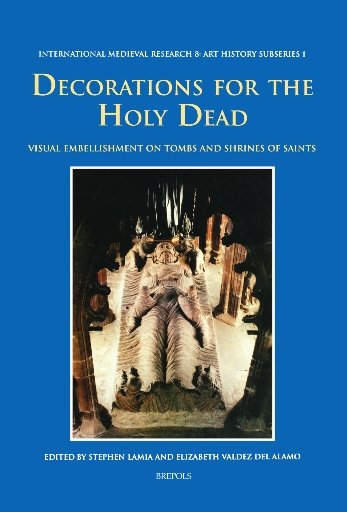
Decorations for the Holy Dead
show More to view fulltext, buy and share links for:Decorations for the Holy Dead show Less to hide fulltext, buy and share links for: Decorations for the Holy DeadDevotion to saints, their cult, and memory was enormously popular in medieval Europe. Factual evidence in the form of tombs, shrines, reliquaries, pilgrimages, vitae and souvenirs is legion and attests to the all-pervasive nature of the phenomenon. Despite the massive bibliography on hagiography, few if any books are devoted entirely to the study of saints’ burial places. The purpose of the papers gathered here, based on presentations sponsored by the International Center of Medieval Art at the International Medieval Congress in Leeds (1999), plus additional papers commissioned by the editors, is to examine the interaction between the visual arts at specific loci sancti and saints’ cults and, further, to enquire whether a corpus of more unusual motifs appeared at saintly sites, beyond the more predictable narrative, symbolic, and iconic representations of saints. The papers address the active role saints’ tombs and their embellishments assumed within the fabric of medieval society: rituals enacted at saints’ burial places, altarpieces, reliquaries, cloister as shrine, the aura of the venerable past, secular burial near saints’ tombs, and political and feminist elements in devotional practice. Monuments from Spain, France, Italy, Greece, Hungary, and England are examined and the volume incorporates 104 illustrations.
-
-
-

De Sion exibit lex et verbum domini de Hierusalem
show More to view fulltext, buy and share links for:De Sion exibit lex et verbum domini de Hierusalem show Less to hide fulltext, buy and share links for: De Sion exibit lex et verbum domini de HierusalemAmnon Linder, professor of medieval history at the Hebrew University of Jerusalem has published seminal studies in the history of the Christian Holy Land and in Jewish-Christian relations in Late Antiquity and the Middle Ages. In recent years he has dedicated himself to the study of medieval liturgy, particularly Crusader liturgy of the liberation and destruction of Jerusalem (forthcoming as the next volume in this series).
The essays gathered here from friends, colleagues and students of Prof. Linder pick up the themes of his publications — medieval law, liturgy and literature. The papers deal with a variety of sources, encompass the fourth to fifteenth centuries, and span from the Holy Land to the British Isles.
-
-
-
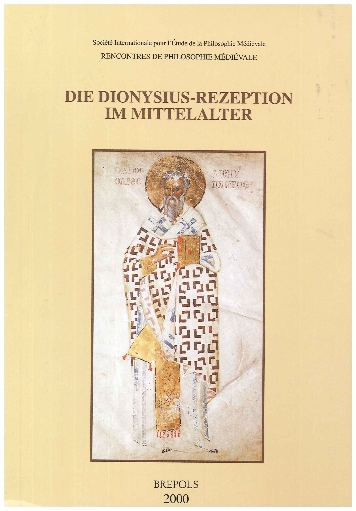
Die Dionysius-Rezeption im Mittelalter
show More to view fulltext, buy and share links for:Die Dionysius-Rezeption im Mittelalter show Less to hide fulltext, buy and share links for: Die Dionysius-Rezeption im MittelalterDer vorliegende Band enthält die Beiträge des internationalen Kolloquiums Die Dionysius-Rezeption im Mittelalter — La réception du Pseudo-Denys durant le moyen âge — The Reception of Pseudo-Dionysius in the Middle Ages, das vom 8. bis 11. April 1999 in Sofia unter der Schirmherrschaft der S.I.E.P.M. stattfand. Im Mittelpunkt steht die Rezeption der unter dem Namen des Pseudo-Dionysius Areopagita überlieferten Werke, die seit ihrem Erscheinen in Byzanz am Beginn des 6. Jahrhunderts und seit der Mitte des 9. Jahrhunderts im lateinischen Abendland einen großen Einfluß auf die europäische Geistesgeschichte ausgeübt haben. Das Corpus Dionysiacum ist nicht nur ein außerordentlich einflußreicher Traditionsstrang des Neuplatonismus bis in die Neuzeit hinein, es stellt darüber hinaus ein europäisches ‘cross-culture’-Phänomen dar, das auf exklusive Weise den griechisch-byzantinischen und den lateinisch-abendländischen Kulturkreis verbindet. Die Erforschung dieser byzantinisch-lateinischen Austauschbeziehung und damit verbunden eine weiterführende Sicht auf die Denkrichtungen der mittelalterlichen europäischen Kultur im Westen und im Osten vor dem Hintergrund der verschiedenen Interpretationen des Werkes des Pseudo-Dionysius Areopagita ist das Grundanliegen dieses Bandes.
-
-
-
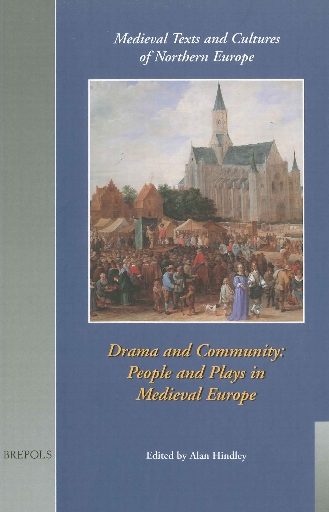
Drama and Community
show More to view fulltext, buy and share links for:Drama and Community show Less to hide fulltext, buy and share links for: Drama and CommunityIn recent years medieval drama has seen a marked revival of interest, much of it informed by an increasing appreciation of its multi-disciplinary nature. The drama of medieval Europe is not just literature; it is a social and indeed commercial event, essentially a communal enterprise, inextricably bound up with the structures of society. This collection of essays by international scholars working in collaboration examines various aspects of the inter-relationship between different European communities and the plays they performed. Its coverage of a wide range of theatres and play-types provides a critical and practical perspective on performance cultures of the Northern Middle Ages. The comparative nature of this volume has the effect of underlining drama as a true medieval mass medium.
-
-
-
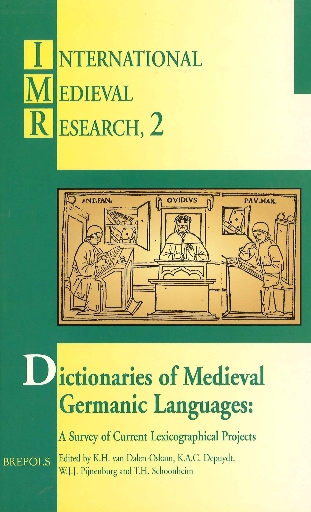
Dictionaries of Medieval Germanic Languages
show More to view fulltext, buy and share links for:Dictionaries of Medieval Germanic Languages show Less to hide fulltext, buy and share links for: Dictionaries of Medieval Germanic LanguagesSelected Proceedings of the International Medieval Congress University of Leeds
This second volume in this series International Medieval Research presents Forschungsberichte as well as papers on twelve current lexicographical projects on medieval Germanic languages. Each Forschungsbericht gives information about the dictionary (title, editors, institute, address), about the contents of the dictionary (type, subject/corpus, described period, described era, example of an entry), about the history of the project and planning (short history of the project, (planned) year of publication, form of publication), and details on lexicographical tools and methods (the hardware, the sofware). The papers were read at the first International Medieval Congress at the University of Leeds (4-7 July 1994), in the three sessions on Dictionaries of Medieval Languages (Projects, Historical Background, Scribes and Scholars). The volume contains valuable information not only for editors of exisitng lexicographical projects but also for editors of future projects. It will also give non-lexicographers a better insight into modern historical lexicography.
K.H. van Dalen-Oskam, K.A.C. Depuydt, W.J.J. Pijnenburg and T.H. Schoonheim are the editors of the Vroegmiddelnederlands Woordenboek (Dictionary of Early Middle Dutch) at the Institute for Dutch Lexicology, Leiden (the Nederlands).
-