


Brepols Online Books Medieval Miscellanea Original Archive v2016 - bobar16mimeo

Collection Contents
6 results
-
-
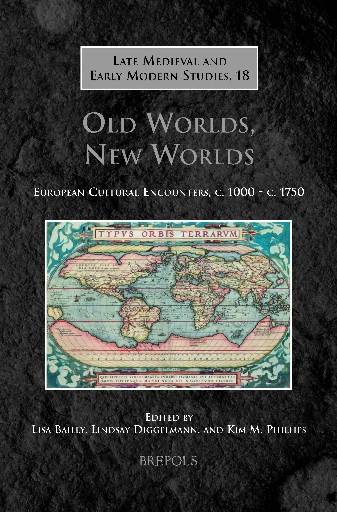
Old Worlds, New Worlds
show More to view fulltext, buy and share links for:Old Worlds, New Worlds show Less to hide fulltext, buy and share links for: Old Worlds, New WorldsPre-modern European history is replete with moments of encounter. At the end of arduous sea and land journeys, and en route, Europeans met people who challenged their assumptions and certainties about the world. Some sought riches, others allies; some looked for Christian converts and some aimed for conquest. Others experienced the forced cultural encounter of exile. Many travelled only in imagination, forming ideas which have become foundational to modern mentalities: race, ethnicity, nation, and the nature of humanity. The consequences were profound: both productive and destructive. At the beginning of the third millennium CE we occupy a world shaped by those centuries of travel and encounter. This collection examines key themes and moments in European cultural expansion. Unlike many studies it spans both the medieval and early modern periods, challenging the stereotype of the post-Columbus ‘age of discovery’. There is room too for examining cross-cultural relationships within Europe and regions closely linked to it, to show that curiosity, conflict, and transformation could result from such meetings as they did in more far-flung realms. Several essays deal with authors, events and ideas which will be unfamiliar to most readers but which deserve greater attention in the history of encounter and exploration.
-
-
-

Oligarchy and Patronage in Late Medieval Spanish Urban Society
show More to view fulltext, buy and share links for:Oligarchy and Patronage in Late Medieval Spanish Urban Society show Less to hide fulltext, buy and share links for: Oligarchy and Patronage in Late Medieval Spanish Urban SocietyHistorians have considered medieval oligarchic groups as part of a hierarchical social structure in urban societies. Frequently the interpretation of oligarchy as an isolated faction makes it difficult to understand its capacity in processes of incorporation and integration. M. Asenjo-González’s study of different cities in Northern Castile - Segovia, Soria, Valladolid and Toledo — attempts to identify bonding processes and the relationships among individuals or groups. In the city of Cuenca, J. A. Jara-Fuente stresses the importance of mechanisms for the attribution of social spaces of projection (related to individuals, lineages or collectivities), because it is through the analysis of the social expectations and of the degree of satisfaction reached in that process that other patterns of relationship come to light. Y. Guerrero-Navarrete deals with the connections between financial groups and the oligarchic policy of the elite in the case of Burgos. In Granada, A. Galán-Sánchez analyzes the Islamic elites’ behaviour, considering their economic and political interests, related to the goodwill of the Christian conquerors, and, their functions as representatives of the second-class citizens who were the moriscos. F. Sabaté focuses his research on the social consequences of the merchant oligarchy investments in the urban surroundings that contributed to establishing a flow of capital between the city and the region in Catalonia. E. Ramírez-Vaquero analyzes aspects of great relevance such as the relationship that oligarchies had with other systems linked to the noble and court spheres in the cities of Navarra. Finally Marc Boone offers an historiographic reflection on Iberian urban elites and analyzes some comparative perspectives about oligarchy and patronage in the Late Middle Ages.
-
-
-
The Old English Homily
show More to view fulltext, buy and share links for:The Old English Homily show Less to hide fulltext, buy and share links for: The Old English HomilyThe quarter-century that has passed since Paul Szarmach’s and Bernard Huppé’s groundbreaking The Old English Homily and its Backgrounds (1978) has seen staggering changes in the field of Anglo-Saxon homiletics. Primary materials have become accessible to scholars in unprecedented levels, whether digitally or through new critical editions, and these have generated in turn a flood of secondary scholarship. The articles in this volume showcase and build on these developments. The first five essays consider various contexts of and infuences on Anglo-Saxon homilies: patristic and early medieval Latin sources, continental homiliaries and preaching practices, traditions of Old Testament interpretation and adaptation, and the liturgical setting of preaching texts. Six studies then turn to the sermons themselves, examining style and rhetoric in the Vercelli homilies, the codicology of the Blickling Book, sanctorale and temporale in the works of Ælfric, and the challenges posed by Wulfstan’s self-referential corpus. Finally, the last entries take us past the Conquest to discuss the re-use of homiletic material in England and its environs from the eleventh to eighteenth century. Together these articles offer medieval scholars a new Old English Homily, one that serves both as an introduction to key figures and issues in the field and as a model of studies for the next quarter-century.
-
-
-
Orality and Literacy in the Middle Ages
show More to view fulltext, buy and share links for:Orality and Literacy in the Middle Ages show Less to hide fulltext, buy and share links for: Orality and Literacy in the Middle Ages“The most important part of the title of this book is the word ‘and’.” These words form the memorable conclusion to D.H. Green’s study Medieval Listening and Reading, they encapsulate how, in the Middle Ages, orality and literacy are not to be considered as two separate and largely unrelated cultures or modes of textual transmission, but as elements in a mutual interplay and interpenetration. In this volume, scholars from Britain, Germany and North America follow Green’s insistence on the conjunction of medieval orality and literacy, and show how this approach can open up new areas for investigation as well as help to reformulate old problems. The languages and literatures covered include English, Latin, French, Occitan and German, and the essays span the whole of the period from the early Middle Ages through to the fifteenth century.
-
-
-
On Barbarian Identity
show More to view fulltext, buy and share links for:On Barbarian Identity show Less to hide fulltext, buy and share links for: On Barbarian IdentityEthnicity has been central to medieval studies since the Goths, Franks, Alamanni and other barbarian settlers of the former Roman empire were first seen as part of Germanic antiquity. Today, two paradigms dominate interpretation of barbarian Europe. In history, theories of how tribes formed (‘ethnogenesis’) assert the continuity of Germanic identities from prehistory through the Middle Ages, and see cultural rather than biological factors as the means of preserving these identities. In archaeology, the ‘culture history’ approach has long claimed to be able to trace movements of peoples not attested in the historical record, by identifying ethnically-specific material goods. The papers in this volume challenge the concepts and methodologies of these two models. The authors explore new ways to understand barbarians in the early Middle Ages, and to analyse the images of the period constructed by modern scholarship. Two responses to the papers, one by a leading exponent of the ‘ethnogenesis’ approach, the other by a leading critic, continue this important debate.
-
-
-
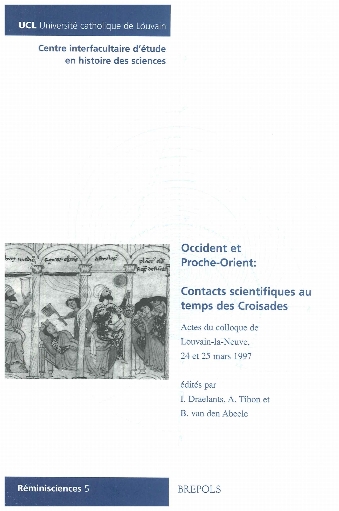
Occident et Proche-Orient: contacts scientifiques au temps des Croisades
show More to view fulltext, buy and share links for:Occident et Proche-Orient: contacts scientifiques au temps des Croisades show Less to hide fulltext, buy and share links for: Occident et Proche-Orient: contacts scientifiques au temps des CroisadesLes échanges entre Orient et Occident au Moyen Age ont fait l’objet de nombreux travaux récents. En histoire des sciences, l’attention a porté en priorité sur l’activité de traduction et de rédaction dans l’Espagne arabo-latine et l’Italie méridionale. Le colloque de Louvain-la-Neuve s’est proposé d’explorer les contacts scientifiques dans un contexte moins étudié, les états latins de Palestine, du XIe au XIIIe s. Les contributions intéressent les trois principales cultures en présence: arabe, byzantine et latine. L’éventail des disciplines abordées couvre l’alchimie, l’astronomie, l’histoire naturelle, les mathématiques, la médecine; une place est faite à l’histoire des techniques, ainsi qu’à certains milieux porteurs: la ville d’Antioche, la cour de Frédéric II de Hohenstaufen. On découvre ainsi que le Proche Orient des Croisades n’a pas seulement été un champ de bataille, mais qu’il y a eu place aussi pour des découvertes, des échanges, des influences réciproques.
-