


Brepols Online Books Medieval Miscellanea Original Archive v2016 - bobar16mimeo

Collection Contents
5 results
-
-
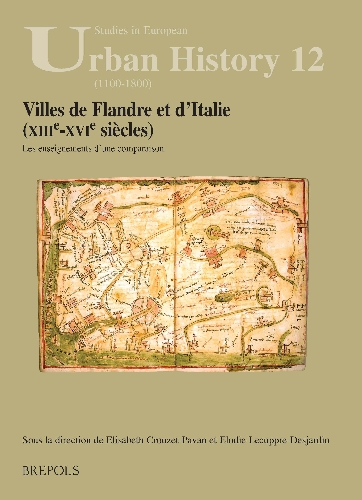
Villes de Flandre et d’Italie (XIIIe-XVIe siècle). Les enseignements d’une comparaison
show More to view fulltext, buy and share links for:Villes de Flandre et d’Italie (XIIIe-XVIe siècle). Les enseignements d’une comparaison show Less to hide fulltext, buy and share links for: Villes de Flandre et d’Italie (XIIIe-XVIe siècle). Les enseignements d’une comparaisonUne comparaison entre les villes de Flandre et d’Italie semble aller de soi tant apparaissent nombreuses, dans les études qui leur sont consacrées, les similitudes et les disparités esquissées. Entre les deux grands espaces urbanisés de l’Europe occidentale, pour qui s’intéresse à l’histoire des villes, le rapprochement paraît s’imposer. Pourtant, bien souvent, la juxtaposition prévaut et la comparaison se limite au seul domaine des convergences de l’histoire économique.
Cinq thèmes ont donc été retenus ici dans un souci de renouvellement et de réorientation des questionnements: la démographie, le fait religieux, les inscriptions et les symboliques du pouvoir, la «fabrique» de la mémoire et la représentation de l’espace. Dans cet ouvrage, est organisée une mise en parallèle qui permet d’identifier les spécificités qui façonnèrent en Italie et au nord de l’Europe les identités urbaines. Sur fond de relations marchandes et d’animation économique, les profils des communautés se précisent alors et la rare gageure d’une véritable histoire comparative est ainsi proposée au lecteur.
-
-
-
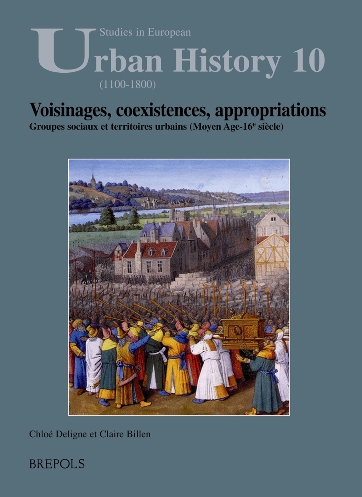
Voisinages, coexistences, appropriations
show More to view fulltext, buy and share links for:Voisinages, coexistences, appropriations show Less to hide fulltext, buy and share links for: Voisinages, coexistences, appropriationsFruit des travaux du colloque intitulé «Groupes sociaux et territoires urbains (Moyen Age-16e siècle)» organisé en décembre 2004 à l’Université Libre de Bruxelles, cet ouvrage rassemble douze contributions originales consacrées aux dynamiques sociales de l’espace urbain en Europe de l’ouest durant le bas Moyen Âge.
Dans sa première partie, l’ouvrage montre la structuration à long terme de l’espace urbain par les stratégies d’occupation de groupes dominants: chapitres canoniaux, élites scabinales, métiers (Tours, Namur, Trévise). Il confronte ce processus d’appropriation à la capacité de réagencement matériel ou symbolique déployée par certains acteurs urbains. Accident aléatoire (Tortosa), circonstances politiques (Bruges), modulation des rapports à la ville (Ratisbonne) redessinent les territoires respectifs, rallument sans cesse la lutte pour la maîtrise de l’espace et de ses éléments signifiants.
Dans sa seconde partie, l’ouvrage donne à penser la société urbaine dans ses relations avec des horizons plus lointains. Dans un premier temps sont abordées les relations des villes avec leur arrière-pays, sur lequel les groupes citadins dominants réinventent sans cesse les modalités économiques et juridiques de leur contrôle (Bruxelles, Chieri, Dijon). Dans un second temps, sont considérées les armatures urbaines de certains territoires (Brabant, Hainaut, Saint-Empire) dont la vivacité économique dépend de l’intensité des relations marchandes.
Les articles réunis ici éclairent, souvent d’un jour nouveau, non seulement l’histoire singulière des villes concernées mais plus fondamentalement les processus et les logiques à l’œuvre dans l’agencement et le réagencement permanent des espaces urbains.
-
-
-
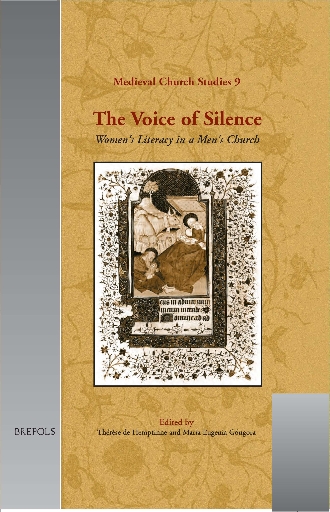
The Voice of Silence
show More to view fulltext, buy and share links for:The Voice of Silence show Less to hide fulltext, buy and share links for: The Voice of SilenceThis book aims to collect and present the results of research done within the context of the project ‘The voice of silence / La voz del silencio: An interdisciplinary research project about literate women and women authors in the West-European late Middle Ages from a gender perspective (11th to 15th centuries)’. The project was a bilateral research project, with participants of the University of Chile in Santiago on the one hand and the Universities of Gent and Antwerpen on the other. Medieval scholars, literary historians and literary theorists joined forces. The angle from which the material was being studied, however, was always the same: gender being the central issue. The project focused on women as participants in late medieval society and culture of the Rhineland and the Low Countries. Indeed, all the researchers involved acquired their expertise in this field and/or the field of women’s literacy.
Several members of this Flemish-Chilean project have contributed an essay to this book, but supplemented by guest authors. The guests are internationally renowned scholars reflecting an expertise in gender studies or in an aspect not covered by the team members of the project. Their contributions complete the research results of the project.
The story told in this book is focused on literate women and gender. In the course of the twelfth and thirteenth centuries, the voices of women authors, many of them religious and mystics, resounded in a literate society dominated by clerics. Hildegard of Bingen and Hadewijch, two of the most famous representatives of this ‘female voice’ are highlighted in Part I. These women were the forerunners of a new reading culture among (semi-)religious and even lay women in which the use of the vernacular was a decisive factor (Part II). Yet, from the thirteenth century onwards, and with increasing intensity towards the end of the Middle Ages, men once more tried to get a grip on women’s reading and writing. Aspects of these attemps are illustrated in part III.
-
-
-
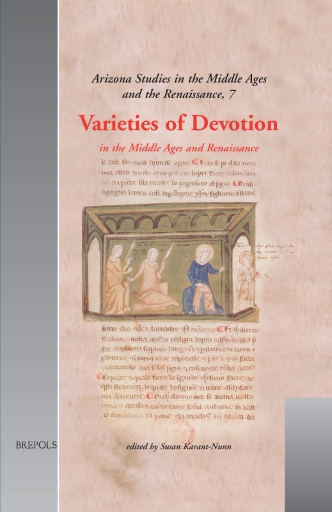
Varieties of Devotion in the Middle Ages and Renaissance
show More to view fulltext, buy and share links for:Varieties of Devotion in the Middle Ages and Renaissance show Less to hide fulltext, buy and share links for: Varieties of Devotion in the Middle Ages and RenaissanceIn the modern world, interest in religious devotion is as great as ever. This volume brings together the research of ten scholars into the diverse ways that Europeans expressed their quest for God over more than a millennium, from the formative centuries of Christianity up to the seventeenth century. Topics include women transvestite saints, Monophysite wall-paintings, Anglo-Saxon sainthood and painful martyrdom, Carmelite self-redefinition, the confident authorship of Gautier de Coinci and Matfre Ermengaud, competition between the bishop and a wandering preacher for popular favor in Le Mans, the contemplative philanthropies of the Poor Clares, Chester Nativity-cycle actors’ masculinity, Jean Gerson’s warm relations with his siblings, and George Herbert’s Eucharistic feeling. The authors’ profound familiarity with primary sources as well as the influence of current theory makes these essays vibrant and timely.
-
-
-
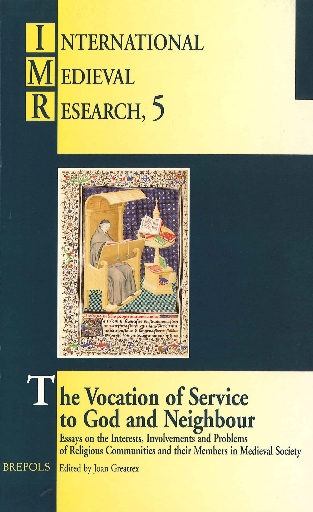
The Vocation of Service to God and Neighbour
show More to view fulltext, buy and share links for:The Vocation of Service to God and Neighbour show Less to hide fulltext, buy and share links for: The Vocation of Service to God and NeighbourThe impingement of monastery on marketplace provides the unifying theme for this collection of nine research papers. Separation from the world, for most members of religious orders in the Middle Ages, did not imply isolation from the rest of society but, rather, a new spirituality orientated relationship which took different forms in different times and circumstances. Three of the contributors are concerned with particular aspects of the intellectual activities of the religious orders in both university and cloister. Two others examine the traumatic effects of the enforced return to secular life of thousands of men and women religious in England when monastic life was brought to an abrupt end in 1540. An individual monk's pastoral role among the laity is explored and evaluated in one paper, while another reveals the extent to which a rural English nunnery was both rooted in the local community and dependent on foreign supervision. Problems encountered by the friars are discussed by two other contributors who, on the basis of their recent research, conclude that the hostility between Franciscans and Benedictines has been overstated and that some German Dominicans risked their reputations in their involvement with contemporary heterodox movements among the laity.
-