Brepols Online Books Medieval Miscellanea Original Archive v2016 - bobar16mimeo

Collection Contents
221 - 240 of 254 results
-
-
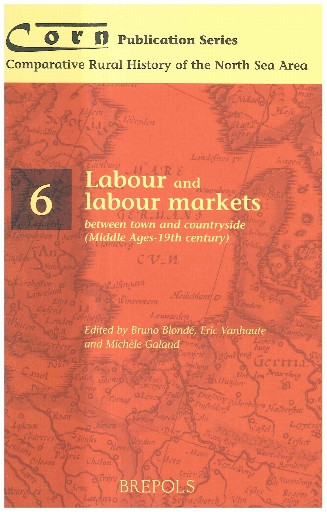
Labour and labour markets between town and countryside (Middle Ages — 19th century)
show More to view fulltext, buy and share links for:Labour and labour markets between town and countryside (Middle Ages — 19th century) show Less to hide fulltext, buy and share links for: Labour and labour markets between town and countryside (Middle Ages — 19th century)Labour and labour markets in and between town and countryside have been puzzling to economic historians for generations. This book brings together specialists in economic and social history to explore a series of key mechanisms related to the organisation and interdependence of urban and rural labour markets.
A variety of issues, such as distribution, specialisation, and division of tasks, economies of urbanisation and (conversely) rural de-localisation, (temporary) mobility of labour and commercial links, organisation of working time, methods of remuneration, gendered specialisation of activities, are dealt with in this book from the viewpoint of (changing) relationships between rural and urban labour markets.
The renewed interest of social scientists in this research field is reflected by the diversity of the cases analysed according to geographical, demographic, and economic and political conditions. This book, therefore, provides interesting opportunities for a comparative reading of the significance of labour in the organisation of societies in the course of the centuries that preceded and led up to the ‘industrial age’ in Western Europe.
-
-
-
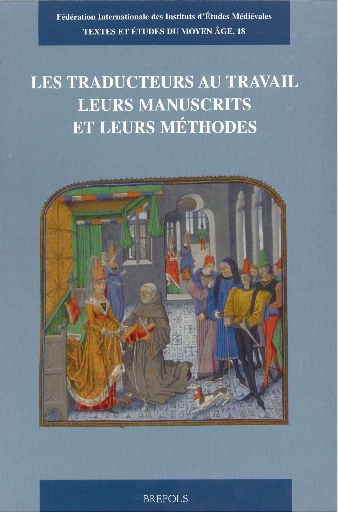
Les traducteurs au travail. Leurs manuscrits et leurs méthodes
show More to view fulltext, buy and share links for:Les traducteurs au travail. Leurs manuscrits et leurs méthodes show Less to hide fulltext, buy and share links for: Les traducteurs au travail. Leurs manuscrits et leurs méthodesLe moyen âge latin fut par définition une période de traduction. Soucieux d’avoir à leur disposition les textes d’autres cultures, les médiévaux n’ont eu de cesse de transférer d’une langue à l’autre les œuvres de l’Antiquité classique ainsi que l’héritage arabe et hébreu avec les moyens dont ils disposaient à leur époque.
Afin d’avoir une meilleure connaissance de leurs méthodes de travail et des problèmes inhérents au passage d’une langue à l’autre, il est important de retrouver les manuscrits qui ont servi de base de travail aux traducteurs. On y trouve des notes de leur main qui expliquent les difficultés rencontrées, les hésitations dans l’utilisation d’un terme plutôt qu’un autre pour rendre en latin un vocable de la langue source ainsi que des notes marginales qui sont autant de remarques philologiques, matériel de première main pour notre compréhension et notre connaissance des niveaux linguistiques tant des traducteurs que des utilisateurs depuis l’Antiquité jusqu’à la Renaissance.
D’autre part, lorsqu’elles existent, les préfaces laissées par les traducteurs en tête de leur travail constituent des documents de première importance pour notre compréhension de leurs problèmes et pour la reconstitution de la méthode utilisée pour les résoudre.
On trouvera dans ce volume beaucoup de matériel encore inédit. Les recherches menées sur les manuscrits ont permis de voir plus clair dans la problématique propre aux traductions faites tant sur le grec, l’arabe, le syriaque, l’hébreu qu’en langues vulgaires. Les exposés sont dus à des spécialistes des divers domaines concernés.
-
-
-
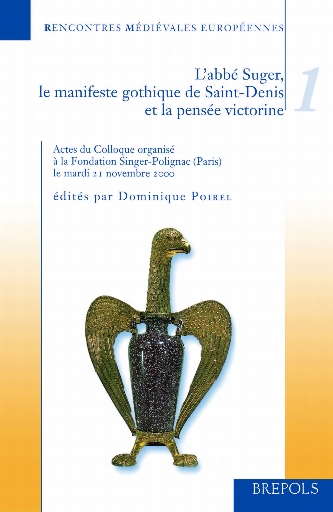
L’abbé Suger, le manifeste gothique de Saint-Denis et la pensée victorine
show More to view fulltext, buy and share links for:L’abbé Suger, le manifeste gothique de Saint-Denis et la pensée victorine show Less to hide fulltext, buy and share links for: L’abbé Suger, le manifeste gothique de Saint-Denis et la pensée victorineLa consécration en 1144 de la basilique de Saint-Denis par l’abbé Suger inaugure l’art gothique, dont la naissance fut longtemps expliquée par l’histoire des formes et des techniques: grâce à diverses découvertes architecturales, le nouveau style se serait peu à peu détaché du roman. La collaboration entre six historiens de l’art et de la pensée conduit à repenser cette explication. D’abord, l’art gothique apparaît bien moins comme la continuation du roman que comme le renouvellement d’un art paléochrétien, lequel était d’ailleurs bien présent dans la basilique présugérienne. Ensuite, le nouveau style est un art à la fois total et cohérent: dès Saint-Denis, l’architecture, la sculpture, le vitrail et les ornamenta ecclesiae sont intégrés dans un programme unifié qui ne saurait s’expliquer sans une étroite collaboration entre le commanditaire Suger et son maître d’œuvre anonyme. Tout ceci conduit à scruter la personnalité intellectuelle de l’abbé Suger: les sources littéraires de ses écrits attestent une familiarité avec la poésie paléochrétienne, tandis que leur tonalité théologique et spirituelle invite à explorer le jeu des relations avec l’école de Saint-Victor. Celle-ci se distingue par la place originale que font Hugues et Richard à l’architecture, soit comme technique, soit comme métaphore de la théologie ou de la vie spirituelle, et par une doctrine dont les thèmes favoris s’accordent de façon singulière avec les tendances profondes du nouveau style. En définitive, malgré son sobriquet de «gothique» dont on entendait flétrir au XVIe s. tout ce qui s’écarte de l’Antiquité, l’art nouveau, porté par le projet de Suger et la pensée humaniste des Victorins, doit être considéré comme un art de Renaissance.
-
-
-
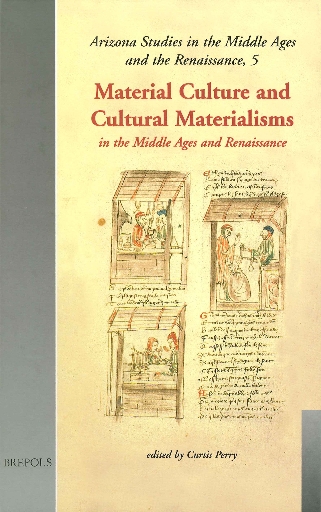
Material Culture and Cultural Materialisms
show More to view fulltext, buy and share links for:Material Culture and Cultural Materialisms show Less to hide fulltext, buy and share links for: Material Culture and Cultural MaterialismsThe phrase ‘cultural materialism’, names an approach to cultural analysis that interrogates the socio-economic conditions within which artefacts are produced as well as their participation in other ideological and material fields of culture. Disciplines that have traditionally studied cultural artefacts like literature and painting have increasingly focused on the material production and ideological operation of objects once thought of in idealized or purely aesthetic terms. By the same token, historians - whose work, of necessity, has always tended to deal with the material traces of culture - have increasingly been willing to consider the social and ideological importance of art. The increasing popularity of this cultural studies approach to the past has in turn spurred investigation into other kinds of materiality. Recent historical and literary scholarship, for example, has become increasingly aware of the ways in which the lived materiality of the human body informs a range of cultural discources.
-
-
-
Peasants into Farmers?
show More to view fulltext, buy and share links for:Peasants into Farmers? show Less to hide fulltext, buy and share links for: Peasants into Farmers?Since his pioneering article of 1976 the American historian Robert P. Brenner has tried to come to terms with an issue that has puzzled historians for generations: how can we explain the differences in growth-patterns of North Western European countries in the transition from feudalism to capitalism. In a frontal attack on both the ‘(homeostatic) demographic’ and ‘commercialization’ models, Brenner traced the roots of the divergent evolutions back to rural and feudal ‘social-property relations’. In the debate that immediately followed Brenner’s first article, and in subsequent exchanges, the Low Countries were sorely neglected, although areas such as Flanders and Holland played a decisive role in the economic development of Europe. This was partly due to a lack of publications on Dutch rural history in foreign languages. This volume aims to fill this lacuna. It draws upon substantial research, and confronts the Brenner thesis with new results and hypotheses; and it contains a powerful and detailed response by Brenner himself.
-
-
-
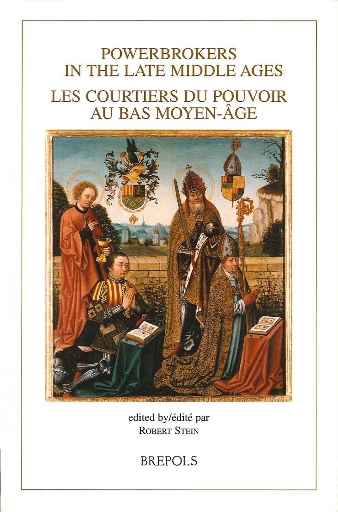
Powerbrokers in the Late Middle Ages. The Burgundian Low countries in a European Context
show More to view fulltext, buy and share links for:Powerbrokers in the Late Middle Ages. The Burgundian Low countries in a European Context show Less to hide fulltext, buy and share links for: Powerbrokers in the Late Middle Ages. The Burgundian Low countries in a European ContextThe fifteenth century was of crucial importance for the Low Countries. After centuries of gradual political disintegration, a rapid unification took place during the reign of the Burgundian dukes, Philip the Good and Charles the Bold. How did this new ‘state’ work? To most people the political high-points are well known; but the slow process of integration that had by then started remains, by contrast, largely unknown. In this process, the regional institutions, which were thoroughly modernised by the Burgundian dukes, seem to have played a key role. The first part of this volume discusses the role of these regional institutions. In particular it studies the role in the principalities of Brabant, Holland and Flanders of civil servants as formal and informal ‘powerbrokers’ between central government and subjects in the Low Countries during the Burgundian period.
The Low Countries, however, cannot be treated in isolation from its neighbours: they were situated literally on the frontier of the Holy Roman Empire and France and there were intensive commercial and political contacts with England. Therefore, by way of comparison, the second part of this volume contrasts developments in other European countries, in particular, France, the Empire and England.
The articles in this volume are written by a group of distinguished specialists in the field of administrative history, working at universities in Belgium, France, Germany, the Netherlands and the United Kingdom.
-
-
-
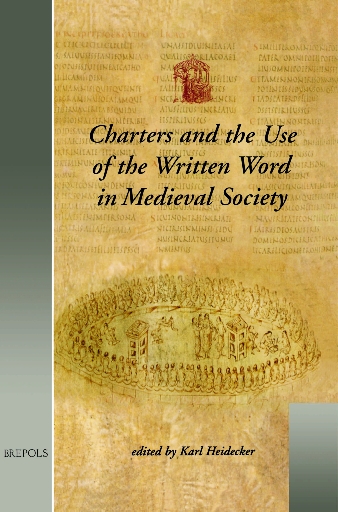
Charters and the Use of the Written Word in Medieval Society
show More to view fulltext, buy and share links for:Charters and the Use of the Written Word in Medieval Society show Less to hide fulltext, buy and share links for: Charters and the Use of the Written Word in Medieval SocietyThere have been periods of growth and of decrease in the quantity of writing produced in the medieval centuries. The present volume is concerned with qualitative developments, asking: which developments can be distinguished in the roles played by writing in medieval societies? In which fields was writing used, and by whom? Why did these changes take place? When attempting to answer these questions, the scholar confronts basic questions about the sources at one’s disposal. Why were documents written? Why were they preserved and in what form? The volume pays especial attention to charters, since these documents have been continuously present throughout the Middle Ages. They also had an impact on most layers of society.
-
-
-
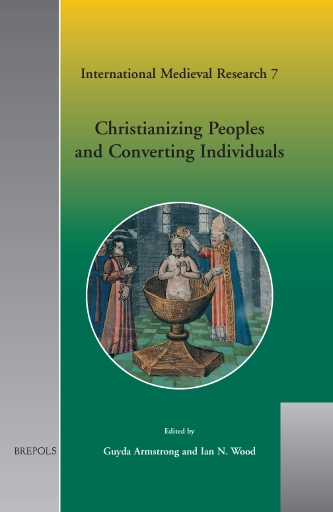
Christianizing Peoples and Converting Individuals
show More to view fulltext, buy and share links for:Christianizing Peoples and Converting Individuals show Less to hide fulltext, buy and share links for: Christianizing Peoples and Converting IndividualsThe anniversary of Augustine’s arrival in Kent in 597, and the subsequent christianization of England, made conversion an obvious theme for the 1997 International Medieval Congress. It was also a theme which attracted massive interest, and not just from early medievalists interested in the christianization of England and its near-contemporary parallels. This volume presents reworkings of 28 of these contributions.
The Early Middle Ages are represented in a number of papers concerned with Central and Eastern Europe and as far east as Georgia. Interest in the Baltic region took this aspect of the christianization of Europe well into the fourteenth century. Papers on these regions constitute a good proportion of the present volume, and they provide a very useful point of entry into work currently being done on christinization in areas which are less well known to most historians than is Western Europe not least because of the range of languages involved.
With respect to later periods of the Middle Ages two issues predominated: one was the interface between Christians and Muslims in Spain and in the Holy Land and also between Christians and Jews once again in Spain, but also in England, and more generally in Western Europe. The other was the rather more theological question of the nature of conversion, as discussed by Aquinas, and in Franciscan writings. This wide-ranging volume concentrates on historical approaches to the topic. The different types of questions posed and materials used are a fascinating indication of the different interpretations to be found among specialists in different fields.
Christianization, as a process affecting complete peoples, or at least large groups, attracts attention, as does conversion of the individual. By putting these varying approaches together, this collection indicates the range of current work on christianization and conversion history and the range itself, quite apart from the individual studies, is an eye-opener.
-
-
-
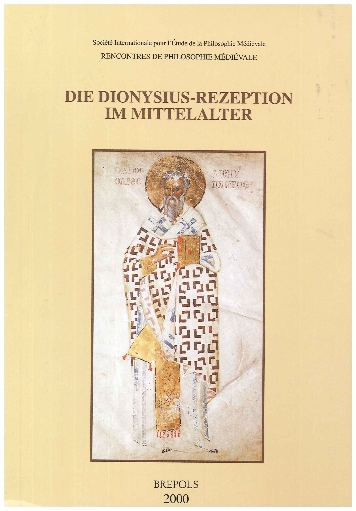
Die Dionysius-Rezeption im Mittelalter
show More to view fulltext, buy and share links for:Die Dionysius-Rezeption im Mittelalter show Less to hide fulltext, buy and share links for: Die Dionysius-Rezeption im MittelalterDer vorliegende Band enthält die Beiträge des internationalen Kolloquiums Die Dionysius-Rezeption im Mittelalter — La réception du Pseudo-Denys durant le moyen âge — The Reception of Pseudo-Dionysius in the Middle Ages, das vom 8. bis 11. April 1999 in Sofia unter der Schirmherrschaft der S.I.E.P.M. stattfand. Im Mittelpunkt steht die Rezeption der unter dem Namen des Pseudo-Dionysius Areopagita überlieferten Werke, die seit ihrem Erscheinen in Byzanz am Beginn des 6. Jahrhunderts und seit der Mitte des 9. Jahrhunderts im lateinischen Abendland einen großen Einfluß auf die europäische Geistesgeschichte ausgeübt haben. Das Corpus Dionysiacum ist nicht nur ein außerordentlich einflußreicher Traditionsstrang des Neuplatonismus bis in die Neuzeit hinein, es stellt darüber hinaus ein europäisches ‘cross-culture’-Phänomen dar, das auf exklusive Weise den griechisch-byzantinischen und den lateinisch-abendländischen Kulturkreis verbindet. Die Erforschung dieser byzantinisch-lateinischen Austauschbeziehung und damit verbunden eine weiterführende Sicht auf die Denkrichtungen der mittelalterlichen europäischen Kultur im Westen und im Osten vor dem Hintergrund der verschiedenen Interpretationen des Werkes des Pseudo-Dionysius Areopagita ist das Grundanliegen dieses Bandes.
-
-
-
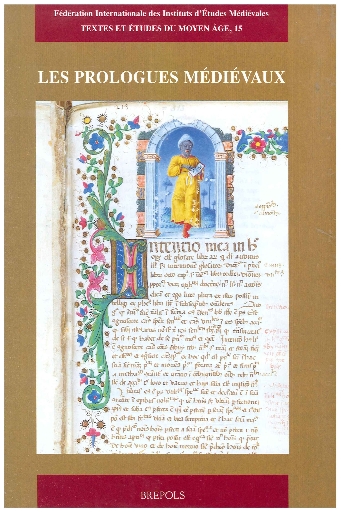
Les prologues médiévaux
show More to view fulltext, buy and share links for:Les prologues médiévaux show Less to hide fulltext, buy and share links for: Les prologues médiévauxCe livre rassemble une série de communications présentées lors d’un Colloque organisé à Rome sur Les prologues médiévaux. Le but était de montrer l’importance de ce genre littéraire et tout l’intérêt que les chercheurs peuvent tirer de l’analyse des introductions. Interdisciplinaire par excellence, le sujet touche tous les médiévistes et à ce titre mérite qu’on s’y attarde puisque à ce jour, malgré des recherches ponctuelles et des études consacrées à des domaines très particuliers, il n’a pas été l’objet d’études systématiques.
De nombreuses questions sont abordées par les auteurs: on peut citer parmi d’autres les problèmes terminologiques, les relations entre le titre d’une œuvre et son prologue, l’évolution du genre littéraire depuis l’Antiquité jusqu’à la fin du Moyen Age, la comparaison entre différents genres littéraires ainsi que l’examen de prologues en langues différentes: grecque, latine ou française.
Les articles publiés dans cet ouvrage permettront de faire un premier tour de la question et d’aboutir à une série de conclusions qui, même si elles ne sont pas définitives, feront progresser nos connaissances en la matière. Ce volume d’actes devrait constituer pour les médiévistes un point de référence sur le sujet.
-
-
-
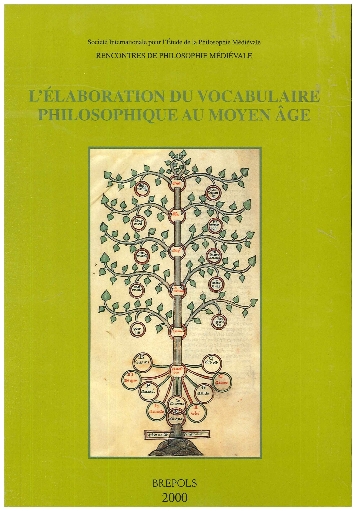
L’élaboration du vocabulaire philosophique au Moyen Age
show More to view fulltext, buy and share links for:L’élaboration du vocabulaire philosophique au Moyen Age show Less to hide fulltext, buy and share links for: L’élaboration du vocabulaire philosophique au Moyen AgeConçu comme un complément du volume consacré Aux origines du lexique philosophique européen, cet ouvrage contient des études qui tentent de montrer comment le vocabulaire philosophique a été élaboré au Moyen Âge occidental.
Les penseurs médiévaux — tant les traducteurs des textes philosophiques grecs, hébraïques et arabes que les philosophes et les théologiens — ont contribué à la multiplication de néologismes et à l’affinement du sens d’anciens concepts. Par leur «travail» linguistique, qui allait de pair avec des efforts de conceptualisation, ils ont forgé un langage propre à leurs diverses disciplines et orientations philosophiques. Les penseurs du Moyen Âge — d’Augustin à Suárez, en passant par tant d’autres maîtres de la scolastique — ont joué de diverses manières un rôle primordial dans la formation du vocabulaire philosophique.
-
-
-
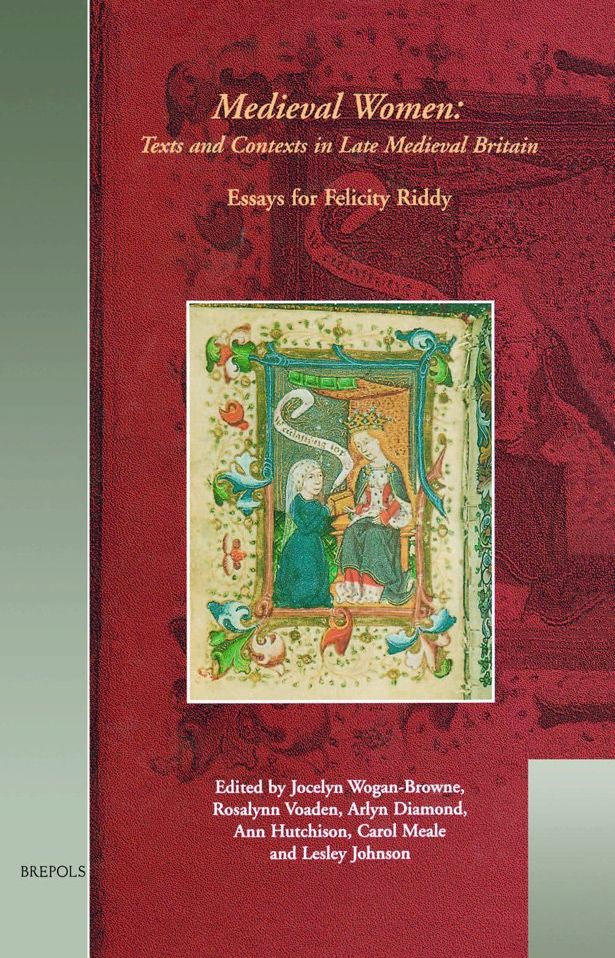
Medieval Women - Texts and Contexts in Late Medieval Britain
show More to view fulltext, buy and share links for:Medieval Women - Texts and Contexts in Late Medieval Britain show Less to hide fulltext, buy and share links for: Medieval Women - Texts and Contexts in Late Medieval BritainIn this themed collection by literary, historical and archaeological scholars, the study of medieval women is confidently and freshly mainstream. Profiting from the development of newly flexible models of gender, literacy, the political, the social, and the domestic, the volume is non-separatist, exploratory both of new source materials and new readings of established sources, and able to consider the broadest implications for the study of medieval culture without simply re-absorbing medieval women into invisibility. Grouped under the headings of matters of reading, of conduct and place, the essays move from legal cases to actual buildings and conceptions of the household, from conduct books to chronicles and romances, from saints’ lives to the medieval unconscious and back again, exemplifying the mature interdisciplinarity of current work on medieval women.
-
-
-
Miracle et Karama. Hagiographies médiévales comparées
show More to view fulltext, buy and share links for:Miracle et Karama. Hagiographies médiévales comparées show Less to hide fulltext, buy and share links for: Miracle et Karama. Hagiographies médiévales comparéesLa reconnaissance du miracle suscita des discussions théologiques dans le christianisme comme dans l’islam. Mais alors qu’une pratique du miracle sur les tombes des saints chrétiens est attestée par les collections de Miracula, la littérature hagiographique musulmane reste généralement sobre en la matière, même lorsqu’il s’agit de saints réputés pour leurs charismes. Les articles de ce volume tentent de déterminer les raisons de ces réticences et leurs rapports avec les circonstances historiques.
Bien que de nombreux miracles soient rapportés dans les Traditions, le Prophète de l’islam ne se signale pas par des miracles spectaculaires, contrairement à Jésus, considéré comme le thaumaturge par excellence. En revanche, Muhammad, recevant la révélation coranique à travers l’archange Gabriel, a été sujet à de multiples visions. Ce contraste entre les modèles, posés par les fondateurs respectifs de l’islam et du christianisme, pourrait expliquer que les miracles, dans l’hagiographie musulmane, soient plutôt constitués d’apparitions, de rêves ou de pouvoir d’ordre initiatique, alors que les miracles à dominante thaumaturgique abondent dans les Vies des saints chétiens.
L’étude des miracles conduit enfin à des comparaisons intéressantes entre christianisme et islam. La proportion entre miracles in vita et post mortem (tombeaux, reliques, images) semble constituer une différence majeure entre les deux religions, tandis que le recensement et la comparaison des topoi mènent à des rapprochements féconds, étant entendu que ces topoi peuvent être réinterprétés à chaque époque.
-
-
-
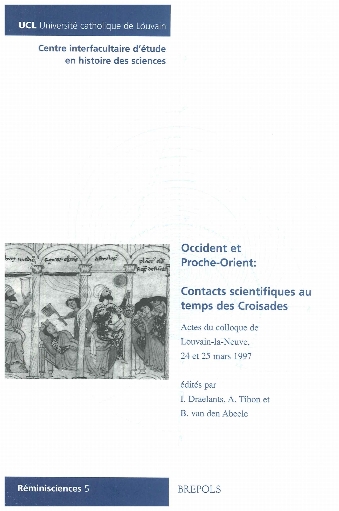
Occident et Proche-Orient: contacts scientifiques au temps des Croisades
show More to view fulltext, buy and share links for:Occident et Proche-Orient: contacts scientifiques au temps des Croisades show Less to hide fulltext, buy and share links for: Occident et Proche-Orient: contacts scientifiques au temps des CroisadesLes échanges entre Orient et Occident au Moyen Age ont fait l’objet de nombreux travaux récents. En histoire des sciences, l’attention a porté en priorité sur l’activité de traduction et de rédaction dans l’Espagne arabo-latine et l’Italie méridionale. Le colloque de Louvain-la-Neuve s’est proposé d’explorer les contacts scientifiques dans un contexte moins étudié, les états latins de Palestine, du XIe au XIIIe s. Les contributions intéressent les trois principales cultures en présence: arabe, byzantine et latine. L’éventail des disciplines abordées couvre l’alchimie, l’astronomie, l’histoire naturelle, les mathématiques, la médecine; une place est faite à l’histoire des techniques, ainsi qu’à certains milieux porteurs: la ville d’Antioche, la cour de Frédéric II de Hohenstaufen. On découvre ainsi que le Proche Orient des Croisades n’a pas seulement été un champ de bataille, mais qu’il y a eu place aussi pour des découvertes, des échanges, des influences réciproques.
-
-
-
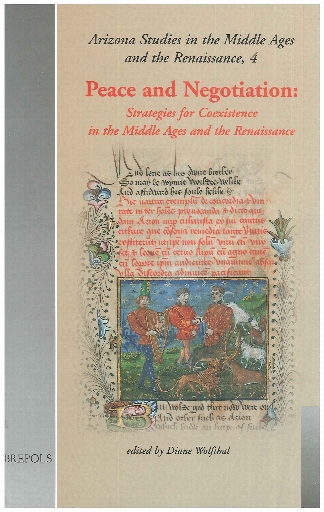
Peace and Negotiation: Strategies for Coexistence in the Middle Ages and the Renaissance
show More to view fulltext, buy and share links for:Peace and Negotiation: Strategies for Coexistence in the Middle Ages and the Renaissance show Less to hide fulltext, buy and share links for: Peace and Negotiation: Strategies for Coexistence in the Middle Ages and the RenaissancePeace was far from a pale, static concept - a simple lack of violence - in the Middle Ages and Renaissance. Rather, it was at times constructed as a rich and complex, positive and dynamic ideal. The thirteen articles in this volume cover a broad range of disciplines, times, and geographical areas and explore strategies that were used in the past to resolve conflict and attain peace. They examine events, texts, and images that date from the fifth through the sixteenth centuries, and their authors focus not only on Western Europe, but also on Scandinavia, the Caucausus, and Egypt. This volume rests on the assumption that peace covers a spectrum of situations that connects the personal and the political. Therefore, the papers presented here examine not only how nations negotiated peace, but also how individuals did. Similarly, although several essays spotlight those in the seat of power, others explore the situation of those lower on the social hierarchy. Our views about peace and conflict, as this collection makes clear, are shaped in part by the mentalités of the past. Although some peacemaking strategies may be unacceptable to us today - forced marriages and conversions, for example - we can learn from other strategies how to transcend or modify various modes of antagonistic thinking.
-
-
-

Sparks and Seeds
show More to view fulltext, buy and share links for:Sparks and Seeds show Less to hide fulltext, buy and share links for: Sparks and SeedsJohn Freccero is internationally renowned for his scholarship on Dante, Petrarch, Machiavelli, and other authors. Currently Professor of Italian and Comparative Literature at New York University, he has also taught at Yale, Stanford, Cornell, and Johns Hopkins. His numerous honors include Fulbright and Guggenheim fellowships and awards from the city of Florence and the Republic of Italy.
Despite the diverse expertise of their authors (fairly evenly divided between Italianists and scholars of English and Comparative Literature), all of the articles included in the volume appertain to Italian literature - from a literary analysis of Bonaventure’s Itinerarium to tracing the State of Maryland’s medieval Italian motto back through its English Renaissance sources. Many of the pieces are concerned with Dante directly, and several others dealing with medieval and Renaissance Italian subjects do so indirectly. Two articles are concerned with pre-modern cultural and literary implications of the history of science; the remainder trace the afterlife of medieval or Renaissance Italian motifs in modern culture. Despite the fact that the articles range from medieval scholasticism to twentieth-century cinema, this volume addresses applications of medieval and Renaissance Italian literature, influenced, above all, by the teaching and scholarship of John Freccero.
-
-
-
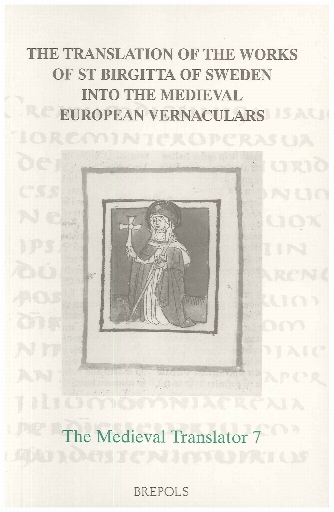
The Translation of the Works of St Birgitta of Sweden into the Medieval European Vernacular
show More to view fulltext, buy and share links for:The Translation of the Works of St Birgitta of Sweden into the Medieval European Vernacular show Less to hide fulltext, buy and share links for: The Translation of the Works of St Birgitta of Sweden into the Medieval European VernacularThis volume of papers, from an international Conference held in Beverley in 1997 on the translation into the medieval European vernaculars of the works of St Birgitta of Sweden, forms volume 7 in the series The Medieval Translator. Previous volumes in the series have been based on papers heard at the Cardiff Conferences on the Theory and Practice of Translation in the Middle Ages (1987- ). While future volumes in the series will continue to provide a record of the Cardiff Conference (the next is planned for Compostella in 2001), the present volume provides a welcome development for the series, and paves the way for scholarly monographs on individual works and writers — including editions of medieval translations — and other publications more narrowly angled at the different questions raised by the study of medieval translation.
-
-
-
Crossing Boundaries
show More to view fulltext, buy and share links for:Crossing Boundaries show Less to hide fulltext, buy and share links for: Crossing BoundariesThe essays presented here cover a range of topics and periods and testify to the breadth and depth of “boundaries” as a concept. The concept’s origins are located in the work of ethnographers, whose most cogent representative is Fredrik Barth. In his seminal work Ethnic Groups and Boundaries, a collection of articles by Barth and others published in 1967, he shifted the scholarly discussion about ethnicity away from particular attributes that define ethnic groups to the boundaries that separate them from another. Boundaries were less significant for what they enclosed than for their very nature and purpose. The disciplines that make most use of the concept of “crossing boundaries” are the youngest, such as feminist and gender studies or, more generally, cultural studies.
The first section of the collection consists of literary approaches to boundaries, ranging widely in subject matter from Norman drama to sixteenth-century goodnight ballads. In the second part, the concept of boundaries is brought to bear on the existentia1 plight of Byzantine refugees, Marian devotion in Milanese music, witch hunters’ manuals and finally strangers in Tudors England. In every case, literary texts come into play, but most of these authors seek to apply the concept of transgression and boundaries to their texts in different ways. Individually and as a group, the essays contribute fresh insights into wel1-known and some less familiar works of the Middle Ages and the Renaissance.
-