Brepols Online Books Medieval Miscellanea Archive Supplement v2016 - bobar16mimex

Collection Contents
6 results
-
-
Ministerium sermonis.
show More to view fulltext, buy and share links for:Ministerium sermonis. show Less to hide fulltext, buy and share links for: Ministerium sermonis.The Sermones ad populum are a part of Augustine’s work that, especially in its relation to the rest of the Augustinian corpus, deserves more attention. Frequently studied topics are the transmission of the sermons, the bishop’s homiletic methodology, his use of Scripture and classical rhetoric, his view on the episcopate, his theology of proclamation and his opinions about the cult of the martyrs. Augustine’s sermons also serve as an invaluable source for the study of the North African Church and its liturgical practices at the end of the fourth and the beginning of the fifth century. The dating and the chronology of the sermons have likewise been the object of many publications. As a matter of fact, they are still much debated.
On May 29-31, 2008, the research units History of Church and Theology and Literary Studies: Latin Literature of the Katholieke Universiteit Leuven organized an international conference on Augustine’s Sermones ad populum in collaboration with the Scientific Committee of the Series Latina of Corpus Christianorum (Brepols Publishers), the Revue bénédictine (Maredsous) and the Augustinian Historical Institute (Heverlee). The conference was intended to bring together scholars who have recently made important contributions to the study of Augustine’s work in general and his preaching in particular, as well as specialists in the field of Early Christian homiletics.
This volume elaborates the contributions presented during the conference and includes articles by I. Bochet, P.-M. Bogaert, L. De Coninck, R. Dodaro, V.H. Drecoll, H. Drobner, A. Dupont, M. Lamberigts, G. Partoens, E. Rebillard, P. Tombeur, P. Van Geest, H. Van Oort, D. Weber, C. Weidmann, J. Yates.
-
-
-
Meeting of the Minds. The Relations between Medieval and Classical Modern European Philosophy
show More to view fulltext, buy and share links for:Meeting of the Minds. The Relations between Medieval and Classical Modern European Philosophy show Less to hide fulltext, buy and share links for: Meeting of the Minds. The Relations between Medieval and Classical Modern European PhilosophyMeeting of the Minds records the proceedings of the S.I.E.P.M. conference held in Boston from June 14-16, 1996. The conference participants centred their attention on the relationships between medieval and classical modern philosophy. These relationships have been painted in dramatically different ways by those who have presented overviews of the two eras. Hans Blumenberg, in The Legitimacy of the Modern Age and his subsequent works, discovers the seeds of modernity in the medieval authors themselves. Leo Strauss and his followers, see a radical difference between the classical world views of the ancients and medievals and the successive layers of modern thought. These general portraits demand specifics, and the strength of the conference, whose results are contained in this volume, was that it provided many specific examinations of concrete relations between the philosophical positions of celebrated medieval and modern thinkers.
Our hope is that this collection of papers will suggest the direction for further cooperative efforts on the interplay of the philosophical views represented by these two eras, and that the issues commonly debated by the medieval and early modern thinkers represented in this volume will give renewed consideration to important philosophical points that have been ignored in more recent debates.
-
-
-
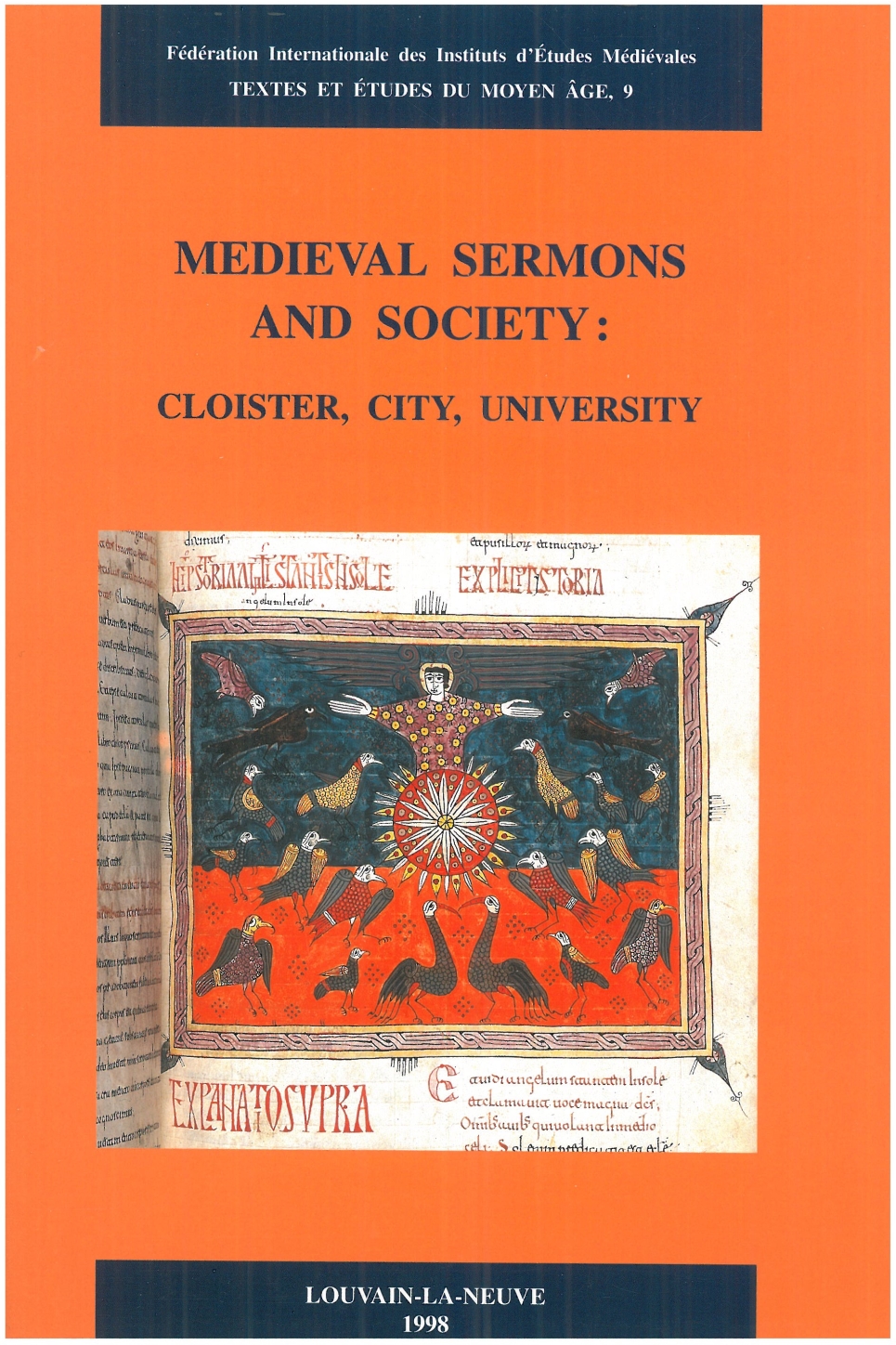
Medieval Sermons and Society: Cloister, City, University
show More to view fulltext, buy and share links for:Medieval Sermons and Society: Cloister, City, University show Less to hide fulltext, buy and share links for: Medieval Sermons and Society: Cloister, City, UniversityThe twenty-one essays in this volume focus on medieval sermons and their relationship to the society they reflect and to the diverse audiences they address, broadly divided into three groups: cloister, city and university. The chronological range of the essays extends from the early to the late Middle Ages, touching on the major periods in the history of preaching: monastic texts for use within religious communities; the preaching of pilgrim-missionary monks; sermons from the twelfth-century world reflecting heightened Marian devotion and also viewing the urbanisation of society with alarm; the Fourth Lateran Council in 1215 with its influential legislation on preaching; the vast preaching activities of the mendicant orders, including sermons written for communities of religious women, a crucial part of the cura monialium; the growth of the cathedral schools and the mendicant studia into universities where preachers were educated and aids for preaching and sermon collections were generated in great quuantities; the production of vernacular materials for lay audiences; and the persuasive power of preaching in urban centres such as London, or Florence, where Italian humanism exerted an early influence on the rhetoric of sermons. In all these eras and venues, medieval preachers both reflected and shaped the society around them. The essays in this volume illustrate amply the wealth of material that sermons offer for the social, intellectual, religious and political history of the Middle Ages.
The volume contains three sections: "The Cloister" with an introduction by D.L. Stoudt and articles by Z. Izydorczyk, L. Martin, J. Blaettler, A. Thayer, R.D; Hale, D.L. Stoudt and A. Syring; "The City" with an introduction by A. Thayer and articles by P.B. Roberts, B.M. Kienzle, C.A. Muessig, C. Ho, L. Carruthers, J. Dah,us, P. Horner and P. Howard; and "The University" with an introduction by J. Hamesse and articles by P.B. Roberts, N. Spatz, D. Pryds, E.W. Dolnikowski, and H.-J. Shiewer.
-
-
-
The Medieval Translator. Traduire au Moyen Age
show More to view fulltext, buy and share links for:The Medieval Translator. Traduire au Moyen Age show Less to hide fulltext, buy and share links for: The Medieval Translator. Traduire au Moyen AgeMost of the papers in this volume consider translation in medieval England (in both Old and Middle English and Anglo-Norman), though translations into other medieval vernaculars are also represented (Icelandic, Dutch, German), as is translation of classical Greek into Latin. Most of the translations are anonymous, though major translators are also included: Cicero, King Alfred, Robert Grosseteste, Jean de Meun, Chaucer. Several papers consider the troubled times during the late fourteenth and early fifteenth centuries in England, when a number of major translation projects were undertaken; others explore the place of translation in daily life (pro forma letters, gynaecological treatises, forged documents in support of a local shrine, texts rewritten so as to update legal references in them); another considers the importance of paper for the rapid dissemination of translated texts. Also featured prominently is the translation of different sorts of religious texts, originally variously in monastic, eremitical and mendicant milieux, and including the 'translations' for their readers of divine messages received by female visionaries. The more generous understanding of the term indicated by the use of quotation marks for these latter is also reflected in a paper considering representations of heaven and hell in visual arts. All the contributions share an awareness of translation as culturally specific - as originating in and addressing specific contexts: of; for example; nationality, politics, class and gender. Above all, translation as a new thing; with a life of its own, may provide a fuller, as well as a different, realisation of what was only partly present in its original.
-
-
-
Models of Holiness in Medieval Sermons
show More to view fulltext, buy and share links for:Models of Holiness in Medieval Sermons show Less to hide fulltext, buy and share links for: Models of Holiness in Medieval SermonsHagiographers and sermonists came together in 1995 to focus on the sermon, the central literary genre in the life of medieval Christians and Jews and the primary medium for conveying and adapting models of holiness to the public. The contribution in this volume elaborate the sermon's role in constructing and diffusing models of holiness in different cultural and chronological categories, from ninth-century Ireland to late medieval Germany, from the synagogues of medieval Spain to the piazzas of fifteenth-century Florence, and from the secret meetings of heretics to the papal court in Avignon.
While ideals of holiness remained relatively consistent, the practical interpretations varied widely. Among the topics explored are the swift construction and propagation of Becket's cult after his martyrdom; the reappearance of certain biblical figures in different milieux; the non-utilization of non-biblical models; the interpretation of models for lay listeners and female audiences: chronological shifts in the vocabulary of sanctity; the theological basis for encouraging lay preaching; and attitudes in the eve of the Reformation.
Methodological concerns are also elucidated here: the challenge in methodology shared by scholars of Jewish and Christian preaching; the sources other than sermons that bear on preaching; compilers' modifications to their sources; the role sermons played in canonization processes; expanding the definition of a sermon to encopass the activities of lay movements, laywyers, monarchs, and contexts beyond the framework of traditional worship.
-