


Brepols Online Books Medieval Miscellanea Archive Supplement v2016 - bobar16mimex

Collection Contents
2 results
-
-
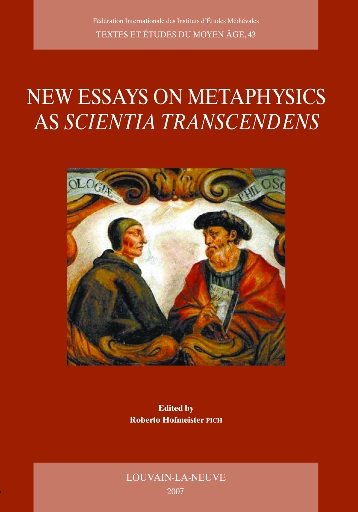
New Essays on Metaphysics as “Scientia Transcendens”
show More to view fulltext, buy and share links for:New Essays on Metaphysics as “Scientia Transcendens” show Less to hide fulltext, buy and share links for: New Essays on Metaphysics as “Scientia Transcendens”This volume is not an historical study of the origins and development of medieval approaches to theories of transcendentals. Its point of departure is rather the role that transcendentals played in natural theology and metaphysical theories of the 13th. and 14th. centuries. Accordingly, the effort of John Duns Scotus (1265/6-1308) to systematize a theory of transcendental concepts provides the central inspiration for this book. The theories in focus are not only linked to metaphysical issues, but come to constitute the understanding of metaphysics as «First Philosophy». In the wake of the 13th-century reception of Aristotle, Scotus inaugurates a new beginning for the «science of reality as a whole», adumbrating theoretical elements that have exercised a remarkable influence on the history of philosophy and continue to do so today.
If Scotus offers a new understanding and a new systematic account of transcendentals in the form of an original conception of First Philosophy as the science of transcendentals - a conception which many believe introduces a «second beginning of metaphysics» within Western philosophy - the essays in this volume evaluate the innovations that his work inspired, and in this sense each of them is itself innovative. They offer a candid evaluation of the extrinsic and intrinsic merits of the Scotist interpretation - that is, they examine just how original the intepretation is within the history of ideas, and assess its internal consistency. In doing so, they take account of earlier philosophical attempts to understand both the interrelationship of transcendentals and the science of metaphysics. They also offer topical and expanded analyses of various elements of Scotus’s theory, as well as of its influence and developments within Scotist circles and the Franciscan tradition, as well as within Spanish scholasticism and the philosophical theology of our times.
-
-
-
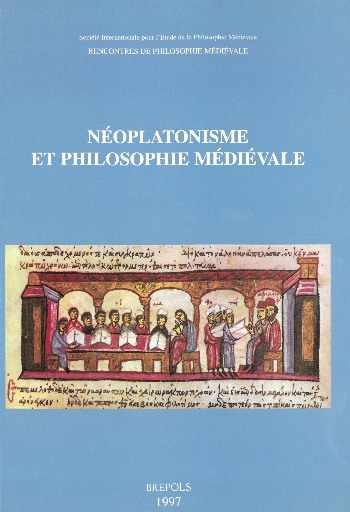
Néoplatonisme et philosophie médiévale
show More to view fulltext, buy and share links for:Néoplatonisme et philosophie médiévale show Less to hide fulltext, buy and share links for: Néoplatonisme et philosophie médiévaleL'intérêt grandissant de la recherche scientifique de ces dernières décennies pour le courant ultime de la pensée grecque ancienne, qui va de Plotin à ses principaux disciples, est reflété par le nombre important de monographies, d'articles et d'autres textes de recherche, qui sont en grande partie publiés par des participants au colloque de Corfou. Les textes des communications sont présentés selon l'ordre systématique adopté lors du colloque: sujets généraux; périodes historiques; penseurs de la tradition philosophique de l'Occident, de Byzance et du monde arabe. La leçon inaugurale du professeur Éd. Jeauneau, spécialiste reconnu dans le dommaine, fait l'objet de la première contribution sur "Denys l'Aréopagite, promoteur du néoplatonisme en Occident".
Un assez grand nombre de communications propose une nouvelle approche des oeuvres de philosophes du Moyen Âge, comme Abélard, Bonaventure, Thomas d'Aquin, Gilles de Rome, Henri de Gand, Richard Rufus, Jean Wyclif, Arethas, Psellos, Sophonias, Choumnos et d'autres.
-