


Brepols Online Books Other Miscellanea Archive v2016 - bobar16miot

Collection Contents
2 results
-
-

Credit and the rural economy in North-western Europe, c. 1200-c. 1850
show More to view fulltext, buy and share links for:Credit and the rural economy in North-western Europe, c. 1200-c. 1850 show Less to hide fulltext, buy and share links for: Credit and the rural economy in North-western Europe, c. 1200-c. 1850This book retraces the nature and role of credit in the pre-industrial European countryside. As part of an ongoing examination of credit and its provision in European past societies, the nine papers collected in this volume offer further insight into the ways in which credit was provided and managed, as well as the opportunities which credit may or may not have presented in effecting economic and social change between c. 1200 and c. 1850. In these respects, the papers in this volume add to a developing investigation of the history of credit and of indebtedness in northern Europe, which also coincides with a continued interest in the structures of credit evident in studies of southern European societies. The present volume also, for a broad North Sea region, develops a concentration upon the economic and social history of credit from the late medieval period to the early nineteenth century. The themes here are deliberately focused on the nature of credit, its form and structure, as well as upon the economic and social impact of credit and the changing availability of the same.
Phillipp Schofield is Professor of Medieval History at Aberystwyth University. He has published extensively on the social, economic and demographic history of late medieval peasant society in England.
Thijs Lambrecht is postdoctoral researcher with the Research Foundation Flanders and the Department of Early Modern History at Ghent University. His research focuses on rural markets in the Southern Netherlands during the early modern period.
-
-
-
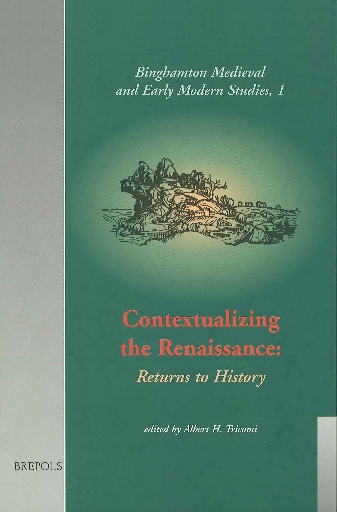
Contextualizing the Renaissance. Returns to History
show More to view fulltext, buy and share links for:Contextualizing the Renaissance. Returns to History show Less to hide fulltext, buy and share links for: Contextualizing the Renaissance. Returns to HistoryThe twenty-eighth annual conference of CEMERS, held on 21-22 October 1994 at Binghamton University, featured thirty-three panel sessions and approximately 150 presentations. The ten essays in this volume consist of the five plenary speakers - leaders in their field - and five panel essays, each of which was reviewed for this volume. The volume comprises a body of work organised around a governing theme - modes of historicisation. Each of the essays demonstrates the practice of, or a commentary upon, a distinctive historicized criticism. By 'historicized' as contrasted with 'historical' criticism, it is meant that these essays problematicize, stretch or reconceive traditional historical practices. Challenging the notion that the production of paintings, dramatic texts or even conduct books can be read against a stable historical ground, they show that paintings, works of literature, and treatises not only participate in history but are exemplars of textual instability. The very content of these texts can be shown, in various editions, to change over time - and yet each bears a single, determinate title. In such ways the contributions gathered here all show that they have been affected by 'the new history'.
-