


Brepols Online Books Other Miscellanea Archive v2016 - bobar16miot

Collection Contents
4 results
-
-
Fußnoten zu Augustinus: Gesammelte Schriften Wilhelm Geerlings
show More to view fulltext, buy and share links for:Fußnoten zu Augustinus: Gesammelte Schriften Wilhelm Geerlings show Less to hide fulltext, buy and share links for: Fußnoten zu Augustinus: Gesammelte Schriften Wilhelm Geerlings“The English mathematician and philosopher A. N. Whitehead described the Western tradition as follows: ‘The safest general characterization of the European philosophical tradition is that it consists of a series of footnotes to Plato.’ By way of analogy, one could state without difficulty: The history of theology in the West consists of a series of footnotes to Augustine.”
This is how Wilhelm Geerlings describes the significance of Augustine in his pithy and short book on the theologian. Just as Whitehead’s statement was not meant to diminish the achievement of later philosophers, but rather aimed at underlining the fundamental significance of Plato, Geerlings did not intend to minimize the significance of post-Augustinian theology.
Likewise, the title given to the collection of the most important articles of Wilhelm Geerlings (1941-2008), Footnotes to Augustine, is not meant to lessen the author’s contribution. It rather highlights the crucial significance of Augustine for the thought and scholarship of the theologian and historian Wilhelm Geerlings. To the general public, he is mainly known as the founder and editor of the Fontes Christiani, a series of new bilingual editions of ancient and medieval Christian sources, which, by the time of his death, comprised one hundred volumes. Furthermore, he was one of two editors of the “Lexikon der antiken christlichen Literatur”.
Georg Röwekamp, Dr. phil., is the manager and theological director of Biblische Reisen GmbH, Stuttgart.
-
-
-
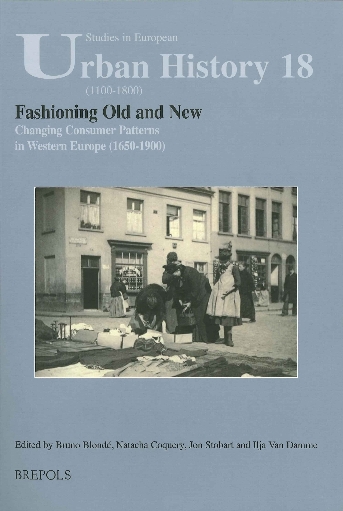
Fashioning Old and New. Changing Consumer Patterns in Europe (1650-1900)
show More to view fulltext, buy and share links for:Fashioning Old and New. Changing Consumer Patterns in Europe (1650-1900) show Less to hide fulltext, buy and share links for: Fashioning Old and New. Changing Consumer Patterns in Europe (1650-1900)A continuing ‘cry for the new’, it is said, drives present-day consumerism. People are producing and buying new goods in ever-larger quantities. However, in the past, consumer choices for new products were paralleled and even overlapped by structurally embedded practices such as re-use, recycling and resale. Unfortunately far too little is known about these important practices. The ‘birth of a consumer society’ was grounded not only in the appearance of new products and new industries; a similar drive manifested itself in the handling, buying and selling of ‘second-hand’.
In this book then the editors confront and integrate historical research on the world of the new and the old. Papers focus on the relationship between material culture and novelty, fashion and innovation on the one hand; and/or patina, second-hand and re-cycling on the other. Differences existed in the use of old and new products according to time, place, social and gender groups. By paying close attention to this historical diversity, this book explores the changing meanings and motivations of consumption. The geographical coverage will be an urban one. The studied time frame will be ‘the long eighteenth-century’ (from circa 1650 until 1900). It was only then that rapid fashion changes, new imports and spreading industrialization changed the existing material culture dramatically. However, comparisons crossing time and place do place sweeping ‘modern’ assumptions in perspective. After all: who can decipher how the concepts old and new are changing today, with the current popularity of more responsible (social and ecological) forms of consumption and recycling, and with vintage-clothing and antique furniture back en vogue?
Bruno Blondé is Research Professor at the Center for Urban History (University of Antwerp). His research interest includes urban networks, transport history and the history of consumption.
Natacha Coquery is appointed Professor at the University of Nantes. She has written extensively on the shopping and consumer habits of the French elites.
Jon Stobart is appointed professor at the University of Northampton. He has worked on urban networks and consumption in spatial perspective.
Ilja Van Damme is Postdoctoral Fellow of the Fund for Scientific Research. He has written a PhD on the interrelationships between consumer changes and retail evolutions.
-
-
-
From Palmyra to Zayton: Epigraphy and Iconography
show More to view fulltext, buy and share links for:From Palmyra to Zayton: Epigraphy and Iconography show Less to hide fulltext, buy and share links for: From Palmyra to Zayton: Epigraphy and IconographyThis volume highlights research by Australian scholars on two major Silk Road cities: Palmyra in Syria - long regarded as the finest example of a "Caravan City" - and Quanzhou (Zayton) in South China which was the destination of the main Maritime Silk Road between Medieval China and the Middle East. The volume exhibits for the first time in a western language publication and in full colour the unique iconography of the Nestorian Christian community in South China under Mongol rule. This material is virtually unknown to western scholars and will be of major importance to the study of the eastward diffusion of Christianity and of East-West contact in the period of Marco Polo. The volume also contains one of the largest collections of Palmyrene inscriptions (Aramaic, Greek, Latin and Hebrew) in English translations with accompanying original texts and detailed analytical indices. The selection focuses on politics and trade but also gives representative texts of almost all genres of Palmyrene inscriptions. The volume should prove indispensable to scholars of East-West contacts and of Roman History given the role played by Palmyra under Zenobia in the Crisis of the Third Century.
-
-
-
Fundamental Changes in Cellular Biology in the 20th Century. Biology of Development, Chemistry and Physics in the Life Sciences
show More to view fulltext, buy and share links for:Fundamental Changes in Cellular Biology in the 20th Century. Biology of Development, Chemistry and Physics in the Life Sciences show Less to hide fulltext, buy and share links for: Fundamental Changes in Cellular Biology in the 20th Century. Biology of Development, Chemistry and Physics in the Life SciencesThis volume presents a collection of selected papers worked out for the XXth International Congress of History of Science held in July 1997 in Liège The first part analyzes interrelations between the exact sciences, chemistry and physics on the one hand, and life sciences on the other hand. It is well known that in many fields of biological sciences, mainly in those working with experimental methods, chemical and physical knowledge was integrated but the historic development of that interrelation is not yet known and cannot be explained enough in all details until the present day. By searching for the events in the past, historians of science find out that introducing physical and chemical methods and knowledge into life sciences was not a simple but very complex historical process. The second part was constructed during the centenary of E.B. Wilson's pioneering book The Cell in Development and Inheritance (1896), with an eye on this tradition of biological research. Wilson attempted to integrate cytology, embryology, and the chromosome theory of inheritance into a common cellular framework. It was only in the late 1970s that the synthesis now called cell biology, developmental biology and developmental genetics came into existence. The work carried out in Zürich under E. Hadorn's supervision was brought to light. Concepts and paths of research were defined, for example: homeosis, physiological genetics, 'body plans' allometry, homologies of process, evolution as 'bricolage' and finally a critical essay on different perspectives on development.
-