


Brepols Online Books Other Miscellanea Archive v2016 - bobar16miot

Collection Contents
3 results
-
-
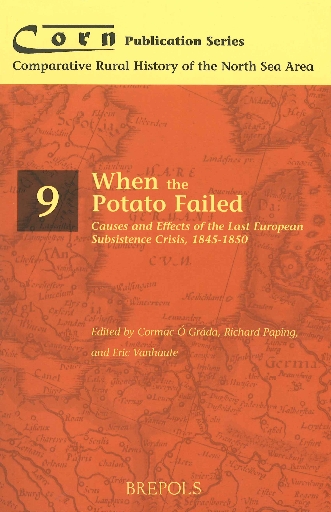
When the Potato Failed. Causes and Effects of the Last European Subsistence Crisis, 1845-1850
show More to view fulltext, buy and share links for:When the Potato Failed. Causes and Effects of the Last European Subsistence Crisis, 1845-1850 show Less to hide fulltext, buy and share links for: When the Potato Failed. Causes and Effects of the Last European Subsistence Crisis, 1845-1850The decade that gave rise to the term ‘the Hungry Forties’ in Europe is often regarded, and rightly so, as one of deprivation, unrest, and revolution. Two events, the Great Irish Famine and the various political events of ‘1848’, stand out. This book is the first to discuss the subsistence crisis of the 1840s in a truly comparative way. This subsistence crisis may be divided into two rather distinct elements. On the one hand, the failure of the potato caused by the new, unfamiliar fungus, phytophthera infestans, which first struck Europe in mid-1845, resulted in a catastrophe in Ireland that killed about one million people, and radically transformed its landscape and economy. Poor potato crops in 1845 and in the following years also resulted in significant excess mortality elsewhere in Europe. On the other hand, this period, and 1846 in particular, was also one of poor wheat and rye harvests throughout much of Europe. Failure of the grain harvest alone rarely resulted in a subsistence crisis, but the combination of poor potato and grain harvests in a single place was a lethal one. Connections between the local and the global, between the economic and the political, and between the rural and the industrial, make the crisis of the late 1840s a multi-layered one.
This book offers a comparative perspective on the causes and the effects of what is sometimes considered as the ‘last’ European subsistence crisis. It begins with an extensive introduction that treats the topic in comparative perspective. The subsistence crisis had its most catastrophic impact in Ireland, and three chapters in the current volume are concerned mainly with that country. A fourth chapter uses price data to shed comparative perspective on the crisis, while the remaining nine chapters are case studies covering countries ranging from Sweden to Spain and from Scotland to Prussia. Throughout, the contributors focus on a range of common themes, such as the extent of harvest deficits, the functioning of food markets, fertility and mortality, and public action at local and national levels.
Cormac Ó Gráda is professor of economics at University College, Dublin. He has worked extensively on the history of famines in Ireland and worldwide.
Richard Paping teaches economic and social history and economics at University of Groningen. He has done extensive research on developments in standard-of-living, economy and demography in the Netherlands.
Eric Vanhaute is professor social and economic history and world history at Ghent University. He has mainly published on the history of the rural society and of labour markets in Flanders and outside.
Table of contents:
Eric Vanhaute, Richard Paping and Cormac Ó Gráda, The European Subsistence Crisis of 1845-1850: a Comparative Perspective
PART I - The Irish Famine in an International Perspective
Cormac Ó Gráda, Ireland’s Great Famine. An overview - Mary E. Daly, Something Old and Something New. Recent Research on the Great Irish Famine - Peter M. Solar, The Crisis of the Late 1840s. What Can Be Learned From Prices? - Peter Gray, The European Food Crisis and the Relief of Irish Famine, 1845-1850
PART II - A Potato Famine Outside Ireland?
Tom M. Devine, Why the Highlands Did Not Starve. Ireland and Highland Scotland During the Potato Famine - Eric Vanhaute, “So Worthy an Example to Ireland”. The Subsistence and Industrial Crisis of 1845-1850 in Flanders - Richard Paping and Vincent Tassenaar, The Consequences of the Potato Disease in the Netherlands 1845-1860: a Regional Approach - Hans H. Bass, The Crisis in Prussia - Gunter Mahlerwein, The Consequences of the Potato Blight in South Germany - Nadine Vivier, The Crisis in France. A Memorable Crisis But Not a Potato Crisis - Jean Michel Chevet and Cormac Ó Gráda, Crisis: What Crisis? Prices and Mortality in Mid-Nineteenth Century France - Pedro Díaz Marín, Subsistence Crisis and Popular Protest in Spain. The Motines of 1847- Ingrid Henriksen, A Disaster Seen From the Periphery. The Case of Denmark - Carl-Johan Gadd, On the Edge of a Crisis: Sweden in the 1840s
-
-
-
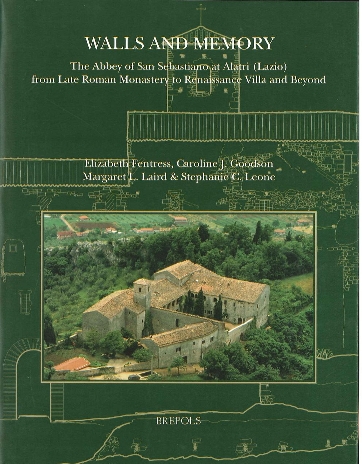
Walls and Memory: The Abbey of San Sebastiano at Alatri (Lazio), from Late Roman Monastery to Renaissance Villa and Beyond
show More to view fulltext, buy and share links for:Walls and Memory: The Abbey of San Sebastiano at Alatri (Lazio), from Late Roman Monastery to Renaissance Villa and Beyond show Less to hide fulltext, buy and share links for: Walls and Memory: The Abbey of San Sebastiano at Alatri (Lazio), from Late Roman Monastery to Renaissance Villa and BeyondThe abbey of San Sebastiano, which lies not far from the town of Alatri in Southern Lazio, preserves within its walls almost fifteen hundred years of history. This history is unusually bound to a number of important figures, from Saint Benedict to Pope Nicholas V and his circle of humanists. For the past four years a small team has been investigating the extant structures of the abbey, analyzing the stratigraphy of the standing walls and tracing the various building phases. The study has produced some startling discoveries: the plan and preserved walls of one of the oldest monasteries in Europe, and one of the earliest Renaissance villas. The book gives an account of the architecture and the history of the building, showing how each phase relates to the last both structurally and thematically.
The project was initiated at the American Academy in Rome, where Elizabeth Fentress was Andrew Mellon Professor, and Caroline Goodson, Margaret L. Laird and Stephanie C. Leone were Fellows. Margaret Laird and Stephanie Leone are now assistant professors at the University of Washington, Seattle and at Boston College. Other contributors include Caroline Bruzelius, Professor of the History of Art at Duke University, Antonio Manfredi, Vatican Library, Serena Romano, Professor of the History of Art at the University of Lausanne, Marco Rossi, director of the Museum of Alatri, and Ingrid Rowland, Andrew Mellon Professor at the American Academy in Rome.
-
-
-
Worlds of the Silk Roads: Ancient and Modern
show More to view fulltext, buy and share links for:Worlds of the Silk Roads: Ancient and Modern show Less to hide fulltext, buy and share links for: Worlds of the Silk Roads: Ancient and ModernDefinitions of Inner Asia vary greatly. Inner Asia includes those lands that have linked the major agrarian civilisations of Eurasia, from China to India to the Mediterranean and Europe, since the late Neolithic period. In the 19th century, it became customary to refer to the trade routes between these regions as the 'Silk Roads'. But silk was just one of the goods exchanged through Inner Asia. religions, diseases, coins, cuisines, artistic fashions, political titles, all travelled the Silk Roads, as did Buddhism, Christianity, Manichaeism and Islam. Seen in this way, Inner Asia appears as the central knot in the vast tapestry of Eurasian history. To take Inner Asian history seriously is to see the underlying unity of Eurasian history. S.N.C. Lieu, From Iran to South China: The Eastward Passage of Manichaeism, L. Cansdale, Jews on the Silk Roads, C. Benjamin, An Introduction to Kushan Research, D. Christian, State Formation in the Inner Eurasian Steppes, S. Helms, Ancient Chorasmia: The Northern Edge of Central Asia from the 6th Century B.C. to the mid-4th Century A.D., H. Hendrischke, Chinese Concerns with Central Asia, C. Mackerras, Some observations on Xinjiang in the 1990s, W. Maley, The Dynamics of Regime Transition in Afghanistan, K. Nourzhanov, Traditional Kinship Structures in Contemporary Tajik Poilitics, S. Akbarzadeh, Reformism in the Bukharan Khanate, G. Lafitte, Re-orienting Mongolia, F. Patrikeef, Baron Ungern and the Eurasian Empire, R. Pitty, Russia and Eurasia in International Relations, A. Van Tongerloo, Turkestan: a Treasury of Civilisations, G. Watson, Central Asia as Hunting Ground: Sporting Images of Central Asia, T. Matthew Ciolek, 'Digital Caravanserais': Essential Online Resources for Inner Asian Studies.
-