Brepols Online Books Other Miscellanea Archive v2016 - bobar16miot

Collection Contents
61 - 80 of 98 results
-
-
Engineering and Engineers
show More to view fulltext, buy and share links for:Engineering and Engineers show Less to hide fulltext, buy and share links for: Engineering and EngineersThis volume is devoted to the history of engineers from the 16th to the 20th century. It begins with two general papers, the first one by M. Duffy on the nature of engineering, the other by E. Knob loch on engineers of the Renaissance and their illustrated manuscripts. The other papers deal with the training of engineers, their methods, and role in the international technological transfers as well as the biography of some famous engineers.
-
-
-
History of Modern Physics
show More to view fulltext, buy and share links for:History of Modern Physics show Less to hide fulltext, buy and share links for: History of Modern PhysicsAddressing modern physics in its largest perspective, the present volume, which includes 34 contributions, begins with a reappraisal of classical science. However, the stress is placed on the contemporary period with sections devoted to thermodynamics and mechanics, the centenary of the electron, Einstein, the quantum theory and particle physics.
-
-
-
Institutions and Societies for Teaching, Research and Popularisation
show More to view fulltext, buy and share links for:Institutions and Societies for Teaching, Research and Popularisation show Less to hide fulltext, buy and share links for: Institutions and Societies for Teaching, Research and PopularisationThis volume is devoted to scientific institutions from the 17th to the 20th century. It consists of three parts: the first deals with teaching and research institutions (universities, technical schools, foundations); the second is about scholarly societies (academies, amateur societies, industrial societies); the last deals with scientific popularisation initiatives, notably those of newspapers. Several papers concern the role of women in scientific communities.
-
-
-
Materials: Research, Development and Applications
show More to view fulltext, buy and share links for:Materials: Research, Development and Applications show Less to hide fulltext, buy and share links for: Materials: Research, Development and ApplicationsThe theme of materials in the history of technology has never been as well researched as other more popular areas like energy, production technology or transport and communication. The present collection of papers originating from the symposium on "Materials: Science, Technology and Early Applications" in conjunction with the xx th International History of Science Congress in Liège, 1997, make a contribution to remedying this unsatisfactory situation. They concentrate on the 19th and 20th centuries and range from research on the metallurgy of zinc in the late 18th and early 19th century to the prospects of ceramic materials to ameliorate contemporary environmental problems.
-
-
-
Nomads, Traders and Holy Men Along China's Silk Road
show More to view fulltext, buy and share links for:Nomads, Traders and Holy Men Along China's Silk Road show Less to hide fulltext, buy and share links for: Nomads, Traders and Holy Men Along China's Silk RoadThis collection of papers formed part of the symposium, “Nomads, Traders and Holy Men Along China’s Silk Road”, held at the Asia Society in New York on November 9-10, 2001. Although the Silk Road has inspired several important museum exhibitions, none had focused on the Hexi Corridor nor attempted to analyze the complexity of the cross-cultural relationships within China’s borders. Nor had any exhibition focused on the nearly four hundred years of political disunity, nomadic incursions and social upheaval, brought about by the collapse of the great Han dynasty (206 B.C.E.-220 C.E.), that then, after a series of short-lived dynasties, culminated in the reunification of China under the Tang empire (618-906).
-
-
-
Science and Technology in the Islamic World
show More to view fulltext, buy and share links for:Science and Technology in the Islamic World show Less to hide fulltext, buy and share links for: Science and Technology in the Islamic WorldThis volume provides a comprehensive overview of current researches on science in the Muslim-Arab world. The papers deal with the religious and institutional context, mathematics, optics, astronomy, mechanics, natural philosophy, and pharmacology.
The present volume also includes a general author index of the 21 volumes that make up the proceedings of the xxth International Congress of History of Science.
-
-
-
Science, Philosophy and Music
show More to view fulltext, buy and share links for:Science, Philosophy and Music show Less to hide fulltext, buy and share links for: Science, Philosophy and MusicThis volume illustrates the old and fruitful dialogue between historians of science and philosophers, as well as new collaborations with artists. It includes two symposia. The first one is on the history of scientific models, the seond is on science and music. It also contains papers on the philosophy of mathematics, physics, technology and politics, but also on Aristotle, Lucretius, Bacon, Le Bon, Spengler, Reichenbach, and Kuhn.
-
-
-
Scientific Instruments and Museums
show More to view fulltext, buy and share links for:Scientific Instruments and Museums show Less to hide fulltext, buy and share links for: Scientific Instruments and MuseumsThe present volume is organised around two symposia of the XXth International Congress of History of Science, respectively devoted to the history of sundials and to the national inventories of scientific instruments. Separate studies on outstanding instruments, instrument-makers, as well as unknown museums and collections in Spain, Italy, Estonia, and Latin-America were also included.
-
-
-
Studies in History of Mathematics Dedicated to A.P. Youschkevitch
show More to view fulltext, buy and share links for:Studies in History of Mathematics Dedicated to A.P. Youschkevitch show Less to hide fulltext, buy and share links for: Studies in History of Mathematics Dedicated to A.P. YouschkevitchIn the framework of the 20th International Congress of History of Science (Liège 1997), a symposium was devoted to the historical work of Adolph P. Youschkevitch (1906-1993). The present volume includes the papers read during the symposium as well as contributions on current issues in the history of mathematics : mathematics as a cultural strength, mathematics from antiquity to the classical period, probability theory and its applications, mathematics in the 19th and 20th centuries.
-
-
-
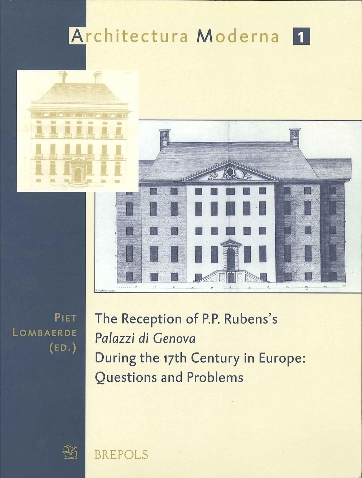
The Reception of P.P. Rubens's 'Palazzi di Genova' during the 17th Century in Europe: Questions and Problems
show More to view fulltext, buy and share links for:The Reception of P.P. Rubens's 'Palazzi di Genova' during the 17th Century in Europe: Questions and Problems show Less to hide fulltext, buy and share links for: The Reception of P.P. Rubens's 'Palazzi di Genova' during the 17th Century in Europe: Questions and ProblemsRubens' book 'Palazzi di Genova' was well diffused in European countries as England, the Netherlands, France, Germany and Italy thanks to the numerous contacts the famous painter and diplomat maintained in humanistic, artistic and political circles. From 1622 on this book, containing two volumes, was edited at several times during the 17th and 18th Century. But the direct influences of the numerous façades, plans, cross-sections, staircases and building details on modern architecture look rather limited, especially in his own country. In this study, several scholars in architectural history analyse how the examples of Genoese palazzi and churches as presented by Rubens were accepted in different European countries. Much attention is given to the question if these examples inspired a new architectural typology, in which the inner court of the houses was substituted by a 'salone in mezzo'. An attempt is made to situate Rubens' book among the late 16th and early 17th Century treatises and model books. The way in which Rubens presented the new Genoese architecture of villa's, palaces and churches and the introduction he wrote as a 'painter-architect' to this book were so modern at that time, that the reception of this prestigious edition in folio had more to do with changes in considering architectural theory and practice as with the propagation of a late renaissance style influenced by Antique examples.
-
-
-
The management of common land in north west Europe, c. 1500-1850
show More to view fulltext, buy and share links for:The management of common land in north west Europe, c. 1500-1850 show Less to hide fulltext, buy and share links for: The management of common land in north west Europe, c. 1500-1850Until the 19th century very large areas of Western Europe were subject to some degree to common rights, where individual users collectively managed resources such as pasture and wood which were central to the agrarian economy. Much scholarship has focused on the dissolution of these rights and the effects of the enclosure of common land on society and agricultural productivity. In contrast, this volume seeks to assess in a comparative framework the long-term management of the common lands and the relative success of strategies in providing the resources sought by the rural population. Chapters covering northern and southern England, France, the Netherlands, Flanders, Sweden and northern and southern Germany examine the institutional and legal framework of commoning, the resources available and their value, the sustainability of practices, and policies of inclusion and exclusion among the group of commoners. Building on the theoretical insights of recent works on commonly managed resources, this volume, the result of an international collaboration in the CORN network, provides a series of detailed historical studies and is the first major work to address this central aspect of the agrarian economy in a comparative European context.
-
-
-
Beatus Rhenanus (1485-1547), lecteur et éditeur des textes anciens
show More to view fulltext, buy and share links for:Beatus Rhenanus (1485-1547), lecteur et éditeur des textes anciens show Less to hide fulltext, buy and share links for: Beatus Rhenanus (1485-1547), lecteur et éditeur des textes anciensLe but du colloque était de décrire, d'analyser et d'évaluer la contribution éditoriale et exégétique de Rhenanus. Les 23 études ont été disposées de manière chronologique pour faciliter l'analyse de son évolution philologique, question qui a été au centre des débats. Les conférenciers ont bénéficié d'une documentation de choix, car ils ont le plus souvent travaillé sur les textes personnels de Rhenanus provenant de sa bibliothèque conservée à Sélestat.
Les Actes intéresseront quatre domaines de recherches : l'étude de la transmission des textes des auteurs grecs et latins, leur critique textuelle et exégétique, les techniques éditoriales au XVI siècle et la nature de l'humanisme.
-
-
-
Emblems from Alciato to the Tattoo
show More to view fulltext, buy and share links for:Emblems from Alciato to the Tattoo show Less to hide fulltext, buy and share links for: Emblems from Alciato to the TattooThis collection of essays reflects the various manifestations of the emblem in cultural forms ranging from the first appearance of printed books in the sixteenth century to very recent visual equivalents in modern advertising and tattoos. The essays are revised versions of papers presented at the Fourth International Conference held at Leuven in 1996. The table of contents provides an overview of the variety of topics and approaches represented in the volume.
-
-
-
Les Publications de l'Académie Royale des Sciences de Paris (1666-1793)
show More to view fulltext, buy and share links for:Les Publications de l'Académie Royale des Sciences de Paris (1666-1793) show Less to hide fulltext, buy and share links for: Les Publications de l'Académie Royale des Sciences de Paris (1666-1793)De sa fondation en 1666 à sa suppression en 1793, l'Académie Royale des Sciences de Paris fut le siège d'une intense activité éditoriale. Ses publications constituent une mine inépuisable d'informations, non seulement pour les historiens des sciences, mais pour quiconque s'intéresse à l'histoire, à la culture et à la société de l'Age Classique. En même temps, cette masse documentaire décourage souvent le chercheur par son abondance et ses problèmes bibliographiques spéciaux.
Le présent ouvrage se veut un outil de travail. Il comprend deux volumes. Le premier contient la description bibliographique des ouvrages publiés par l'Académie Royale et le détail de leur contenu d'après les exemplaires originaux. Le second comprend des études quantitatives, ainsi que les index des auteurs des publications, des personnages cités dans les titres et des sujets traités.
-
-
-
Medieval and Classical Traditions and the Renaissance of Physico-Mathematical Sciences in the 16th Century
show More to view fulltext, buy and share links for:Medieval and Classical Traditions and the Renaissance of Physico-Mathematical Sciences in the 16th Century show Less to hide fulltext, buy and share links for: Medieval and Classical Traditions and the Renaissance of Physico-Mathematical Sciences in the 16th CenturyCe volume est une contribution à l'histoire de la transition entre la science médiévale et la science moderne, en ce qui concerne les mathématiques et la science du mouvement. Le processus de cette transformation a été relativement peu étudié: les études historiques se sont concentrées de façon dominante sur la description de la phase finale de ce processus; le travail historique a établi une description très documentée et structurée de la situation de la philosophie naturelle à l'aube de la science classique. Au cours des dernières décennies des travaux sur des auteurs et des oeuvres du XVIe siècle peu étudié font cependant apparaître que cette description est altérée structurellement par des interprétations anachroniques de certains concepts qui y occupent manifestement une place centrale. Les études présentées dans ce volume sont un reflet des travaux effectués récemment dans ce sens sur deux aspects singuliers d'un tel programme: l'oeuvre scientifique de MAurolico d'une part, et l'émergence de la science galiléenne du mouvement d'autre part.
-
-
-
Optics and Astronomy
show More to view fulltext, buy and share links for:Optics and Astronomy show Less to hide fulltext, buy and share links for: Optics and AstronomyL'ouvrage qui paraît sous le titre " Optics and Astronomy " groupe un ensemble de communications présentées lors du XXe congrès international d'histoire des sciences. Toutes relèvent de ces domaines intimement liés au cours du temps. Qu'aurait été l'évolution de l'astronomie sans le développement de l'optique ? Quant à ce dernier domaine il a trouvé un terrain de prédilection dans les applications qu'en ont fait les astronomes. Dans l'antiquité, d'Euclide fonde en géomètre une optique qui trouve un premier aboutissement chez Ptolémée. La grande école arabe prend le relais en renouvelant la théorie de la lumière et de la vision. Le premier XVIIe siècle européen invente la lunette, analyse ses implications optiques et construit des instruments qui modifient l'idée même qu'on se faisait des choses et des cieux. Mécanique céleste s'appliquant principalement au système solaire, marginalisation d'une tradition astrologique pourtant rémanente, création de modèles, analyse de données..., tout concourt à former les esprits - au siècle des Lumières notamment - à la compréhension du Monde que viennent renforcer les découvertes de l'astrométrie et de l'astrophysique. L'unité du volume, confortée par la variété des sujets traités, doit permettre au lecteur qui n'a pu se rendre à Liège en 1997, d'apprécier l'influence réciproque précoce des deux domaines de la recherche qu'il couvre.
-
-
-
Science and Technology in East Asia. The Legacy of Joseph Needham
show More to view fulltext, buy and share links for:Science and Technology in East Asia. The Legacy of Joseph Needham show Less to hide fulltext, buy and share links for: Science and Technology in East Asia. The Legacy of Joseph NeedhamThe xx th International Congress of History of Science (Liège, July 1997) was the first to be held after Joseph Needham (1900-1995) passed away. During the Congress the symposium entitled “Global history of science” was dedicated to this scholar usually recognised as the founder of the study of East Asian science. The symposium aimed at highlighting the significance of his research, which has influenced historians of science in their study of all civilisations. The papers presented there and included in this volume focus on various historiographical and methodological issues raised by Needham’s work and on questions which he has opened to investigation. These issues and questions are relevant not only to the history of East Asian science and technology, but also to the history of science at large, once one envisions it in a global perspective. This volume is rounded off by four further papers that are representative of current research in the history of East Asian science.
-
-
-
Emblematik und Kunst der Jesuiten in Bayern: Einfluss und Wirkung
show More to view fulltext, buy and share links for:Emblematik und Kunst der Jesuiten in Bayern: Einfluss und Wirkung show Less to hide fulltext, buy and share links for: Emblematik und Kunst der Jesuiten in Bayern: Einfluss und WirkungVom 5. - 5. Juli 1998 fand an der Hochschule für Philosophie in München ein internationales Symposion zum Thema "Jesuitische Emblematik in Bayern: Einfluss und Wirkung" statt, das sich mit der wissenschaftlichen Erforschung der Entstehungs-, Entwicklungs- und Verbreitungsgeschichte des Symbols auseinandersetzte.
Die vorliegende publikation beschränkt sich bewusst nur auf die "bayerischen" Beiträge des Symposions, erweitert durch ergänzende Studien zum Thema Emblematik und Kunst der Jesuiten in Bayern, wie der Vorstellung der Frontispize der Werke des grossen Naturwissenschaftlers Christoph Scheiner, Aspekte zu Georg Stengels Ova paschalia, Betrachtung der Jesuitenkirche Franz Xaver in Luzern oder der neuen Interpretationen eines Kupferstiches der Heiligen Familie vor der St. Michaelskirche München. Vorangestellt ist dem Band ein Abriss über Gründer, Leitmotiv, Signet und Satzungen der Gesellschaft Jesu und das neue Logo des Ordens in Zentral-europa. Einführung in die Thematik Rita Haub und Richard Müller SJ "Jesuiten" Alois Schmid; Templum aulicum. Das Jesuitenkolleg St.Michael zu München als Herrschaftskirche im frühneuzeitlichen Bayern Emblembücher Peter M. Daly; A Survey of Emblematic Publications of the Jesuits of the Upper German Province to the Year 1800 Rita Haub; Bey was erkennet man einen Catholischen Christen? Illustrationen im Bilderkatechismus des Petrus Canisius James Latham SJ; Text and Image in Jeremias Drexel's Orbis Phaëthon G. Richard Dimler SJ; Octiduum S. Francisco Borgiae (1671) : The Munich Jesuits Celebrate the Canonization of Francis Borgia Franz Daxecker; Frontspize in den Werken P. Christoph Scheiners SJ Helmut Zäh; Die Welt im Ei : Georg Stengels Ova paschalia Elisabeth Klecker; Regiae virtutis et felicitatis XII symbola (Dillingen 1636). Panegyrik und Paränese in einem Emblembuch für Ferdinand III Paul Richard Blum; Die Versuchung der Philosophie durch graphische Schemata : Berthold Hauser und die Arbor Porphyriana Angewandte Emblematik Bernhard Paal SJ; Die Heilige Familie vor der St. Michaelskirche in München. Ein theologisches und ikonographisches Programm-Bild Joseph Imorde; Gebaute Emblematik. Die Jesuitenkirche Franz Xaver in Luzern Sabine Mödersheim; Matthäus Rader und das allegorische Programm im Augsburger Rathaussaal. Einfluss und Wirkung jesuitischer Emblematik Alan Young; Protestant Meditation and Two 1647 English Translations of Jeremias Drexel's Zodiacus christianus Paul Begheyn SJ; The Emblem Books of Jeremias Drexel in the Low Countries
-
-
-
L'Orient dans l'histoire religieuse de l'Europe
show More to view fulltext, buy and share links for:L'Orient dans l'histoire religieuse de l'Europe show Less to hide fulltext, buy and share links for: L'Orient dans l'histoire religieuse de l'EuropeCet ouvrage constitue les Actes du quatrième colloque, co-organisé par la Section des Sciences Religieuses de l'École Pratique des Hautes Études et l'Université Hébraïque de Jérusalem, qui eut lieu à Paris, les 1er et 2 février 1999. Son objet était moins d'étudier l'influence qu'ont pu exercer les grandes religions de l'Orient sur celles de l'Europe que de retrouver, de décrire et d'analyser la construction, historiographique, spirituelle ou bien imaginaire, de quelques «origines orientales». Des mouvements de retour au sources, réelles ou mythiques, traversent les diverses religions de l'Europe, du Moyen Âge à nos jours, constituant souvent l'élément dynamique de leur évolution tandis que paradoxalement ils suscitent et alimentent aussi les fondamentalismes: croisades et mythes de croisades, pèlerinages, travaux d'historiens et d'érudits, éditions de textes, constitutions des formes de critiques, expériences mystiques. À travers les différentes études de ce recueil, on se demandera ainsi quelle est la part des réalités historiques, des constructions historiographiques, des recherches scientifiques, des illusions ou encore des quêtes spirituelles dans la constitution des «Orients» comme référents des grands courants religieux de l'Europe.
Mohammed Ali Amir-Moezzi est Directeur d'Études à la Section des Sciences Religieuses de l'EPHE, où il est titulaire de la chaire «Exégèse et théologie de l'Islam Chiite». Parmi ses travaux, son ouvrage Le voyage initiatique en terre d'islam. Ascensions célestes et itinéraires spirituels a paru, en 1997, dans la collection de la Bibliothèque de l'École des Hautes Études.
John Scheid est Directeur d'Études à la Section des Sciences Religieuses de l'EPHE où il est titulaire de la chaire «Religions de Rome». Son dernier ouvrage codirigé avec Valérie Huet, Autour de la colonne Aurélienne. Geste et image sur la colonne de Marc Aurèle à Rome, est paru, en 2000, dans la collection de la Bibliothèque de l'École des Hautes Études.
-