Brepols Online Books Other Miscellanea Archive v2016 - bobar16miot

Collection Contents
81 - 98 of 98 results
-
-
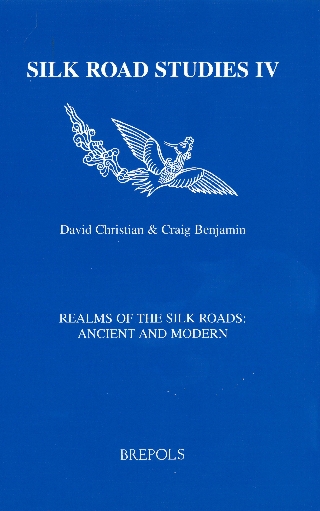
Realms of the Silk Roads: Ancient and Modern
show More to view fulltext, buy and share links for:Realms of the Silk Roads: Ancient and Modern show Less to hide fulltext, buy and share links for: Realms of the Silk Roads: Ancient and ModernRealms of the Silk Roads Part 1: New Sources on Inner Asian History N. Sims-Williams, Some Reflections on Zoroastrianism in Sogdiana and Bactria; G. Mikkelsen, Traité/Sermon on the Light-Nous in Chinese and its Parallels in the Parthian, Sogdian and Old Turkish; A.V.G. Betts & V.N. Yagodin, Hunting Traps on the Ustiurt Plateau, Uzbekistan. Part 2: Long Distance Contacts S. Lieu, Byzantium, Persia and China: Interstate Relations on the Eve of the Islamic Conquest; D. Christian, Silk Roads or Steppe Roads ? The Silk Roads in World History; M. Underdown, The Northern Silk Road: Ties between Turfan and Korea. Part 3: Political Life C. Benjamin, The Yuezhi and their Neighbours: Evidence for the Yuezhi in the Chinese Sources c. 220 - c. 25 BCE; K. Nourzhanov, Politics of National Reconciliation in Tajikistan: From Peace Talks to (Partial) Political Settlements; S. Akbarzadeh, Islam and Regional Stability in Central Asia; C. Mackerras, Relations Between the Uygur State and China's Tang Dynasty, 744-840. Part 4: Perspectives G. Watson, Prestigious Peregrinations : British Travellers in Central Asia c. 1830-1914; F. Patrikeeff, The Geopolitics of Myth: Interwar Northeast Asia and Images of an Inner Asian Empire; D. Thwaites, The Road to Urumqui: Zunun Kadir's Lost World; F. Patrikeeff & J. Perkins, National and Imperial Identity: A Triptych of Baltic Germans in Inner Asia. Part 5: Teaching Inner Asian History R. Fletcher & E. Hetherington, The China TimeMap Project: China and the Silk Roads; M. With, Creating Responsible Educational Images of Judaic / Christian / Islamic Relations.
-
-
-
René Taton. Etudes d'histoire des sciences
show More to view fulltext, buy and share links for:René Taton. Etudes d'histoire des sciences show Less to hide fulltext, buy and share links for: René Taton. Etudes d'histoire des sciencesPour taus les historiens des sciences, René Taton (né en 1915) est un des pères fondateurs de leur discipline. Si son nom demeure attaché à l' Histoire générale des sciences, il est l'auteur de bien d'autres travaux sur l'histoire des sciences exactes et des milieux scientifiques. Dans son séminaire, déjà légendaire, du Centre Alexandre Koyré, il a forme des générations de chercheurs, aujourd'hui actifs dans le monde entier. Pour son quatre-vingt-cinquième anniversaire, ses élèves et ses amis lui offrent un recueil de ses articles choisis par lui-même.
-
-
-
Révolution scientifique et libertinage
show More to view fulltext, buy and share links for:Révolution scientifique et libertinage show Less to hide fulltext, buy and share links for: Révolution scientifique et libertinagePeut-on mettre en relation - et de quelle façon ? - l'émergence et le déploiement de la science moderne, au xvii e siècle, avec ceux du "libertinage" ou "libertinisme" pendant la même période ? C'est à cette question complexe et quelque peu redoutable, car elle concerne les origines de notre modernité, que se sont efforcés de répondre treize historiens des idées scientifiques, philosophiques ou littéraires. Il n'était pas à l'ordre du jour - il parut même présomptueux ou prématuré - d'affronter le problème dans son abstraite généralité : il s'agissait bien plutôt de mettre en lumière, aussi précisément et concrètement que possible, le cheminement intellectuel de certains hommes de science, de certains libertins avérés, ou la fortune d'une idée apparemment "transversale". Ce recueil permet le repérage des nombreuses voies de rencontre qui parfois favorisèrent le dialogue entre hommes de science et esprits "déniaisés" au xvii e siècle, mais aussi des obstacles qui parfois l'empêchèrent. Il fait peut-être entrevoir la lente émergence d'un régime univoque de la "raison", à mesure que le siècle avance. Enfin, sa polyphonie interdisciplinaire apporte un éclairage varié sur certaines théories et notions philosophiques, comme l'atomisme et l'infini, qui jouent un rôle capital au xvii e siècle.
Auteurs : Armand Beaulieu, Michel Blay, François de Graux, Antonella Del Prete, Dominique Descotes, Vincent Jullien, Didier Kahn, Alain Mothu, Alain Niderst, Isabelle Pantin, Richard H. Popkin, Giovanni Ruocco, Bertram E. Schwarzbach, Ann Thomson.
-
-
-
Science, Technology and Industry in the Ottoman World
show More to view fulltext, buy and share links for:Science, Technology and Industry in the Ottoman World show Less to hide fulltext, buy and share links for: Science, Technology and Industry in the Ottoman WorldThis volume gathers together the papers of the Symposium on Science, Technology and Industry in the Ottoman World which was organized within the XXth International Congress of History of Science held in Liège in July 1997. This symposium was the first to focus exclusively on the Ottoman World within the congresses convened by the International Union for the History and Philosophy of Science (IUHPS).
Scholarly interest in the scientific activities caried out in various geographical areas of the Ottoman Empire between the 14th and 20th century yielded a growing number of studies in recent years. The initial findings of these studies led scholars to question the view that Islamic science went into a decline after the 12th century, and to argue that Ottoman science constituted a new episode in Islamic science.
The present volume begins with a survey on the Ottomans' transition from the Islamic to the European scientific tradition. This survey is followed by research papers dealing with: the introduction of modern science and technology to Turkey in the 18th and 19th centuries as regards the military technical training, the first railway line in Asiatic Turkey and the teaching of modern botany; the introduction of modern medicine and Darwinism in Egypt; Bonaparte's expedition to Egypt from the viewpoint of history of science and technology; and the mathematical activities in the Maghreb in both pre-Ottoman and Ottoman periods.
-
-
-
Technology and Engineering
show More to view fulltext, buy and share links for:Technology and Engineering show Less to hide fulltext, buy and share links for: Technology and EngineeringToo often technology is seen as inferior to science, as a simple practical application of a self-sufficient "pure" knowledge. Such a dichotomy is for sure an illusion. The contributions met in this volume, reflecting the richness and the density of the session Science, Technology and Industry during the XXth International Congress of History of Science in Liège in 1997, show all technology as nothing less than the bridge between science on one side, society and economy on the other side. And this bridge is not a one-way road but a place of interactions between the theoretical and the applied, between the knowledge and the know-how. A special section of this book demonstrates that this equal footing dialogue has been particularly intense as far as the military technical development is concerned, and that for many centuries.
This collection does not bring a synthesis or a state of the art, but some rich material able to stimulate the debates, still active since the 1970s, in the social studies of science and technology. Most of the papers integrate and try to touch the complexity of the processes at work when a discovery, an invention, has to be adapted, or when the social and economic structures solicit from science a solution to very peculiar problems. The diversity of topics, approaches, even the variety of the vocabulary used by the authors to describe apparently similar patterns, reflect the dynamic of a research flow but also, probably, the necessity to elaborate new analytical frames, new synthetic schemes.
-
-
-
Between the Natural and the Artificial. Dyestuffs and Medicines
show More to view fulltext, buy and share links for:Between the Natural and the Artificial. Dyestuffs and Medicines show Less to hide fulltext, buy and share links for: Between the Natural and the Artificial. Dyestuffs and MedicinesThis thematic volume consists of a selection of papers from the XXth International Congress of History of Science, which was held in Liège in 1997. Two separated symposia were concerned with the study of historical connections between such different scientific fields as chemistry, botany, pharmacy, medicine and their technical aspects. Natural products from plants and animals, and their artificial equivalents, which were especially studied and used for dyeing and for medicinal purposes, were discussed in both meetings. The various contributions of the present volume deal with many of these products in several countries (in Europe, Asia, Africa and America) from the medieval period to the XIXth century. The first part treats of some historical aspects of chemical and pharmaceutical questions related to selected dyestuffs. The second part deals with pharmaceutical products for medicinal and biological purposes. These studies should contribute to foster new interdisciplinary research in this field, which is bound to develop at the international level.
-
-
-
Contextualizing the Renaissance. Returns to History
show More to view fulltext, buy and share links for:Contextualizing the Renaissance. Returns to History show Less to hide fulltext, buy and share links for: Contextualizing the Renaissance. Returns to HistoryThe twenty-eighth annual conference of CEMERS, held on 21-22 October 1994 at Binghamton University, featured thirty-three panel sessions and approximately 150 presentations. The ten essays in this volume consist of the five plenary speakers - leaders in their field - and five panel essays, each of which was reviewed for this volume. The volume comprises a body of work organised around a governing theme - modes of historicisation. Each of the essays demonstrates the practice of, or a commentary upon, a distinctive historicized criticism. By 'historicized' as contrasted with 'historical' criticism, it is meant that these essays problematicize, stretch or reconceive traditional historical practices. Challenging the notion that the production of paintings, dramatic texts or even conduct books can be read against a stable historical ground, they show that paintings, works of literature, and treatises not only participate in history but are exemplars of textual instability. The very content of these texts can be shown, in various editions, to change over time - and yet each bears a single, determinate title. In such ways the contributions gathered here all show that they have been affected by 'the new history'.
-
-
-
Fundamental Changes in Cellular Biology in the 20th Century. Biology of Development, Chemistry and Physics in the Life Sciences
show More to view fulltext, buy and share links for:Fundamental Changes in Cellular Biology in the 20th Century. Biology of Development, Chemistry and Physics in the Life Sciences show Less to hide fulltext, buy and share links for: Fundamental Changes in Cellular Biology in the 20th Century. Biology of Development, Chemistry and Physics in the Life SciencesThis volume presents a collection of selected papers worked out for the XXth International Congress of History of Science held in July 1997 in Liège The first part analyzes interrelations between the exact sciences, chemistry and physics on the one hand, and life sciences on the other hand. It is well known that in many fields of biological sciences, mainly in those working with experimental methods, chemical and physical knowledge was integrated but the historic development of that interrelation is not yet known and cannot be explained enough in all details until the present day. By searching for the events in the past, historians of science find out that introducing physical and chemical methods and knowledge into life sciences was not a simple but very complex historical process. The second part was constructed during the centenary of E.B. Wilson's pioneering book The Cell in Development and Inheritance (1896), with an eye on this tradition of biological research. Wilson attempted to integrate cytology, embryology, and the chromosome theory of inheritance into a common cellular framework. It was only in the late 1970s that the synthesis now called cell biology, developmental biology and developmental genetics came into existence. The work carried out in Zürich under E. Hadorn's supervision was brought to light. Concepts and paths of research were defined, for example: homeosis, physiological genetics, 'body plans' allometry, homologies of process, evolution as 'bricolage' and finally a critical essay on different perspectives on development.
-
-
-
Land Productivity and Agro-systems in the North Sea Area (Middle Ages - 20th Century). Elements for Comparison
show More to view fulltext, buy and share links for:Land Productivity and Agro-systems in the North Sea Area (Middle Ages - 20th Century). Elements for Comparison show Less to hide fulltext, buy and share links for: Land Productivity and Agro-systems in the North Sea Area (Middle Ages - 20th Century). Elements for ComparisonThis book deals with land productivity. Agriculture took the largest share of GNP before the mid-19th century and so economic growth must focus on agricultural transformations and measurements of agricultural productivity and its determinants. The 1963 study by B.H. Slicher van Bath on yield ratios across Europe was epoch-making. But more recent studies point to the necessity of placing and analysing land productivity more clearly within agricultural, ecological and socio-economic contexts. This publication, made by the CORN research team, reflects the new developments and findings in this field, for the North Sea area from the Middle Ages to the 20th century. The book consists of three sections: the first contains national longterm overviews for each of the North Sea countries; the second part presents several case studies which examine the relationship between land productivity and agro-systems; and the last part consists of general comparative studies. The publication thus hopes to advance our understanding of developments in land productivity and to build the material for further research.
-
-
-
Le charbon de terre en Europe occidentale avant l'usage du coke
show More to view fulltext, buy and share links for:Le charbon de terre en Europe occidentale avant l'usage du coke show Less to hide fulltext, buy and share links for: Le charbon de terre en Europe occidentale avant l'usage du cokeTout au long du xix e siècle et pendant une partie du xx e siècle, la houille a été la plus importante source d'énergie utilisée dans le monde, elle a joué un rôle de premier plan dans l'avènement de la société industrielle. Cette victoire du charbon a débuté en Europe, d'abord en Grande-Bretagne, puis sur le continent. Une telle mutation a été préparée par l'expérience accumulée depuis des siècles. Ce sont les aspects essentiels de cette histoire plus ancienne (extraction du combustible minéral, commerce, usages) que les auteurs du présent ouvrage ont choisi de présenter lors d'un symposium du xx e Congrès international d'Histoire des Sciences tenu à Liège en 1997. Le champ chronologique dans lequel s'inscrit cette réflexion débute avec les premières utilisations du charbon de terre à l'époque romaine et s'étend jusqu'au moment où les hommes ont utilisé de manière systématique le coke en métallurgie. Des périodes aux caractères bien définis scandent ce temps. De l'époque romaine à la fin du xii e siècle, toute trace d'utilisation de la houille disparaît en Europe. En 1195 à Liège, les Annales de Renier de Saint Jacques révèlent l'emploi médiéval de la houille mais rapidement les sources signalent une exploitation anglaise d'importance. Cependant, l'usage de la houille demeure longtemps limité et très inégal selon les régions. Ce n'est qu'au xvii e siècle en Angleterre, quelques décennies plus tard sur le continent, que la production s'accroît. Le grand essor houiller du xix e siècle s'inscrit donc dans un long processus qui débute bien avant l'ère industrielle.
-
-
-
Les Positivismes. Philosophie, Sociologie, Histoire, Sciences
show More to view fulltext, buy and share links for:Les Positivismes. Philosophie, Sociologie, Histoire, Sciences show Less to hide fulltext, buy and share links for: Les Positivismes. Philosophie, Sociologie, Histoire, SciencesLe terme "positivisme" répond traditionnellement à la définition suivante: un système philosophique qui récuse les a priori métaphysiques et voit dans l'observation des faits positifs et dans l'expérience l'unique fondement de la connaissance. Mais cette définition est-elle suffisante? N'y a-t-il alors qu'un seul "positivisme", et s'agit-il d'un mode de pensé révolu, sans influence sur notre temps, ou au contraire d'un ou de plusieurs modes de pensée qui gardent leur actualité?
Les études rassemblées dans ce volume abordent différentes facettes, non plus du positivisme mais bien des positivismes. Traité par des philosophes, des historiens, des sociologues, ce thème s'épanouit en questions multiples. La pensée comtienne y est réexaminée sous l'angle du système philosophique proprement dit, de son actualité et de ses archaïsmes. L'on y examine les glissements de sens du mot positivisme, sa présence - parfois implicite - au sein de notre pensée actuelle, les différentes "écoles positivistes", comme le positivisme logique, ou encore l'influence exercée par les positivismes sur d'autres disciplines, histoire, sociologie, sciences exactes...
-
-
-
Marriage and Rural Economy. Western Europe since 1400
show More to view fulltext, buy and share links for:Marriage and Rural Economy. Western Europe since 1400 show Less to hide fulltext, buy and share links for: Marriage and Rural Economy. Western Europe since 1400The history of marriage in Western Europe, because of its peculiarities when viewed in a global setting, compels attention. This volume examines rural marriage patterns in the long run, relating these to changing economic conditions in the North Sea area, from c. 1400 to the present. More than thirty years after Hajnal's path-breaking publication it presents a state of the art as regards the study of the European Marriage Pattern in Ireland, Scotland, England, Belgium, the Netherlands, Germany and Scandinavia. By examining different forms of rural economy such as peasant farming, capitalist farming, prot-industry and other systems of production with differing implications for marriage and family formation, demographic and economic mechanisms emerge more clearly. Turning from description to explanation, a complex of interacting factors which regulate the formation of new households is identified and new directions into the research of this phenomenon are promoted. This volume comprises 11 article-chapters and introduction and conclusion and is the result of international collaboration from members of the CORN network. It is a work of richness, subtlety and historical depth, which makes essential reading for those interested in the evolution of marriage patterns, in the distant past and in more recent times.
-
-
-
Science, Technology and Political Change
show More to view fulltext, buy and share links for:Science, Technology and Political Change show Less to hide fulltext, buy and share links for: Science, Technology and Political ChangeThis is the first of a series of thematic volumes consisting of a selection of papers from the 20th International Congress of History of Science, which was held in Liège in 1997, and organised by the International Union of History and Philosophy of Science (IUHPS), an organisation linked to UNESCO through the International Council for Science (ICSU).
The present volume deals with the relationship between science, technology and politics in the 20th century, with a special emphasis on some areas of the world that recently underwent serious political change including the German Democratic Republic and other countries from the former "Eastern bloc" such as Hungary, Ukraine, the Baltic countries, Russia, and countries in Central Asia. Individual contributions from Japan, Algeria and Portugal have also been included, since they should help initiate a transnational reflection on the subject.
-
-
-
The Spread of the Scientific Revolution in the European Periphery, Latin America and East Asia
show More to view fulltext, buy and share links for:The Spread of the Scientific Revolution in the European Periphery, Latin America and East Asia show Less to hide fulltext, buy and share links for: The Spread of the Scientific Revolution in the European Periphery, Latin America and East AsiaThis volume includes papers presented during a symposium on the spreading of the scientific revolution outside Western European countries, which was held during the XXth International Congress of History of Science in Liège in 1997.
The contributions aim to answer some recent historiographical questions such as the modalities of the spreading of science in different countries, the reception of the new science by different cultures, the kind of changes this reception set in motion, the periodisation in adopting the new scientific knowledge, the structures set up for this adoption.
Three geographical areas are presented here: the European countries in the border of the "scientific center", Latin America countries and East Asian regions.
The volume constitutes the first attempt at making a synthesis at an international level on the important question of the spreading of the "new science" throughout the world.
-
-
-
Worlds of the Silk Roads: Ancient and Modern
show More to view fulltext, buy and share links for:Worlds of the Silk Roads: Ancient and Modern show Less to hide fulltext, buy and share links for: Worlds of the Silk Roads: Ancient and ModernDefinitions of Inner Asia vary greatly. Inner Asia includes those lands that have linked the major agrarian civilisations of Eurasia, from China to India to the Mediterranean and Europe, since the late Neolithic period. In the 19th century, it became customary to refer to the trade routes between these regions as the 'Silk Roads'. But silk was just one of the goods exchanged through Inner Asia. religions, diseases, coins, cuisines, artistic fashions, political titles, all travelled the Silk Roads, as did Buddhism, Christianity, Manichaeism and Islam. Seen in this way, Inner Asia appears as the central knot in the vast tapestry of Eurasian history. To take Inner Asian history seriously is to see the underlying unity of Eurasian history. S.N.C. Lieu, From Iran to South China: The Eastward Passage of Manichaeism, L. Cansdale, Jews on the Silk Roads, C. Benjamin, An Introduction to Kushan Research, D. Christian, State Formation in the Inner Eurasian Steppes, S. Helms, Ancient Chorasmia: The Northern Edge of Central Asia from the 6th Century B.C. to the mid-4th Century A.D., H. Hendrischke, Chinese Concerns with Central Asia, C. Mackerras, Some observations on Xinjiang in the 1990s, W. Maley, The Dynamics of Regime Transition in Afghanistan, K. Nourzhanov, Traditional Kinship Structures in Contemporary Tajik Poilitics, S. Akbarzadeh, Reformism in the Bukharan Khanate, G. Lafitte, Re-orienting Mongolia, F. Patrikeef, Baron Ungern and the Eurasian Empire, R. Pitty, Russia and Eurasia in International Relations, A. Van Tongerloo, Turkestan: a Treasury of Civilisations, G. Watson, Central Asia as Hunting Ground: Sporting Images of Central Asia, T. Matthew Ciolek, 'Digital Caravanserais': Essential Online Resources for Inner Asian Studies.
-