Brepols Online Books Medieval Monographs Archive v2016 - bobar16mome

Collection Contents
12 results
-
-
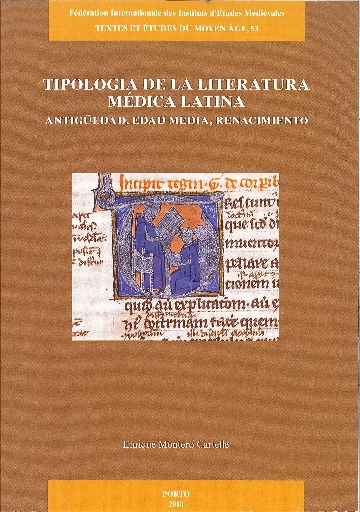
Tipologia de la literatura médica latina. Antigüedad, edad media, renacimiento
show More to view fulltext, buy and share links for:Tipologia de la literatura médica latina. Antigüedad, edad media, renacimiento show Less to hide fulltext, buy and share links for: Tipologia de la literatura médica latina. Antigüedad, edad media, renacimientoEl interés por las formas literarias de la literatura médica ha ido creciendo progresivamente ya que atiende cada vez más a las formas de la literatura médica características de las distintas épocas, compartidas en su mayoría con otras ramas de la ciencia como la filosofía, la teología o el derecho. Pero faltaba una visión de conjunto de estos textos médicos desde el punto de vista literario. La tipología de esos tratados es un indicio revelador de su origen, finalidad, cultura del autor y demanda social. Este estudio pretende mostrar un panorama general de las formas literarias de los estudios médicos y sus medios de expresión. El estudio del comportamiento de los escritores médicos ante el hecho de escribir proporciona una dimensión, como complemento, de gran relieve para los estudios estrictamente doctrinales. El escritor es un hombre de su tiempo y, como tal, refleja sus usos y modos.
Enraízados en la tradición de la Antigüedad y siguiendo una distribución armónica de la medicina diaetetica, pharmaceutica y chirurgia, los géneros literarios de la literatura médica medieval, por influjo de la filosofía y teología escolásticas, conocieron una riqueza asombrosa de formas literarias, como summae, specula, compendia, practica, concordantiae, synonyma, disputationes, problemata, accessus, tacuina, secreta, consilia, etc., que afectaron también a la tipología de su lengua. El Renacimiento fue otra época de renovación en la que continúan algunos géneros de corte tradicional, otros decaen o se transforman, mientras que toman cuerpo otras actividades más filológicas a veces que doctrinales, como las ediciones o los comentarios críticos. Cada época revela los problemas con los que se enfrentaron los escritores médicos al intentar forjar unas formas literarias y una terminología basadas en unos conocimientos médicos -en muchos casos expresados originariamente en otra lengua- y darles la forma literaria que consideraban más apropiada para publicar sus logros.
Un estudio como éste puede ser útil para todos aquellos que desde el campo de la Filología, la Historia en general o de la Historia de la Ciencia y de la Medicina o de la cultura en particular, deseen adentrarse en la literatura médica.
-
-
-

Trinity and Creation
show More to view fulltext, buy and share links for:Trinity and Creation show Less to hide fulltext, buy and share links for: Trinity and CreationThe Trinity and Creation are central themes in the theology of the Augustinian Canons of the Abbey of St Victor during its time of greatest flourishing in the twelfth century. In this volume, three of the most important Victorine theological works are introduced and completely translated into English for the first time: On the Three Days, by Hugh of St. Victor (d. 1141), a lyrical yet philosophical study of how the power, wisdom, and goodness of God can be known from the things God has made; Hugh’s Sentences on Divinity, lecture notes which show how the divine ideas (“primordial causes”) serve God in creation; and On the Trinity, by Richard of St. Victor (d. 1173), one of the enduring classics of Christian theology, which analyzes the Trinity in terms of love. Also included are two of Adam of St. Victor’s sequences in praise of the Trinity.
This volume is edited by Boyd Taylor Coolman (PhD, Notre Dame University; Theology Dept. Boston College), author of The Theology of Hugh of St. Victor: An Interpretation (2010), and Dale M. Coulter (DPhil, Oxford; School of Divinity, Regent University), author of Per Visibilia ad Invisibilia: Theological Method in Richard of St. Victor (d. 1173) (2006).
-
-
-
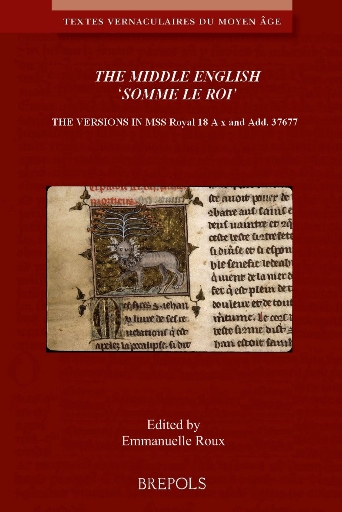
Two Middle English Translations of Friar Laurent's 'Somme le roi': critical edition
show More to view fulltext, buy and share links for:Two Middle English Translations of Friar Laurent's 'Somme le roi': critical edition show Less to hide fulltext, buy and share links for: Two Middle English Translations of Friar Laurent's 'Somme le roi': critical editionThis is the first volume of a two-volume project whose aim is to publish all the known Middle English manuscript translations of the French Somme le roi, a thirteenth-century manual of religious instruction offering teaching on the Decalogue, the seven deadly sins and their remedies, compiled by the Dominican friar Laurent of Orleans. The project extends and deepens our knowledge of the influence of this popular French text, known today only from the versions entitled The Ayenbite of Inwit and The Book of Vices and Virtues, published in 1866 and 1942, respectively.
This volume presents the versions extant in BL MSS Royal 18. A. x and Add. 37677; the second will cover the versions in Cambridge, Corpus Christi College, MS 494, Oxford, Bodleian Library, MS Ashmole 1286, and Oxford, Bodleian Library, MS e Musaeo 23. The texts of both volumes have been prepared with the help of the recently-published edition of the French text (2008), a circumstance from which the earlier English editions were unable to benefit. It is likely that the versions edited here for the first time will make a considerable contribution to our understanding of the processes of textual transmission and to that of translation itself in English literary circles of the fifteenth century.
-
-
-
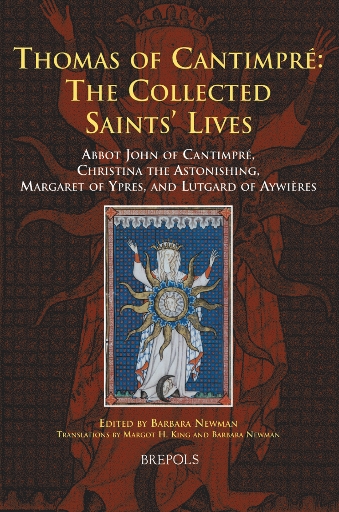
Thomas of Cantimpré: The Collected Saints' Lives
show More to view fulltext, buy and share links for:Thomas of Cantimpré: The Collected Saints' Lives show Less to hide fulltext, buy and share links for: Thomas of Cantimpré: The Collected Saints' LivesThe Dominican Thomas of Cantimpré (c. 1200-c. 1270) was a key figure in the 'evangelical awakening' of the thirteenth century. A prolific hagiographer, he lauded such diverse subjects as the abbot and apostolic preacher John of Cantimpré; the teenaged ascetic Margaret of Ypres, an urban recluse who died at twenty; Lutgard of Aywières, a Cistercian nun and mystic; and the theatrical, mentally troubled Christina 'the Astonishing' of Sint-Truiden. Thomas had few peers in portraying the ritual theatre of penance. He gives us such memorable scenes as a naked moneylender led out of a pit by a rope, a formerly rapacious prince kissing his peasants’ feet as he restores their stolen goods, St Christina leaping into fires and boiling cauldrons to save souls in purgatory, and the deceased Pope Innocent III in agony, begging St Lutgard for her prayers. In this volume readers will find all four lively and eventful lives between the same covers for the first time. The Life of Abbot John of Cantimpré has been newly translated by Barbara Newman, who has also supplied a new introduction. The other three Lives are revised reprints from Margot H. King's Peregrina Translations Series.
-
-
-
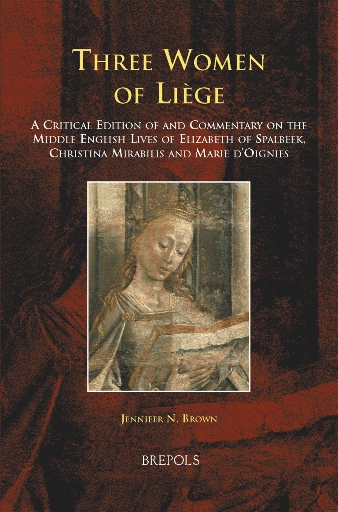
Three Women of Liège
show More to view fulltext, buy and share links for:Three Women of Liège show Less to hide fulltext, buy and share links for: Three Women of LiègeElizabeth of Spalbeek, Christina Mirabilis, and Marie d'Oignies were three of the famous late twelfth-/early thirteenth-century 'holy women' from the region of Brabant and Liège: their life stories (written in Latin by Philip of Clairvaux, Thomas of Cantimpré, and Jacques of Vitry) were read throughout later medieval Europe, and Margery Kempe modelled her Book, and her life, upon Marie’s. The Latin lives of these beguine saints were not well known in England, but they were translated into English in the fifteenth century, and survive in a single manuscript together in Oxford, Bodleian Library, Douce 114.
Three Women of Liège is the first critical edition of these Lives, which represent some of the only evidence of English interest in continental female mysticism. This edition includes an introduction that discusses the role of the manuscript in England and three essays that analyze the roles of these beguines in their Low Countries home of Liège along with the English reception of their lives. The edition itself is also extensively annotated and glossed, making it accessible to any scholar of English medieval literature.
-
-
-
Tendenda Vela
show More to view fulltext, buy and share links for:Tendenda Vela show Less to hide fulltext, buy and share links for: Tendenda VelaÉdouard Jeauneau a déjà publié deux recueils d'articles. Le premier, Lectio philosophorum (1973) était centré sur l'École de Chartres, le second, Études érigéniennes (1987, prix Victor Cousin 1990) sur Jean Scot Érigène. Ce troisième recueil, "Tendenda Vela", combine les deux thèmes.
Les travaux qui y sont rassemblés, et qui couvrent plus de vingt années de recherches, portent non seulement sur Jean Scot et sur les maîtres chartrains, mais sur leurs sources bibliques, patristiques et profanes. Parmi les sources patristiques, une place de choix est faite aux Pères grecs: Denys l'Aréopagite, Grégoire de Nysse, Maxime le Confesseur. Pour les sources profanes, l'accent est mis sur les textes philosophiques qu'on lisait dans le monde latin en la première moitié du XIIe siècle, notamment le Timée de Platon et la Consolation de Philosophie de Boèce.
Ce nouveau recueil ne se distingue pas seulement par la diversité des sujets traités, mais aussi par la variété de leur approche. Tantôt l'auteur dresse le bilan des recherches qu'il a menées sur les manuscrits en pays tchèque (Plato apud Bohemos) ou en Californie (Berkeley UCB Ms. 95), tantôt il approfondit les thèmes philosophiques (Translatio studii, Processio et Reditus, Cogito érigénien) et théologiques (le Filioque) qu'il a rencontrés au cours de ses excursions à travers le Moyen Âge, tantôt il propose une nouvelle interprétation de quelques œuvres d'art appartenant à cette période: De l'art comme mystagogie, Les sirènes dans le chœur des Vieillards. Un livre qui devrait intéresser les historiens de l'art, de la philosophie et de la théologie.
De 1958 à 1992, Édouard Jeauneau (° 1924) á été chercheur et depuis 1975 directeur de recherche de 1ère classe au Centre National de la Recherche Scientifique (Section Philosophie) à Paris. Depuis 1974 il est aussi fellow du Pontifical Institute of Mediaeval Studies (Toronto).
-
-
-
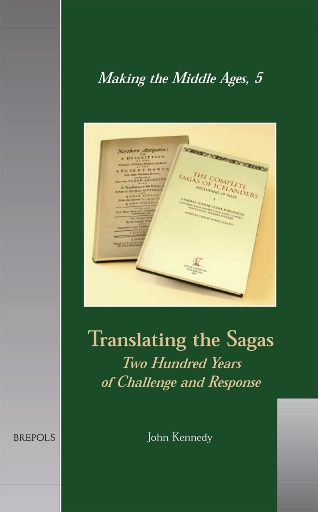
Translating the Sagas
show More to view fulltext, buy and share links for:Translating the Sagas show Less to hide fulltext, buy and share links for: Translating the SagasFew speakers of English have ever been able to read the Icelandic sagas in the original language, and published saga translations have played a major role in shaping attitudes towards Viking Age Scandinavia and the great literary achievements of medieval Iceland in the English-speaking world. This book is the first publication to provide an extended examination of the history and development of Icelandic saga translations into English from their beginnings in the eighteenth century to today. It explores reasons for undertaking saga translation, and the challenges confronting translators. Chapters are devoted to the pioneering saga translations, the later Victorian and Edwardian eras, the often-neglected period of the two World Wars and their aftermath, and the upsurge of saga translation in the second half of the twentieth century. The contributions of individual translators and teams are reviewed, from James Johnstone in the 1780s through major Victorians such as Samuel Laing, George Webbe Dasent, and William Morris, distinguished twentieth century figures such as Lee M. Hollander, Gwyn Jones, Magnus Magnusson and Hermann Pálsson, and George Johnston, and the great co-operative project which produced The Complete Sagas of Icelanders at the century’s end. The book concludes with saga translation facing interesting new possibilities and challenges, not least those generated by information technology.
-
-
-
Traité de la division des royaumes. Introduction à une histoire universelle
show More to view fulltext, buy and share links for:Traité de la division des royaumes. Introduction à une histoire universelle show Less to hide fulltext, buy and share links for: Traité de la division des royaumes. Introduction à une histoire universelleDans les premières années du XIVe siècle, Jean de Saint-Victor entreprend la rédaction d'une chronique qu'il fait précéder d'une courte description des régions et des royaumes. Conduit à réviser ce travail et à lui donner l'envergure d'une histoire universelle depuis la Création, désormais intitulée Memoriale historiarum, il développe l'introduction initiale en un véritable traité, fruit d'une réflexion longuement mûrie au contact des sources sollicitées pour l'élaboration de son premier texte. Il y expose, à l'aide de tous les exemples historiques qu'il a pu rassembler, ce qui lui apparaît commun l'une des lois fondamentales de l'histoire, la divisio regnorum : tels des organismes naturels, les royaumes, mais aussi les empires, naissent, vivent et meurent. Ainsi fait-il place à la pensée aristotélicienne dans une lecture traditionnellement augustinienne de l'Histoire sainte.
-
-
-
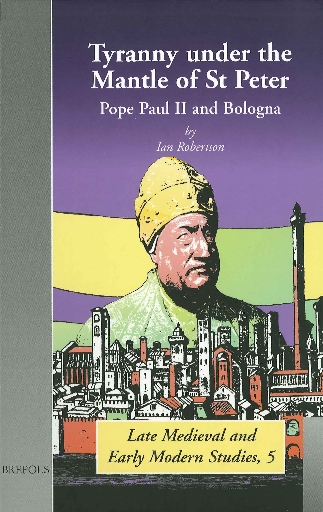
Tyranny under the Mantle of St Peter
show More to view fulltext, buy and share links for:Tyranny under the Mantle of St Peter show Less to hide fulltext, buy and share links for: Tyranny under the Mantle of St PeterThe clash between Pope Paul II ( 1464-1471) and Bologna was one of two opposed concepts of government and 'state'. Paul II held to a high concept of princely sovereignty, and to a vision of the papal temporal dominions as a genuinely co-ordinated territorial state, an enduring public; entity. Inevitably he clashed with the Commune of Bologna, second city of the Papal State, over which he aspired to more jurisdiction. The political vision of the Bolognese regime had a. local focus which precluded the sacrifice of independence in favour of integration into a wider entity, and sprang from a view of government as rightfully the private preserve of a restricted oligarchic group, from the 1440s consolidated in the magistracy of the 'Sixteen Reformers of the Regime of Liberty'. Paul II regarded the regime of the Sixteen as a 'tyranny', and declared that no such ty rannies should flourish 'under the mantle of St Peter'. But his intervention failed and, instead, Paul modified the constitution which gave the long-developing predominance of the Bentivoglio family an institutional basis. This 'signorial' regime aggravated the tension between collegiality and despotism and paved the way for the eventual destruction of the Bentivoglio dominance and later the fuller incorporation in the sixteenth century of Bologna into the Papal State.
-
-
-
Teachers and Code-Breakers: The Latin Genesis Tradition, 430-800
show More to view fulltext, buy and share links for:Teachers and Code-Breakers: The Latin Genesis Tradition, 430-800 show Less to hide fulltext, buy and share links for: Teachers and Code-Breakers: The Latin Genesis Tradition, 430-800That Genesis was a key text in the formation of the medieval intellectual world is well recognised. But what were the motives and methods of those who used it? This book looks at the writers and how they wrote about Genesis to reconstruct the intellectual history of the period. It explores how their use of Genesis discloses common attitudes to revelation, authority, and one another.In turn the book examines, how awareness of their self-understanding, can help in understanding their exegesis. Since they built on authorities and one another, and wished 'to remain true' to their authorities, how did exegesis change and develop? This study reveals a group who saw themselves as a single body dispersed over time, charged with a common task as 'Christian Schoolmasters', and who wished to retain all the had received, make it suitable for teaching their students, and ensure its continuance. The book explores the intellectual bonds between those we usually study (e.g. Augustine) and umpteen others whose often anonymous exegeses we tend to ignore - yet it was the cumulative impact of both that created medieval theology. born in 1958 in Ireland, Thomas O'Loughlin is a lecturer in theology in the Department of Theology and Religious Studies in the University of Wales Lampeter. His research in recent years has focused on the theology of the early medieval period, especially as seen in their biblical exegesis.
-