


Brepols Online Books Other Monographs Archive v2016 - bobar16moot

Collection Contents
5 results
-
-
The Didascalia apostolorum: An English version with introduction and annotation
show More to view fulltext, buy and share links for:The Didascalia apostolorum: An English version with introduction and annotation show Less to hide fulltext, buy and share links for: The Didascalia apostolorum: An English version with introduction and annotationThe Didascalia apostolorum is one of the ancient church orders, setting out the duties and responsibilities of laypeople, bishops and widows, regulating the keeping of Pascha and engaging in polemic with Judaism. It is a work of extraordinary interest for the history of the church in Syria, as a document of social and liturgical history and as a document bearing witness to relations between Christians and Jews.
Alistair Stewart-Sykes presents the text in a readable English version which takes full account of the various textual witnesses. Of particular importance is the introduction. The Didascalia is conventionally ascribed to a single hand in third-century Syria, but here an entirely new compositional hypothesis is proposed in which the work is shown to be composite and to include sources of much greater antiquity than the period of final redaction. In the light of the compositional hypothesis there are radically new discussions of ministry (including the ministry of widows), relationships with Judaism, and liturgy (including the penitential process). Beyond this the introduction engages with the social context in which these developments emerged.
The work is suitable for a wide audience. The translation will be useful to undergraduate and graduate students whereas the introduction and commentary will be of interest to scholars in ecclesiastical history, historical liturgy, forming Judaism and Jewish-Christian relations as well as Syriac studies.
The author, Alistair Stewart-Sykes, is well-known in the field having produced the first critical text for over a century of the Apostolic church order and the first full-length commentary on the Apostolic tradition.
-
-
-
Des idoles mortes et muettes au Dieu vivant: Joseph, Aséneth et le fils de Pharaon dans un roman du Judaisme hellénisé
show More to view fulltext, buy and share links for:Des idoles mortes et muettes au Dieu vivant: Joseph, Aséneth et le fils de Pharaon dans un roman du Judaisme hellénisé show Less to hide fulltext, buy and share links for: Des idoles mortes et muettes au Dieu vivant: Joseph, Aséneth et le fils de Pharaon dans un roman du Judaisme helléniséLe Roman d'Aséneth était, jusqu'il y a peu, désigné sous le titre de Joseph et Aséneth. Les premières études relevant des "gender studies" ont toutefois démontré la prédominance du personnage d'Aséneth par rapport à celui de Joseph. Le titre de Roman d'Aséneth s'avère donc justifié. L'appellation Joseph et Aséneth, qui ne provient pas des manuscrits, marquait implicitement l'idée que ce texte appartenait à la même sphère, pour ne pas dire au même genre, que celle illustrée par des romans tels que Chairéas et Callirhoé, ou Habrocomès et Anthia, pour ne citer que ceux-là. Le changement de titre qui a été adopté ici indique donc d'emblée la parti pris (qui sera justifié plus loin) de ne pas mette l'écrit sur le même pied qu'un roman d'amour grec. Le Roman d'Aséneth fait partie de cette littérature dite apocryphe ou pseudépigraphique qui pose tant de problèmes aux chercheurs et aux simples lecteurs d'aujourd'hui. Il suscite de nombreuses difficultés tant d'édition, de datation, d'attribution et d'origine que d'interprétation. On parvient même difficilement à donner à la question fondamentale des buts poursuivis par son auteur anonyme une réponse entièrement satisfaisante. Ainsi, ce petit récit plein de mystère ne cesse-t-il, depuis la publication de ses éditions modernes, de faire l'objet de nouvelles interprétations, suggestions, et analyses en tout genre.
-
-
-
Das nestorianische Christentum an den Handelswegen durch Kyrgystan bis zum 14. Jh
show More to view fulltext, buy and share links for:Das nestorianische Christentum an den Handelswegen durch Kyrgystan bis zum 14. Jh show Less to hide fulltext, buy and share links for: Das nestorianische Christentum an den Handelswegen durch Kyrgystan bis zum 14. JhThe missionary enterprise of the so-called Nestorian christianity in Asia is an amazing chapter of the religious history. Without any support by rulers or states and independent from the important western church centers Rome, Constantinople, Alexandria and Antioch, the Assyrian Church did not only survive so many centuries but it spread by the Silk Road through many parts of the Asian continent. The present book focuses for the first time on a limited region, the northern branch of the Silk Road in the modern state Kyrghyzstan. This concentration makes it possible to understand the conditions of expansion, survive and eclipse of Christianity there. The reader is introduced in the political and religious environment which its competition of Zoroastrianism, Manichaeism, Buddhism, Shamanism and Islam. Archaeological and literal sources and especially many tombstone inscriptions are not only introduced and discussed, but raised to live. The reader gets an intime impression of the society in the Kyrghyzstan of the 7th to the 14th century with its important Christian minority. This society was more similar to our's today than to that of the Middle Ages in Europe because in Europe Christianity was a state religion. Therefore the experiences of Christianity at the Silk Road can help us to understand the evolution of our own modern world.
-
-
-
Demiurge and Providence. Stoic and Platonist Readings of Plato's Timaeus
show More to view fulltext, buy and share links for:Demiurge and Providence. Stoic and Platonist Readings of Plato's Timaeus show Less to hide fulltext, buy and share links for: Demiurge and Providence. Stoic and Platonist Readings of Plato's TimaeusOf the rich legacy of the Timaeus, this study deals with the cross-pollination between Stoic and Platonist readings of Timaeus, spanning the period from Plato's writings to that of the so-called Middle Platonist authors. Plato's Timaeus and Stoic doctrine had their fates intertwined from very early on, both in polemical and reconciliatory contexts. The blend of Platonic and Stoic elements ultimately constituted one of the main conceptual bridges between the pagan tradition on the one hand and the Judeo-Christian, in its own search for the distinction between transcendence and immanence, on the other. Contrary to the received opinion, later platonist authors do not merely borrow Stoic terminology. Rather, in a genuine 'discourse of assimilation' the Stoic analysis of the universe has left a profound mark on Platonist views of the principles, of the place of humans in the universe, as well as of human freedom and its interaction with divine Providence.
-
-
-
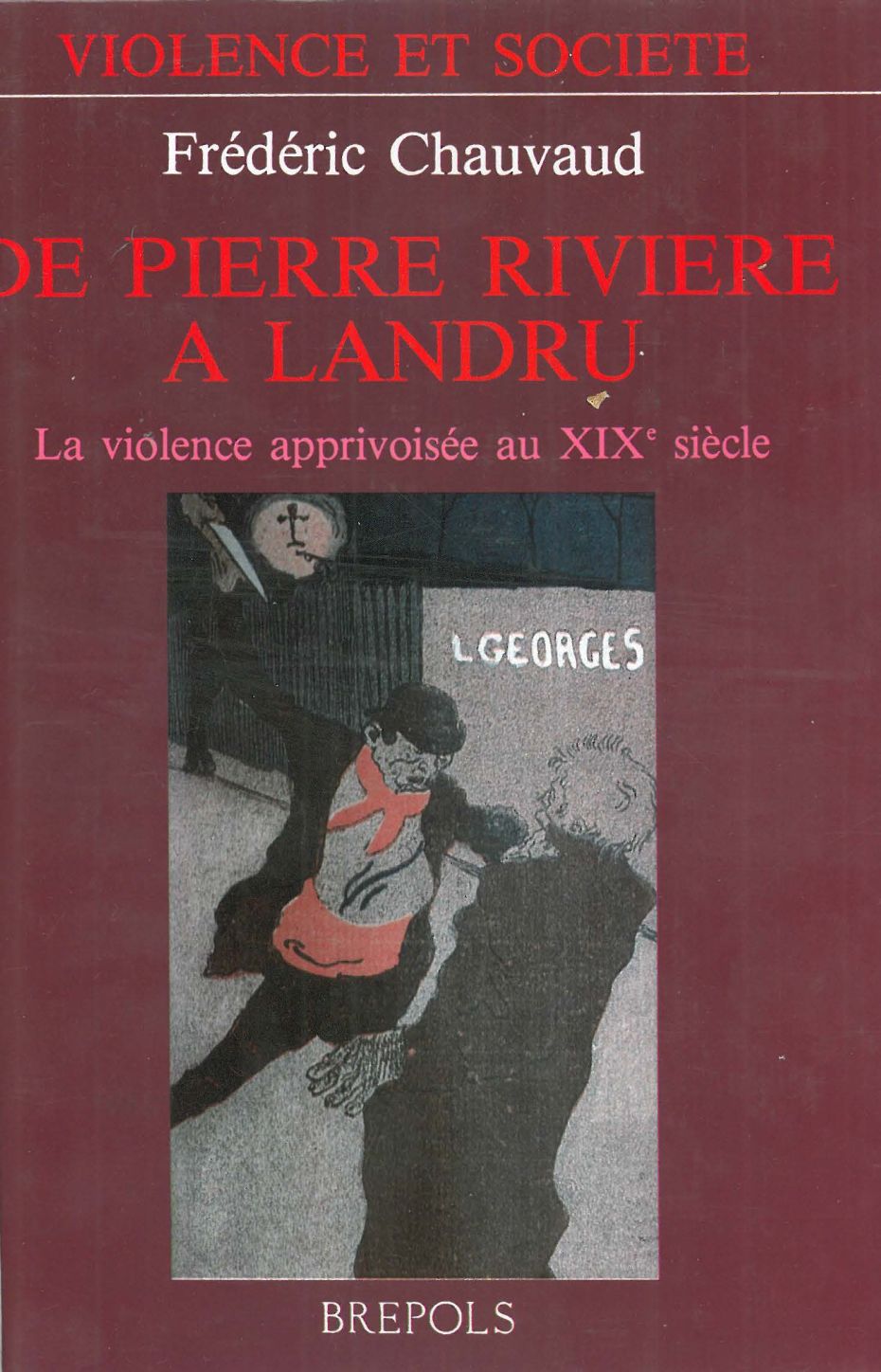
De Pierre Rivière à Landru
show More to view fulltext, buy and share links for:De Pierre Rivière à Landru show Less to hide fulltext, buy and share links for: De Pierre Rivière à LandruA l'époque de la Premiére Guerre, les crimes de Landru, les grèves ouvrières, les mauvais traitements infligés aux animaux apparaissent comme les ultimes manifestations de la force brutale.
Et pourtant, au début de la Restauration les coups sont fréquents et le sang coule d'abondance. Pierre Riviére égorga sa famille, les maisonnées et le voisinage connaissent de funestes démêlés, les pugilats au village comme les rixes en rase campagne foisonnent, les émeutes et la répression rythment le siécle. Comment est-on passé d'une époque où la brutalité était familière à une autre qui a rejeté toutes les formes de violence?
L'ouvrage retrace cette grande métamorphose à travers les pratiques, les discours et les perceptions.
-