


Brepols Online Books Other Monographs Archive v2016 - bobar16moot

Collection Contents
7 results
-
-
Ephrem, a 'Jewish' Sage
show More to view fulltext, buy and share links for:Ephrem, a 'Jewish' Sage show Less to hide fulltext, buy and share links for: Ephrem, a 'Jewish' SageThis book seeks to reconsider the commonly held view that some of Ephrem’s writings are anti-Semitic, and that his relationship with Judaism is polemical and controversial. The outcome of the research highlights several key issues. First, it indicates that the whole emphasis of Ephrem’s critical remarks about Jews and Judaism is directed towards Christian conduct, and not towards Jews; and second, it considers Ephrem’s negative remarks towards Jews strictly within the context of his awareness of the need for a more clearly defined identity for the Syriac Church.
Furthermore, this book examines discernible parallels between Ephrem’s commentaries on Scripture and Jewish sources. Such an exercise contributes to a general portrait of Ephrem within the context of his Semitic background. And in addition, the book offers an alternative reading of Ephrem’s exegetical writings, suggesting that Ephrem was aiming to include Jews together with Christians among his target audience. Further analysis of Ephrem’s biblical commentaries suggests that his exegetical style resembles in many respects approaches to Scripture familiar to us from the writings of Jewish scholars.
A comparison of Ephrem’s writings with Jewish sources represents a legitimate exercise, considering ideas that Ephrem emphasises, exegetical techniques that he uses, and his great appreciation of ‘the People’ - the Jews as a chosen nation and the people of God - an appreciation which becomes apparent from Ephrem’s presentation of them. The process of reading Ephrem’s exegetical writings in parallel with Jewish sources strongly identifies him as an heir of Jewish exegetical tradition who is comfortably and thoroughly grounded in it. This reading identifies Ephrem on a theological, exegetical and methodological level as a Christian writer demonstrating the qualities and features of a Jewish sage.
The author, Elena Narinskaya, has been awarded a PhD at Durham University (Department of Theology and Religion) and is currently involved in Post-doctoral Studies offered by the Department of Theology and Religious Studies at the University of Wales, Lampeter. In her research she works with a variety of methodologies including historical and literary criticism, and philosophical techniques.
-
-
-
Emblematic Paintings from Sweden’s Age of Greatness
show More to view fulltext, buy and share links for:Emblematic Paintings from Sweden’s Age of Greatness show Less to hide fulltext, buy and share links for: Emblematic Paintings from Sweden’s Age of GreatnessEmblematic Paintings of the Swedish Baroque is the first full-length study of the cycle of emblematic canvases hanging in the corridors at Skokloster Castle outside Stockholm. These imposing paintings were commissioned by a wealthy nobleman and cultural patron from Sweden's Age of Greatness and were inspired by images from one of the most important emblem books of the seventeenth century, Otto Vænius's Emblemata Horatiana. The principal importance of the Skokloster paintings lies in the fact that they appear to be a unique instance of paintings wholly adapted from images in a printed emblem book, a phenomenon never previously recorded in emblem studies. As such, they prompt questions about the place of the emblem within the fine and applied arts, generic issues explored in some detail in the introductory essay. The study presents a detailed reconstruction of the paintings' place within a lost decorative milieu at the Uppland castle of Salsta, and offers interpretations of the role emblems played within its wider conceptive framework. The appeal of Vænius to the commissioning patron is also examined, and through this, a broader consideration of the reception of literary emblematics in seventeenth-century Sweden. This marks a significant attempt at opening up the rich subject of the emblem in Sweden, a national tradition hitherto largely neglected and little understood within emblem studies.
Emblematic Paintings of the Swedish Baroque is the result of extensive field and archival research in major public and private collections in Sweden, and documents a historically significant group of artworks little known outside Scandinavia. The introductory essay presents the necessary groundwork of the pictures' date, provenance, and probable circumstances of commission, as well as an extended reconstruction of the original context in which they were first displayed. Establishing that they were originally owned by Count Nils Bielke, the study examines the intellectual preoccupations of a Swedish nobleman, and the reasons he found the Neo-Stoic ideas promoted in Vænius's emblems conducive to his interests and tastes. The study situates the Skokloster paintings within the intellectual framework of Great Power Sweden, conceiving of the pictures as attempts at private self-representation, but concomitantly aesthetic expressions of the nationalist-mytholopoeic movement promoted by the scholars Olof Rudbeck, Johan Peringskiöld, and Urban Hjärne.
This volume presents the paintings as an emblem text, reassembling the paintings in the order in which they occur in Vænius, and providing each with a commentary on iconography, sources, and analogues. Each plate is accompanied by a moralizing gloss by the seventeenth-century French author and editor of Vænius, Marin Le Roy, Sieur de Gomberville in the translation of Thomas Mannington Gibbs.
-
-
-
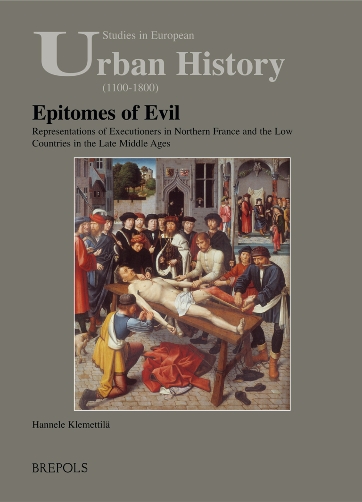
Epitomes of Evil
show More to view fulltext, buy and share links for:Epitomes of Evil show Less to hide fulltext, buy and share links for: Epitomes of EvilHangmen were familiar characters from urban reality to people living in France and the Burgundian Netherlands in the late Middle Ages. These officers played an essential role in the new penal system. However, general attitudes towards public executioners were highly ambiguous, often hostile and disparaging. In past imagery, various hangman figures, real or fictitious, were closely linked to ideas of otherness, cruelty, sin and evil. They were identified with criminals, marginal people and demons. In the period of the late Middle Ages, the hangman's representations were actively exploited, shaped and modified for various reasons by different social and cultural groups in different products of culture, religious as well as secular.
This study casts light on ways of perceiving the executioner in French and Burgundian culture and society from the fourteenth to the early sixteenth century. The primary sources used in this work consist of wide and varied printed and non-printed textual materials such as chronicles, writings by legal experts and theologians, drama and poetry. Significant role is also given to the testimony offered by pictorial art, both sacred and profane, especially miniatures and panel paintings.
-
-
-
Europe. Comédie héroique attribuée à Richelieu
show More to view fulltext, buy and share links for:Europe. Comédie héroique attribuée à Richelieu show Less to hide fulltext, buy and share links for: Europe. Comédie héroique attribuée à RichelieuRichelieu, cardinal ministre, considérait la nécessité de l’intervention de l’État dans tous les domaines de la vie du royaume - guerre, finances, commerce, organisation du territoire, diplomatie, religion et culture. La France de Richelieu est engagée dans la Guerre de Trente ans qui, caractérisée par une double dimension nationale et religieuse, implique toutes les puissances européennes et ravage les territoires. Richelieu conçoit sa mission d’homme d’État comme devant apporter la paix à l’intérieur et à l’extérieur du royaume et conforter les positions de la France face à l’impérialisme espagnol. Plus que quiconque conscient de l’apparition d’une opinion publique dont il fallait convaincre les différents cercles (la cour, Paris, le royaume) de la légitimité de ses actions et de ses choix, notamment sur la scène extérieure, il mit sa plume au service de ses desseins politiques. On connaît le Richelieu mémorialiste, épistolier, théoricien politique, orateur, on le connaît fondateur de l’Académie française et créateur de la Gazette ; on sait qu’il a encouragé et soutenu le théâtre, qui s’enrichit de très nombreuses formes dans cette première moitié du dix-septième siècle. Richelieu conçut des pièces et les fit écrire, de même que Rubens concevait les toiles dont il confiait ensuite la réalisation à son atelier. Tel est le cas de Europe, dont nous donnons la première publication française depuis 1642, qui peut être ainsi attribuée à la fois à Desmarets de Saint-Sorlin et au Cardinal. Rédigée dans les bouleversements de l’actualité politique dont elle restitue les grandes tensions, cette comédie héroïque en alexandrins qui donne à des thèmes d’abord précieux une coloration tragique met en scène, à travers les péripéties sinueuses de l’ambition du roi d’Espagne, Ibère, le difficile accouchement d’une concorde des nations européennes, sous l’égide d’un héros pacificateur et vertueux, Francion, enfin libérées de leur passion amoureuse mimétique et délétère pour la belle Europe, voire pour l’ensemble du monde - c’est-à-dire libérées de leur impérialisme.
-
-
-
The Emblem Tradition and the Low Countries
show More to view fulltext, buy and share links for:The Emblem Tradition and the Low Countries show Less to hide fulltext, buy and share links for: The Emblem Tradition and the Low CountriesAntwerp and Amsterdam were among the most active publishing centres for emblematic forms in Europe during the sixteenth and seventeenth centuries. Nowhere else was the emblematic mode more integrated into the literary and artistic culture than in the Low Countries. The essays are revised versions of papers presented at the Fourth International Emblem Conference held at Leuven in 1996. The table of contents provides an overview of the variety of topics and approaches represented in the volume.
-
-
-
The Emblem and Architecture: Studies in Applied Emblematics from the Sixteenth to the Eighteenth Centuries
show More to view fulltext, buy and share links for:The Emblem and Architecture: Studies in Applied Emblematics from the Sixteenth to the Eighteenth Centuries show Less to hide fulltext, buy and share links for: The Emblem and Architecture: Studies in Applied Emblematics from the Sixteenth to the Eighteenth CenturiesThis publication is a collection of essays on the function and significance of emblematic decoration of buildings in Europe from the sixteenth to the eighteenth century, dealing with general issues involved in architectural emblematics, while a number of the essays are case studies of specific types of building.
The emblematic decoration of buildings, both secular and ecclesiastical, was widespread in Europe from the sixteenth to the nineteenth centuries. The function and significance of such decoration is, however, frequently overlooked. The two introductory essays seek to come to grips with the general issues involved in architectural emblematics. The remaining essays are case studies of specific types of building while the final two consider the relation of architecture to the book. The essays are revised versions of selected papers presented at an international conference on the subject held at the Canadian centre for Architecture in November 1994.
-
-
-
Entre Meuse, Rhin et Moselle
show More to view fulltext, buy and share links for:Entre Meuse, Rhin et Moselle show Less to hide fulltext, buy and share links for: Entre Meuse, Rhin et MoselleDie 1792 und 1794 besetzten und am 1. Oktober 1795 (9 Vendémiaire, Jahr IV) unter der Bezeichnung "Belgien und Lütticher Land" teilweise von der Französischen Republik annektierten Gebiete gehören heute größtenteils zum Königreich Belgien, zum Großherzogtum Luxemburg und, in geringerem Maße, zum Königreich der Niederlande sowie zu den deutschen Bundesländern Nordrhein-Westfalen und Rheinland-Pfalz. In diesen Ländern krankte die Geschichtsschreibung der französischen Zeit bis gegen 1960 im allgemeinen an einer flagranten Einseitigkeit, die durch vorgefasste Meinungen, voreilige Schlüsse und Klischees gekennzeichnet war. Die Religionsgeschichte war schon immer bevorzugtes Feld für Autoren die, nach dem Urteil von Gilbert Trausch, nie zum Kern der revolutionären Mentalität vorgedrungen sind und den Schwierigkeitsgrad der Probleme, mit denen die Französische Republik konfrontiert wurde, nie verstanden haben. Und die nie daran gedacht haben, dazwischen der Verkündigung eines Gesetzes in Paris und seiner Anwendung vor Ort manchmal eine enorme Lücke klaffen konnte. Vor Ort: das ist im vorliegenden Band der Reihe "Hommes de Dieu et Révolution" das Gebiet zwischen Maas, Rhein und Mosel, Grenz- und Begegnungsland an der nord-östlichen Grenze der Republik. Seine uneinheitliche Humangeographie (politischen Zersplitterung, Koexistenz der romanischen und germanischen Kultur, Vielsprachigkeit) verleiht diesem Raum eine Originalität, die auch den in komplexen Strukturen eingeschlossenen Klerus prägt. Die "Franzosenzeit" hat diese Originalität noch verstärkt, da hier, im Gegensatz zu Frankreich, die religiöse Krise und Verfolgung in der Zeit des Direktoriums ihren Hohepunkt erreichte. Diese beiden Elemente weisen der Verwaltungsgeschichte eine zentrale Stellung inmitten der politisch-religiösen Konflikte zu. Sicher hat der Priester, das Pfarroberhaupt, die Hauptrolle gespielt, aber er war den gegensätzlichen Einflüssen der Departements- und Munizipale
-