Brepols Online Books Other Monographs Archive v2016 - bobar16moot

Collection Contents
6 results
-
-
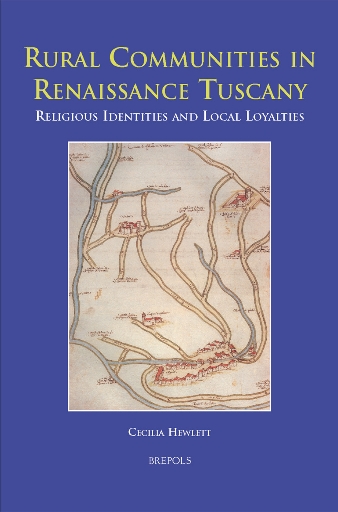
Rural Communities in Renaissance Tuscany
show More to view fulltext, buy and share links for:Rural Communities in Renaissance Tuscany show Less to hide fulltext, buy and share links for: Rural Communities in Renaissance TuscanyAt the conclusion of the fifteenth century and well into the first half of the sixteenth, Florence underwent radical political and social transformations. The republic, which had nurtured the cultural phenomenon of the Renaissance, was finally overthrown and the Medici returned triumphant as outright rulers of the once-free commune. Throughout this period, the administration of the Florentine territory continued to be one of the single most important issues faced by successive Florentine governments, and yet very little is known about the people they governed. This study explores the nature of these communities and the relationships they forged with the central authorities; it provides an overview of the extraordinary diversity of rural communes, and looks in detail at three areas of the Florentine territory. The communes of Gangalandi, Scarperia, and the communities located in the Pistoian mountains provide the vivid contexts in which the fluid natures of local religious, social, and political ties are examined. The character of each of these rural communities was unique, challenging not only the Florentine government’s mechanisms of control, but our own understanding of the ‘peasant’ as a social category. Hewlett demonstrates that these communes were not one-dimentional social organizations, but rather vibrant communities of individuals who pursued a vast range of different activities within a series of complex cultural networks. Rural Communities in Renaissance Tuscany also addresses the importance of religion to these communities; an exciting addition to a field that has been until now dominated by the study of urban religious practice.
-
-
-
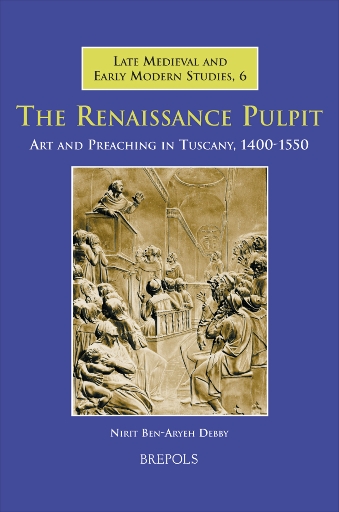
The Renaissance Pulpit
show More to view fulltext, buy and share links for:The Renaissance Pulpit show Less to hide fulltext, buy and share links for: The Renaissance PulpitThis volume examines the relationship between preaching and art, addressing with particular detail the use of works of art in preaching and the importance of the pulpit itself. A challenging issue in the field of sermon studies is the relationship between preaching and art, in particular the manner in which preachers used works of art in their preaching and described specific pictures in their sermons; and the pulpit itself.
The thesis of the book is that pulpits should be viewed in the context of the world of preaching in Renaissance Florence and in connection with sacred oratory. Indeed, like preached sermons, pulpits used rhetorical strategies to deliver religious messages. The author adopts an interdisciplinary approach to the topic by combining art history, historical analysis, and sermon studies; and she examines the pulpit's patronage, location, and function as well as its chronological development. This book combines a general survey of pulpits in Tuscany, with close analysis of five specific pulpits. Designed and executed by important artists located in Florence and Prato, these five pulpits are the most exquisite and impressive monuments of their type, and each has a complex and rich iconographic programme. The author reveals that the period between the fifteenth and early sixteenth centuries constitutes a distinct phase in the development of pulpits, different from the earlier tradition, and from pulpits constructed after the Council of Trent and during the Catholic Reformation.
-
-
-
Rhétorique, poétique, spiritualité: La technique épique de Corippe dans la "Johannide"
show More to view fulltext, buy and share links for:Rhétorique, poétique, spiritualité: La technique épique de Corippe dans la "Johannide" show Less to hide fulltext, buy and share links for: Rhétorique, poétique, spiritualité: La technique épique de Corippe dans la "Johannide"In the Iohannis the African poet Corippus, circa A.D. 550, celebrates the recent triumph of John Troglita, a Byzantine general, over insurgent Moors : an event which he regards as a victory of the Roman world over barbarians and of Christians over pagans. This study demonstrates that the poem belongs simultaneously to the panegyrical and epic genres. Then follows a survey of the neo-classical principles governing such a composition and an analysis of the epic style of Corippus (narrative, descriptions, catalogues, speeches, narrator’s intrusion), of the world view and of the spirituality pervading the poem. Corippus was aware that he might produce merely an impoverished classical epic : this is why he made of the Iohannis an original Christian epic.
-
-
-
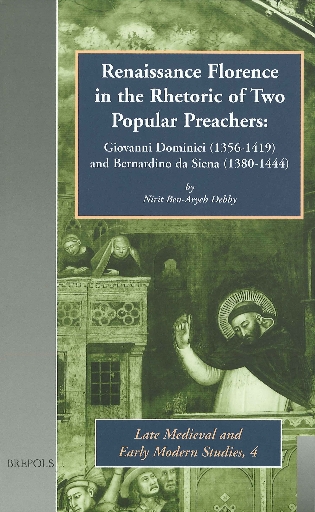
Renaissance Florence in the Rhetoric of Two Popular Preachers
show More to view fulltext, buy and share links for:Renaissance Florence in the Rhetoric of Two Popular Preachers show Less to hide fulltext, buy and share links for: Renaissance Florence in the Rhetoric of Two Popular PreachersThe preaching of the Dominican friar Girolamo Savonarola and the period of his dominance (1494-1498) are a well-known chapter in the history of Renaissance Florence. Comparatively less research has been done on Savonarola's predecessors, the Dominican Giovanni Dominici and the Franciscan Bernardino da Siena whose sermons, as they appear in Tuscan reports (reportationes) by anonymous listeners of their preaching, are an invaluable source for the period. The reportationes are unique in that they transmit in full the actual preaching event and are not merely a doctrinal summary composed by the preacher. Many of these sermons are still in manuscript form, especially those of Dominici, whose sermons have never before been studied in detail and remain unpublished till now.
Dominici and Bernardino were active in Florence at a time when broad legal, social and cultural changes were taking place. This study examines the preachers' response to these changes, the alternatives they offered and their attempts to direct the life of the laity. The author focuses on their opinions on secular and ecclesiastical politics, education and humanism, morality and the family, and the economy and usury (including the role of the Jews). These preachers had widespread impact on the spiritual and daily lives of their listeners, particularly women, on political developments and on legislation against fringe groups such as Jews, homosexuals and prostitutes.
The study includes an edition of ten sermons by Dominici from MS Ricc. 1301 wich were delivered in Santa Maria Novella between 1400 and 1406.
-
-
-
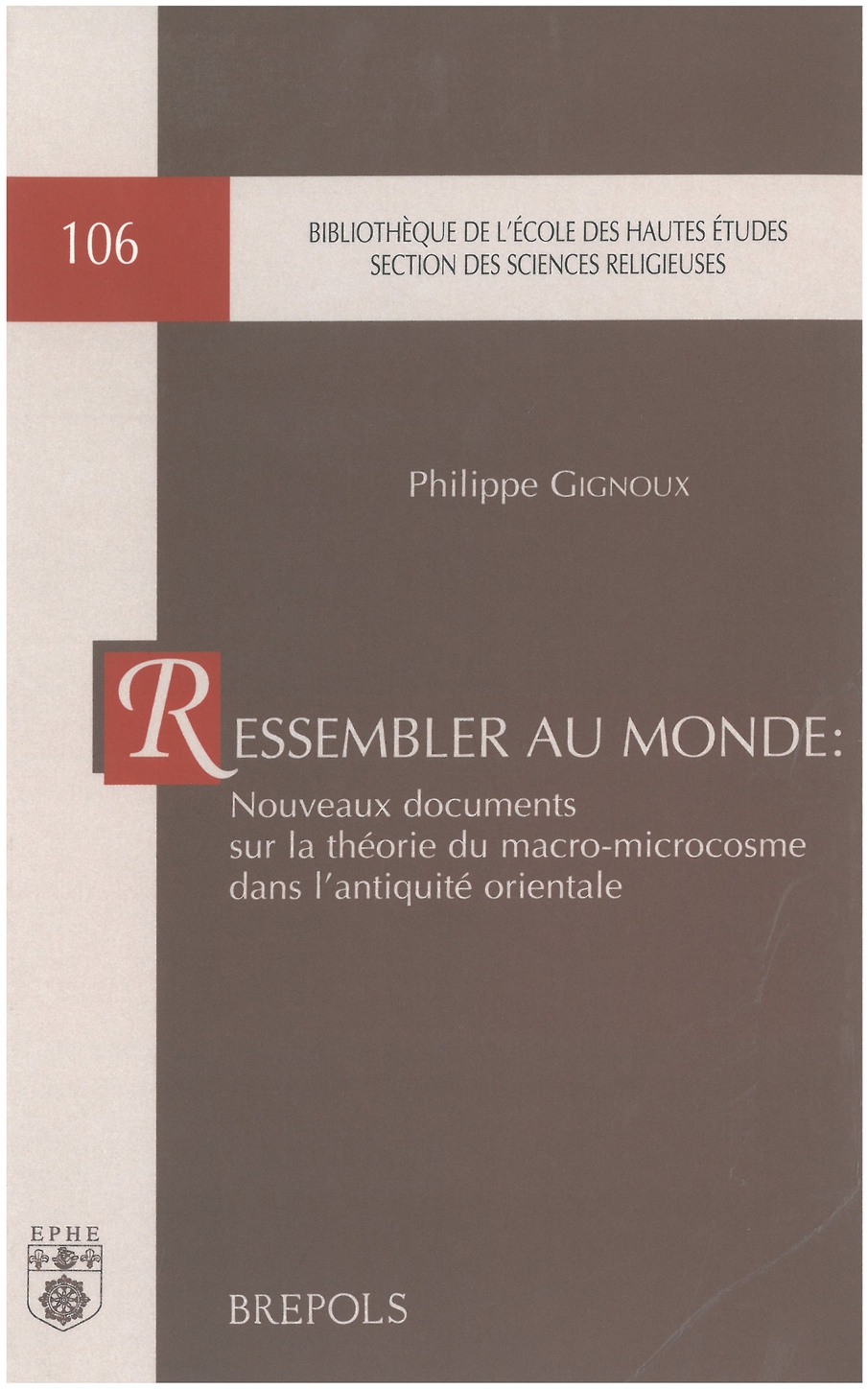
Ressembler au monde
show More to view fulltext, buy and share links for:Ressembler au monde show Less to hide fulltext, buy and share links for: Ressembler au mondeLa théorie du micro-macrocosme qui établit des similitudes de toutes sortes entre les éléments du monde et ceux qui composent l'homme, a constitué dans les civilisations orientales l'une des grandes représentations de l'être humain face au cosmos.Elle a perduré dans toutes les écoles de pensée de l'Antiqué au Moyen Age. L'étude de ce thème dans différentes cultures religieuses de la Méditerranée Orientale à l'Inde peut permettre une approche comparative à partir du présent volume. Aux innombrables homologies que les brahmanes se sont appliqués à construire, répondent les spéculations que les Odes de Salomon, les psaumes manichéens ou les nouveaux documents sur le marcionisme fournissentsur ce même thème, aussi bien qu'un poème syriaque jusqu'ici inédit d'un auteur du 13ème siècle, G. Wardâ. Sans doute la Chine ou le Tibet, comme la Grèce ou la culture arabe, pourraient nous apporter bien d'autres éléments de comparaison, mais un seul volume ne pouvait contenir un ensemble de représentations religieuses aussi riche de sens.
-