Brepols Online Books Other Monographs Archive v2016 - bobar16moot

Collection Contents
9 results
-
-
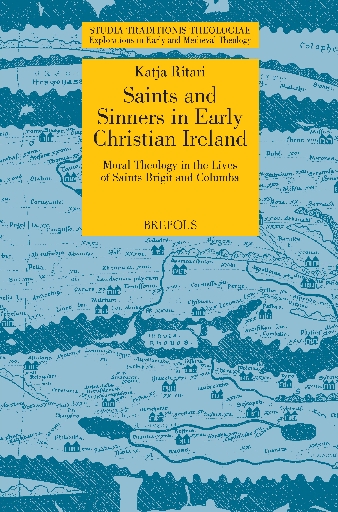
Saints and Sinners in Early Christian Ireland: Moral Theology in the Lives of Saints Brigit and Columba
show More to view fulltext, buy and share links for:Saints and Sinners in Early Christian Ireland: Moral Theology in the Lives of Saints Brigit and Columba show Less to hide fulltext, buy and share links for: Saints and Sinners in Early Christian Ireland: Moral Theology in the Lives of Saints Brigit and ColumbaIn this volume Katja Ritari shows how a theological reading of hagiography works towards gaining a fuller understanding of the complexity of issues that can be addressed in a hagiographical narrative and of the aims of the medieval authors. The three texts examined in this study belong to the earliest stratum of hagiographical writing in Ireland and thus provide evidence of the formation of an Irish Christian society. This work presents a fresh look at the earliest Lives of saints Brigit and Columba concentrating on moral theology through the image of an ideal Christian and his or her antithesis. In hagiography, the saint is presented as the paragon of perfect Christian behaviour, but the moral message concerning ideal Christian living can also be conveyed through the minor characters which populate the Lives as companions of the saint, and as witnesses and receivers of the effects of his or her miracles. This study is groundbreaking because it turns attention towards the portrayal of these characters, especially towards the lay people whose role in hagiography has thus far been neglected in scholarly studies. The topic of this study - a good Christian life - is a fundamental spiritual and theological question that has relevance to all Christians. It is a central question to the formation of a Christian identity and its soteriological significance makes it a focal theological issue.
Katja Ritari is a postdoctoral researcher at the department of World Cultures, Study of Religions, University of Helsinki. She holds a PhD from University College Cork, Ireland.
-
-
-
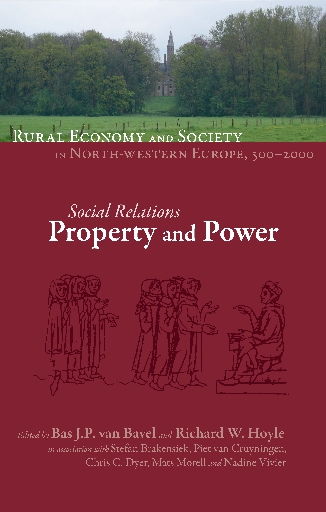
Social Relations: Property and Power
show More to view fulltext, buy and share links for:Social Relations: Property and Power show Less to hide fulltext, buy and share links for: Social Relations: Property and PowerThe organization of society formed a crucial element in the remarkable development of the countryside in the North Sea area in the last 1500 years. Vital questions are: who owned the land? Who gained the profits from its exploitation? How was the use of rural resources controlled and changed? These questions have no simple answers, because the land has been subjected to competing claims, varying from region to region. In early times peasants mostly possessed and worked their holdings, but lords took much of the produce, and had the ultimate control over the land. In more recent times the occupiers and cultivators gained stronger rights over their farms. Neither lords nor peasants were free agents because communities governed the use of common lands. In the highly urbanized North Sea region towns and townspeople had considerable and increasing influence over the countryside. Change came from within society, for example from the tension and negotiation between lords and peasants, and the growing importance of the state and its policies. This volume also looks at the interaction between society and external changes, such as the rise and fall of the market, trends in population, and European integration.
Bas J.P. van Bavel is professor of Economic and Social History of the Middle Ages at Utrecht University, the Netherlands
Richard W. Hoyle is professor of Rural History at the University of Reading, United Kingdom
-
-
-
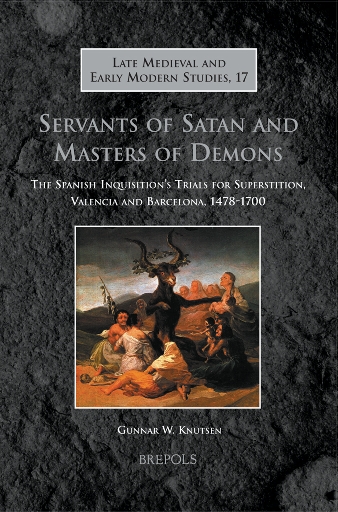
Servants of Satan and Masters of Demons
show More to view fulltext, buy and share links for:Servants of Satan and Masters of Demons show Less to hide fulltext, buy and share links for: Servants of Satan and Masters of DemonsThis book offers a systematic study of the trials for superstition in the Spanish Inquisition’s two tribunals in Valencia and Barcelona in the period 1478-1700. One of the most intriguing contrasts between the trials in northern and southern Spain is that while both areas saw a large number of trials for superstition, Valencia did not conduct trials for demonological witchcraft. Catalonia, on the other hand, saw a large number of such trials, the majority of which occurred in secular courts.
These contrasts bring into focus significant differences in culture and mythology. The Barcelona Inquisition was unable to enforce its jurisdiction over trials for diabolical witchcraft, while the Valencian Inquisition was able to do just that because Valencians rejected the demonological concept of witchcraft. This was due mainly to the Valencians’ own magical culture which emphasized man’s ability to control and force demons, but also to the fact that Moriscos formed the majority of the rural population, which was the primary focus of witchcraft trials in Europe. By comparing the Catalan and Valencian tribunals, the book thus seeks to explain the absence in the southern half of Spain of brujas, witches who gave their souls to the devil, flew through the night, took part in wild orgies at the witches’ sabbat, and caused death and destruction through magical means.
-
-
-
Supplicare deis
show More to view fulltext, buy and share links for:Supplicare deis show Less to hide fulltext, buy and share links for: Supplicare deisAmongst the rites for procurating prodigies, those ominous signs of divine anger, the supplication holds a special place.
A lavish ceremony in which not only the priests but the whole Roman people took part, it gathered men, women, and children who were due to visit all the sanctuaries of the City in order to address their prayer to the gods, according to a religious rhetoric where verbal request and body language were associated. Through the supplicatio, ‘self-abasement’ rather than a properly ‘kneeling’ rite which a much debated etymology suggests, Roman people intended to placate deities of whom they acknowledged in the same way as the undeniable superiority.
The purpose of the present work is to define this rite, regarding the people, the places and the various elements it involved. At the same time, the point is also to clarify the controversial origins of a ceremonial traditionally related to the ritus Graecus. Quite similar to the supplication ‘between human people’ with which it shares most of its ritual elements, the religious supplication seems to have been influenced by the ritus Graecus and the practices which come under it, without asserting, though, a Greek origin. Complexity and contradictions characterise, as well, the supplication which, without breaking thoroughly with the austerity of ancestral rites, still belongs to the typically Roman procuration. Officially attested since the fifth century B. C., this rite disappeared in the last century of the Roman Republic, just as the notion of prodigy changed, under the influence of a new way of thinking.
Caroline Février is maître de conférences in Latin language at the University of Caen. Her research work focuses mainly on Roman religion. Her doctoral thesis and several of her articles are devoted to the expiation of prodigies.
-
-
-
Science et théologie dans les débats savants de la seconde moitié du XVIIe siècle
show More to view fulltext, buy and share links for:Science et théologie dans les débats savants de la seconde moitié du XVIIe siècle show Less to hide fulltext, buy and share links for: Science et théologie dans les débats savants de la seconde moitié du XVIIe siècleThe second half of the 17th century witnessed a veritable revolution in communication in the Republic of Letters, with the appearance of the first scientific periodicals, the earliest and most important of which were established in 1665: the Journal des Savants and the Philosophical Transactions. Making use of the book reviews published in these two great scholarly journals, sources still largely underexploited, this book studies the relations between science and theology, and more precisely the narrative of Genesis, in the period leading up to the Enlightenment. Juxtaposition of the two journals, connected respectively to the French Académie royale des sciences and the Royal Society, permits a comparison between France, a Roman Catholic country, and England, a Protestant one, which changes the face of conventional wisdom. The pages devoted to the first decades of the Philosophical Transactions provide an original and welcome study which fills a gap on the subject. The problems raised by the exegesis of certain verses of Genesis evoke a broad range of theological, philosophical, scientific and sometimes even properly political questions. In book reviews, the confrontation between scientific theories and the narrative of Genesis most often discloses little-known works and takes us off the beaten track. Indeed, what posterity has retained as essential has not always received a wide circulation among contemporaries, whereas forgotten authors once found in their own time a large audience through the intermediary of scholarly periodicals. After a systematic inspection, the author has compiled a database on the scientific and theological content of the two scholarly journals. This has been conveniently placed at the reader’s disposal in the form of a CD-ROM attached to the volume.
-
-
-

Sixteenth-century Antwerp and its Rural Surroundings
show More to view fulltext, buy and share links for:Sixteenth-century Antwerp and its Rural Surroundings show Less to hide fulltext, buy and share links for: Sixteenth-century Antwerp and its Rural SurroundingsThis study of sixteenth-century Antwerp and its surroundings is an attempt to combine commercial explanation models concerning the impact of great towns on their surrounding countryside with an approach in which institutional factors, and especially property relations, play the major role. It focuses on four types of influence of Antwerp on its surroundings:
- the demographic impact
- the increasing urban demand for agrarian products
-the impact of the urban economy on non-agrarian types of labour in the countryside and
- the purchases of land and other investments made by Antwerp citizens and their impact on the property relations in the surrounding countryside
Within the framework of these four fields of interaction between town and countryside, three essential questions have to be answered: First, how can we characterize the urban influence in each of these fields? Can it be considered a stimulus for the rural economy or rather an obstacle? Second, what was the economic response of the rural economy to the urban impact? Did it respond by specializing, according to the model presented by J. de Vries, and others, or were there obstacles that obstructed specialization? Third, what role did the medieval legacies play in the interaction between the ‘capitalist’ metropolis and the 'feudal' countryside?
Michael Limberger teaches at the Catholic University Brussels (KUB) and at Ghent University. His research covers late medieval and early modern economic and social history, especially of the Low Countries.
-
-
-
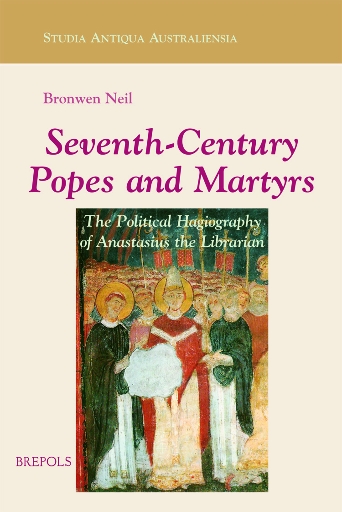
Seventh-Century Popes and Martyrs: The Political Hagiography of Anastasius Bibliothecarius
show More to view fulltext, buy and share links for:Seventh-Century Popes and Martyrs: The Political Hagiography of Anastasius Bibliothecarius show Less to hide fulltext, buy and share links for: Seventh-Century Popes and Martyrs: The Political Hagiography of Anastasius BibliothecariusThis collection of Latin texts, published in a new edition with an English translation, draws on the rich hagiographical corpus of Anastasius, papal diplomat, secretary and translator in late ninth-century Rome. The texts concern two controversial figures: Pope Martin I (649-653), whose opposition to the imperially-sponsored doctrines of monoenergism and monothelitism saw him exiled to Cherson where he died in 655, and Maximus the Confessor, an Eastern monk condemned to suffer amputation and exile to Lazica for similar reasons in 662. The author seeks to place these works in their political context, namely the growing hostility between the eastern and western churches in the late ninth century, and to assess Anastasius's contribution to the deteriorating relations between the two through his translations of hagiography.
Dr Bronwen Neil is Burke lecturer in Ecclesiastical Latin at the Centre for Early Christian Studies, Australian Catholic University, Brisbane.
This is the 2nd volume in the series Studia Antiqua Australiensia, produced within the Ancient HistoryDocumentation Research Centre, Macquarie University.
-
-
-
Salomon et Saturne
show More to view fulltext, buy and share links for:Salomon et Saturne show Less to hide fulltext, buy and share links for: Salomon et SaturneLes dialogues de Salomon et Saturne emmènent le lecteur dans un monde religieux chrétien où se côtoient, s'entrecroisent et s'amalgament des idées, des croyances parfaitement orthodoxes, canoniques, et d'autres apocryphes et légendaires, qui se sont tissés autour des premiers. Ensuite, ces textes sont le fruit de ce que l'on pourrait appeler "le mode de pensée apocryphe", qui n'est pas le propre des premiers siècles seulement, et qui n'a jamais cessé de fonctionner.
Ainsi, les moines des monastères irlandais et anglais du haut moyen âge, du VIIe au XIe siècle, nourris autant par la Bible, les Pères de l'Église, les grands théologiens de l'époque, que par les apocryphes, même les plus fantastiques, ont continué à créer des mondes foisonnant de "fables apocryphes". Ici, ils leur ont donné comme cadre des dialogues entre le roi sage Salomon et le mystérieux Saturne.
Par ces deux dialogues en prose et ses deux poèmes, le lecteur est invité à goûter la saveur d'un ancien monde où les thèmes du christianisme s'expriment sur l'arrière fond culturel germanique.
Robert Faerber a enseigné, à la Faculté des Lettres et Sciences humaines de Strasbourg, la linguistique historique et la poésie médiévale anglaises. Il a déjà fait connaître des thèmes et des textes apocryphes en vieil-anglais, notamment l'Apocalypse de Thomas.
-