


Brepols Online Books Other Monographs Archive v2016 - bobar16moot

Collection Contents
2 results
-
-
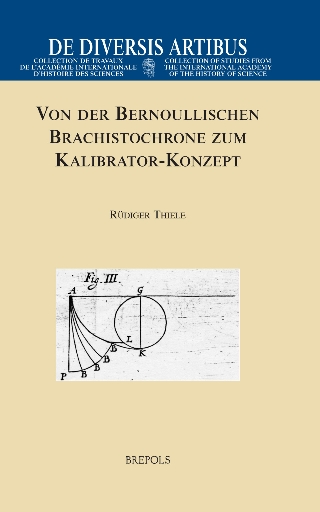
Von der Bernoullischen Brachistochrone zum Kalibrator-Konzept
show More to view fulltext, buy and share links for:Von der Bernoullischen Brachistochrone zum Kalibrator-Konzept show Less to hide fulltext, buy and share links for: Von der Bernoullischen Brachistochrone zum Kalibrator-KonzeptDie Aufgabe der klassischen Variationsrechnung besteht darin, Kurven oder Funktionen zu bestimmen, denen im Vergleich mit anderen eine bestimmte Eigenschaft im größten oder kleinsten Maße zukommt. Die Art des Vergleichens bestimmt dabei den Charakter des Extremums. In dieser Studie wird die Frage untersucht, wie für starke Extrema (in der Norm des C 0) hinreichende Kriterien (sogenannten Feldtheorie) entstanden, entwickelt und eingesetzt worden sind. Diese Untersuchungen sind mit Namen wie Joh. Bernoulli, Jacobi, Weierstraß, Schwarz, Darboux, Hilbert, Kneser, Carathéodory, Lepage und anderen verbunden. Der Zeitraum reicht von Brachistochronenproblem 1696 bis in die Mitte des vorigen Jahrhunderts, betrachtet werden sowohl einfache als auch mehrdimensionale Variationsprobleme mit mehreren gesuchten Funktionen. Neben den entsprechenden gedruckten Arbeiten sind in die Untersuchungen in einem Maße, wie es in der Geschichte der Variationsrechnung bisher noch nicht erfolgt ist, ungedruckte Quellen wie einschlägige Briefe, Notizbücher, Vorlesungskonzepte, -mitschriften und -ausarbeitungen einbezogen worden, wodurch selbst in manchen Fragen auf die allgemeine Entwicklung der Variationsrechnung neues Licht geworfen wird.
-
-
-
Vivarium. I libri, il destino
show More to view fulltext, buy and share links for:Vivarium. I libri, il destino show Less to hide fulltext, buy and share links for: Vivarium. I libri, il destinoIn its understated way, this work establishes several theses each one of which, taken separately, could reasonably be considered sensational. First we have the discovery of the autograph of Cassiodorus. In shorthand, as one would expect from a busy man with a strong sense of time management, it testifies that Cassiodorus reviewed (Cassiodorus legi), or verified (perlegi Cassiodorus) a text. The signature occurs in codices that had already, through other considerations, been associated with Vivarium, and becomes in turn a strong criterion for the identification of works not previously associated with the Calabrian foundation. In some manuscripts a hand already known as 'manus prima', can now be identified with those of scribes active at Vivarium. These hands were not simply copying orthodox texts, but critically examining those written by authors of different persuasions: we know now that a codex well-known for its Arian scholia was studied and annotated at Vivarium. Cassiodorus and his team of writers/translators were squirreling away on texts by Church Fathers and heretics, analysing them, taking from them what could be suitable, reading everything. So, Vivarium was a militantly Chalcedonian monastery, but also one where the alternatives, dubbed by modern scholars 'Arian scholia' were duly studied and annotated. These essays by Fabio Troncarelli are an example of 'integral palaeography' in the sense of the definition, by now a classic, of Leonard E. Boyle (Medieval Latin Palaeography, Author's Preface, p. xv). Through the highly specialised technique of demanding discipline, the author succeeds in reconstructing the intellectual climate and the historical setting of Vivarium.
-