EMISCA

Collection Contents
9 results
-
-
England and the Continent in the Tenth Century
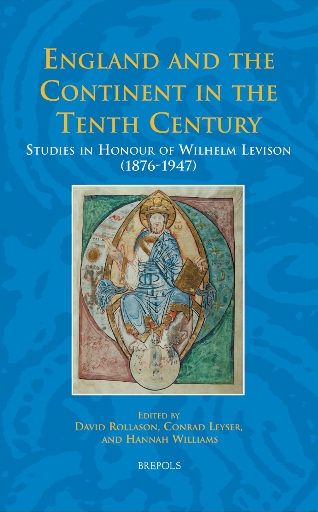
show More to view fulltext, buy and share links for:England and the Continent in the Tenth Century show Less to hide fulltext, buy and share links for: England and the Continent in the Tenth CenturyDedicated as a memorial to the great historian of England and the Continent in the eighth century, Wilhelm Levison, this book provides the widest and most in-depth exploration to date of relations between England and the Continent during an equally crucial period, the tenth century. The volume, which comes out of a sustained collaboration between English and Continental universities, contains thematically arranged essays by established leading specialists and also by younger scholars. By building on the approaches used by Levison as well as other methods that have been developed in the decades since his death, these essays tackle a broad range of questions: What routeways and modes of contact linked England with the Continent? How similar were attitudes to rulership and dynastic strategies? How did the law, the working of government, and the organization and culture of the church differ between England and the Continent? How was the past seen and represented on the two sides of the English Channel? In answering these questions, this volume offers news ways of exploring the links and developing the comparison between England and the Continent in the century after the collapse of the Carolingian Empire, a formative period for the development of Europe.
-
-
-
Études de langue et de littérature médiévales offertes à Peter T. Ricketts à l’occasion de son 70ème anniversaire
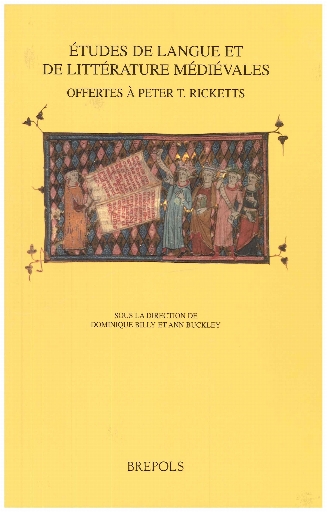
show More to view fulltext, buy and share links for:Études de langue et de littérature médiévales offertes à Peter T. Ricketts à l’occasion de son 70ème anniversaire show Less to hide fulltext, buy and share links for: Études de langue et de littérature médiévales offertes à Peter T. Ricketts à l’occasion de son 70ème anniversaire«Honorary Professor» de Français à l’Université de Birmingham, et Professeur Émérite à Queen Mary and Westfield, Université de Londres, Peter T. Ricketts a mené une carrière longue et remarquable dans le domaine de la Philologie Romane, et dans les études occitanes en particulier.
Outre son rôle majeur dans l’animation de l’Association Internationale d’Études Occitanes (AIEO), Peter T. Ricketts a consacré de nombreuses années aux études occitanes. Son œuvre est plus spécialement marquée par l’édition encore inachevée (avec Cyril P. Hershon) du Breviari d’Amor de Matfre Ermengaud, et l’élaboration de la Concordance de l’Occitan Médiéval (COM), vaste banque de données appelée à terme à couvrir l’ensemble des textes occitans du moyen âge et mettant à la disposition des chercheurs un outil de travail exhaustif et performant. La publication de la première tranche consacrée à la poésie des troubadours (Brepols 2001) a déjà recueilli un accueil très favorable de la critique et la seconde vient de paraître.
Le présent recueil de Mélanges réunit les travaux de 63 spécialistes de la littérature médiévale, dans des domaines aussi variés que l’histoire, la littérature, la linguistique, la philologie, la musicologie, la métrique ou la philosophie, explorant des matériaux et des sources de diverses provenances, en ancien français et en ancien occitan, mais aussi en latin médiéval, castillan, catalan, moyen-haut-allemand, hispano-arabe, hébreux.
L’ouvrage est divisé en deux sections principales, la première étant consacrée aux textes non lyriques: roman, épopée et littérature religieuse; la seconde à la poésie des troubadours, soit naturellement à leur production lyrique, à ses sources et son influence, aux vidas qui accompagnent leur transmission, aux troubadours eux-mêmes, mais aussi à leur production non lyrique tels que textes proverbiaux et ensenhamens. Ces Mélanges incluent également quelques éditions de textes, quelquefois inédits. Leur ensemble constitue un panorama très complet des recherches actuelles, avec des avancées substantielles dans le domaine des études médiévales.
-
-
-
Early Medieval Palimpsests
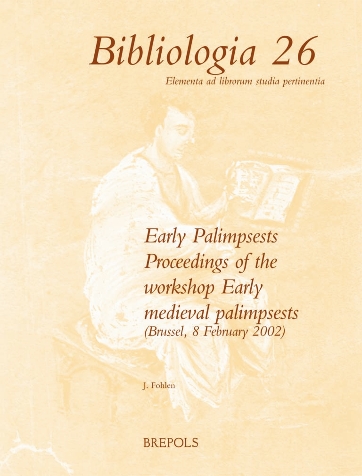
show More to view fulltext, buy and share links for:Early Medieval Palimpsests show Less to hide fulltext, buy and share links for: Early Medieval PalimpsestsPalimpsests are texts from which the primary text has been effaced to make room for fresh writing. The practice was particularly important in the early Middle Ages, when numerous, often precious, books were subjected to this treatment. As a result, many ancient texts lay hidden in European libraries for centuries.
Ever since the first palimpsests were discovered in the seventeenth century, scholars have been fascinated by the possibility of discovering hitherto unknown texts. For a long time, the lower script of palimpsests could only be brought back to the light of day through the use of chemical reagents that proved very detrimental to the manuscripts. The great advance away from these destructive techniques came at the beginning of the twentieth century with the application of ultra-violet photography. Today, striking advances in this field are again being made with the development of digital imaging.
The contributions in this volume focus mainly on the cultural evidence offered by palimpsests from the early Middle Ages. Some contributors have examined particular manuscripts in great detail (the London palimpsest of Jerome’s Chronicle or the Munich palimpsest codex from Benediktbeuern); others have looked at specific types of texts that have suffered deletion in this way (liturgical palimpsests, Carolingian letters). The volume also contains a handlist of all known palimpsested manuscripts in Beneventan script.
-
-
-

Entre la ville, la noblesse et l’Etat: Philippe de Clèves (1456-1528), homme politique et bibliophile
show More to view fulltext, buy and share links for:Entre la ville, la noblesse et l’Etat: Philippe de Clèves (1456-1528), homme politique et bibliophile show Less to hide fulltext, buy and share links for: Entre la ville, la noblesse et l’Etat: Philippe de Clèves (1456-1528), homme politique et bibliophilePhilippe de Clèves (1456-1528) est un homme remarquable à plus d’un titre. Fils d’Adolphe, seigneur de Ravenstein, et de Béatrice de Coïmbre, Philippe jouit, à l’instar de bon nombre d’aristocrates à l’automne du Moyen Âge, d’un luxueux train de vie. Partisan de Maximilien d’Autriche dans sa lutte contre les cités du comté de Flandre jusqu’en 1488, il choisit alors de défendre le particularisme urbain contre l’autorité bourguignonne. Vaincu en 1492, il se tourne vers la cour du roi de France Charles VIII. Il parcourt l’Europe, gouverne Gênes pour finalement revenir aux Pays-Bas et demeurera fidèle à Charles Quint jusqu’à sa mort.
Les différentes contributions de ce volume entendent apporter une réponse à la question-clé des intérêts de Philippe durant cette période troublée: dans quelle mesure privilégie-t-il la relation avec le prince et avec les autres aristocrates ou entend-il plutôt assurer ses intérêts dans la ville? À partir d’une documentation largement inédite, l’attention est ainsi portée sur le rôle culturel, politique, social et militaire qu’a joué Philippe de Clèves dans les conflits entre la Ville et l’État. En outre, Philippe lui-même a rédigé L’instruction de toutes manieres de guerroyer. S’il est auteur, il est aussi collectionneur: plusieurs articles mettent également l’accent sur l’analyse du contenu de sa bibliothèque et sur la comparaison avec les librairies d’autres nobles et de certains fonctionnaires d’État.
Ce volume constitue la publication des Actes d’un colloque interdisciplinaire organisé à la Bibliothèque royale de Belgique dans le cadre du «Pôle d’Attraction Interuniversitaire» (La société urbaine dans les anciens Pays-Bas, bas Moyen Âge-XVIe siècle, projet V, n° 10), programme de recherche financé par la Politique scientifique fédérale belge.
-
-
-
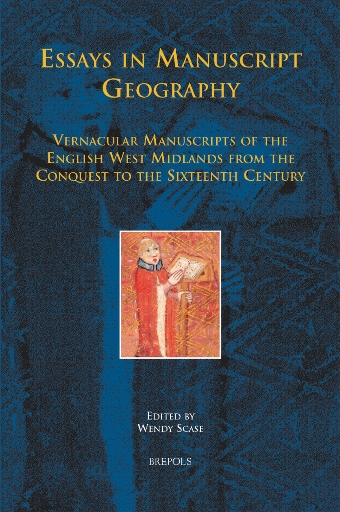
Essays in Manuscript Geography
show More to view fulltext, buy and share links for:Essays in Manuscript Geography show Less to hide fulltext, buy and share links for: Essays in Manuscript GeographyThe medieval English West Midlands has long been associated with the production of vernacular texts, in Old and Middle English, and with the making of several famous manuscripts. The aim of this volume is to re-think assumptions about medieval literature and the region in the light of new research in medieval book history. A series of specially commissioned essays in ‘manuscript geography’ examines the making and use of texts and books in relation to cultural networks in the region and beyond. Included are case studies of manuscripts of Worcester and the Worcester diocese from the eleventh to the thirteenth centuries; investigations of manuscript production in fourteenth-century Shropshire and its wider regional links; and essays on textual cultures in Warwickshire from the activities of the aristocrats and gentry of the fifteenth and sixteenth centuries to the projects of later antiquarians. Essays in the final section of the volume reflect on the possibilities of large-scale, corpus-based research on medieval manuscript books. Collectively the essays identify and explore some of the investments of traditional regionalist accounts of vernacular literary culture and model new theoretical and methodological approaches.
-
-
-
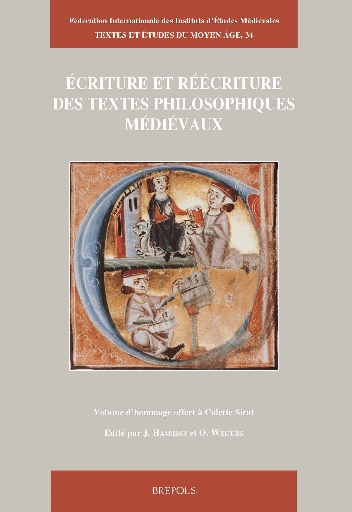
Ecriture et réécriture des textes philosophiques médiévaux
show More to view fulltext, buy and share links for:Ecriture et réécriture des textes philosophiques médiévaux show Less to hide fulltext, buy and share links for: Ecriture et réécriture des textes philosophiques médiévauxPhilosophe et paléographe, Colette Sirat s’est illustrée dans ces deux domaines pendant toute sa carrière académique. Un fil conducteur relie d’ailleurs ces deux secteurs d’activité: les manuscrits qui sont toujours à la base de ses recherches, fournissant ainsi les sources mêmes et les documents de première main de ses études philosophiques.
Ses publications ont fait date tant dans l’histoire de la philosophie juive que dans les études de paléographie hébraïque et d’histoire de l’écriture. Le thème de ce volume la préoccupe depuis bien longtemps. En effet, la manière d’écrire des textes au moyen âge, la réécriture constante pour beaucoup d’entre eux, constitue un sujet encore peu étudié, bien qu’il s’agisse d’un trait essentiel de la culture écrite de cette époque. Il a été limité aux textes philosophiques, domaine dans lequel ce phénomène est particulièrement présent et qui est l’un des terrains de chasse de la récipiendaire.
Dans tous ses travaux, on découvre les mêmes traits fondamentaux, dont une grande curiosité intellectuelle, une largeur de vue due à un vaste programme de lectures dans des domaines très divers et une richesse d’idées nouvelles sont peut-être les plus marquants.
-
-
-

Emotions in the Heart of the City (14th-16th century)
show More to view fulltext, buy and share links for:Emotions in the Heart of the City (14th-16th century) show Less to hide fulltext, buy and share links for: Emotions in the Heart of the City (14th-16th century)Whoever is curious about emotions and their expression in the Old Regime has to discover Johan Huizinga’s works. From his point of view, even if it is a real challenge to comprehend the world of the mind and of the sentimental life, historians of medieval and early modern societies cannot help themselves from examining character studies to reconcile daily life and historicity. Anglo-Saxon studies have proved since the beginning of the seventies that we can give historical meaning to fierce emotions like anger and fear, to mental suffering characterized by tears and pain, or even to the sudden feeling of aesthetic pleasure, mystical ecstasy and delight… all those emotions which put the breath of life into anonymous people crowded into our historical studies. Outside the debates of psycho-history, our study views the topic of emotions from the angle of social construction and civilization’s process.
The town reveals itself as an ideal context within which to articulate values, mentalities, customs and aesthetics. From the marketplace to the court of justice, from the procession route to the scaffold, from the theatre stage to the scene of riots, the town concentrates in its heart a public space where both delicate and strong emotions are repeatedly enacted. The purpose of this book is to develop different approaches —according to sphere, events, social categories, social relations, gender, etc.— and thus to suggest a more precise analysis of emotion as a means of communication inside the town. Three urban social «spheres» where divergent emotions were publicly expressed, manipulated, discussed and represented are put into focus: that of the urban revolt, that of the urban administration of justice and that of the staging of urban theatre and poetry.
-
-
-
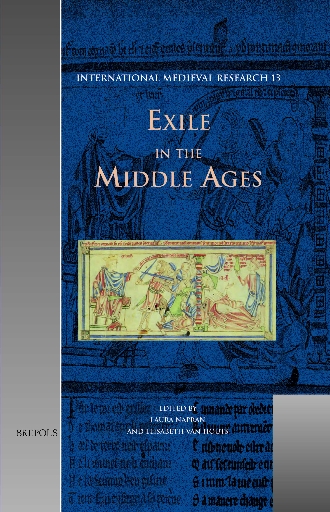
Exile in the Middle Ages
show More to view fulltext, buy and share links for:Exile in the Middle Ages show Less to hide fulltext, buy and share links for: Exile in the Middle AgesExile in the Middle Ages took many different forms. As a literary theme it has received much scholarly attention in the Latin, Greek and vernacular traditions. The historical and legal phenomenon of exile is relatively unexplored territory. In the secular world, it usually meant banishment of a person by a higher authority for political reasons, resulting in the exile leaving home for a shorter or longer period. Sometimes an exile did not wait to be expelled but left of his or her own accord. Leaving home to go on pilgrimage, or, in the case of women to marry, could be experienced as a form of exile. In the ecclesiastical sphere, two forms of exile stand out. Monasticism was often seen as a form of spiritual (permanent) exile from the secular world. Excommunication was a punishment exercised by the Church authorities in order to eject persons (often only temporarily) from the community of Christians. Banishment as a form of social punishment is therefore the central theme of this volume on Exile in the Middle Ages. The book covers the period of the central Middle Ages from ca. 900 to ca. 1300 in Western Europe, though some chapters have a wider remit. The genesis of the volume was a series of presentations delivered at the Leeds International Medieval Congress in 2002, which was devoted to the theme of Exile.
-