EMISCA

Collection Contents
4 results
-
-
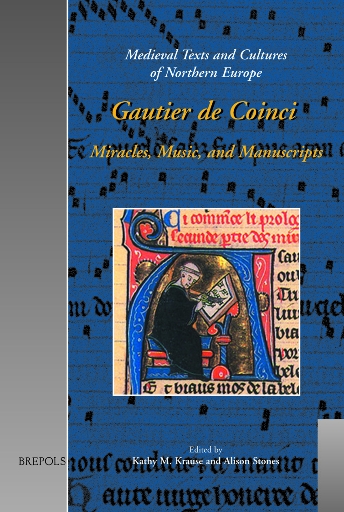
Gautier de Coinci
show More to view fulltext, buy and share links for:Gautier de Coinci show Less to hide fulltext, buy and share links for: Gautier de CoinciGautier de Coinci (c. 1177-1236) was a Benedictine prior, a poet and composer, and the author of several very popular religious works, including a large collection of Miracles of the Virgin in French, which enjoyed a wide circulation during the Middle Ages. Gautier drew on multiple Latin sources for his work, embellishing and personalizing them as he adapted them to his poetic design. Conceiving of his collection of miracles as a complete work, Gautier carefully organized the tales into two books, framing each with authorial exordia and lyrics praising the Virgin. In addition to its obvious literary interest, the subsequent manuscript tradition offers a remarkable panorama of medieval manuscript production, in particular due to the fascinating combination of text, music and illustration. Bringing together a select group of scholars from multiple disciplines (including art history, musicology, and literary studies), this collection of essays explores complementary aspects of Gautier, his works, and his manuscripts. The volume offers both breadth and depth in its examination of Gautier de Coinci and his Miracles de Nostre Dame. It promises to redefine Gautier studies through its interdisciplinary consideration of the varied facets of his work as it makes available to scholars and students the first interdisciplinary examination of this key figure in medieval vernacular religious culture.
-
-
-
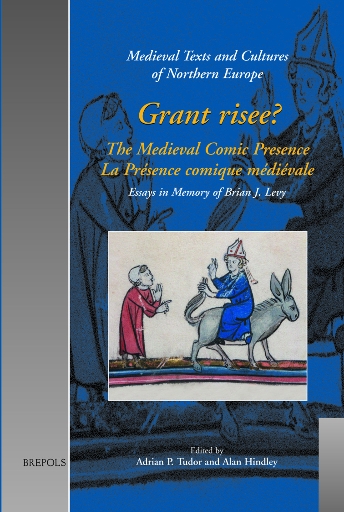
Grant risee?
show More to view fulltext, buy and share links for:Grant risee? show Less to hide fulltext, buy and share links for: Grant risee?Celebrating the work of Brian J. Levy in the realm of comedy and humour in the Middle Ages, this collection of twenty essays explores unusual, unexpected or unacknowledged elements of humour in medieval literature and art. Scholars from Britain, France, Italy, the USA, Denmark, and the Netherlands consider comic elements taking an unusual form; a comic presence in unexpected places; comic elements intentionally or unintentionally hidden; comic elements surprisingly vaunted; a comic presence in standard contexts which stands out for a particular reason; comic elements which are for some reason controversial; comic elements as yet unidentified or unacknowledged; a commonly acknowledged comic presence which is in fact no such thing. Essays in English and French deal with a broad range of subjects. If the Roman de Renart is particularly well represented amongst these essays, other subjects make up the majority of the book. These include: Cicero’s De Oratorei; the Mannekin pis; late-medieval wall paintings; German and French Drama; fabliaux; vernacular pious tales and dits; the romance epic Richard Coeur de Lyon; Les Quinze joyes de mariage; bestiaries; and misericords. Sometimes shocking, often surprising, and always intriguing, the medieval comic presence rarely corresponds to our expectations and assumptions. This book shows that in numerous cases the medieval joke is actually on the modern scholar.
-
-
-
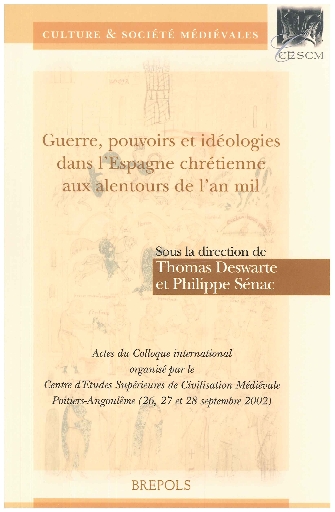
Guerre, pouvoirs et idéologies dans l’Espagne chrétienne aux alentours de l’an mil
show More to view fulltext, buy and share links for:Guerre, pouvoirs et idéologies dans l’Espagne chrétienne aux alentours de l’an mil show Less to hide fulltext, buy and share links for: Guerre, pouvoirs et idéologies dans l’Espagne chrétienne aux alentours de l’an milDepuis l’invasion arabo-berbère de la Péninsule ibérique en 711, les sociétés hispaniques chrétiennes sont très affectées par la guerre. Aux alentours de l’an mil, cette guerre prend une nouvelle dimension. Après une période de conflits internes et de défaites, culminant lors des fameux raids d’al-Mansûr, les principautés chrétiennes prennent l’offensive.
A cet égard, l’an mil constitue bien un tournant dans l’histoire de l’Espagne chrétienne. Vers le milieu du onzième siècle, la Reconquista est en marche, tandis que quatre forces politiques s’imposent: les royaumes de León, de Pampelune et d’Aragon, et les comtés catalans. La multiplication des conflits influe très fortement sur l’organisation des pouvoirs civils, et implique des enjeux fondamentaux dans la genèse des Espagnes chrétiennes médiévales, qui connaissent alors de profondes mutations culturelles, juridiques et idéologiques.
Les 26, 27 et 28 septembre 2002, plusieurs historiens et historiens de l’art venus de France, d’Espagne et d’Allemagne se sont retrouvés au Centre d’Etudes Supérieures de Civilisation Médiévale de Poitiers et à Angoulême pour travailler sur ces thèmes. Ils ont suivi trois axes de recherche, qui structurent les actes de ce colloque: la rencontre des mondes chrétien et musulman, la guerre comme enjeu de pouvoir et la dimension religieuse des idéologies.
-