


EMISCA

Collection Contents
7 results
-
-
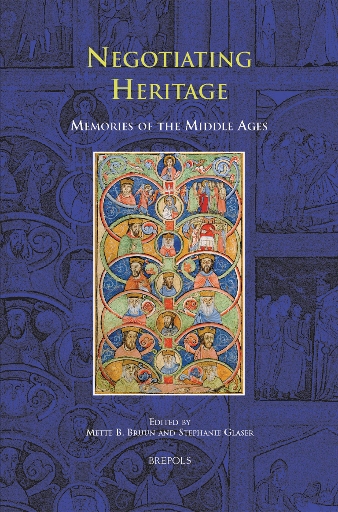
Negotiating Heritage
show More to view fulltext, buy and share links for:Negotiating Heritage show Less to hide fulltext, buy and share links for: Negotiating HeritageA key impulse of cultural transmission is engaging with the past for the benefit of the present. In seventeen essays on subjects that range from Paschasius Radbertus to Orhan Pamuk, the Regularis Concordia to Kurt Weill, and from Augustine to Adorno, Negotiating Heritage examines specific historical case-studies that reveal the appropriation, modification, or repudiation of a legacy. The overall focus of this interdisciplinary volume is memory: medieval conceptions of memory, resonances of the Middle Ages in later periods, and memory as a heuristic methodological device. Through tokens or other vestiges of the past - the physical memorial of a tomb, the ritualized retention of past acts or structures, the reverberations of a doctrinal, literary, musical, or iconographic topos, or the symbolic reminiscences of a past ideal - memory acts as the manifestation of something absent. This anthology studies such tokens in a way that provides a fruitful new perspective for the field of research into memory, and explores the methodological dimension of issues of heritage, genealogy, and tradition. Furthermore, Negotiating Heritage also probes the reception and construction of the Middle Ages in later periods; exploring the shifting territory of the meaning of the medieval itself. In its movement between medievalism and the medieval period, Negotiating Heritage is an important contribution to both established and emerging trends in critical thought.
-
-
-
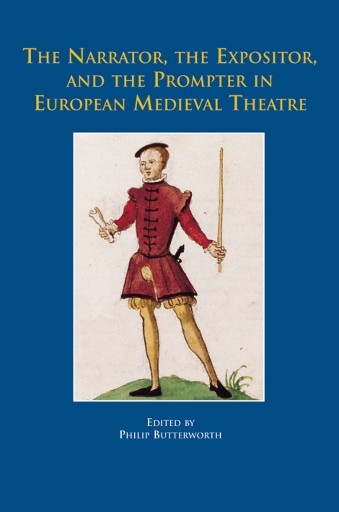
The Narrator, the Expositor, and the Prompter in European Medieval Theatre
show More to view fulltext, buy and share links for:The Narrator, the Expositor, and the Prompter in European Medieval Theatre show Less to hide fulltext, buy and share links for: The Narrator, the Expositor, and the Prompter in European Medieval TheatreInterest in the content of this book has developed out of an examination of the prompter who operated in full view of the audience and offered all the lines to the players. In 2001 at Groningen a production of the Towneley Second Shepherds’ Play focused on an examination of this convention. Many of the audience responses then were concerned with the figure of the prompter as he was seen to operate simultaneously both ‘inside’ and ‘outside’ the action of the play. Such a role and its function is fascinating, not only in its own right, but also in relation to how it might inform us about the nature and purpose of presented theatre. The ability of such a figure to move in and out of the action, and thus different realities, characterizes a relationship to the action and the audience. The same fascination exists in relation to roles of the narrator and the expositor. Sometimes these roles are overt ones; sometimes they ‘double up’ with roles of actors, personages or characters. These figures are of pivotal significance in the communication of those plays in which they operate. The purpose of this book is to investigate the nature of these roles in order to identify their influence upon the performance of medieval plays.
-
-
-

Narrative and History in the Early Medieval West
show More to view fulltext, buy and share links for:Narrative and History in the Early Medieval West show Less to hide fulltext, buy and share links for: Narrative and History in the Early Medieval WestThis collection deliberately brings together work which is chronologically, geographically and generically diverse. Texts studied include traditional narrative historiography, alongside poetry, chronicles, charters, dispute settlements and hagiography. The essays range from Italy and Frankia to Scandinavia and England, as they examine texts produced from the seventh to the early twelfth century. In exploring the nature and function of narrative in texts, which modern scholars use to study the Middle Ages, the contributors to this interdisciplinary volume integrate social, political, intellectual and literary history. Each essay and the volume as a whole illustrate that narrative form offers both new vantage points on the Middle Ages and new opportunities for collaborative study.
-
-
-
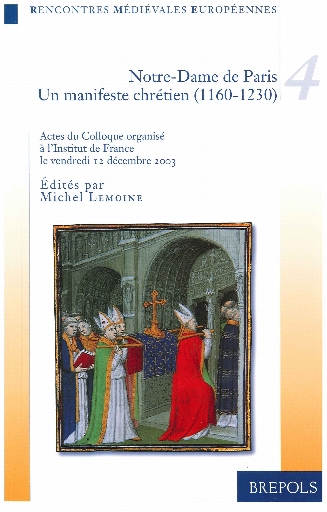
Notre-Dame de Paris. Un manifeste chrétien, 1160-1230
show More to view fulltext, buy and share links for:Notre-Dame de Paris. Un manifeste chrétien, 1160-1230 show Less to hide fulltext, buy and share links for: Notre-Dame de Paris. Un manifeste chrétien, 1160-1230Les précédents colloques des Rencontres médiévales européennes ont renouvelé notre connaissance des origines de l’architecture gothique en mettant en évidence les liens qui existent entre le propos de Suger, tel qu’il a pris corps à Saint-Denis, et les nouveaux courants spirituels du xii e siècle. Les études réunies dans le présent volume prolongent cette enquête. Elles rappellent en particulier le rôle important joué par l’évêque de Paris, Maurice de Sully. Proche des Victorins, attentif aux directives réformatrices de la papauté, il fonde sa pastorale sur un renouveau liturgique dont l’exigence théologique n’est jamais exclue. C’est à lui, par exemple, que l’on doit la pratique de l’ostension de l’hostie. On trouvera ici le portrait de cet évêque exceptionnel ainsi que l’analyse de son grand dessein: la reconstruction de la cathédrale Notre-Dame de Paris. Cette entreprise fut accompagnée d’une renaissance artistique perceptible notamment dans le domaine musical. En arrière-plan, on retrouve l’abbaye de Saint-Victor, dont on a tenté d’évaluer l’influence dans la vie spirituelle du temps. L’œuvre de Godefroid, auteur d’un Microcosme, illustre bien ce milieu si original. Notre époque traversée de révolutions et d’incertitudes peut encore tirer des leçons du manifeste que fut en son temps Notre-Dame de Paris.
-
-
-
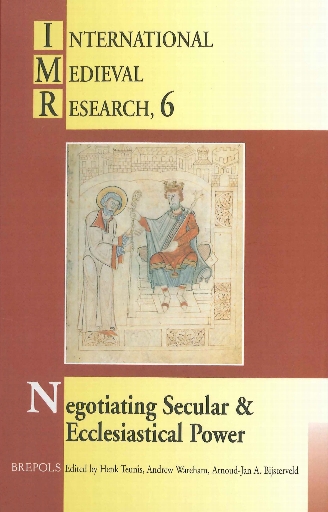
Negotiating Secular and Ecclesiastical Power
show More to view fulltext, buy and share links for:Negotiating Secular and Ecclesiastical Power show Less to hide fulltext, buy and share links for: Negotiating Secular and Ecclesiastical PowerTraditional historiography generally stresses the opposition and contradiction between secular and ecclesiastical power. By contrast, this volume focuses upon the interdependence of secular and ecclesiastical power and on the ways both secular rulers, kings, counts and other lords, and ecclesiastical authorities and institutions continuously interacted, trying to affirm the relationships between them. This selection of a historiographical introduction plus nine case-studies from England, northern France and the Low Countries enables a subtle comparison of secular and ecclesiastical links and social interactions in a series of regional and local contexts during the Central Middle Ages. The volume demonstrates that this process of negotiation led to an affirmation of shared values and contributed to the creation of common social values in medieval Europe.
Ludo Milis (Universiteit Gent), “This book, composed around three major themes (‘Texts as Tools of Power’, ‘Land and Kinship’, and ‘Conflict and Affirmation’), exemplifies how medievalists can reshape their discipline into a more responsive one. Its scope is not to offer a wide range of definitive explanations, but it shows how medievalists should try (and indeed do try) to return to a close reading of their documents. For far too long, institutional history, legal history, and histoire événémentielle have tried to monopolize power relationships and to encapsulate them in rather narrow explanatory schemes. This volume offers a broader and more encompassing approach.”
-
-
-

New Approaches to Medieval Communication
show More to view fulltext, buy and share links for:New Approaches to Medieval Communication show Less to hide fulltext, buy and share links for: New Approaches to Medieval CommunicationThis volume will serve as a textbook for studying this field, and as an introduction to current research. It is written in accessible language for non-specialists. The volume has three sections: introductions by two of the leading exponents worldwide: Michael Clanchy and Marco Mostert; a series of essays by members of the Utrecht ‘Pionierproject’ which consider writing and written culture against the background of all forms of communication available to a given medieval society, both in western and east-central Europe; and a comprehensive bibliography on the subject, comprising 1500 titles which will serve as a fundamental starting-point for work in this field.
-
-
-

New Trends in Feminine Spirituality
show More to view fulltext, buy and share links for:New Trends in Feminine Spirituality show Less to hide fulltext, buy and share links for: New Trends in Feminine SpiritualityWas there a women’s movement in the thirteenth century and is such a question meaningful in its medieval context? Far from being resolved, the issue of whether women had a thirteenth-century renaissance has still decisively to unsettle the periodization of Western European history in twelfth and sixteenth-century humanist renaissances. Herbert Grundmann long ago demonstrated the participation of women in the eremitically-inspired reforming movements of the twelfth and thirteenth centuries, and in the production of vernacular literature. Yet it is upon his work that this volume builds, for the diocese of Liège is the key area in this development. It was from Liège that Jacques de Vitry approached the papacy to secure permission for the women of the bishopric of Liège, France and Germany to live together and to promote holiness in each other by mutual example. The seventeen contributors to this volume examine not only the beguine religious life in the southern Low Countries, but also the impact of this movement on later medieval Sweden, England and France, the new modes of influence exerted by women in their religious lives, and the revivals of feminine spirituality in the late medieval West through to contemporary North America. Research does not yet allow for a whole new synthesis, but this volume directs scholars to detailed work on specific localities and persons, with an awareness of the problems and possibilities of wider European comparisons.
-