EMISCA

Collection Contents
6 results
-
-
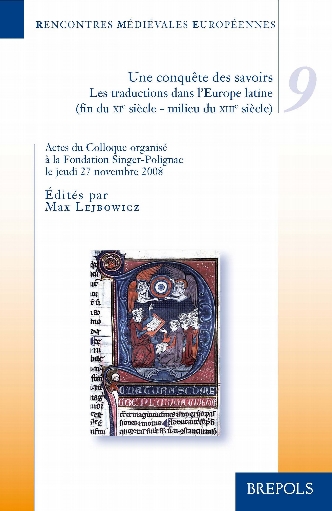
Une conquête des savoirs
show More to view fulltext, buy and share links for:Une conquête des savoirs show Less to hide fulltext, buy and share links for: Une conquête des savoirsLes nouveautés culturelles qui se répandent en Europe latine aux xii e et xiii e siècles sont les expressions les plus hautes d’une longue période de croissance. Bien que déjà largement documentée, cette expansion pluriséculaire mérite d’être reprise et précisée.
Un cercle vertueux s’est enclenché aux alentours de l’an mil dans l’Europe latine, sans qu’il y ait simultanéité de dates et de rythmes sur tout le territoire. Pour être multiples, les composantes de cet essor se réduisent à un même thème: ce sont autant de triomphes de l’homme européen sur son environnement et sur lui-même: amélioration de l’outillage et des techniques agricoles, poussée démographique, défrichements, nouveaux sites de peuplement, renouveau urbain, renforcement de l’artisanat, essor de l’économie monétaire, développement et diffusion de l’écrit, promotion des langues vernaculaires.
Véhicule déterminant du nouveau savoir, les traductions surviennent dans un monde latin à l’essor multiforme. Elles l’accompagnent et le transfigurent. Elles en décuplent les possibilités. Elles expriment un engouement dévorant pour l’étude, dont en retour elles accroissent l’intensité et rehaussent le niveau. Les clercs sont aspirés par cette spirale, dont le terme marque la fin du Moyen Âge. Les acquis des siècles précédents servent aux hommes du xv e à renouer directement avec l’hellénisme et avec le classicisme latin, tout en franchissant les océans d’une terre maintenant centrée sur le soleil.
La polysémie du mot «monde» rend compte de la totalité des nouveautés qui, apparues au cours du xii e siècle de Europe latine, transforment en quelques cent ans le continent: le xii e siècle latin s’est transfiguré en véritable Nouveau Monde.
-
-
-
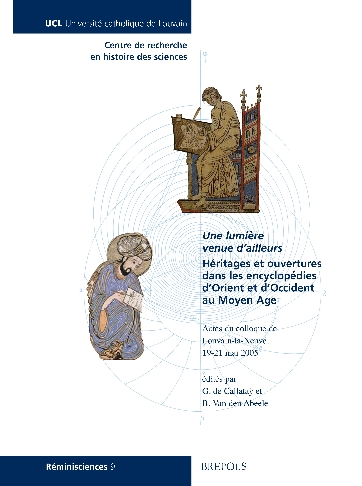
Une lumière venue d’ailleurs. Héritages et ouvertures dans les encyclopédies d’Orient et d’Occident au Moyen Age
show More to view fulltext, buy and share links for:Une lumière venue d’ailleurs. Héritages et ouvertures dans les encyclopédies d’Orient et d’Occident au Moyen Age show Less to hide fulltext, buy and share links for: Une lumière venue d’ailleurs. Héritages et ouvertures dans les encyclopédies d’Orient et d’Occident au Moyen AgeL’encyclopédisme médiéval a fait l’objet de divers colloques ces dernières années, apportant des éclairages complémentaires. Un biais peu exploré encore est celui des relations entre œuvres encyclopédiques orientales et occidentales.
Le colloque de Louvain-la-Neuve «Une lumière venue d’ailleurs» s’est donné pour objectif général de mettre en parallèle les deux traditions, sur base d’études philologiques et historiques. Les onze articles publiés abordent les traditions arabe (C. Baffioni, G. de Callataÿ), persane (Ž. Vesel), juive (M. Zonta), la réception d’auteurs arabes par le Moyen Age latin (A. Galonnier, M.-C. Duchenne et M. Paulmier), la diffusion des textes latins (J. Loncke, B. Van den Abeele) et les avatars tardifs de l’encyclopédisme en Occident (C. Boucher, B. Roling, I. Ventura). Par le croisement de ces éclairages, le volume souhaite faire mieux comprendre les influences que l’Occident chrétien, l’Islam et le monde hébraïque exercèrent réciproquement à cette époque-charnière de leur histoire.
-
-
-
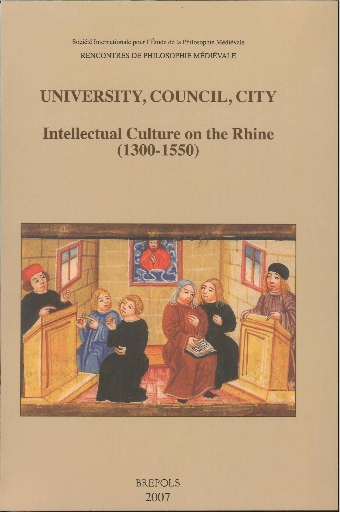
University, Council, City. Intellectual Culture on the Rhine (1300-1550)
show More to view fulltext, buy and share links for:University, Council, City. Intellectual Culture on the Rhine (1300-1550) show Less to hide fulltext, buy and share links for: University, Council, City. Intellectual Culture on the Rhine (1300-1550)Stretching from Basel to Cologne, the Rhine formed the geographical axis of a broad cultural realm in the late Middle Ages, lending vitality not only to its cities and universities but also to the two great Councils to which it played host. Already in the fourteenth century, the lives of such famous German mystics as Meister Eckhart, Heinrich Seuse and Johannes Tauler testify to the presence of an advanced intellectual culture in the cities of the upper and lower Rhine. In the fifteenth century, the most famous Councils of the late Middle Ages took place along the Rhine, namely the Councils of Constance and Basel, which formed loci of intellectual exchange and which became seedbeds of philosophical ideas that engaged and influenced such participants as Heymericus de Campo and Nicholas of Cusa. With the establishment of the Universities of Cologne (1388), Freiburg (1457), Basel (1459) and Mainz (1476), the intellectual culture of this region took an institutional form that continues to exist to this day, and symbolizes the stability of the intellectual culture of the Rhineland. The main purpose of this volume is to explore the intellectual richness and vitality of the Rhineland in its various facets and on its different levels.
-
-
-
Urban Theatre in the Low Countries
show More to view fulltext, buy and share links for:Urban Theatre in the Low Countries show Less to hide fulltext, buy and share links for: Urban Theatre in the Low CountriesThis collection of essays by international scholars focuses on the vernacular urban culture of the Chambers of Rhetoric in the Low Countries of the fifteenth and sixteenth centuries. Reflecting social, religious, and economic realities at a time of fundamental change, the Rhetoricians’ plays also reveal a range of poetic and theatrical conventions that make them an important source of information both on practical stagecraft and on the role of theatre in the urban community, as seen in their involvement in civic processions or the organization of drama competitions. The volume sets the Rhetoricians’ drama in the cultural life of the provinces of the Low Countries during a period dominated by ruling foreign dynasties: the Burgundian dukes and then the Habsburg dynasty, most prominently the Emperor Charles V and his son King Philip II of Spain. It was a time of intense religious controversy which gave rise to debates both on and off stage. These debates, far from damaging Rhetorician culture, actually stimulated its activities and development to such an extent that Rhetoricians became representative voices for their time. The admixture of entertainment and education offered by the Chambers to their own members - and to a wider public - was one which, though originating in a medieval context, soon became linked with humanist and Renaissance thinking. This volume illustrates how, as a consequence, the Chambers of Rhetoric contributed to the development in the Low Countries of an increasingly articulate society.
-
-
-
Urban public debts, urban government and the market for annuities in Western Europe (14th-18th centuries)
show More to view fulltext, buy and share links for:Urban public debts, urban government and the market for annuities in Western Europe (14th-18th centuries) show Less to hide fulltext, buy and share links for: Urban public debts, urban government and the market for annuities in Western Europe (14th-18th centuries)The essays in this volume offer a state-of-the-art analysis of a heretofore somewhat neglected part of financial history: the way in which urban governments in Western Europe during the Late Middle Ages and Early Modern Times handled the public debts their cities were confronted with. The technical aspects of the sale of annuities (renten, rentes) may have already been abundantly studied, but the links with social and political history still needed to be tackled. Who bought these annuities and thus participated in sharing the burden and profits which were likely to arise from them? What were their motives? How did the obvious links with urban elites work? And, perhaps most significantly, how did these occasional sales evolve into a structural way of linking financially important private persons with public finances, in the context both of cities and of growing states, since often the cities needed the money on a short-term basis in order to accomplish their own financial obligations toward ‘the state’. Participants in the colloquium where a large number of the essays were first presented represent in the first place the urban strongholds of Europe in the period under scrutiny: the Low Countries and Northern and Central Italy, but the Swiss cities, the cities of Aragon, London and papal Rome are also considered.
-