EMISCA

Collection Contents
81 - 100 of 260 results
-
-
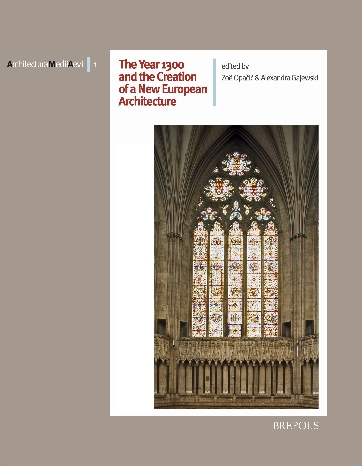
The Year 1300 and the Creation of a new European Architecture
show More to view fulltext, buy and share links for:The Year 1300 and the Creation of a new European Architecture show Less to hide fulltext, buy and share links for: The Year 1300 and the Creation of a new European ArchitectureThe theme of the book is the origin of Late Gothic architecture in Europe around the year 1300. It was then that Gothic ecclesiastical architecture graduated from a largely French into a wholly European phenomenon with new centres of art production (Cologne, Florence, York, Prague, Kraków) and newly-empowered institutions: kings, the higher nobility, towns and friars. Profound changes in spiritual and devotional life had a lasting effect on the relationship between architecture and liturgy. In short, architecture around 1300 became at once more cosmopolitan and more heterogeneous.
The book addresses these radical changes on their own terms-as an international phenomenon. By bringing together specialists in art, architecture and liturgy from many parts of Europe and from the USA it aims to employ their separate expertise, and to integrate each into a broader European perspective.
Dr Zoë Opačić is lecturer in the history and theory of architecture at Birkbeck College, University of London. She specialises in the field of late medieval architecture and art, particularly in Central Europe.
Dr Alexandra Gajewski is a Visiting Assistant Professor at the University of Michigan, Ann Arbor and a Fellow of the Society of Antiquaries, London. She works on Burgundian Gothic architecture and on Cistercian art in medieval France and the Empire.
-
-
-
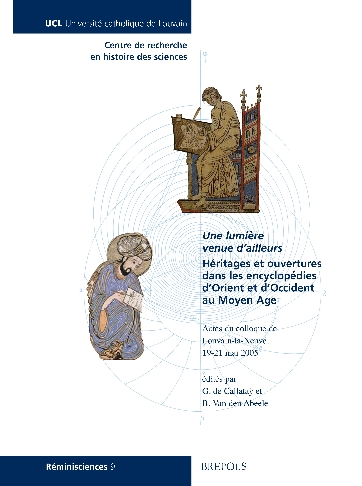
Une lumière venue d’ailleurs. Héritages et ouvertures dans les encyclopédies d’Orient et d’Occident au Moyen Age
show More to view fulltext, buy and share links for:Une lumière venue d’ailleurs. Héritages et ouvertures dans les encyclopédies d’Orient et d’Occident au Moyen Age show Less to hide fulltext, buy and share links for: Une lumière venue d’ailleurs. Héritages et ouvertures dans les encyclopédies d’Orient et d’Occident au Moyen AgeL’encyclopédisme médiéval a fait l’objet de divers colloques ces dernières années, apportant des éclairages complémentaires. Un biais peu exploré encore est celui des relations entre œuvres encyclopédiques orientales et occidentales.
Le colloque de Louvain-la-Neuve «Une lumière venue d’ailleurs» s’est donné pour objectif général de mettre en parallèle les deux traditions, sur base d’études philologiques et historiques. Les onze articles publiés abordent les traditions arabe (C. Baffioni, G. de Callataÿ), persane (Ž. Vesel), juive (M. Zonta), la réception d’auteurs arabes par le Moyen Age latin (A. Galonnier, M.-C. Duchenne et M. Paulmier), la diffusion des textes latins (J. Loncke, B. Van den Abeele) et les avatars tardifs de l’encyclopédisme en Occident (C. Boucher, B. Roling, I. Ventura). Par le croisement de ces éclairages, le volume souhaite faire mieux comprendre les influences que l’Occident chrétien, l’Islam et le monde hébraïque exercèrent réciproquement à cette époque-charnière de leur histoire.
-
-
-
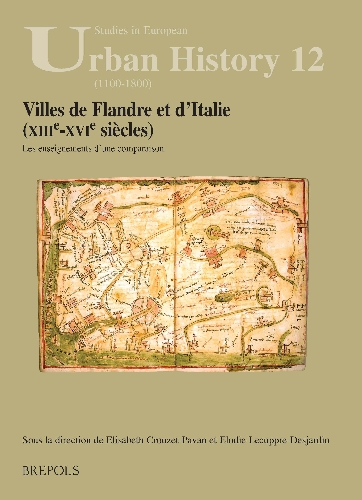
Villes de Flandre et d’Italie (XIIIe-XVIe siècle). Les enseignements d’une comparaison
show More to view fulltext, buy and share links for:Villes de Flandre et d’Italie (XIIIe-XVIe siècle). Les enseignements d’une comparaison show Less to hide fulltext, buy and share links for: Villes de Flandre et d’Italie (XIIIe-XVIe siècle). Les enseignements d’une comparaisonUne comparaison entre les villes de Flandre et d’Italie semble aller de soi tant apparaissent nombreuses, dans les études qui leur sont consacrées, les similitudes et les disparités esquissées. Entre les deux grands espaces urbanisés de l’Europe occidentale, pour qui s’intéresse à l’histoire des villes, le rapprochement paraît s’imposer. Pourtant, bien souvent, la juxtaposition prévaut et la comparaison se limite au seul domaine des convergences de l’histoire économique.
Cinq thèmes ont donc été retenus ici dans un souci de renouvellement et de réorientation des questionnements: la démographie, le fait religieux, les inscriptions et les symboliques du pouvoir, la «fabrique» de la mémoire et la représentation de l’espace. Dans cet ouvrage, est organisée une mise en parallèle qui permet d’identifier les spécificités qui façonnèrent en Italie et au nord de l’Europe les identités urbaines. Sur fond de relations marchandes et d’animation économique, les profils des communautés se précisent alors et la rare gageure d’une véritable histoire comparative est ainsi proposée au lecteur.
-
-
-
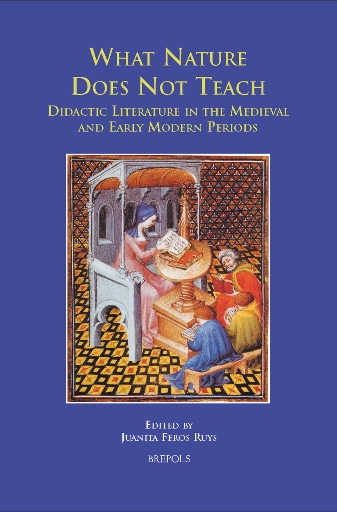
What Nature Does Not Teach
show More to view fulltext, buy and share links for:What Nature Does Not Teach show Less to hide fulltext, buy and share links for: What Nature Does Not TeachThis interdisciplinary study takes as its subject the multi-faceted genre of didactic literature (the literature of instruction) which constituted the cornerstone of literary enterprise and social control in medieval and early-modern Europe. Following an introduction that raises questions of didactic meaning, intent, audience, and social effect, nineteen chapters deal with the construction of the individual didactic voice and persona in the premodern period, didactic literature for children, women as the creators, objects, and consumers of didactic literature, the influence of advice literature on adult literacy, piety, and heresy, and the revision of classical didactic forms and motifs in the early-modern period. Attention is paid throughout to the continuities of didactic literature across the medieval and early-modern periods — its intertextuality, reliance on tradition, and self-renewal — and to questions of gender, authority, control, and the socially constructed nature of advice. Contributors particularly explore the intersection of advice literature with real lives, considering the social impact of both individual texts and the didactic genre as a whole. The volume deals with a wide variety of texts from the early Middle Ages to the eighteenth century, written in languages from Latin through the European vernaculars to Byzantine Greek and Russian, offering a comprehensive overview of this pervasive and influential genre.
-
-
-
Agire da donna
show More to view fulltext, buy and share links for:Agire da donna show Less to hide fulltext, buy and share links for: Agire da donnaL’evidenza scritta e materiale sulle donne dell’alto medioevo presenta una importante caratteristica di fondo: la descrizione delle azioni femminili non è normalmente il prodotto della percezione delle donne, né appare organizzata e prodotta per fornire una rappresentazione diretta dell’operato, delle capacità e delle caratteristiche femminili in termini reali. Piuttosto, sia sotto il profilo materiale, sia sotto il profilo scritto, le donne sono utilizzate - dal loro gruppo parentale, dagli avversari oppure dai sostenitori dei loro congiunti - come paradigmi simbolicamente efficaci per far apprezzare le possibilità economiche e di prestigio dei gruppi famigliari, i meriti e gli errori dei loro uomini, il clima politico di un regno. Si rafforza quindi, nella società altomedievale, il tema retorico dell’ “influenza femminile” per spiegare, in modo diretto e persuasivo, la consonanza o la dissonanza con il clima politico complessivo. Come tali, dunque, i modelli di rappresentazione femminile, di volta in volta utilizzati, non sono semplici ripetizioni. Essi variano nel corso del tempo, precisamente in rapporto con la trasformazione dei valori condivisi dalle società altomedievali, e con le reali possibilità femminili che sono progressivamente accettate oppure disapprovate, misconosciute oppure valorizzate. Le immagini della regina buona che converte il proprio marito al cristianesimo e della regina perfida che lo tradisce, così come i ricchi corredi funerari e le iscrizioni femminili rappresentano lo specchio attraverso cui la società altomedievale valutava sé stessa, le proprie tensioni e le proprie certezze.
-
-
-
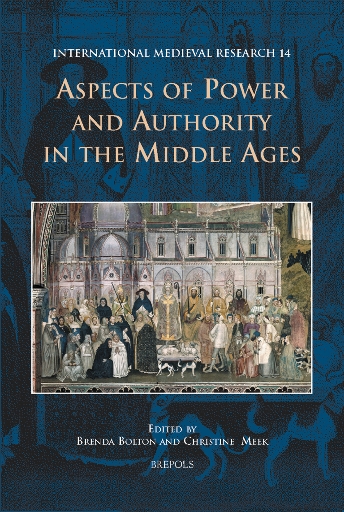
Aspects of Power and Authority in the Middle Ages
show More to view fulltext, buy and share links for:Aspects of Power and Authority in the Middle Ages show Less to hide fulltext, buy and share links for: Aspects of Power and Authority in the Middle AgesConcepts of power and authority and the relationship between them were fundamental to many aspects of medieval society. The essays in this collection present a series of case studies that range widely both chronologically and geographically, from Lombard Italy to early modern Iberia and from Anglo-Saxon, Norman and later medieval England to twelfth-century France and the lands beyond the Elbe in the conversion period. While some papers deal with traditional royal, princely and ecclesiastical authority, they do so in new ways. Others examine groups and aspects less obviously connected to power and authority, such as the networks of influence centring on royal women or powerful ecclesiastics, the power relationships revealed in Anglo-Saxon and Old-Norse literature or the influence that might be exercised by needy crusaders, by Jews with the ability to advance loans or by parish priests on the basis of their local connections. An important section discusses the power of the written word, whether papal bulls, collections of miracle stories or the documents produced in lawsuits. The papers in this volume demonstrate the variety and multiplicity of both power and authority and the many ways by which individuals exercised influence and exerted a claim to be heard and respected.
-
-
-
At the Table
show More to view fulltext, buy and share links for:At the Table show Less to hide fulltext, buy and share links for: At the TableThis volume surveys recent studies of the metaphorical and material facets of food in medieval and early modern Europe. Ranging from literary, historical, and political analyses to archaeological and botanical ones, this collection explores food as a nexus of pre-modern European culture. Food and feasting are understood not simply as the consumption of material goods but also as the figurative and symbolic representations of culture. To understand the myriad ways in which discourses about food and feasting are mobilized during this period is to better understand the fundamental role food and feasting played in the development of Europeans’ habitual patterns of behavior and of thought.
-
-
-
Constructing Nations, Reconstructing Myth
show More to view fulltext, buy and share links for:Constructing Nations, Reconstructing Myth show Less to hide fulltext, buy and share links for: Constructing Nations, Reconstructing MythThis collection of essays examines the ‘Grimmian Revolution’, the paradigm shift in the humanities that came with the publication of Jacob Grimm’s Deutsche Grammatik. In doing so, it honours T. A. Shippey, who has been a leading figure in reconsidering the contributions of the Old Philology and its impact on the humanities, particularly the rediscovery of the ancient languages and literatures of Northern Europe; the role this has played in the creation of national and regional identities; the attempts to extend the methods of comparative philology to comparative mythology; and the collection of folktales, folk-ballads, and the development of folkloristics. The sixteen essays in this collection focus on the impact made by nineteenth- and early-twentieth-century philology in the fields of medieval studies and language studies, and in the construction of Northern European national identities, mythologies, and folklore.
-
-
-
Creations
show More to view fulltext, buy and share links for:Creations show Less to hide fulltext, buy and share links for: CreationsThe meanings of the noun ‘creation’, and the verb ‘to create’, range from the traditional theological idea of God creating ex nihilo to a more recent sense of the process of artistic conception. This collection of thirteen essays, written by scholars of music, literature, the visual arts, and theology, explores the complicated relationship between medieval rituals and theology, and the development of an idea of human artistic creation, which came to the fore in the sixteenth century.
The volume concentrates on the period from the Carolingians to the Counter-Reformation but also includes some twentieth-century musicians. Each essay is dedicated to a particular topic concerned with ritual or artistic beginnings, inventions, harmony and disharmony, as well as representations or celebrations of creation. Central themes include the interplay of the ideas of God as creator, of God acting and recreating in medieval liturgy, of God as artist—the deus artifex of the Pythagorean cosmology, which was occasionally referred to as recently as the early nineteenth century—and, finally, of the homo creator, a concept in which man reflected (and eventually replaced) God in his artistic creativity.
This book therefore features new, significant, individual contributions from a range of scholarly disciplines, but, taken as a whole, it also constitutes a complex interdisciplinary study, with large-scale historical constructions.
-
-
-
Cultural Exchange between the Low Countries and Italy (1400-1600)
show More to view fulltext, buy and share links for:Cultural Exchange between the Low Countries and Italy (1400-1600) show Less to hide fulltext, buy and share links for: Cultural Exchange between the Low Countries and Italy (1400-1600)
-
-
-
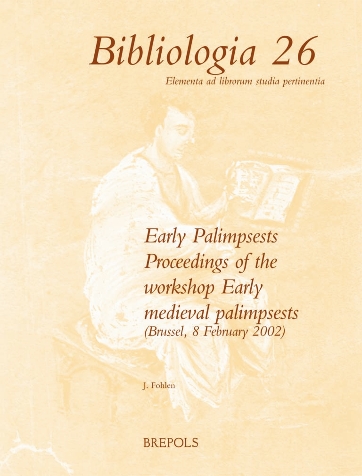
Early Medieval Palimpsests
show More to view fulltext, buy and share links for:Early Medieval Palimpsests show Less to hide fulltext, buy and share links for: Early Medieval PalimpsestsPalimpsests are texts from which the primary text has been effaced to make room for fresh writing. The practice was particularly important in the early Middle Ages, when numerous, often precious, books were subjected to this treatment. As a result, many ancient texts lay hidden in European libraries for centuries.
Ever since the first palimpsests were discovered in the seventeenth century, scholars have been fascinated by the possibility of discovering hitherto unknown texts. For a long time, the lower script of palimpsests could only be brought back to the light of day through the use of chemical reagents that proved very detrimental to the manuscripts. The great advance away from these destructive techniques came at the beginning of the twentieth century with the application of ultra-violet photography. Today, striking advances in this field are again being made with the development of digital imaging.
The contributions in this volume focus mainly on the cultural evidence offered by palimpsests from the early Middle Ages. Some contributors have examined particular manuscripts in great detail (the London palimpsest of Jerome’s Chronicle or the Munich palimpsest codex from Benediktbeuern); others have looked at specific types of texts that have suffered deletion in this way (liturgical palimpsests, Carolingian letters). The volume also contains a handlist of all known palimpsested manuscripts in Beneventan script.
-
-
-

Entre la ville, la noblesse et l’Etat: Philippe de Clèves (1456-1528), homme politique et bibliophile
show More to view fulltext, buy and share links for:Entre la ville, la noblesse et l’Etat: Philippe de Clèves (1456-1528), homme politique et bibliophile show Less to hide fulltext, buy and share links for: Entre la ville, la noblesse et l’Etat: Philippe de Clèves (1456-1528), homme politique et bibliophilePhilippe de Clèves (1456-1528) est un homme remarquable à plus d’un titre. Fils d’Adolphe, seigneur de Ravenstein, et de Béatrice de Coïmbre, Philippe jouit, à l’instar de bon nombre d’aristocrates à l’automne du Moyen Âge, d’un luxueux train de vie. Partisan de Maximilien d’Autriche dans sa lutte contre les cités du comté de Flandre jusqu’en 1488, il choisit alors de défendre le particularisme urbain contre l’autorité bourguignonne. Vaincu en 1492, il se tourne vers la cour du roi de France Charles VIII. Il parcourt l’Europe, gouverne Gênes pour finalement revenir aux Pays-Bas et demeurera fidèle à Charles Quint jusqu’à sa mort.
Les différentes contributions de ce volume entendent apporter une réponse à la question-clé des intérêts de Philippe durant cette période troublée: dans quelle mesure privilégie-t-il la relation avec le prince et avec les autres aristocrates ou entend-il plutôt assurer ses intérêts dans la ville? À partir d’une documentation largement inédite, l’attention est ainsi portée sur le rôle culturel, politique, social et militaire qu’a joué Philippe de Clèves dans les conflits entre la Ville et l’État. En outre, Philippe lui-même a rédigé L’instruction de toutes manieres de guerroyer. S’il est auteur, il est aussi collectionneur: plusieurs articles mettent également l’accent sur l’analyse du contenu de sa bibliothèque et sur la comparaison avec les librairies d’autres nobles et de certains fonctionnaires d’État.
Ce volume constitue la publication des Actes d’un colloque interdisciplinaire organisé à la Bibliothèque royale de Belgique dans le cadre du «Pôle d’Attraction Interuniversitaire» (La société urbaine dans les anciens Pays-Bas, bas Moyen Âge-XVIe siècle, projet V, n° 10), programme de recherche financé par la Politique scientifique fédérale belge.
-
-
-
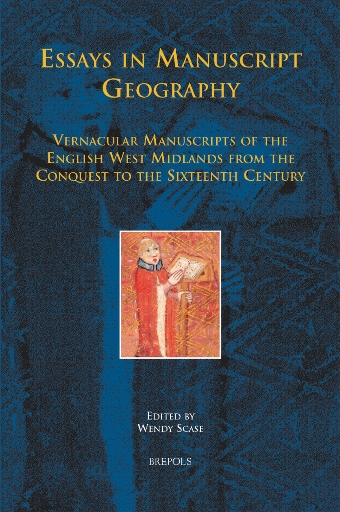
Essays in Manuscript Geography
show More to view fulltext, buy and share links for:Essays in Manuscript Geography show Less to hide fulltext, buy and share links for: Essays in Manuscript GeographyThe medieval English West Midlands has long been associated with the production of vernacular texts, in Old and Middle English, and with the making of several famous manuscripts. The aim of this volume is to re-think assumptions about medieval literature and the region in the light of new research in medieval book history. A series of specially commissioned essays in ‘manuscript geography’ examines the making and use of texts and books in relation to cultural networks in the region and beyond. Included are case studies of manuscripts of Worcester and the Worcester diocese from the eleventh to the thirteenth centuries; investigations of manuscript production in fourteenth-century Shropshire and its wider regional links; and essays on textual cultures in Warwickshire from the activities of the aristocrats and gentry of the fifteenth and sixteenth centuries to the projects of later antiquarians. Essays in the final section of the volume reflect on the possibilities of large-scale, corpus-based research on medieval manuscript books. Collectively the essays identify and explore some of the investments of traditional regionalist accounts of vernacular literary culture and model new theoretical and methodological approaches.
-
-
-
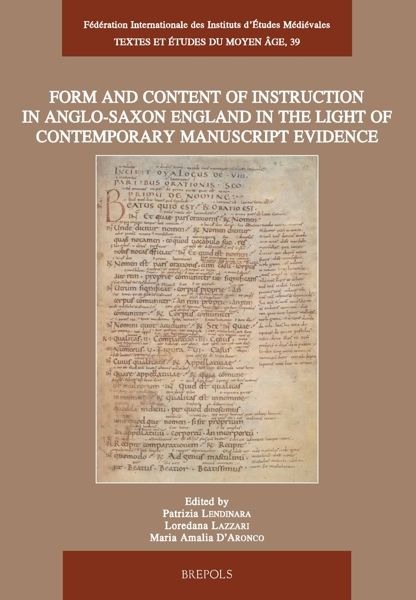
Form and content of instruction in Anglo-Saxon England in the light of contemporary manuscript evidence
show More to view fulltext, buy and share links for:Form and content of instruction in Anglo-Saxon England in the light of contemporary manuscript evidence show Less to hide fulltext, buy and share links for: Form and content of instruction in Anglo-Saxon England in the light of contemporary manuscript evidenceThe essays collected in this volume focus on a prominent aspect of Anglo-Saxon culture: educational texts and the Insular manuscripts which have preserved them.
The English imported manuscripts and texts from the Continent, whilst a series of foreign masters, from Theodore of Tarsus to Abbo of Fleury, brought with them knowledge of works which were being studied in Continental schools. Although monastic education played a leading role for the entire Anglo-Saxon period, it was in the second half of the tenth and early eleventh centuries that it reached its zenith, with its renewed importance and the presence of energetic masters such as Æthelwold and Ælfric. The indebtedness to Continental programs of study is evident at each step, beginning with the Disticha Catonis. Nevertheless, a number of texts initially designed for a Latin-speaking milieu appear to have been abandoned (for instance in the field of grammar) in favour of new teaching tools.
Beside texts which were part of the standard curriculum, Anglo-Saxon manuscripts provide abundant evidence of other learning and teaching instruments, in particular those for a specialized class of laymen, the Old English læce, the healer or physician. Medicine occupies a relevant place in the book production of late Anglo-Saxon England and, in this field too, knowledge from very far afield was preserved and reshaped.
All these essays, many by leading scholars in the various fields, explore these issues by analysing the actual manuscripts, their layout and contents. They show how miscellaneous collections of treatises in medieval codices had an internal logic, and highlight how crucial manuscripts are to the study of medieval culture.
-
-
-
Frères et soeurs : les liens adelphiques dans l’Occident antique et médiéval
show More to view fulltext, buy and share links for:Frères et soeurs : les liens adelphiques dans l’Occident antique et médiéval show Less to hide fulltext, buy and share links for: Frères et soeurs : les liens adelphiques dans l’Occident antique et médiévalComment définir les liens adelphiques? À quelles réalités biologiques, sociales, politiques, renvoient-ils dans l’Occident antique et médiéval?
Les textes rassemblés dans ce volume tentent d’éclairer les liens entre frères et soeurs en se fondant sur des approches linguistiques, historiques, juridiques et littéraires.
Ils abordent des aspects aussi divers et complexes que le rôle du frère aîné, le choix du nom, le lignage, les pratiques successorales, les liens du sang, la défense de l’honneur familial et la solidarité, les affinités, mais aussi les antagonismes, le fratricide et la vengeance.
L’exploration de cette problématique est inévitablement pluridisciplinaire car toute réflexion sur les liens adelphiques doit interroger aussi bien l’histoire, le droit, que les textes littéraires.
-
-
-

La Sainte-Chapelle de Paris. Royaume de France ou Jérusalem céleste?
show More to view fulltext, buy and share links for:La Sainte-Chapelle de Paris. Royaume de France ou Jérusalem céleste? show Less to hide fulltext, buy and share links for: La Sainte-Chapelle de Paris. Royaume de France ou Jérusalem céleste?La Sainte-Chapelle est un chef-d’œuvre hors du commun, l’un des monuments du XIIIe siècle les plus appréciés du grand public. Emblème du gothique à son apogée, elle est aussi une œuvre majeure dont on connaît exceptionnellement bien le contexte historique et politique de sa création et la personnalité de ses commanditaires, le roi Louis IX et sa mère, Blanche de Castille. Négligée par les historiens de l’art dès les années 60 du siècle dernier, elle connaît heureusement un regain d’intérêt depuis quelques années.
Ce volume rassemble les communications d’un colloque international réuni pour faire la synthèse des acquis les plus récents concernant cet exceptionnel monument. Les contributeurs y traitent de divers aspects de la Sainte-Chapelle: restaurations, architecture, décor sculpté, vitraux, fonction, signification et mise en scène des reliques, liturgie et héraldique, personnalité et préoccupations artistiques, politiques et religieuses du commanditaire royal, à la veille de son départ pour la croisade. Il en résulte une image fascinante et très complète de ce chef-d’œuvre unique qu’est la chapelle palatine de saint Louis.
-
-
-
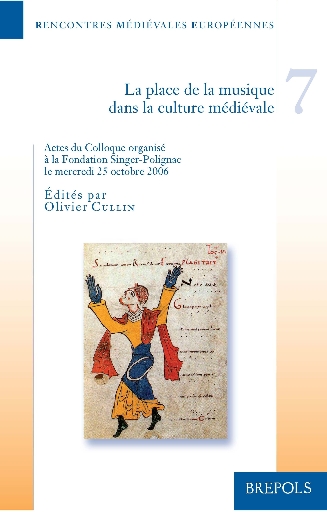
La place de la musique dans la culture médiévale
show More to view fulltext, buy and share links for:La place de la musique dans la culture médiévale show Less to hide fulltext, buy and share links for: La place de la musique dans la culture médiévaleAu Moyen Âge, la musique est l’un des sept arts libéraux et, à ce titre, elle joue un rôle prépondérant dans la vie intellectuelle et sociale. Avec un héritage théorique et mythologique gréco-romain qu’elle saura reprendre à son compte, la période médiévale est, pour cet art, tout sauf une période obscure. La musique est le chant de l’âme et du corps, le chant de la terre et du ciel quotidiennement pratiqué et éprouvé. Elle est l’un des grands principes de l’organisation du monde et l’un des plus puissants moyens d’accès à la compréhension de sa création et à la contemplation de sa beauté. La musique s’incarne aussi dans la réalité sociale et politique dont elle scande l’ordre comme le désordre.
L’ouvrage conjugue la diversité et la richesse des approches de cette journée d’études en mêlant des regards croisés sur le sujet: la musique et la philosophie, la liturgie ou la mythologie; la musique et la rhétorique, les enseignements médiévaux, les arts de la mémoire; la musique et son expression sociale…
Le volume défend autant qu’il explique la place singulière exercée par l’art de la musique durant ces siècles médiévaux, riche creuset dans lequel s’est écrite une page fondamentale et originale de l’histoire culturelle occidentale.
-
-
-

Learning and Understanding in the Old Norse World
show More to view fulltext, buy and share links for:Learning and Understanding in the Old Norse World show Less to hide fulltext, buy and share links for: Learning and Understanding in the Old Norse WorldThis volume presents twenty essays by leading scholars of Old Norse which bring into focus the nature of learned traditions — both oral and written — in medieval Scandinavia and the interpretation and re-interpretation of them over time. Theoretical frameworks for understanding Old Norse literature is the initial topic of the collection, which then moves on to present recent work on Old Norse myth and society; current perspectives on oral traditions in performance and text; and reflections on medieval ideas about language, both vernacular and Latin. The collection is rounded off by a section on prolonged traditions — the transformation of local and imported traditions into new literary forms. Individual essays in the volume offer significant primary research as well as reconsiderations of key issues in scholarship, their subjects ranging widely, both conceptually and chronologically, around the twin themes of learning and understanding. Like the research of the volume’s honorand, Margaret Clunies Ross, Learning and Understanding in the Old Norse World exemplifies the diversity and vigour of current research in the field of Old Norse and draws together philological, literary, historical and anthropological perspectives on the subject.
-