


EMISCS12

Collection Contents
3 results
-
-
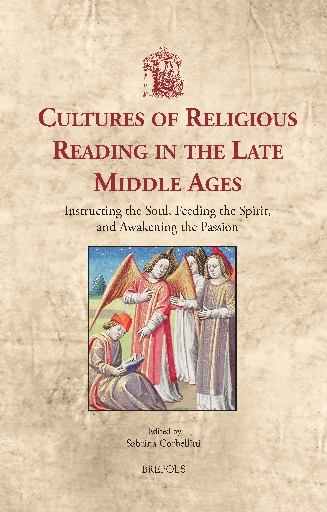
Cultures of Religious Reading in the Late Middle Ages
show More to view fulltext, buy and share links for:Cultures of Religious Reading in the Late Middle Ages show Less to hide fulltext, buy and share links for: Cultures of Religious Reading in the Late Middle AgesRead often, learn all that you can. Let sleep overcome you, the roll still in your hands; when your head falls, let it be on the sacred page.
- St Jerome, 384 AD
With these words, the Church Father Jerome exhorted the young Eustochium to find on the sacred page the spiritual nourishment that would give her the strength to live a life of chastity and to keep her monastic vows. His call to read does not stand alone. Books and reading have always played a pivotal role in early and medieval Christianity, often defined as ‘a religion of the book’.
A second important stage in the development of the ‘religion of the book’ can be attested in the late Middle Ages, when religious reading was no longer the exclusive right of men and women living in solitude and concentrating on prayer and meditation. Changes in the religious landscape and the birth of new religious movements transformed the medieval town into a privileged area of religious activity. Increasing literacy opened the door to a new and wider public of lay readers. This seminal transformation in the late medieval cultural horizon saw the growing importance of the vernacular, the cultural and religious emancipation of the laity, and the increasing participation of lay people in religious life and activities.
This volume presents a new, interdisciplinary approach to religious reading and reading techniques in a lay environment within late medieval textual, social, and cultural transformations.
-
-
-
Christian readings of Aristotle from the Middle Ages to the Renaissance
show More to view fulltext, buy and share links for:Christian readings of Aristotle from the Middle Ages to the Renaissance show Less to hide fulltext, buy and share links for: Christian readings of Aristotle from the Middle Ages to the RenaissanceWidely recognized as one of the main characteristics of Latin Aristotelianism, the ‘Christianisation’ of Aristotle from the thirteenth to the seventeenth century has received as yet little attention. Aiming to answer the need for a more systematic investigation, the articles here collected approach Christian readings of the Stagirite’s works from different perspectives. Setting aside abstract discussions about ‘degrees of orthodoxy’, they address a few specific questions: which ‘images’ of Aristotle were offered by Medieval and Renaissance interpreters, and in particular how did some of them argue that — far from being a pagan or even an impious thinker — he did not contradict the truths revealed by Holy Scripture? Which strategies did they adopt to harmonize Aristotelian philosophy with Christian religion, or at least to avoid their clash? How did they conceive the task of expounding Aristotle’s thought? How did they understand and apply the distinctions, developed since the mid-thirteenth century, between the point of view of the philosophers and that of the believers, between what is true ‘speaking naturally’ and what is true ‘according to faith’? Were these distinctions — and other disclaimers or cautionary statements — effective in protecting masters that taught Aristotle’s texts from accusations of heresy? To what extent were ideas issuing from Christian theology integrated within the Peripatetic worldview, or even treated within Aristotelian commentaries?
Discussing these and related questions, the ten contributors to this volume examine relevant doctrines of outstanding thinkers – Roger Bacon (Chiara Crisciani), Siger of Brabant and Henry of Ghent (Pasquale Porro), Dante Alighieri (Gianfranco Fioravanti); offer a fine analysis of some commentaries on the Nicomachean Ethics (Iacopo Costa), the Politics (Stefano Simonetta) and the libri naturales (Amos Corbini); suggest innovative interpretations of the genesis of the Liber de bona fortuna (Valérie Cordonier) and of the condemnation of 1277 (Dragos Calma); inspect minor but significant figures of the Italian Renaissance such as Ludovico Beccadelli (Pietro Rossi) and Cesare Crivellati (Luca Bianchi).
-
-
-
The Calligraphy of Medieval Music
show More to view fulltext, buy and share links for:The Calligraphy of Medieval Music show Less to hide fulltext, buy and share links for: The Calligraphy of Medieval MusicThe Calligraphy of Medieval Music treats the practical aspects of the book making and music writing trades in the Middle Ages. It covers most major regions of music writing in medieval Europe, from Sicily to England and from Spain to the eastern Germanic regions. Specific issues raised by the contributors include the pricking and ruling of books; the writing habits of scribes and their reliance on memory; the cultural influence of monastic orders such as the Carthusians; graphic variants between regional styles of music notation ranging from tenth-century Saint-Gall to sixteenth-century Cambrai; and the impact of print on late medieval notation. The volume opens with a few essays dealing with general issues such as page layout and manuscript production both in and out of medieval Europe. The second part of the book covers early music notations from the tenth and eleventh centuries, and the third part, the twelfth to the sixteenth centuries.
-