


EMISCS12

Collection Contents
2 results
-
-
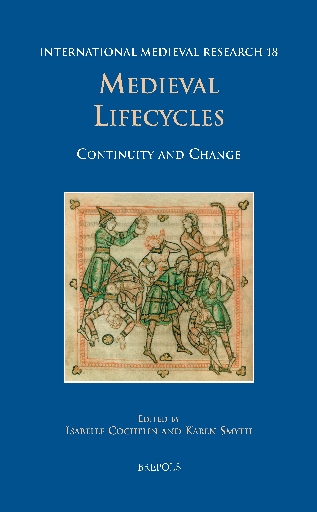
Medieval Life Cycles
show More to view fulltext, buy and share links for:Medieval Life Cycles show Less to hide fulltext, buy and share links for: Medieval Life CyclesThe essays in this collection present new research into a variety of questions on birth, childhood, adolescence, adulthood, middle age, and old age, ordered in a more or less chronological manner according to the life cycle. The volume exposes attitudes and representations of the life cycle from the Anglo-Saxon period to the end of the Middle Ages as being full of inconsistencies as well as definitive categories, and of variation and stasis. This attests to the fact that medieval conceptions and representations of the stages of life and their interrelationships are much more nuanced and less idealized than is usually credited. Medieval conceptual, mental, artistic, cultural, and sociological processes are scrutinized using various approaches and methods that cross disciplinary boundaries. What is emphasized across the volume is that there were varying, context-dependent rhythms of continuity and change in every stage of life in the medieval period. The volume’s selection of authors is international in scope and represents some of the leading current scholarship in the field.
-
-
-

Multilingualism in Medieval Britain (c. 1066-1520)
show More to view fulltext, buy and share links for:Multilingualism in Medieval Britain (c. 1066-1520) show Less to hide fulltext, buy and share links for: Multilingualism in Medieval Britain (c. 1066-1520)This book is devoted to the study of multilingual Britain in the later medieval period, from the Norman Conquest to John Skelton. It brings together experts from different disciplines — history, linguistics, and literature - in a joint effort to recover the complexities of spoken and written communication in the Middle Ages. Each author focuses on one specific text or text type, and demonstrates by example what careful analysis can reveal about the nature of medieval multilingualism and about medieval attitudes to the different living languages of later medieval Britain. There are chapters on charters, sermons, religious prose, glossaries, manorial records, biblical translations, chronicles, and the macaronic poetry of William Langland and John Skelton. By addressing the full range of languages spoken and written in later medieval Britain (Latin, French, Old Norse, Welsh, Cornish, English, Dutch, and Hebrew), this collection reveals the linguistic situation of the period in its true diversity and shows the resourcefulness of medieval people when faced with the need to communicate. For medieval writers and readers, the ability to move between languages opened up a wealth of possibilities: possibilities for subtle changes of register, for counterpoint, for linguistic playfulness, and, perhaps most importantly, for texts which extend a particular challenge to the reader to engage with them.
-