


EMISCS14

Collection Contents
4 results
-
-

England and Rome in the Early Middle Ages
show More to view fulltext, buy and share links for:England and Rome in the Early Middle Ages show Less to hide fulltext, buy and share links for: England and Rome in the Early Middle AgesThis volume explores the special connection that linked England and Rome between the seventh and the eleventh centuries, a topic which in spite of its relevance and attraction has never before been dealt with in a publication of this scale and depth. By bringing together scholars from different countries and disciplines and by relying on important recent archaeological findings that have led to a firmer knowledge of early medieval Rome, the volume provides a detailed and integrated investigation of the ways in which contacts between England and the Eternal City developed across the early Middle Ages. With special attention to major themes such as pilgrimage, artistic exchange, and ecclesiastical politics, the essays in this volume show the continuity of the Anglo-Saxons’ relations with Rome as well as the ways in which, over time, these adapted to different circumstances. They also show that Anglo-Saxon England should not be thought of as just a passive recipient of influential cultural trends, but rather as an important player in the multi-faceted world of early medieval Europe in which Rome, by now the city of the popes, kept its centrality as a source of spiritual and political power.
-
-
-
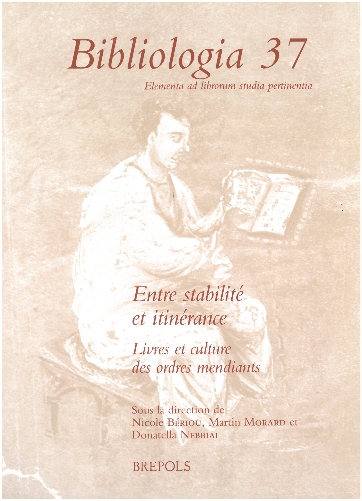
Entre stabilité et itinérance
show More to view fulltext, buy and share links for:Entre stabilité et itinérance show Less to hide fulltext, buy and share links for: Entre stabilité et itinéranceLes travaux de ces dernières années confirment que les livres tiennent une place centrale dans l’organisation des couvents mendiants et dans leurs pratiques économiques. Au quotidien, les livres font partie intégrante de la vie des couvents, comme vecteur de connaissances, support d’édification et outil de communication. Les frères les acquièrent pour étudier, pour transmettre les savoirs et pour discipliner la société. Les sœurs sont aussi, souvent, familières de la culture écrite, qui peut représenter un lieu de rencontre et de complémentarité entre les communautés masculines et féminines. Les contributions réunies dans ce volume s’attachent à considérer les différentes formes sous lesquelles les uns et les autres ont exprimé leur adhésion à la culture livresque, ou leurs éventuelles réserves, et reconnaissent dans la tension entre stabilité et itinérance l’un des points essentiels de l’identité culturelle des ordres mendiants. Parmi les aspects étudiés, figurent, en particulier, les réseaux institutionnels et interpersonnels, où les échanges de livres ont eu une très grande ampleur à l’humanisme, ainsi que les conditions historiques qui marquent le passage du manuscrit à l’imprimé.
-
-
-
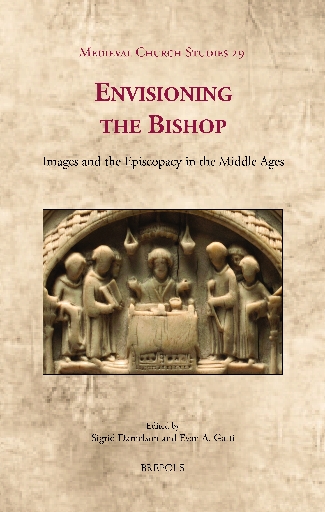
Envisioning the Bishop
show More to view fulltext, buy and share links for:Envisioning the Bishop show Less to hide fulltext, buy and share links for: Envisioning the BishopThe bishop wielded significant authority in religious, intellectual, and political spheres during the Middle Ages, but how was this influence articulated, and once articulated, how was it received? The essays in this volume represent a variety of disciplinary perspectives, each tuned to the production of images made by, for, and about the medieval episcopacy. They present the bishop as a model of piety and intellectual life as well as political and religious action.
Considering material from Late Antiquity through the thirteenth century, the essays offer a series of case-studies demonstrating that crafting episcopal imagery was a complicated endeavour employing pictorial, historical, literary, and historiographic devices. Never a static institution, the episcopacy was formed and reformed making it visible to the bishop, to those with whom he interacted, and to broader communities. These efforts at making present the power and authorities of the office asserted the duties, expectations, and ideals of the bishop in ways often specific to time and place.
The diverse perspectives on the episcopal image assembled here reveal the office, not as a singular contour, but as a succession of marks and erasures. Shaped by supporters and detractors alike, medieval images of the bishop engaged with historical models, responded to present realities, and considered the eschatological future.
-
-
-
Eriugena and Creation
show More to view fulltext, buy and share links for:Eriugena and Creation show Less to hide fulltext, buy and share links for: Eriugena and CreationUnjustly ignored as a result of a thirteenth-century condemnation, the thought of Johannes Scottus Eriugena (ca. 810-877) has only been subject to critical study in the twentieth century. Now, with the completion of the critical edition of Eriugena’s masterwork - the Periphyseon - the time has come to explore what is arguably the most intriguing and vital theme in his work: creation and nature.
In honor of Edouard Jeauneau - Institute Professor at the Pontifical Institute of Mediaeval Studies, University of Toronto and Honorary Research Director at the C.N.R.S. in Paris - to whom the field of Eriugenian studies is enormously indebted, this volume seeks to undertake a serious examination of the centrality of Eriugena’s thought within the Carolingian context, taking into account his Irish heritage, his absorption of Greek thought and his place in Carolingian culture; of Eriugena as a medieval thinker, both his intellectual influences and his impact on later medieval thinkers; and of Eriugena’s reception by modern philosophy, from considerations of philosophical idealism to technology.
-