


EMISCS99

Collection Contents
5 results
-
-
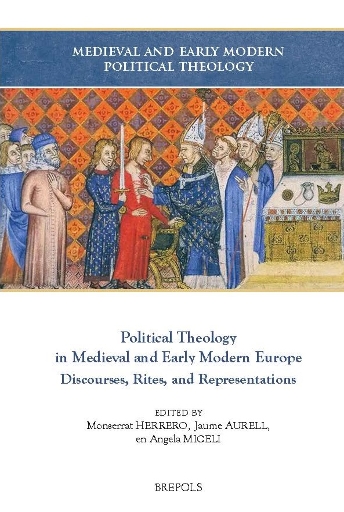
Political Theology in Medieval and Early Modern Europe
show More to view fulltext, buy and share links for:Political Theology in Medieval and Early Modern Europe show Less to hide fulltext, buy and share links for: Political Theology in Medieval and Early Modern EuropeThis book aims to provide new historical and theoretical perspectives on political theology with an interdisciplinary approach, from political philosophy and theology to art and history. After a comprehensive introduction and three introductory chapters on both the theory and the concept of “political theology” (based on the works of Schmitt, de Lubac and Kantorowicz), this volume explores the transferences between the temporal and the spiritual experimented on the past. It interprets some historical events (medieval crusades, royal wisdom, and early modern idea of tolerance), examines some philosophical and theological narratives (John of Paris, Spinoza, Locke, Bayle, Leibniz, Montesquieu, Tocqueville), and deciphers some rites (royal coronations) and representations (the Holy Crown, royal banquets, royal coats of arms).
-
-
-
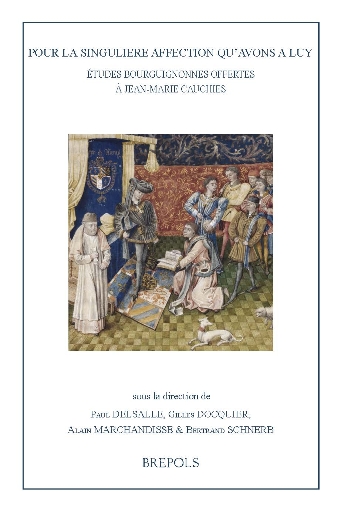
Pour la singuliere affection qu’avons a luy. Études bourguignonnes offertes à Jean-Marie Cauchies
show More to view fulltext, buy and share links for:Pour la singuliere affection qu’avons a luy. Études bourguignonnes offertes à Jean-Marie Cauchies show Less to hide fulltext, buy and share links for: Pour la singuliere affection qu’avons a luy. Études bourguignonnes offertes à Jean-Marie CauchiesMembre de la Classe des Lettres et des Sciences morales et politiques de l’Académie royale de Belgique et de la Commission royale d’Histoire de Belgique, Docteur honoris causa des Universités Jean Moulin Lyon 3 et de Haute-Alsace à Mulhouse, Professeur des Universités Saint-Louis de Bruxelles et catholique de Louvain, Secrétaire général du Centre européen d’Études bourguignonnes, Jean-Marie Cauchies a connu un parcours académique et une carrière universitaire prestigieux et exemplaires. À l’heure où il quitte sa charge d’enseignement pour une retraite sereine, mais sans doute aussi très studieuse, ses collègues et amis ont souhaité lui offrir un ensemble d’études relevant d’une matière à laquelle le jubilaire a consacré une part majeure de sa production scientifique - avec les trois volumes d’Ordonnances de Jean sans Peur et de Philippe le Bon, générales et destinées au Hainaut, parus à ce jour (Commission royale pour la publication des Anciennes Lois et Ordonnances de Belgique) et sa biographie de Philippe le Beau (Brepols, Coll. Burgundica) - en l’occurrence l’histoire des pays bourguignons des ducs de la Maison de Valois, puis de leurs successeurs Habsbourg. Si elles ne peuvent rendre compte de l’extrême diversité des thèmes auxquels Jean-Marie Cauchies aura consacré ses travaux bourguignons, lesquels relèvent aussi souvent, de façon fatalement imbriquée, des histoires du Hainaut et du droit, auxquels d’autres recueils d’hommage sont consacrés ailleurs, elles se veulent l’expression, à son égard, d’une admiration fondée et d’un riche esprit de convivialité scientifique et humaine.
-
-
-

Pursuing Middle English Manuscripts and their Texts
show More to view fulltext, buy and share links for:Pursuing Middle English Manuscripts and their Texts show Less to hide fulltext, buy and share links for: Pursuing Middle English Manuscripts and their TextsThis volume brings together essays by leading authorities on the production, reception, and editing of medieval English manuscripts in honour of Ralph Hanna, on the occasion of his retirement as Professor of Palaeography at the University of Oxford. Ralph Hanna has made an enormous contribution to the study of Middle English manuscripts; his numerous essays and books have discussed the development of London literature, alliterative poetry (especially Piers Plowman), regionalism, and the production and circulation of manuscripts. The essays included in this volume are arranged into four major sections corresponding to Ralph Hanna’s core areas of interest: Manuscript production; Dialect; Regionalism; Reading and Editing manuscripts.
These essays, written by leading scholars in their fields, offer new insights into the manuscripts of major Middle English writers and on scribal practice, as well as studies of individual codices. Essays cover a wide regional and chronological range, stretching from the beginnings of London literature traced in the works of Peter of Cornwall to the circulation of John Lydgate’s Troy Book, and encompassing manuscripts and texts composed and circulated outside the capital. Dialectal studies offer reconsiderations of the evidence for a Wycliffite orthography, the dialect of William Langland, and the vocabulary of the alliterative Morte Arthure. A final section on reading and editing investigates the structure and divisions in the manuscripts of the A Version of Piers Plowman, and examines specific readings in the Prick of Conscience and the Canterbury Tales. The volume also includes a tribute to Ralph Hanna and a list of his extensive publications.
-
-
-
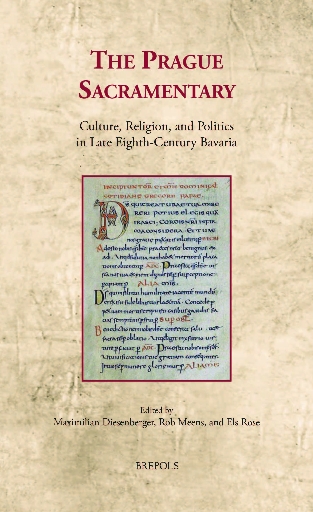
The Prague Sacramentary
show More to view fulltext, buy and share links for:The Prague Sacramentary show Less to hide fulltext, buy and share links for: The Prague SacramentaryThe Prague Sacramentary is a unique liturgical manuscript which can be very precisely located in a specific social and historical context. It was written in the turbulent period when Charlemagne crossed Bavaria to fight the Avars and when his son Pippin rebelled against him, seeking support among the Bavarian nobility. The manuscript can be linked to specific groups of Bavarian elites that had to come to terms with this explosive political situation. It also elucidates the ways in which Christian culture was expressed and experienced in Bavaria at the end of the eighth century. Although Bavaria may be regarded as a periphery from a Frankish perspective, it was certainly no cultural backwater. Because of its geographical position at the crossroads of Italian, Bavarian, and Frankish culture, Bavaria produced unique and intriguing texts and artefacts.
One such object is analysed here by a team of experts, shedding renewed light on the earthly and heavenly concerns of an early medieval community in a specific region. It includes a discussion of the topics of the formal invocation of saints, vernacular understandings of Latin texts, marriage, politics, and concerns for ritual purity as well as the well-being of the conflict-ridden Carolingian family.
-
-
-
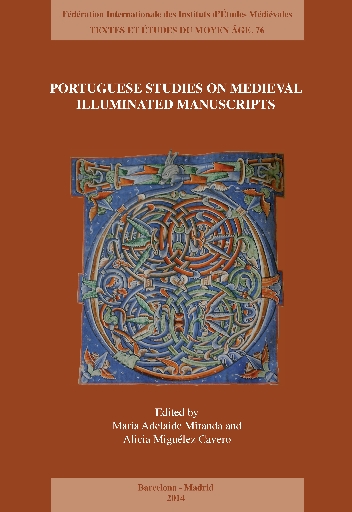
Portuguese Studies on Medieval Illuminated Manuscripts
show More to view fulltext, buy and share links for:Portuguese Studies on Medieval Illuminated Manuscripts show Less to hide fulltext, buy and share links for: Portuguese Studies on Medieval Illuminated ManuscriptsIn the most recent years a group of young researchers has given a new impetus to the study of Book Illumination in Portugal, promoting national and international research that focuses on understanding illuminated manuscripts in both their aesthetics and material dimensions, as well as the relationship between text and image. The developement of interdisciplinary research thanks, in part, to strategic partnerships between the Humanities and the domain of Exact Science has been established to address new issues raised by the need of more comprehensive and wide studies around the illuminated manuscript.
This volume gives thus light to the most important contributions of these new approaches, including new technical studies of pigments in manuscripts of the fund of the Monastery of Alcobaça and three copies of Hugh of Fouilloy’s Book of Birds, inquiries concerning a mismounted mappamundiin the Lorvão Beatus, a study of two southern French legal manuscripts, the image of the artist in astrological iconography, problems raised by two books of hours in the National Library of Portugal, and penwork decoration in fifteenth-century Hebrew manuscripts.
The authors of the volume belong to three Portuguese academic institutions. Maria Adelaide Miranda, Alicia Miguélez Cavero, Catarina Fernandes Barreira, Maria Alessandra Bilotta, Ana Lemos and Luís Ribeiro are integrated members of the Institute of Medieval Studies of the Nova University of Lisbon; Maria João Melo, Rita Castro, Conceição Casanova, Vania Solange Muralhas e Rita Araújo are members of the Department of Conservation and Restoration of the Nova University of Lisbon; Luís Urbano Afonso e Tiago Moita are members of the Institute of History of Art of the University of Lisbon.
-