


Antiquité Tardive - Late Antiquity - Spätantike - Tarda Antichità
Revue Internationale d'Histoire et d'Archéologie (IVe-VIIIe siècle)
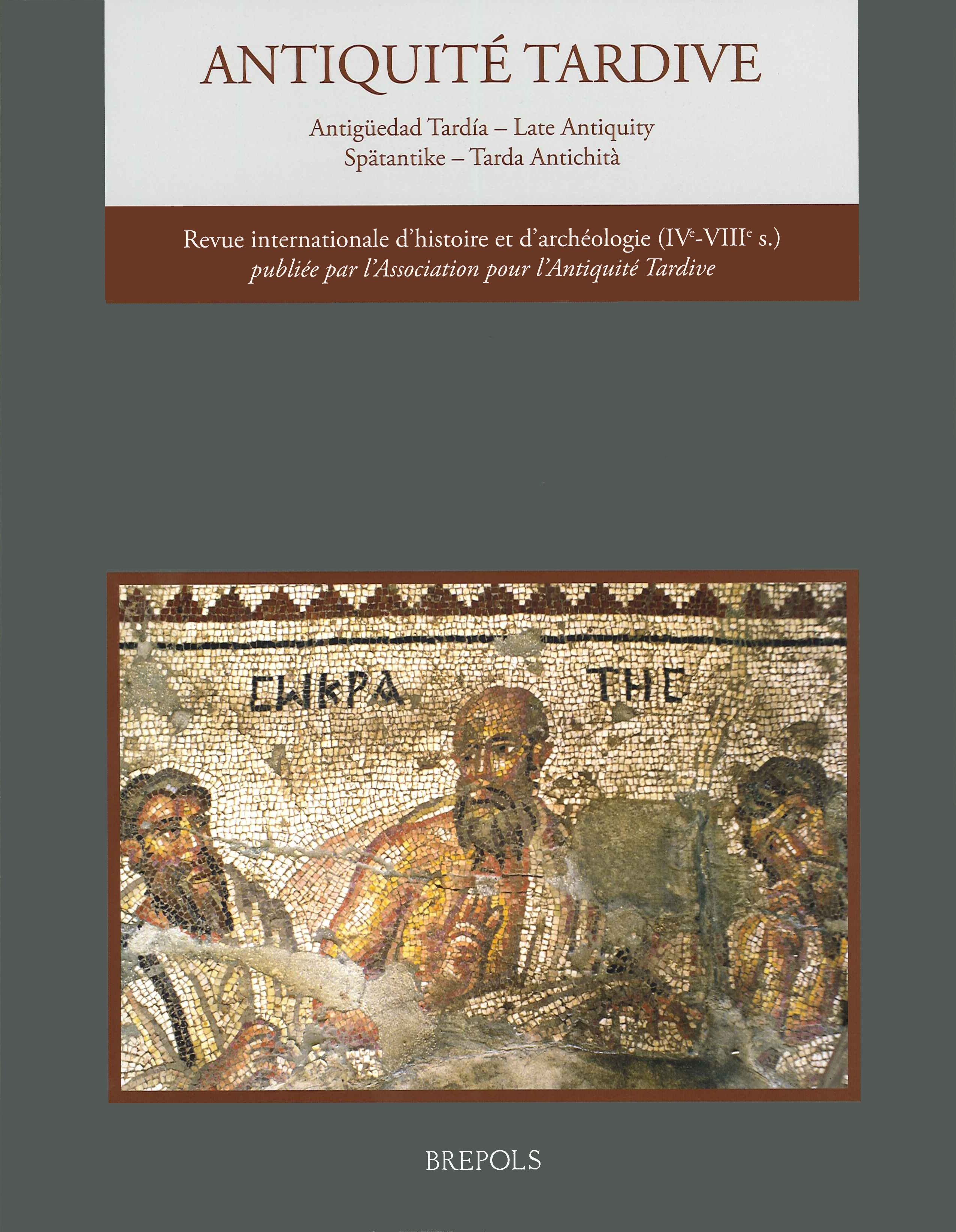
Volume 18, Issue 1, 2011
-
-
Front Matter (“Title page”, “Principal abbreviations”, “Table of contents”, “Editorial”, “Editorial board”, “Notes on colloquium”)
show More to view fulltext, buy and share links for:Front Matter (“Title page”, “Principal abbreviations”, “Table of contents”, “Editorial”, “Editorial board”, “Notes on colloquium”) show Less to hide fulltext, buy and share links for: Front Matter (“Title page”, “Principal abbreviations”, “Table of contents”, “Editorial”, “Editorial board”, “Notes on colloquium”)
-
-
-
Libri, lettura e biblioteche nella tarda antichità: Un Panorama e qualche riflessione
show More to view fulltext, buy and share links for:Libri, lettura e biblioteche nella tarda antichità: Un Panorama e qualche riflessione show Less to hide fulltext, buy and share links for: Libri, lettura e biblioteche nella tarda antichità: Un Panorama e qualche riflessioneBy: G. CavalloAbstractDoes Late Antiquity — whether considered under the perspective, even if partial, of books, reading, libraries — show an autonomy or at least a specificity, or rather is it only a period of transformations, during which Antiquity knows its twilight while Middle Age is beginning? It is difficult to answer to this question. Anyway, on the ground of the evidences here considered, it is possible to say that Late Antiquity is deeply different from the previous period. Ancient models disappear or resist for some time only if adapted to the new socio-cultural contexts, and at the same time new models of books, writing, reading, libraries have a bigger preponderance, finally turning in a system of written culture completely different from the past one. For what concerns the parallel with the following period, the Middle Ages, it would be crucial to assess if books, reading, and libraries of that period have their roots in Late Antiquity, and, if so, to what extent; or, on the contrary, if they gained their own, specific morphology. But similar considerations are beyond the topic of this paper.
-
-
-
Le biblioteche nella tarda antichità: l’apporto dell’archeologia
show More to view fulltext, buy and share links for:Le biblioteche nella tarda antichità: l’apporto dell’archeologia show Less to hide fulltext, buy and share links for: Le biblioteche nella tarda antichità: l’apporto dell’archeologiaAbstractIn the earlier studies devoted to the architecture and fitting out of ancient libraries, little attention was paid to their late antique phases. As often with Greek and Roman monuments, they were studied mainly from the architectural point of view, therefore only the original structure of the buildings and possibly their major transformations (as in the case of the library of Hadrian in Athens) were investigated, without taking into account their becoming in the course of time. Based on a misinterpretation of a passage in Ammianus Marcellinus, and the premise of a widespread cultural decay, it is generally taken for granted that libraries were abandoned by the middle of the fourth century. The aim of this paper is to verify the correctness of this picture, reconsidering both the archaeological and the textual evidence. The basic data on the main public and private Roman libraries are presented, with reference to the excavations reports; they show that public libraries follow either a standardized, elaborate architectural scheme (the rectangular room, with rows of niches in the walls) or simpler solutions, where free wooden shelves are used to store the books. This seems to be the case also with most of the private libraries; on the other hand the wide use of niches made by the residential architecture starting from the 1th c. A.D. makes it difficult to identify with certainty any specific function.
As far as late antiquity is concerned, recent archaeological investigations show that the picture is far from homogeneous; there is no evidence of an early neglect, and in the case that the library buildings are damaged by external causes at the end of the 4th c. (Ephesus, Sagalassos), they were taken care of as civic monuments. The written sources confirm that the cultural life remained active up to the 5th-6th centuries, manifestly in Athens, but also in Rome, where one of its settings was the area of the Trajan’s Forum and of its libraries. They also attest the major role of libraries in the aristocratic style of life; however, as in previous centuries, the architectural setting of private libraries, as well as their possible distinctive features, remain hardly perceptible. Equally, very little is known from the archaeological point of view of the ecclesiastic libraries, the only possible cases being the scanty rests of the scrinium Lateranense; the identification as libraries of the two side chambers of Saint John the Evangelist in Ravenna, although suggestive, should be cautiously received, while the attribution to the bibliotheca Agapeti of a late antique hall on the Celio in Rome has been finally discarded, since it has been proved that the large apsis still standing is the reception hall of a domus.
-
-
-
Les lieux des lettres dans les villae occidentales de l'antiquité tardive
show More to view fulltext, buy and share links for:Les lieux des lettres dans les villae occidentales de l'antiquité tardive show Less to hide fulltext, buy and share links for: Les lieux des lettres dans les villae occidentales de l'antiquité tardiveBy: J.-Ph. CarriéAbstractThis paper summarizes an attempt to identify a socially crucial space of the aristocratic residence: the “study room”. Many writers, like Pliny the Younger, Sidonius or Symmachus, left testimonies about the social significance of being well read for the aristocrat. This statutory obligation implies that special spaces should have been devoted to the practice of study in the aristocratic residence. But one must admit that, unlike dining rooms or other reception spaces involved in the self-representation strategy, the “study rooms” are not easy to isolate within the private residence, mainly because reading and studying are, by nature, low constraint activities, which are likely to take place in a variety of spots in the house, and the scarcity of explicit archaeological evidence doesn’t help to propose identificatory elements for the “study rooms”. Nevertheless such an attempt, perhaps less hazardous as it first seems, is worth being ventured.
A first step in the identification process is to analyze the antique sources in order to make out the ideal profile of the “study room”. A second one consists in comparing the ideal profile and the available archaeological structures. As a result, this experiment allows to isolate nine probable “study rooms”. It doesn’t allow us, for the moment, to draw out a typology. But it confirms the existence of such structures in the late western villae and encourages carrying on the observations.
-
-
-
Le opere dei padri della chiesa tra produzione e ricezione: la testimonianza di alcuni manoscritti tardoantichi di Agostino e Girolamo
show More to view fulltext, buy and share links for:Le opere dei padri della chiesa tra produzione e ricezione: la testimonianza di alcuni manoscritti tardoantichi di Agostino e Girolamo show Less to hide fulltext, buy and share links for: Le opere dei padri della chiesa tra produzione e ricezione: la testimonianza di alcuni manoscritti tardoantichi di Agostino e GirolamoAuthors: O. Pecere and F. RonconiAbstractIn Late Antiquity the development of an autonomous Christian culture brought about important changes in the methods of composition and revision of texts. In the first instance, St Augustine’s Retractationes clearly show that many of his works (including the De Trinitate and the De Civitate Dei) were composed in desultory fashion over a long period. This implies textual instability, incompatible with the idea of a static archetype. Such instability is reflected in the physical characteristics of some of the oldest Patristic manuscripts, for example Petropol. Q.v.I.3 which contains one of the first collections of various works by Augustine. This collection was probably initiated, between the 4th and 5th century, by a scribe working in an African milieu connected with Augustine and then completed elsewhere in the 6th or 7th century. Another important observation concerns the Late Antique revision of texts: subscriptiones and certain marginal notes in sixth- and seventh-century Patristic manuscripts attest to the practice of textual correction. Study of these notes reveals the intention of stabilizing the transmission which had often been disrupted through complexity of the composition process.
The palaeographical and codicological study of the sixth-century manuscripts Paris. lat. 12214 and Paris. lat. 2235 (respectively the two most ancient manuscripts of St Augustine’s De civitate Dei and of the Tractatus in librum Psalmorum attributed to St Jerome) enables us to reconstruct the process of their transcription and their subsequent history. Paris. lat. 12214 was probably copied from two models (one containing the canon, the other the first part of the De civitate Dei), which may have orginated in the milieu of Eugippius. Paris. lat. 2235 is made up of three original manuscripts — probably three volumes of one single ‘edition’ — which were later bound together as a book. It also derives from several models, each containing a short section of the Tractatus. The emendationes made in both manuscripts shortly after their transcription reveal a strong attention to the material aspects of the books.
-
-
-
Le Juvénal des Carolingiens à la lumière du Ms Cambridge King’s College 52
show More to view fulltext, buy and share links for:Le Juvénal des Carolingiens à la lumière du Ms Cambridge King’s College 52 show Less to hide fulltext, buy and share links for: Le Juvénal des Carolingiens à la lumière du Ms Cambridge King’s College 52By: V. von BürenAbstractSince the nineteenth century, Heiric ‘of Auxerre’, as he is usually called, has been credited with a commentary on Juvenal’s Satires attributed in some late manuscripts to a Cornutus. No earlier manuscript evidence has ever been found for Heiric’s authorship. The manuscript that is now Cambridge King’s College 52, privately owned until 1954 and ignored by all editors of Juvenal, furnishes the oldest testimony for the Nicaean subscription and contains one of the richest sets of glosses in the ninth-century manuscripts. On paleographical grounds it can be considered a product of the scriptorium of Hincmar of Rheims, and its text belongs to Knoche’s lambda family, held to go back to Antiquity. Its marginal commentary, copied along with the text, contains, in condensed form, most of the information found in the vulgate ‘Cornutus commentary’. Some of the glosses, added later, can be attributed to the hand of Heiric. Most of this material also appears in the vulgate commentary. The King’s manuscript makes it possible to recognize the Carolingian contribution to what is mostly a late-antique commentary. Thus, it advances our understanding of the Carolingian approach to Roman satire, which in fact seems quite limited and largely concerned with prosody.
-
-
-
Portraits de lecteurs: Athénée de Naucratis et Aulu Gelle
show More to view fulltext, buy and share links for:Portraits de lecteurs: Athénée de Naucratis et Aulu Gelle show Less to hide fulltext, buy and share links for: Portraits de lecteurs: Athénée de Naucratis et Aulu GelleBy: Chr. JacobAbstractAthenaeus and Aulus Gellius are key authors in order to understand the role of libraries and books in the writing of scholarly texts: extracts and quotations play a central part in their works. Reading practices are also displayed through various characters or through self-reflection. This paper is a first step towards a comparison between these two writers, in order to shed light upon their specific use of books, in its technical, social and intellectual dimensions. Beyond the information they provide us with, Deipnosophists and Attic Nights are essential sources in order to understand a particular idea of culture (paideia), where the knowledge drawn from books inspires various scholarly practices, between memory and performance.
-
-
-
Lettura e lettori in Agostino
show More to view fulltext, buy and share links for:Lettura e lettori in Agostino show Less to hide fulltext, buy and share links for: Lettura e lettori in AgostinoBy: M. CaltabianoAbstractBook reading had a crucial role in St Augustine’s life and guided his long and troubled path to conversion. This paper considers various elements present in his works related to reading Holy Scripture and letters in the Monastery of Ippona; however, the focus here is not on Augustine as a reader but on Augustine as promoter of book reading among men who were variously active in political and religious life, but who were all highly cultivated.
-
-
-
Saxa loquuntur? Epigrammi epigrafici e diffusione della paideia nell’Oriente tardoantico
show More to view fulltext, buy and share links for:Saxa loquuntur? Epigrammi epigrafici e diffusione della paideia nell’Oriente tardoantico show Less to hide fulltext, buy and share links for: Saxa loquuntur? Epigrammi epigrafici e diffusione della paideia nell’Oriente tardoanticoBy: G. AgostiAbstractThis paper deals with the reading and the reception of Greek epigraphic epigrams in Late Antiquity. Inner features of the texts — repeated allusions to the ‘voices’ of the poems, frequency of dialogic structures —, as well as aspects of the mise en page, combined with literary testimonies, lead to conclude that in Late period also epigraphic epigrams were read aloud, through an ‘oralised’ reading. The high literary language and style of many late epigrams were obviously not accessible to a wider audience: from the point of view of reception, we should distinguish between the cultivated élite, able to properly understand the literary content of the epigrams, and a semiliterate audience, which probably ‘read’ the texts through the intermediation of a lector. The greatest part of the ‘readers’, nevertheless, was aware of the cultural prestige of an inscribed literary poem, even when they could not well grasp all the subtleties of the text. In the last part of the paper, after examining the possible reception of some epigrams in Christian context, I suggest that epigrams on stones played a significant role in assuring the social importance of classical paideia in the Christian world.
-
-
-
Le livre comme objet d’usage, le livre comme valeur symbolique
show More to view fulltext, buy and share links for:Le livre comme objet d’usage, le livre comme valeur symbolique show Less to hide fulltext, buy and share links for: Le livre comme objet d’usage, le livre comme valeur symboliqueBy: J.-M. CarriéAbstractRather than trying to draw artificially unifying conclusions from such a mutif-faceted conference, it has been choosed to come back to the personal experience of some privileged witnesses, — mainly Libanios, but also the Gallic arstocrats of the fifth century and, as an earlier couterpoint, Galienus. Through their different ways of leading a life with books, it has been tempted to consider from their rational or affective view-point and handling such problems as obtaining books, paying for books, sharing books, living among books or doing without books. The guiding hypothesis was that in the late classic world book was a costly non necessary item with a high subjective and symbolic value, which explains how it economically behaved differently from other artifacts or valuables.
-
-
-
Septime Sévère à Byzance: L’invention d’un fondateur
show More to view fulltext, buy and share links for:Septime Sévère à Byzance: L’invention d’un fondateur show Less to hide fulltext, buy and share links for: Septime Sévère à Byzance: L’invention d’un fondateurBy: A.-V. PontAbstractThe theme of Septimius Severus, second founder of Byzantium and builder of edifices in this city, after the legendary Byzas and before Constantine, was spread through literary works written in Constantinople and in Antioch from the 6th century onwards. And yet, that is not confirmed by archaeology, and neither is it voiced in sources from the beginning of the 3rd century. I proposed therefore to broach this subject from a different perspective, by comparing the elements of this singular narrative with contemporary, historiographical and numismatic sources, and with the information on these geopolitical balances of an empire engaged in profound restructuring in the 3rd century. In comparison, the Byzantine corpus upon which I led my investigation is made up of two parts: historiographers, chronographers or abbreviators on the one hand, the Patria, poetic descriptions of sites or public monuments on the other hand. The classification of this information thus shows how, on the model of Antioch in Syria, Byzantium was endowed a posteriori with a rank that was not rightfully hers in the 3rd century, from a teleological perspective that has little relation with historical reality. With this operation, Nicomedia, neighbour of Byzantium, whose role throughout the 3rd century led it to go as far as to grow, like Cologne, Milan or Antioch, so that it became an imperial capital under Diocletian, was symbolically dispossessed and cast into the shadows for reasons of constantinopolitan civic pride.
-
-
-
Domitius Zenophilus, les Actus Silvestri et la province d’Asie
show More to view fulltext, buy and share links for:Domitius Zenophilus, les Actus Silvestri et la province d’Asie show Less to hide fulltext, buy and share links for: Domitius Zenophilus, les Actus Silvestri et la province d’AsieBy: A. de BeynastAbstractThe article proposes the joint study of an epigraphic and prosopographic appraisal on Domitius Zenophilus (cos. 333), a major figure of the Constantinian reign, and of the question of his symbolic figuration in the Actus Silvestri. By demonstrating the influence of Ephesian traditions on the choice of the judges of the Judeo-Christian controversy in these Actus Silvestri, it leads to formulate several hypotheses, among which the confirmation of his Asian proconsulate and of the attribution of the ILAfr 456 headless inscription, as well as a conversion to Christianity to be dated before his consulate, probably connected with this Asian period.
-
-
-
Greek rhetoric and the later Roman empire. The bubble of the ‘third sophistic’
show More to view fulltext, buy and share links for:Greek rhetoric and the later Roman empire. The bubble of the ‘third sophistic’ show Less to hide fulltext, buy and share links for: Greek rhetoric and the later Roman empire. The bubble of the ‘third sophistic’By: L. Van HoofAbstractLongtemps négligée, la rhétorique tardo-antique fait maintenant l’objet d’un nombre croissant d’études. Pour mieux marquer cette revalorisation, on a introduit la dénomination de “Troisième Sophistique”. Le présent article entend démontrer que ce syntagme reste problématique: faute de s’accorder sur son signifié précis, les caractéristiques qui lui sont attribuées font l’objet d’une discussion constante. En particulier, le rapport entre la “Troisième Sophistique” et son prédécesseur, la Seconde Sophistique, manque de clarté. Un obstacle majeur qui a empêché de définir ce rapport est la différence d’approche que l’on constate entre les spécialistes de la littérature du Bas Empire et ceux de la littérature du Haut Empire: si la Seconde Sophistique a été longtemps interprétée — comme l’est encore trop souvent la littérature tardo-antique — comme une expression culturelle en déclin ou, du moins, privée de vitalité, les nouvelles approches méthodologiques développées au cours des deux dernières décennies en ont au contraire démontré le dynamisme et l’incidence sociale. Plutôt que de repartir du syntagme “Seconde Sophistique”, on propose une autre vision des choses: appliquées à l’Antiquité tardive, ces mêmes approches méthodologiques nous montrent pour cette époque des sophistes qui, loin d’avoir perdu leur prestige social au profit des professeurs de droit, des sténographes, ou des évêques, continuaient à jouer un rôle important dans la vie politique. Il en résulte, premièrement, une réévaluation des auteurs tardo-antiques, de leur position et de leur influence sociales; en second lieu le remplacement du paradigme “rupture et déclin” par le paradigme “transformation et adaptation”, selon un changement de perspective déjà opéré dans d’autres domaines de la recherche sur l’Antiquité tardive; et finalement, grâce à une comparaison plus serrée des littératures du Bas et du Haut Empire, la mise en évidence d’importants éléménts de continuité dans l’histoire de la rhétorique antique, sans pour autant oublier les éléments de discontinuité.
-
-
-
Un unicum nel Codice Teodosiano: il venerabilis papa di XVI, 5, 62
show More to view fulltext, buy and share links for:Un unicum nel Codice Teodosiano: il venerabilis papa di XVI, 5, 62 show Less to hide fulltext, buy and share links for: Un unicum nel Codice Teodosiano: il venerabilis papa di XVI, 5, 62By: E. DovereAbstractCTh. 16, 5, 62 is a shorter version of a law, addressed to the prafectus Urbis Romae, of a much longer one addressed by Aquileia, in the summer of the year 425, to the praefectus praetorio Galliarum: the Sirmondiana 6; within this, but not in the text of the previous more extensive document, one can find the only reference to the ‘papa’ — affectionate naming of the Roman bishop — in the Codex Theodosianus. The reasons of the use of such a title, never investigated by the scholars, appear to be dictated by the effort of the very young Valentinian III (in reality by his mother Galla Placidia) of obtaining, as soon as back from his exile in Orient but not yet in Rome, the political benevolentia of the Peter’s successor.
-
-
-
Un dossier d’accusation déposé auprès du praeses de Syrie Seconde pour faire parvenir une pétition à Justin Ier
show More to view fulltext, buy and share links for:Un dossier d’accusation déposé auprès du praeses de Syrie Seconde pour faire parvenir une pétition à Justin Ier show Less to hide fulltext, buy and share links for: Un dossier d’accusation déposé auprès du praeses de Syrie Seconde pour faire parvenir une pétition à Justin IerBy: F. MillarAbstractThis paper emphasises the great importance for the study of Late Antiquity of the availability of a large range of material which is «documentary» in character, but is preserved in later manuscripts. It then takes as an example the dossier of documents relating to the beginning of the reign of Justin I in CE 518, and the reversal of the favour shown by Anastasius to the monophysites, a dossier which was presented before the Synod of Constantinople of CE 536. Within this dossier, it sets out the structure and nature of the very detailed documentation submitted by the Chalcedonian bishops of Syria II to the governor of the province in order to secure the eventual deposition by the Emperor of their monophysite metropolitan, Peter of Apamea. In an Appendix Denis Feissel sets out a precise chronology of these exchanges.
-
-
-
Las ciudades de la Bética en la Antigüedad tardía
show More to view fulltext, buy and share links for:Las ciudades de la Bética en la Antigüedad tardía show Less to hide fulltext, buy and share links for: Las ciudades de la Bética en la Antigüedad tardíaBy: I. SanchezAbstractSe pretende concretar con carácter general cuáles fueron las incidencias urbanísticas más representativas que determinaron la imagen de la ciudad tardoantigua en la Bética. Se analizan los procesos de continuidad en la topografía urbana, y muy especialmente de ruptura, como la aparición y consolidación de unos nuevos hitos constructivos de referencia que deben ponerse en relación con los cambios sociales y religiosos que afectaron a las comunidades locales.
-
-
-
Le deversorium dans les villae occidentales tardives: éléments pour une identification archéologique
show More to view fulltext, buy and share links for:Le deversorium dans les villae occidentales tardives: éléments pour une identification archéologique show Less to hide fulltext, buy and share links for: Le deversorium dans les villae occidentales tardives: éléments pour une identification archéologiqueBy: J.-Ph. CarriéAbstractSince the early XXth century it is globally admitted that the aristocratic Roman house offered lodgings for guests and occasional visitors. But practical questions remain when we attempt to precise the archaeological identification of those quarters. This article is aimed to provide criteria fit for pinpointing guests’ lodgings, through the combination of ancient texts and archaeological sources. The analysis of the texts, from Vitruvius to Isidore of Seville, allows understanding that the guests’ quarters are a very old housing concept, already known as domunculae or hospitalia during the Ist century BC. It also shows that in late Antiquity those structures, now called deversoria and strictly reserved for aristocratic guests, unlike the hospitalia, seemed to be a central part of the autorepresentative architectural apparatus. The ancient texts also provide helpful indications, once combined together, for delineating the shapes of the guests’ apartment and its position within the house. Beside elements of definition inferred from the texts, this paper proposes a method for the archaeological identification of the guests’ quarters among the spaces of the aristocratic residence. This method, based on 4 techniques, gave the opportunity to isolate 31 deversoria in 28 residences mainly throughout the dioceses of Spain, Britain and Gaul, from the Ist to the VIIth centuries p.C.
Thanks to these structures it has been eventually possible to propose a threefold typology for the deversorium. A first level refers to its shape, which could be “simple”, “multiple” or “occasional”. A second level of that typology, also drawn from field observations, proposes to specify the position of the deversorium within the entire building. Here, the three starting types are declined in six new types, which can be “isolated” or “inserted” in the house. The third and last level, inspired by Vitruvius’ explanations, concerns only the “inserted deversorium” and makes a difference between a lodging related to the œcus and another equipped with a proper access. Far from any dogmatism, this work does not intend to be definitive, but pretends only to trigger reactions and to foster the interest of archaeologists for the deversorium, as the study of this structure seems crucial to the understanding of the practical and social functioning of the late roman aristocratic house.
-
-
-
La écfrasis de la catedral de Lyon como híbrido intersistémico. Sidonio Apolinar y el Gesamtkunstwerk tardoantiguo
show More to view fulltext, buy and share links for:La écfrasis de la catedral de Lyon como híbrido intersistémico. Sidonio Apolinar y el Gesamtkunstwerk tardoantiguo show Less to hide fulltext, buy and share links for: La écfrasis de la catedral de Lyon como híbrido intersistémico. Sidonio Apolinar y el Gesamtkunstwerk tardoantiguoBy: J. H. LobatoAbstractThis paper aims to analyse the only extant literary testimony of the first Lyons cathedral, a remarkable early Christian building, whose exiguous remains still lie under today’s Cathédrale Saint-Jean-Baptiste-et-Saint-Étienne. The text is a detailed poetic ekphrasis of the temple, composed around 469 A.D. by the sophisticate Gallo-Roman writer Sidonius Apollinaris. These verses were commissioned, moreover, to be visually displayed on the apse of the church, as part of an extensive decorative programme carefully designed by Patiens (the bishop of Lyons). This paper undertakes an exhaustive literary analysis of the piece, which is seen as a perfect exponent of late antique aesthetic hybridization. To do so, it introduces some interesting theoretical considerations, such us the distinction between intra- and inter-systemic hybridizations — based to a great extent on Even-Zohar’s influential polysystem theory. As for the results, on the one hand, this work contributes to the precarious archaeological evidence of the lost temple a deep study of the sole literary source describing it, providing an essential help for the reconstruction of its shape, history and purpose. On the other hand, it essays a new approach to one of the most outstanding aesthetic features of Late Antiquity: the ekphrasis, which is now interestingly contextualized within the broader cultural pattern of hybridization.
-
-
-
Chronique
show More to view fulltext, buy and share links for:Chronique show Less to hide fulltext, buy and share links for: ChroniqueBy: F. PaschoudAbstractThis survey paper comments on various recent publications: a new volume of the full commentary of Ammianus by four dutsch scholars on book 26, a biography of the emperor Theodosius I, a commentary of the abbreviator Festus, and some remarks about a paper and a book of interest for the specialists of the «Historia Augusta».
-
-
-
Comptes Rendus
show More to view fulltext, buy and share links for:Comptes Rendus show Less to hide fulltext, buy and share links for: Comptes RendusAbstractHistoire et archéologie de l’Antiquité tardive.
P. Athanassiadi,Vers la pensée unique. La montée de l’intolérance dans l’Antiquité tardive (S. Destephen); S. Bœsch Gajano,Grégoire le Grand. Aux origines du Moyen Âge, et S. Bœsch Gajano,Grégoire le Grand hagiographe. Les Dialogues (D. Moreau); M. Dulaey,Symbole des Evangiles (Ier–VIe siècles), «Le Christ médecin et thaumaturge» (A.-O. Poilpré); K. M. Girardet,Kaisertum, Religionspolitik und das Recht von Staat und Kirche in der Spätantike (S. Destephen); P. L. Gavrilyuk,Histoire du catéchuménat dans l’Eglise ancienne (J. Spöth-Prudhomme); Ph. Henne,Grégoire le Grand et Ph. Henne,Léon le Grand (D. Moreau); M. Kahlos,Forbearance and Compulsion. The Rhetoric of Religious Tolerance and Intolerance in Late Antiquity (S. Destephen); J. van Oort et O. Hesse (eds), Christentum und Politik in der Alten Kirchen (S. Destephen); P. Pellegrini,Militia clericatus monachici ordines. Istituzioni ecclesiastiche e società in Gregorio Magno (S. Destephen); S. A. Takács,The Construction of Authority in Ancient Rome and Byzantium. The Rhetoric of Empire (S. Destephen); R. Webb,Demons and Dancers. Performance in Late Antiquity (L. Lugaresi).
Régions.
F. Alpi,La route royale. Sévère d’Antioche et les Églises d’Orient (512-518) (S. Destephen); R. Crampet alii, Wearmouth and Jarrow Monastic Sites (J.-P. Caillet); P. Donabédian,L’âge d’or de l’architecture arménienne. VIIe siècle (A. Arbeiter); T. Gnoli,The Interplay of Roman and Iranian Titles in the Roman East (1st-3rd Century A. D.) (A. Piras); R. Hachlili,Ancient Mosaics Pavements. Themes, Issues, and Trends. Selected Studies (A. Michel); P. Pourshariati,Decline and Fall of the Sassanian Empire: The Sassanian — Parthian Confederacy and the Arab Conquest of Iran (M. Omidsalar); R. Rizzo,Prosopografia siciliana nell’epistolario di Gregorio Magno (S. Destephen); J. Schiettecatte et C. J. Robin (eds), L’Arabie à la veille de l’islam, Bilan Clinique (V. Christides); H. Sivan,Palestine in Late Antiquity (Z. T. Fiema).
Philologie et sources.
M. Aubrun (trad.), Le Livre des papes — Liber pontificalis (492-891) (D. Moreau); M. G. Bajoni,Les grammairiens lascifs - La grammaire à la fin de l’Empire romain (St. Gioanni); Cyprien de Carthage,L’unité de l’Église (De ecclesiae catholicae unitate) (L. Ciccolini); Cyprien de Carthage,La jalousie et l’envie (L. Ciccolini); S. Gioanni et B. Grévin (eds), L’Antiquité tardive dans les collections médiévales. Textes et représentations, VIe-XIVe siècle (D. Moreau); Grégoire le Grand,Registre des lettres. II (St. Gioanni); C. Petit,Galien, tome III. Le Médecin (S. Destephen); S. Toscano,Tolle Divitem. Etica, Società e Potere nel De Divitiis (M. Casella); E. M. Tyler et R. Balzaretti (eds.), Narrative and History in the Early Medieval West (St. Gioanni).
-
Volumes & issues
-
Volume 32 (2024)
-
Volume 31 (2024)
-
Volume 30 (2022)
-
Volume 29 (2022)
-
Volume 28 (2021)
-
Volume 27 (2020)
-
Volume 26 (2019)
-
Volume 25 (2018)
-
Volume 24 (2017)
-
Volume 23 (2016)
-
Volume 22 (2015)
-
Volume 21 (2013)
-
Volume 20 (2013)
-
Volume 19 (2012)
-
Volume 18 (2011)
-
Volume 17 (2010)
-
Volume 16 (2009)
-
Volume 15 (2008)
-
Volume 14 (2007)
-
Volume 13 (2006)
-
Volume 12 (2005)
-
Volume 11 (2004)
-
Volume 10 (2003)
-
Volume 9 (2002)
-
Volume 8 (2001)
-
Volume 7 (2000)
-
Volume 6 (1999)
-
Volume 5 (1998)
-
Volume 4 (1997)
-
Volume 3 (1995)
-
Volume 2 (1994)
-
Volume 1 (1993)
Most Read This Month
