


Antiquité Tardive - Late Antiquity - Spätantike - Tarda Antichità
Revue Internationale d'Histoire et d'Archéologie (IVe-VIIIe siècle)
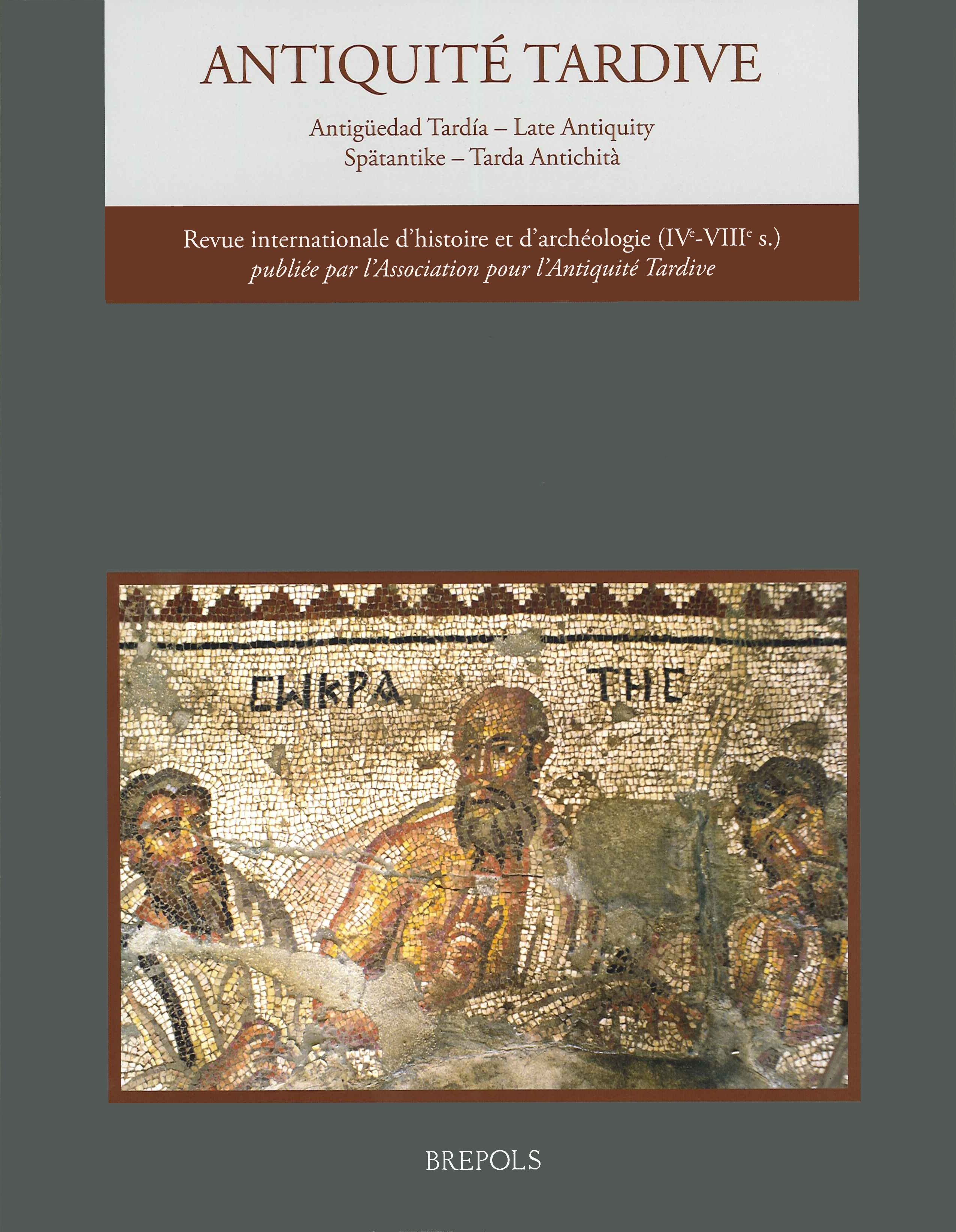
Volume 23, Issue 1, 2016
-
-
Isidoro de Sevilla y su época. A modo de introducción
show More to view fulltext, buy and share links for:Isidoro de Sevilla y su época. A modo de introducción show Less to hide fulltext, buy and share links for: Isidoro de Sevilla y su época. A modo de introducciónAuthors: Isabel Velázquez and Gisela Ripoll
-
- Isidore, ses œuvres et la culture de son temps
-
-
-
La lengua de Isidoro
show More to view fulltext, buy and share links for:La lengua de Isidoro show Less to hide fulltext, buy and share links for: La lengua de IsidoroBy: Carmen CodoñerAbstractIsidore’s language has been studied from the phonetic, morphological and syntactic point of view. The vision offered in this article is different. From the textual analysis of several Isidorian works belonging to different genres, and the comparison of some of them with previous and subsequent texts, we have tried to abstract the characteristics of the Isidorian prose, without taking into account the higher or lower degree of the accepted grammatical correction.
The conclusion, as is usual in this kind of syntactical studies, affects the discourse composition.
-
-
-
-
Connaître la bibliothèque pour connaître les sources : Isidore de Séville
show More to view fulltext, buy and share links for:Connaître la bibliothèque pour connaître les sources : Isidore de Séville show Less to hide fulltext, buy and share links for: Connaître la bibliothèque pour connaître les sources : Isidore de SévilleBy: Jacques ElfassiAbstractThe knowledge of Isidore’s sources did not stop progressing these last years, in particular thanks to the electronic databases. However, the list of these sources is not closed: this article begins with a list of recently discovered sources. It also shows how the criteria generally established to distinguish certain and uncertain, direct and indirect sources are not always valid; to this purpose, the reconstruction of Isidore’s library is not only a result of the search for his sources, but also, rather often, an essential prerequisite for this research. The article ends by suggesting new paths for future research, in particular about the history of the texts which converged into Isidore’s library.
-
-
-
Revisiones de autor y de copistas en las obras de Isidoro de Sevilla. A propósito de la Historia Gothorum
show More to view fulltext, buy and share links for:Revisiones de autor y de copistas en las obras de Isidoro de Sevilla. A propósito de la Historia Gothorum show Less to hide fulltext, buy and share links for: Revisiones de autor y de copistas en las obras de Isidoro de Sevilla. A propósito de la Historia GothorumBy: Isabel VelázquezAbstractThis paper deals with some aspects related to the works of Isidore of Seville that were revised by the author, as well as to other Isidorian works that were altered by copyists, introducing spurious interpolations and other modifications. This kind of study mainly focuses on the textual tradition and the extant manuscripts, but it should also take into account internal inquiry of the texts themselves, the sources used by the author, the aims of the works and their late tradition. Within this perspective, we make some considerations concerning the double recension of the De origine Gothorum (or Historia Gothorum) and its manuscript tradition.
-
-
-
Unidad y paz en el reino visigodo. Dos aspectos del pensamiento politico de Isidoro de Sevilla
show More to view fulltext, buy and share links for:Unidad y paz en el reino visigodo. Dos aspectos del pensamiento politico de Isidoro de Sevilla show Less to hide fulltext, buy and share links for: Unidad y paz en el reino visigodo. Dos aspectos del pensamiento politico de Isidoro de SevillaAbstractIsidore of Seville tried to support the survival of the Visigothic Kingdom in two fundamental political concepts: unity and peace. To obtain unity, which should encompass all matters affecting the people (religion, social community, law, economics and politics), it was first necessary to end the Arian heresy and restore rule under a single religion; it was also necessary to include all the population whether Goths or Hispani; to have the same law in force for the entire territory of the kingdom and strengthen the monarchy to guarantee political union. Isidore reported this necessity in the History of the Goths, with concrete examples from the past, which caused disunity, a weakening of political power and the decline of the Visigothic Kingdom. Peace was always a consequence of social and political unity and social justice leading to a legal whole. For peace and unity in the Visigothic Kingdom, Isidore of Seville did not hesitate to accept and justify actual situations that could have been qualified as unfair, such as the coup of Sisenandus.
-
-
-
„Isidorische Renaissance“ - oder: Über die Anbahnung einer Wiedergeburt
show More to view fulltext, buy and share links for:„Isidorische Renaissance“ - oder: Über die Anbahnung einer Wiedergeburt show Less to hide fulltext, buy and share links for: „Isidorische Renaissance“ - oder: Über die Anbahnung einer WiedergeburtBy: Markus MülkeAbstractIn what follows, the widespread idea of “Isidorian Renaissance” will be critically revised. The cultural floruit which marked Visigothic history in the 7th century had important roots already in the 6th century, i.e. in the time when Isidore himself was born, grew up and formed his own eruditio. For this development during the 6th century, the conflict between the Arian king Leovigild and the Catholic church played a decisive part and influenced the following era more than generally expected.
-
-
-
Isidore de Séville en son monde : lieux, peuples, époques
show More to view fulltext, buy and share links for:Isidore de Séville en son monde : lieux, peuples, époques show Less to hide fulltext, buy and share links for: Isidore de Séville en son monde : lieux, peuples, époquesBy: Hervé InglebertAbstract“Isidorus of Seville in his world” is different from “Isidore in his world”or “Isidore’s world” by putting the emphasis not on realia or on Weltanschauungen, but on the relations between Isidore’s writings, his classical and biblical culture and his public. Isidore had to describe a new Visigothic world with ancient Latin words. It was sometimes easy because the world was not so very different, such as astronomy or zoology, even if their meaning needed to be understood in relation to the Bible. In some cases though, the world was very different from that of Rome, in the case of, for example administrative geography, political ethnography or history. In the face of the imperial Constantinopolitan inheritance, Isidore praised the Visigothic Catholic kingdom using cultural geography, biblical ethnography and providential history. Finally, Isidore’s interest in integrating the classical culture in the definition of the new Christian knowledge showed he was more a ‘late antique’, than a ‘medieval’ man.
-
- Isidore et les acteurs sociaux contemporains
-
-
-
Isidor von Sevilla und das Königtum
show More to view fulltext, buy and share links for:Isidor von Sevilla und das Königtum show Less to hide fulltext, buy and share links for: Isidor von Sevilla und das KönigtumBy: Gerd KampersAbstractApproximately one and a half century after the end of the Roman Empire in the West, Isidore of Seville was the first one to develop a coherent idea of Christian kingship. This can be reconstructed mainly from his Historia Gothorum, canon 75 of the fourth council of Toledo, and above all his Sententiae. The article starts with an examination of the picture of the Visigothic kings and kingship as presented by Isidore in the Historia Gothorum. The analysis of canon 75 offers some new considerations regarding the deposition of king Suinthila, which - as he argues - was not contrary to the principles laid down by Isidore in the Sententiae. The article ends with a survey and assessment of Isidore’s idea of Christian kingship contained in the Sententiae.
-
-
-
-
Isidore and the gens Gothorum
show More to view fulltext, buy and share links for:Isidore and the gens Gothorum show Less to hide fulltext, buy and share links for: Isidore and the gens GothorumAuthors: Walter Pohl and Philipp DörlerAbstractQuelle portée avait la gens Gothorum dans les écrits d’Isidore et dans le monde dans lequel il vivait ? Cet article aborde la façon dont les Goths apparaissent dans l’Historia Gothorum, les Etymologiae et les Actes de Tolède III et IV. Le règne des Goths et l’existence d’un monde politique de gentes y apparaissent banals. Isidore promeut la vision d’une unité catholique de l’Espagne et de ses différents peuples sous l’autorité gothique, mais continue de distinguer les Goths comme un peuple à part entière. Leurs victoires et leur conversion au catholicisme donnent une légitimité à leur règne sur l’ensemble de la péninsule où ils doivent rechercher l’appui des évêques en tant que représentants de la patrie hispanique. Cette vision n’est pas vouée à masquer les différences entre les Goths et les autres populi d’Espagne, mais à trouver un équilibre fondé sur les valeurs du christianisme. Isidore était conscient des problèmes qu’avait engendré par le passé le règne des Goths etespérait contribuer à ce que leur autorité s’exerce de manière plus responsable dans le futur.
-
-
-
L'idéal monastique, les moines et les monastères du monde wisigothique selon Isidore de Séville
show More to view fulltext, buy and share links for:L'idéal monastique, les moines et les monastères du monde wisigothique selon Isidore de Séville show Less to hide fulltext, buy and share links for: L'idéal monastique, les moines et les monastères du monde wisigothique selon Isidore de SévilleAbstractThe monastic thought of St. Isidore is scattered in various works of different genres, each one demonstrating signs of an internal coherence that results from real-life experience and observation of monastic structures, coupled with a rigorous knowledge of the literary tradition. However, his contemporaries or immediate successors almost forgot the legacy of Isidore regarding the government of the monasteries. The purpose of this article is to identify some characteristics of the monastic vision of St. Isidore determined by a literary tradition, his observation of reality, and his need to convert monasteries into useful and positive communities transposed into the Visigothic church and Visigothic society.
-
-
-
Derecho y jurisprudencia en las fuentes de Isidoro de Sevilla
show More to view fulltext, buy and share links for:Derecho y jurisprudencia en las fuentes de Isidoro de Sevilla show Less to hide fulltext, buy and share links for: Derecho y jurisprudencia en las fuentes de Isidoro de SevillaAbstractThis paper aims to present a review of the “state of the art” concerning the problem of the legal sources (above all the ancient Roman law sources) used by Isidore of Seville in composing his works, mainly the Etymologies. First, the teaching of Law in the Early Middle Ages in the western former Roman Empire is briefly discussed, as well as how Isidore may have gained his his legal competence in the framework of the Medieval artes liberales. The content of the two principal works of Isidore which demonstrate knowledge of the Law (Etymologiae liber V de legibus and Differentiae liber I) is then described, and some comments are made about his methods of composition. To finish there is a brief description of the various works in Antiquity which could have inspired the writing of the juridical lemmata considered in the two books.
-
- La culture matérielle dans l'Hispanie d'Isidore
-
-
-
Material culture and the economy in the age of Saint Isidore of Seville (6th and 7th centuries)
show More to view fulltext, buy and share links for:Material culture and the economy in the age of Saint Isidore of Seville (6th and 7th centuries) show Less to hide fulltext, buy and share links for: Material culture and the economy in the age of Saint Isidore of Seville (6th and 7th centuries)By: Paul ReynoldsAbstractCet article présente une synthèse du large éventail de la culture matérielle de l’Hispanie des vie et viie siècles (péninsule Ibérique et Baléares), période qui couvre l’occupation et l’expansion wisigothiques ainsi que la reconquête byzantine. Y sont présentés les vestimenta, armamenta et outils agricoles, les objets liturgiques, les textiles, le mobilier et le décor ecclésiastiques, la poterie locale et d’importation (vaisselle de table, amphores, vaisselle de cuisine). Y sont également abordés la question du commerce à longue distance, de la Méditerranée et de l’Atlantique, ainsi que le rôle de l’Église, de la Carthage byzantine et de la Méditerranée orientale dans l’économie.
-
-
-
-
Isidoro y el paisaje rural contemporáneo (s. VII)
show More to view fulltext, buy and share links for:Isidoro y el paisaje rural contemporáneo (s. VII) show Less to hide fulltext, buy and share links for: Isidoro y el paisaje rural contemporáneo (s. VII)By: Javier ArceAbstractIn Isidore’s Etymologies there are very few references to the rural contemporary habitat. However, there are some worthy to be commented on and to be considered in the light of the archaeological work carried out in recent years. So, the present article is a study of the buildings mentioned by Isidore as part of the countryside and, eventually, their archaeological identification. The article deals also with problems of the different meanings of the vocabulary used to designate such buildings, as, for example, villa/castellum, villulae, castra, diversorium and so on, and the evolution of their meaning from the 5th to the 7th centuries in the Iberian Peninsula.
-
-
-
Die Sakralarchitektur Hispaniens im „Reich von Toledo“, aus der Sicht der aktuellen Forschung
show More to view fulltext, buy and share links for:Die Sakralarchitektur Hispaniens im „Reich von Toledo“, aus der Sicht der aktuellen Forschung show Less to hide fulltext, buy and share links for: Die Sakralarchitektur Hispaniens im „Reich von Toledo“, aus der Sicht der aktuellen ForschungBy: Achim ArbeiterAbstractThis inevitably basic contribution tries first of all to provide an overview of Hispano-Christian religious architecture, such as it appeared after a long development, in the eyes of the contemporaries of Isidore’s time. A distinction is made between urban and suburban churches on the one hand, and temples of the rural domain on the other. In addition, as the decades around 600 stand for a twofold occurrence - firstly, they serve for drawing a balance of what has been achieved, and secondly they give rise to new constructive ideals -, a comment is made on the important innovations of the 7th century, especially the structures made of ashlarblocks, which today are extant or prevail as examples of of the architecture of the kingdom of Toledo. Such a perception is presumably partial since it is almost exclusively based on the monumental examples of the rural environment while we know practically nothing about the public urban architecture of the 7th century.
-
-
-
La organización del espacio litúrgico hispánico entre los siglos VI y XI
show More to view fulltext, buy and share links for:La organización del espacio litúrgico hispánico entre los siglos VI y XI show Less to hide fulltext, buy and share links for: La organización del espacio litúrgico hispánico entre los siglos VI y XIAuthors: Eduardo Carrero and Daniel RicoAbstractThe study of the Old Hispanic rite as a means of understanding Late-Antique and Early Medieval Hispanic churches has been very fruitful since the publication in 1965 of a pioneer work by A. Rodríguez G. de Ceballos. However, in most recent years there have arisen some errors of perspective that tend to reduce liturgical arrangement of space to the architectural typology and morphology of church buildings, forgetting that the organisation of ritual space was commited to liturgical furniture as much (and even more) as to architectural forms, whether structural or typological. This paper identifies some recent misinterpretations of important liturgical-architectural matters, such as the hierarchical division of sacred space or the multiplication of altars within a same building, in order to permit a more realistic approach to liturgical space, less biased by the typological abstractions and stylistic assumptions of (non-liturgical) disciplines, such as the old History of Art and the new “archaeology of architecture”. From this point of view, it can be said that, in terms of liturgical space, Iberian architecture from the 6th to 11th centuries is in essence identical to the rest of Western architecture of the same period.
-
- L'héritage d'Isidore
-
-
-
En torno a la figura de Isidoro en el s. XIII: Lucas de Tuy
show More to view fulltext, buy and share links for:En torno a la figura de Isidoro en el s. XIII: Lucas de Tuy show Less to hide fulltext, buy and share links for: En torno a la figura de Isidoro en el s. XIII: Lucas de TuyBy: Emma FalqueAbstractThis article deals with Isidore of Seville’s influence on the works of the 13th-century author Lucas of Tuy. The three works of this author are precisely related to Isidore: the Chronicon mundi, De altera uita and Miracula sancti Isidori. Concurrently, we need to exclude from this analysis two other works, also about Isidore, which have been attributed to Lucas: the Vita sancti Isidori and Historia translationis sancti Isidori. These works, which are in some manuscripts associated with the Chronicon mundi, are from León and are related to Isidore. This has led scholars to believe that they were written by Lucas of Tuy, but today we know that they preceded him.
In addition we could draw attention to the false prophecy that Lucas attributed to Isidore in a council celebrated in Toledo where, according to this text, he predicted Spain’s future. In this context it makes sense that Lucas attributed this false prophecy to him, considering the importance of the saint in the work of this author.
-
-
-
-
Los Godos en la memoria histórica castellana del medievo
show More to view fulltext, buy and share links for:Los Godos en la memoria histórica castellana del medievo show Less to hide fulltext, buy and share links for: Los Godos en la memoria histórica castellana del medievoAbstractThe memory of the Gothic past is an essential component of Hispanic historical conscience. It has two dimensions: one political, the other religious. Political Gothicism as an ideological tool helped legitimize the territorial expansion of Hispanic Christian kingdoms in the Middle Ages. It’s character was both dynastic and ethnic. Religious Gothicism also had two facets: the cult of saints Isidore and Ildefonso and the bases of the rights of episcopal sees, especially the primacy of Toledo. The following stages can be observed in the evolution of hispanic Gothicism: foundations (the development of dynastic Gothicism in the Asturian chronicles of the 9th century and the origins of ethnic Gothicism), maturity in the great historians of the 13th century (Lucas de Tuy, Jiménez de Rada and Alfonso X), decline in the royal chronicles of the 14th century, and finally revival in the 15th century, which was linked to the international prestige of Castile and to the role of Alonso de Cartagena as statesman and scholar.
-
- Varia
-
-
-
Caius Valerius Diocles. Le premier nom d'empereur de Dioclétien et la reconnaissance de son autorité en Égypte. À propos de P. Oxy. XLII 3055 et AE 1973, 540
show More to view fulltext, buy and share links for:Caius Valerius Diocles. Le premier nom d'empereur de Dioclétien et la reconnaissance de son autorité en Égypte. À propos de P. Oxy. XLII 3055 et AE 1973, 540 show Less to hide fulltext, buy and share links for: Caius Valerius Diocles. Le premier nom d'empereur de Dioclétien et la reconnaissance de son autorité en Égypte. À propos de P. Oxy. XLII 3055 et AE 1973, 540By: Alexandra StefanAbstractFrom the P. Oxy. XLII 3055 dated « Year 1 of Dioklês » and from the reputation of Diqlot (Diocles) in Palestine as remembered in the rabbinic tradition, we retain that the authority of the new Augustus was recognized in the East under the name of C. Valerius Diocles. The cognomen Dioklês, -êtos attested in this papyrus shows that Diocletianus was derived from the stem Dioklet-, and refutes the hypothesis recently supported of the Illyrian origin of the last emperor’s cognomen. The same P. Oxy. 3055 leads to establishing the date of the recognition in Egypt of the Augustus Diocles probably in December 284, and to clarifying the chronology of the two successive prefects Pomponius Ianuarianus and M. Aurelius Diogenes. The first emperor’s name Caius Valerius Diocle was replaced in December 284 or in January 285 by the second, Caius Valerius Diocletianus, the only name used after the abandonment of Diocles and until the proclamation of Maximianus, and we propose a new restoration on this topic to the inscription AE 1973, 540. These precisions enable us to shed light on some political and ideological problems in a decisive stage of the conflict with Carinus.
-
-
-
-
Remarks on the logistics and infrastructure of the Annona Militaris in Eastern Mediterranean and Aegean areas
show More to view fulltext, buy and share links for:Remarks on the logistics and infrastructure of the Annona Militaris in Eastern Mediterranean and Aegean areas show Less to hide fulltext, buy and share links for: Remarks on the logistics and infrastructure of the Annona Militaris in Eastern Mediterranean and Aegean areasBy: Efthymios RizosAbstractCet article explore l’organisation et l’infrastructure matérielle du réseau de l’annone militaire dans l’empire Romain de l’Est, sur la base d’inscriptions et d’entrepôts publics. Les informations les plus anciennes sur les pratiques et l’infrastructure de l’annone militaire viennent de l’Anatolie méridionale. Les fameux horrea d’Hadrien à Patara et Myra pourraient être mieux expliqués comme des édifices reliés à l’approvisionnement de l’armée impériale plutôt qu’à l’annone civique ou au commerce, comme on le croyait jusqu’à maintenant. Cela était certainement le cas durant l’Antiquité tardive, quand l’inscription d’Eutolmius Tatianus incisée sur l’horreum de Myra décrit les procédures de collecte et entrepôt temporaire de l’annone militaire dans les entrepôts de l’état. Les deux grands ports lyciens s’inscrivent parmi d’autres sur les côtes méditerranéennes où on concentrait les produits provenant des provinces côtières avant de les envoyer aux frontières de l’empire, comme on le voit aussi sur une inscription de la province d’Achaïe/Grèce. Des exemples d’entrepôts publics de l’époque tardoromaine, localisés sur des sites d’Anatolie méridionale (Maximianopolis, Korasion), à Caesarea Maritima et au port de Maronea sur la côte égéenne de la Thrace, pourraient être aussi associés au même réseau annonaire.
L’impact de l’annone militaire sur la vie des populations provinciales se retrouve dans les inscriptions de primipilaires trouvées à Novae et Oescus en Moésie Inférieure, qui préservent la mémoire des officiels qui voyageaient des provinces Méditerranéennes au Danube en assurant le service de l’organisation, du transport et de la livraison des provisions annonaires. La manifestation la plus tardive des efforts de l’état pour maintenir le réseau annonaire est l’affectation de l’annone de Thrace à la quaestura exercitus sous Justininien.
-
-
-
Loans from Lords in the growth of the colonate
show More to view fulltext, buy and share links for:Loans from Lords in the growth of the colonate show Less to hide fulltext, buy and share links for: Loans from Lords in the growth of the colonateBy: Morris SilverAbstractSelon la théorie économique, le colonat aurait connu un important développement durant l’Antiquité tardive en lien avec les interventions de l’état romain concernant les marchés du crédit. Celui-ci avait imposé des mesures pour assurer légalement la sécurité des fermiers à la recherche d’emprunts et pour limiter les taux d’intérêt qui pouvaient être demandés par les bailleurs. À la suite de ces interventions, les propriétaires terriens ont pu bénéficier de meilleures conditions sur le plan légal pour obtenir des prêts leur permettant d’engager de petits fermiers que ne l’étaient les bailleurs ordinaires pour tirer avantage des prêts accordés aux petits fermiers indépendants. Ces conjectures s’appuient sur des lettres écrites par des fermiers (Anoup et Pieous) et des quittances, ainsi que par des discussions de Césaire d’Arles et de Salvien.
-
-
-
La percepción del espacio en el urbanismo tardoantiguo: características evolutivas en el ejemplo hispano
show More to view fulltext, buy and share links for:La percepción del espacio en el urbanismo tardoantiguo: características evolutivas en el ejemplo hispano show Less to hide fulltext, buy and share links for: La percepción del espacio en el urbanismo tardoantiguo: características evolutivas en el ejemplo hispanoAuthors: Pilar Diarte Blasco and Josep Maria Gurt i EsparragueraAbstractRoman urbanism experimented, in Late Antiquity, a fundamental transformation of its structural principles and organisation of space. However, the process - the context in which it took place and its phases - is currently imprecise and its guidelines remain difficult to determine. Taking the Iberian Peninsula as a case study, this article analyses the variants of these transformations, which seemed to be partially perceived by contemporary citizens. Moreover, and following our investigation of Hispanic urban centres, the article outlines the elements that define the characteristics of the Late Antique city and its projection onto the social imaginary: first, a different assessment of urban space, and secondly, a new conception of the horizontal and vertical lines of the construction project of cities.
-
-
-
El paisaje urbano de Toledo en la antigüedad tardía
show More to view fulltext, buy and share links for:El paisaje urbano de Toledo en la antigüedad tardía show Less to hide fulltext, buy and share links for: El paisaje urbano de Toledo en la antigüedad tardíaAbstractThis paper will assess the urban reality of Toletum within the overall process of transformation which is manifest in Hispanic cities, as well as other cities in the western Mediterranean during Late Antiquity. The urban landscape of Toletum inherited from the classical period had undergone major modifications, given that there had been fundamental changes in the reorganisation and concept of the ancient suburbium with regard to its buildings and function. Christianity, being a long-lasting phenomenon, was one of the most decisive elements in the transformation of society and, hence, the urban landscape during the 4th to 5th centuries. A few centuries later, the consolidation of the Visigothic capital had also particular consequences in the spatial planning and structurisation of new public and representational spaces as well as private space. Episcopal and royal evergetism contributed to the development of a new monumental architecture that defined a particular late Antique topography of urban and suburban landscape in which civil palatial architecture was combined with an urban liturgy and the so-called sacred itinerary by which the Christian city was defined.
-
-
-
Esporre la Scrittura. L'uso di testi biblici in epigrafi d'ambito pubblico fra Tarda Antichità e prima età bizantina (secoli IV-VIII)
show More to view fulltext, buy and share links for:Esporre la Scrittura. L'uso di testi biblici in epigrafi d'ambito pubblico fra Tarda Antichità e prima età bizantina (secoli IV-VIII) show Less to hide fulltext, buy and share links for: Esporre la Scrittura. L'uso di testi biblici in epigrafi d'ambito pubblico fra Tarda Antichità e prima età bizantina (secoli IV-VIII)AbstractFrom almost 800 Christian inscriptions bearing direct quotations of Biblical texts between the 4th and the 8th century AD collected in the corpus of the Biblia Epigraphica, more than a half is related to contexts of public use. By this expression one refers to those inscriptions which have as their first purpose - by their position, typology, quality, writing - the visibility and the readability of the widest possible audience: we will consider the “epigraphic adornment” (Ramsay) of public spaces and buildings, first of all - but not only - in churches and religious contexts.
Using a series of examples from both the West and the East of the orbis christianus antiquus, ranging from the end of the 4th century to the first decades of the 8th century, the aim of this paper is to illustrate the use and reception of Biblical texts from inscriptions made for an audience which deeply changes from Late Antiquity to the Early Middle Ages and Early Byzantium.
-
-
-
Quasi et ipsi nunc lapident iustos et occident prophetas: reflexiones críticas respecto de la motivación histórica del sermo XIII de Cromacio de Aquileia
show More to view fulltext, buy and share links for:Quasi et ipsi nunc lapident iustos et occident prophetas: reflexiones críticas respecto de la motivación histórica del sermo XIII de Cromacio de Aquileia show Less to hide fulltext, buy and share links for: Quasi et ipsi nunc lapident iustos et occident prophetas: reflexiones críticas respecto de la motivación histórica del sermo XIII de Cromacio de AquileiaBy: Esteban NoceAbstractJudaism and its followers are a usual target of the invectives of Chromatius of Aquileia. In fact, with reference to common stereotypes from aduersus Iudaeos literature, his Sermones and his Tractatus in Mathaeum offered an extremely depreciating image of the Jewish religion and its members. Nevertheless, several scholars have asserted that sermo XIII involved a reaction to the Jewish presence in the city, based principally on the fact that Chromatius linked the contemporary Jews to the stoning of the prophets and the murder of the Just. The aim of this paper is to reconsider this interpretation. I will maintain, on the one hand, that the crimes denounced by Chromatius in sermo XIII did not transcend the clichés of the aduersus Iudaeos literature; and on the other hand, that the imputation of these crimes to the contemporary Jews is not sufficient evidence to accept that the homily was historically motivated, since the attribution of the sins committed by the Jews of the past to the Jews of the present is a usual rhetorical practice in Chromatius’ work.
-
-
-
Simulación, abjuración y delación de Maniqueos en África: el testimonio de Augustín
show More to view fulltext, buy and share links for:Simulación, abjuración y delación de Maniqueos en África: el testimonio de Augustín show Less to hide fulltext, buy and share links for: Simulación, abjuración y delación de Maniqueos en África: el testimonio de AugustínAbstractHeresiological discourse has turned the simulatio of Manicheans into a recurrent topic. The integration of this issue into imperial legislation during the reign of Theodosius I was accompanied by the incorporation of denunciation as a method to uncover Manicheans and by the instituting of harsh penalties against those who persevered in their error. Nonetheless, from Constantine onwards, heretics could elude the punishment set forth in the laws through public abjuration of heresy. In the case of Manicheans, Honorius in 407 ratified the possibility of freeing them from their guilt provided they agreed to make public and voluntary condemnation of their error.
The implementation of the laws left ample margin for interpretation, elusion and adaptation to various contexts. Augustine, a former Manichean auditor and an expert in the simulatio strategy, reports a process of the implementation of anti-Manichean laws which both included non-exclusive options: the Manicheans’ abjuration of their heresy would only be credible as long as it was accompanied by the denunciation of the highest possible number of co-religionists. This paper examines the iter followed by a commonplace in heresiological discourse after it was incorporated into the laws and the implementation of anti-Manichean legislation in Africa based on the testimony of Augustine.
-
-
-
Zosimus' Synod of Rome in September 417 and his Letter to Westem Bishops (Cum aduersus)
show More to view fulltext, buy and share links for:Zosimus' Synod of Rome in September 417 and his Letter to Westem Bishops (Cum aduersus) show Less to hide fulltext, buy and share links for: Zosimus' Synod of Rome in September 417 and his Letter to Westem Bishops (Cum aduersus)By: Geoffrey D. DunnAbstractLe 22 septembre 417, l’évêque de Rome Zosime écrivit une lettre aux évêques d’Afrique, de Gaule et d’Espagne (Ep. 4 - Cum aduersus ; JK 331). Cette lettre faisait suite à un synode lors duquel il avait été question du refus de certains évêques de Gaule à se soumettre à l’autorité grandissante de Patrocle, évêque d’Arles, que Zosime avait soutenu les jours suivant son élection en mars de la même année (Ep. 1 - Placuit apostolicae ; JK 328). La question avait porté en particulier sur l’ordination par Procule, évêque de Marseille, de deux évêques, Tuentius et Ursus, et sur la création à leur intention de deux nouveaux diocèses, initiatives que la lettre condamnait également. Alors qu’on situait habituellement ce synode à Rome, David Frye a voulu qu’il se soit tenu à Turin et que Zosime s’y soit déplacé. Récemment, Michael Kulikowski est revenu à l’interprétation traditionnelle. Cum Aduersus est la première lettre parmi de nombreuses autres écrites en l’espace d’une semaine et répondant à l’accueil négatif fait aux projets de Zosime et Patrocle concernant la Gaule. Dans cet article, je souhaite proposer une nouvelle lecture de cette lettre, notamment en la rapprochant d’une autre lettre écrite la veille (Ep. 3 - Posteaquam a nobis ; JK 330) et adressée à Aurélien de Carthage au sujet de la controverse pélagienne et de la réhabilitation par Zosime de Caelestius : selon moi, lors des synodes de Rome tenus cette année-là, les débats sur le pélagianisme et sur la restructuration des églises de Gaule se sont agrégés au point d’exacerber l’esprit de l’évêque de Rome sur leur sérieux.
-
- Chronique
-
-
-
Notes on a new publication on the religious architecture of Caucasus in the 7th century
show More to view fulltext, buy and share links for:Notes on a new publication on the religious architecture of Caucasus in the 7th century show Less to hide fulltext, buy and share links for: Notes on a new publication on the religious architecture of Caucasus in the 7th centuryAbstractLe livre récent d’Armen Kazaryan est une étude considérable en 4 volumes, consacrée à l’histoire de l’architecture des pays du Caucase du Sud (Transcaucasie) au viie siècle. Il s’agit de l’Ibérie (Géorgie orientale), de l’Arménie et de l’Albanie Caucasienne. Cette monographie se concentre sur l’époque de l’essor de l’architecture ecclésiastique dans la région caucasienne et celle de la construction des grandes églises à coupole de plans variés. Parallèlement, A. Kazaryan se penche sur la question du développement de l’architecture de la région à l’époque paléochrétienne pour donner une idée des étapes qui ont précédé. L’étude comporte des chapitres analytiques et un catalogue. Les discussions autour des théories qui prédominaient à l’époque soviétique et des méthodes de recherches constituent l’intérêt majeur de ce livre. Alors que les chercheurs de l’époque soviétique insistaient sur les particularités nationales et sur le charactère strictement autochtone du développement architectural en Géorgie et également en Arménie, A. Kazaryan reconnaît des traits communs dans l’architecture des pays du Caucase du Sud et montre que cette région était ouverte à tous les contacts et toutes les influences des pays voisins, en premier lieu Byzance. L’auteur n’accepte ni la méthode typologique et évolutioniste de Josef Strzygowski, ni celle purement stylistique de l’historien de l’art géorgien Guiorgui Čubinašvili. Il suit au contraire l’approche multi-disciplinaire qui consiste dans l’analyse des formes architecturales, de la technique de construction, notamment des coupoles et des voûtes, du décor sculpté, ainsi que des sources écrites ; il montre le rôle important des ecclésiastiques connus et essaye de détecter les innovations créatives des bâtisseurs des édifices les plus importants. Cette approche permet d’établir une chronologie plus sure, même si un certain nombre de questions peu claires demeurent encore. Ce livre ample et novateur dresse une sorte de bilan des recherches sur l’architecture caucasienne du Haut Moyen Âge sur plus d’un siècle.
-
-
-
-
Bulletin critique
show More to view fulltext, buy and share links for:Bulletin critique show Less to hide fulltext, buy and share links for: Bulletin critiqueAbstractHistoire et archéologie de l’Antiquité tardive
P. Brown, Through the Eye of a Needle (Richard Westall) ; C. Kelly (dir.), Theodosius II. Rethinking the Roman Empire in Late Antiquity (Sylvain Destephen) ; A. D. Lee, From Rome to Byzantium AD 363 to 565 (Sylvain Janniard) ; A. Perrot (dir.), Les chrétiens et l’hellénisme (Camille Gerzaguet) ; I. Wood, The Modern Origins of the Early Middle Ages (Agnès Graceffa)
Régions
C. Balmelle et al., Carthage, colline de l’Odéon (Nicolas Lamare) ; R. Bockmann, Capital continuous (François Baratte) ; N. Gauthier, E. Marin, F. Prévot (dir.), Salona IV. Inscriptions de Salone chrétienne ive-viie siècles (Marc Heijmans) ; A. G. López, Shenoute of Atripe and the uses of poverty (Christel Freu) ; P. Thonemann (dir.), Roman Phrygia (Sylvain Destephen)
Philologie et sources
Amphiloque d’Iconium, Homélies. Tome I. Homélies 1-5, Amphiloque d’Iconium, Homélies. Tome II. Homélies 6-10 (Sylvain Destephen) ; I. Bochet (dir.), Augustin philosophe et prédicateur (Pierre Descotes) ; J. Chameroy, Les fouilles de la cathédrale de Rouen, 1985-1993. Tome 1, Le numéraire antique (Vincent Drost) ; C. Corbo, Constitutio Antoniniana (Antonino Metro) ; Eunape de Sardes, Vies des philosophes et des sophistes (François Paschoud)
-
-
-
Back Matter ("Publications reçues en 2015", "Instructions aux auteurs", "Recommendations to authors", "Volumes de la Bibliothèque de l’Antiquité Tardive")
show More to view fulltext, buy and share links for:Back Matter ("Publications reçues en 2015", "Instructions aux auteurs", "Recommendations to authors", "Volumes de la Bibliothèque de l’Antiquité Tardive") show Less to hide fulltext, buy and share links for: Back Matter ("Publications reçues en 2015", "Instructions aux auteurs", "Recommendations to authors", "Volumes de la Bibliothèque de l’Antiquité Tardive")
-
Volumes & issues
-
Volume 32 (2024)
-
Volume 31 (2024)
-
Volume 30 (2022)
-
Volume 29 (2022)
-
Volume 28 (2021)
-
Volume 27 (2020)
-
Volume 26 (2019)
-
Volume 25 (2018)
-
Volume 24 (2017)
-
Volume 23 (2016)
-
Volume 22 (2015)
-
Volume 21 (2013)
-
Volume 20 (2013)
-
Volume 19 (2012)
-
Volume 18 (2011)
-
Volume 17 (2010)
-
Volume 16 (2009)
-
Volume 15 (2008)
-
Volume 14 (2007)
-
Volume 13 (2006)
-
Volume 12 (2005)
-
Volume 11 (2004)
-
Volume 10 (2003)
-
Volume 9 (2002)
-
Volume 8 (2001)
-
Volume 7 (2000)
-
Volume 6 (1999)
-
Volume 5 (1998)
-
Volume 4 (1997)
-
Volume 3 (1995)
-
Volume 2 (1994)
-
Volume 1 (1993)
Most Read This Month
