


Antiquité Tardive - Late Antiquity - Spätantike - Tarda Antichità
Revue Internationale d'Histoire et d'Archéologie (IVe-VIIIe siècle)
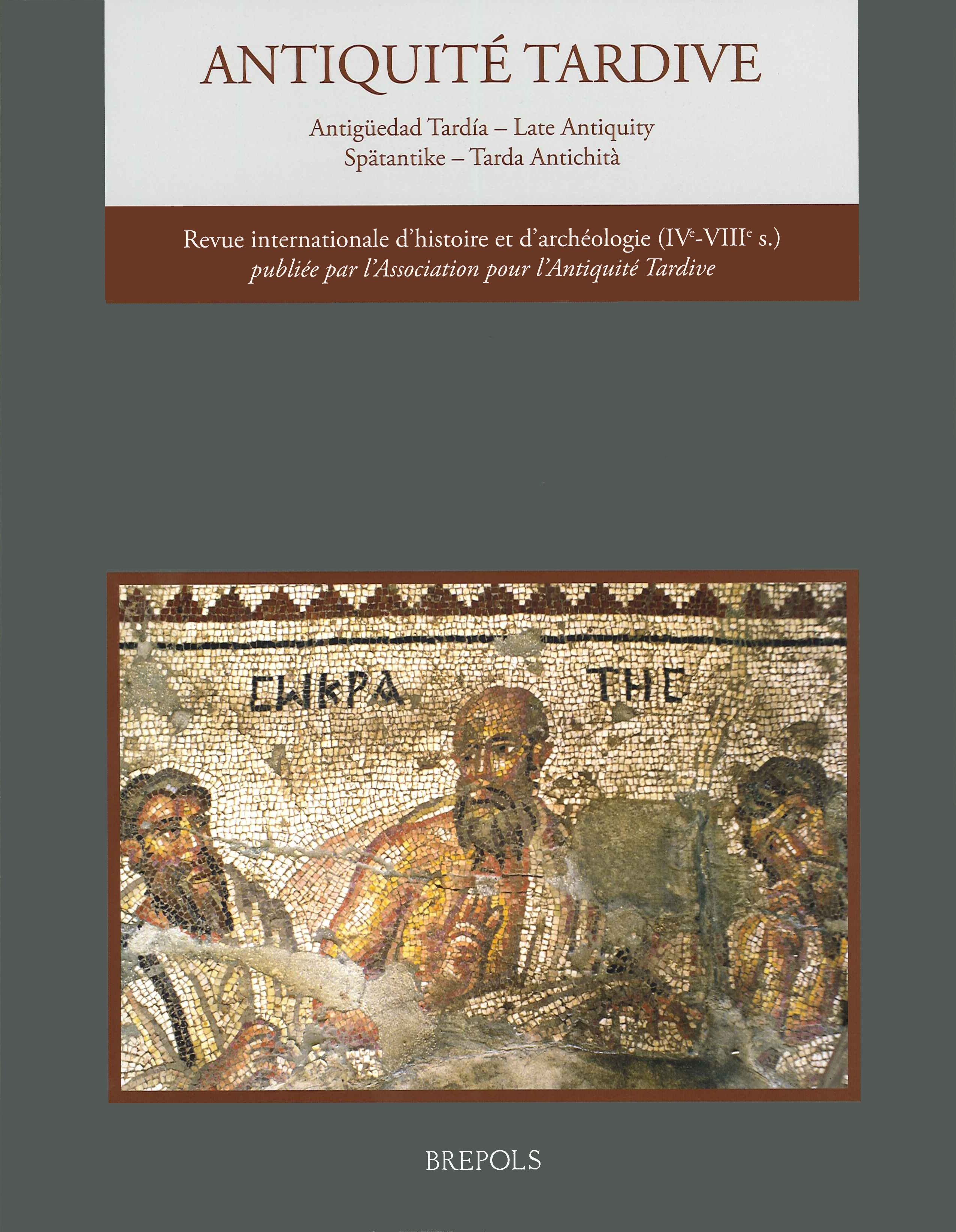
Volume 4, Issue 1, 1997
-
-
Front Matter (editorial information, title page, principales abbréviations, Table des matières, éditorial, erratum, in memoriam, avant-propos, bibliographie essentielle et abbréviations)
show More to view fulltext, buy and share links for:Front Matter (editorial information, title page, principales abbréviations, Table des matières, éditorial, erratum, in memoriam, avant-propos, bibliographie essentielle et abbréviations) show Less to hide fulltext, buy and share links for: Front Matter (editorial information, title page, principales abbréviations, Table des matières, éditorial, erratum, in memoriam, avant-propos, bibliographie essentielle et abbréviations)
-
-
-
Introduction. La recherche sur les "églises doubles" depuis 1936 : historique et problématique
show More to view fulltext, buy and share links for:Introduction. La recherche sur les "églises doubles" depuis 1936 : historique et problématique show Less to hide fulltext, buy and share links for: Introduction. La recherche sur les "églises doubles" depuis 1936 : historique et problématiqueAuthors: N. Duval and Jean-Pierre CailletAbstractThis is an attempt to present a status quaestionis tracing the parallel development of archeological evidence and its interpretation: 1) at the beginning of this century, the discovery of the problem (Niemann, Gnirs. Egger) following the excavations at Aquileia, Salona and Hemmaberg; - 2) R. Krautheimer's first theory (1936) regarding the case of Pavia, mainly based on mediaeval tradition and liturgical texts from Northern Italy; 3) the extension of those problematics to early mediaeval France (J. Hubert) and mediaeval Russia (A. Grabar (1938-1943); — 4) the excavations at Milano as interpreted by A. Capitano d'Arzago, and the diggings at Trier following the cathedral's bombing during WW II; - 5) the emergence of a general reflection among early mediaevalist circles and J. Hubert's first synthesis (1951); the renewal of researches at Aquileia (M. Mirabella Roberti, G. C. Menis, P.-L. Zovatto et L. Bertacchi) and in the Adriatic area; - 6) the German school's interest in double churches in relation to churches with a double sanctuary: double absides and Westwerk (Lehmann, Bandmann, Buauerreis, Radnoti, Jacobsen); - 7) J. Hubert's new synthesis following the discoveries at Geneva (1962), and from then onwards the many investigations made in the Gallic area, altogether infield excavations (Geneva, Grenoble, Lyon, Rouen, l'Isle-Joudain), on texts and mediaeval monuments (mainly in Provence, from P.-A. Février to Y. Codou and M. Fixot) and on the mediaeval topography of episcopal cities; - 8) the reappraisal of the Italian double cathedrals from 1966 onwards (Fonseca-Violante, P. Testini, G. Cantino-Wataghin, P. Piva); — 9) the progress of researches in the Adriatic and Southern Alps areas (Hemmaberg, Vranje, Dalmatia); the problem of the Aquileian patriarcate 's influence on those regions (R. Bratož) and that of rural groups of double churches (F. Glaser, P. Chevalier); — 10) the examination of the most recent attempts to present a synthesis: J.-P. Sodini (1984), P. Peterson Henriks (1989), P. Piva (1990, revised in 1994), E. van Welie (1993). The provisional conclusion mentions the documentation from other regions and presents a list of questions. An atlas of ca. 30 plans of well known and frequently-mentioned cases constitutes the visual documentation for the entire volume, in addition to the illustrations of each specific contribution.
-
-
-
Églises doubles et groupes d'églises du point de vue de l'histoire de la liturgie
show More to view fulltext, buy and share links for:Églises doubles et groupes d'églises du point de vue de l'histoire de la liturgie show Less to hide fulltext, buy and share links for: Églises doubles et groupes d'églises du point de vue de l'histoire de la liturgieBy: Pierre-Marie GyAbstractThe author begins with some thoughts on vocabulary: ecclesia usually refers to the community of the faithful and not to the building, a rather late meaning of the word; ecclesia mater is a metaphor or later designates the mother church of a diocese, not the main building of a group of churches; ecclesia major does not necessarily imply a ecclesia minor. He stresses also that the common distinction in the 4th and 5th centuries between fideles and catechumeni may have had consequences for the physical organization of the church. The author then reviews some liturgical documents. The ordines from Trier, Paris and Lyon are not earlier than the 13th century and make no distinction between liturgical function for different buildings. The ordines from Milan and a church in northern Italy (probably Aquileia according to G. C. Menis and P. Piva) mention the separate distinction in the 11th century (since when ?) between ecclesia hiemalis and ecclesia aestiva and allude to scrutini for the catechumens, who, however, were children at this time. The medieval distinction between ecclesia clericorum and ecclesia laicorum is linked to the internal division of the main building by the rood-screen. The notion of cura animarum is a modern one. The cult of martyrs does not necessarily imply a separate church, since the Eucharist is also celebrated in those churches dedicated to a martyr. The distinction between the liturgy of the Word and the liturgy of the Eucharist is valid only for the Early Church and implies separate locations for the fideles and the catechumeni, not buildings for the two liturgies. The liturgy of baptism during the Easter Vigil may have implied different spaces.
-
-
-
La "cattedrale doppia" e la storia della liturgia
show More to view fulltext, buy and share links for:La "cattedrale doppia" e la storia della liturgia show Less to hide fulltext, buy and share links for: La "cattedrale doppia" e la storia della liturgiaBy: Paolo PivaAbstractI - The author sets out to examine the theory, which is based, in part, on a passage from the Itinerarium Egeriae, and which concerns the Holy Sepulchre at Jerusalem, according to which the "Martyrium" is thought to have been the site of the first part of the Mass (the Liturgy of the Word), whereas the eucharistic rite was celebrated within the "Anastasis". This thesis, favoured by liturgists, was generally applied to "double cathedrals". Most recent historiography, however, has demonstrated that, whereas the oblatio was celebrated within the Martyrium, a lengthened or repeated, "oblatio" took place within the Anastasis. In the second part of the article, the author, taking into consideration information from Jerusalem and Milan, and reasoning on the basis of wider considerations within the history of liturgy, attempts to demonstrate that even the double episcopal churches of Trier and Aquileia, from the time of the Constantinian Peace, corresponded to the double character of early Christian worship (Sunday eucharist - weekday liturgical offices of praise and intercession). The larger church was intended principally for festive Masses, the smaller churches for the daily offices of matins and vespers. II - Re-examining an ordo scrutinomm, perhaps from the sixth century (within its original nucleus), and the "Testamentum Domini" (5th century), in addition to the Itinerarium Egeriae (4th century), the author maintains that there were no sites specifically intended for the instruction of the competentes. Instead, such instruction took place within the episcopal church during Lent. The more advanced catechumens and the competentes were allowed to participate in the Liturgy of the Word and in the daily offices of lauds, along with the faithful. Even acknowledging that fixed rules did not necessarily exist concerning the practices of the 'liturgical year', it can be said that in the case of the "double cathedral", the larger church was utilised for the instruction of the competentes, and the smaller church for the catechesis of neophytes during the Easter Octave (Jerusalem).
-
-
-
La liturgia battesimale ad Aquileia nel complesso episcopale del IV secolo - P. Piva, Domus episcopalis e aula di udienza: dove si trova il secretarium teodoriano di Aquileia ?
show More to view fulltext, buy and share links for:La liturgia battesimale ad Aquileia nel complesso episcopale del IV secolo - P. Piva, Domus episcopalis e aula di udienza: dove si trova il secretarium teodoriano di Aquileia ? show Less to hide fulltext, buy and share links for: La liturgia battesimale ad Aquileia nel complesso episcopale del IV secolo - P. Piva, Domus episcopalis e aula di udienza: dove si trova il secretarium teodoriano di Aquileia ?By: G.C. Menis
-
-
-
L'Anastasis: chiesa minor di una cattedrale
show More to view fulltext, buy and share links for:L'Anastasis: chiesa minor di una cattedrale show Less to hide fulltext, buy and share links for: L'Anastasis: chiesa minor di una cattedraleBy: Paolo PivaAbstractFocusing on the disagreement between Corbo and Couasnon on the archaeological reconstruction of the "Anastasis", and using the most recent historiography (Bermejo Cabrera), the author confirms the "status" of the complex of the Holy Sepuichre at Jerusalem as "double cathedral". The testimony of Egeria reveals that the Martyrium or ecclesia maior was primarily the site of festive Eucharists, and the "Anastasis", the location of the daily offices of Lauds. Zerfass demonstrated that this was the true and proper "cathedral" liturgy at Jerusalem, resembling the "stational" liturgy typical of sanctuaries.
-
-
-
Antike Kirchenanlage im Bereich von Dom und Liebfrauen - P. Piva, Osservazioni sull'evoluzione e la cronologia del gruppo episcopale di Treviri
show More to view fulltext, buy and share links for:Antike Kirchenanlage im Bereich von Dom und Liebfrauen - P. Piva, Osservazioni sull'evoluzione e la cronologia del gruppo episcopale di Treviri show Less to hide fulltext, buy and share links for: Antike Kirchenanlage im Bereich von Dom und Liebfrauen - P. Piva, Osservazioni sull'evoluzione e la cronologia del gruppo episcopale di TreviriBy: W. Weber
-
-
-
La cathédrale double de Rouen : état actuel du dossier
show More to view fulltext, buy and share links for:La cathédrale double de Rouen : état actuel du dossier show Less to hide fulltext, buy and share links for: La cathédrale double de Rouen : état actuel du dossierBy: Jacques Le MahoAbstractJacques Le Maho, who conducts since ten years an excavation around the cathedral, presents in this paper a new hypothesis about early churches in Rouen. Before and after WW II, remains of the cathedral's Romanesque apse and a deep installation in front of the Gothic transept were found. It is not an Early Christian altar, as previously believed, but more likely a crypte baldaquin belonging to the tenth-century church. During the recent excavation, a church with three aisles and part of a portico were discovered north of the cathedral. This new church can be dated to the second half of the fourth century and lies over a later Roman domus, whose baths (including the hot room, but not the pools) have been reused. A 10m. wide rotunda (only the foundations remain) was later constructed inside the central nave. This construction cannot be the baptistery, that lies more to the south, according to medieval tradition, but more probably a Carolingian martyrium, maybe the one built for the relics which bishop Vitrice honors in a speech dated 395-396. In this homily, Victrice speaks of a new basilica, still unfinished, that might be the three nave church. In this case, the first cathedral of Rouen still lies under the present one. According to the ancient Medieval tradition, the northern church was dedicated to Saint Stephen, whereas the ecclesia had been to Notre Dame from the very Merovingian period.
-
-
-
Le groupe cathédral paléochrétien de Lyon est-il une église double ?
show More to view fulltext, buy and share links for:Le groupe cathédral paléochrétien de Lyon est-il une église double ? show Less to hide fulltext, buy and share links for: Le groupe cathédral paléochrétien de Lyon est-il une église double ?AbstractThe author re-examines the Church of the Holy Cross which, following the thesis of J. Hubert, was first thought to be part of an Early Christian double church on the site of the cathedral group. Now he identifies the northern room with a heating system on the site of the future Holy Cross Church as a reception hall (perhaps linked to the episcopal church on the model of the cathedral group at Geneva revealed by C. Bonnet). The double cathedral (with a baptistery between the two churches) would either be of Carolingian, possibly Merovingien date. According to the author, the baptistery dates from tire fourth century: one wonders where the main church was before the fifth century and if a second one existed.
-
-
-
Le groupe cathédral de Grenoble (Isère) : essai sur ses origines
show More to view fulltext, buy and share links for:Le groupe cathédral de Grenoble (Isère) : essai sur ses origines show Less to hide fulltext, buy and share links for: Le groupe cathédral de Grenoble (Isère) : essai sur ses originesAuthors: Francois Baucheron and Alain de MontjoyeAbstractThe present arrangement of the cathedral, as well as medieval tradition and the dual dedication to St Vincent (now St Hugh) and Notre Dame, are reminiscent of a double church, until now considered medieval one, founded by Charlemagne himself according to legend. Scholars have long thought that the ancient cathedral was located outside the walls in Saint-Laurent. Jean Hubert and Paul-Albert Fevrier were the first to suggest that the origin of the double church might be older than medieval, but they lacked proof: an undated apse in the eastern side of the cloister south of Notre-Dame and a complex stratigraphy under St Hugues were juged insufficient proof. Since 1989, part of the tetrarchic curtain wall and a portion of the "Viennoise" gateway, a forth century construction built against this wall and a small funerary area were found in an excavation in front of the cathedral and suggested a Christian occupation as early as the fourth century. Anyhow from the very fifth century there existed a baptistery in front of the present cathedral: originally rectangular, endowed with an eastern apse, thereafter turned in a tetraconch. Meanwhile, the baptismal pool became narrower in depth and breadth. Light traces of the northern and eastern arcades of an atrium, in front of what could have been an ancient double cathedral, have been discovered.
-
-
-
Les installations liturgiques du baptistère et des trois églises épiscopales de Genève durant l'Antiquité tardive
show More to view fulltext, buy and share links for:Les installations liturgiques du baptistère et des trois églises épiscopales de Genève durant l'Antiquité tardive show Less to hide fulltext, buy and share links for: Les installations liturgiques du baptistère et des trois églises épiscopales de Genève durant l'Antiquité tardiveBy: Charles BonnetAbstractThe succession of developments in the Geneva episcopal group from the TV"1 century to the Carolingian period enables us to study differentiated liturgical fittings and a move towards a more and more visual liturgy. The author concludes that each church had his own function.
-
-
-
L'église paléochrétienne double de Martigny (Valais/Suisse)
show More to view fulltext, buy and share links for:L'église paléochrétienne double de Martigny (Valais/Suisse) show Less to hide fulltext, buy and share links for: L'église paléochrétienne double de Martigny (Valais/Suisse)Authors: Hans-Jorg Lehner and Frangois WibléAbstractIn this paper, F. Wible and H.-G. Lehner provide the conclusions of a report on the excavation conducted in the parish church of Martigny, the capital of Valais in Roman times and bishopric from the fourth to sixth century. The parish church lies outside the Roman town o/Forum Claudii Vallensianum. The first likely Christian building included two rooms, each with an eastward-facing exedra, belonging to an unidentified Roman building. In one of them, there was a pool which the authors think was a baptistery, whereas the condition of the other does not allow us to interpret its function. The first clearly double church, in the end of the fourth century, consisted of two rectangular rooms (15,40 x 7,70 north and 15,40 x 6 south) further extended by rectangular apses. The excavation revealed the complex development of the church: the baptistery, first included in the south church, was removed when the apse, which had a passage outside, was built; traces of later installations were also noted: a chancel screen in the north church, a semi-circular wall inside the two apses, a portico or gallery in front of the west side, additional constructions (parekklesion ?); one of which is a long narrow building with an absidal chapel, full of graves. In Carolingian times, the north church was rebuilt but the south church was deserted; later, the plan of the Romanesque church was still a double church with a large nave and only one aisle with an apse. In the seventeenth century, this arrangement completely vanished in a now westwardfacing church.
-
-
-
Le complexe de l'lsle-Jourdain : une église double ?
show More to view fulltext, buy and share links for:Le complexe de l'lsle-Jourdain : une église double ? show Less to hide fulltext, buy and share links for: Le complexe de l'lsle-Jourdain : une église double ?By: Jean-Paul CazesAbstractThe author directed an excavation on the ancient and medieval site «/Mutatio Bucconis, later called "Use" in medieval times, and abandoned in the twelfth century, when the castle was transferred to Lisle- Jourdain. In the vicinity of the Roman road, two funerary areas have been found, one of which is a small Prankish cemetery. An important Christian group developed in the main funerary enclosure: a church rebuilt in the fifth or sixth century and then in the First Middle Age, and a targe building with two apses, containing a baptistery, and probably deserted in the sixth or seventh century but rebuilt as a church once in the tenth century, then in the eleventh. We still do not know if this important baptismal and pastoral center, previously unknown, was ever been used as a double church.
-
-
-
Le "basiliche doppie" paleocristiane nell'Italia settentrionale: La documentazione archeologica
show More to view fulltext, buy and share links for:Le "basiliche doppie" paleocristiane nell'Italia settentrionale: La documentazione archeologica show Less to hide fulltext, buy and share links for: Le "basiliche doppie" paleocristiane nell'Italia settentrionale: La documentazione archeologicaAbstractNorthern Italy plays a leading role in the discussion on the "double churches", which actually arose from the results of the excavations in the precincts ofAquileia's basilica and ofKrautheimer's analysis of the tradition on Pavia's cathedral. In the long run, the presence of a Early Christian group consisting of two churches has been maintained for many episcopal cities of the region, often on the ground of later evidence, mainly the early medieval or even medieval organisation and/or double dedication of the cathedral. As a matter of fact, the archaeological evidence is limited to a minority of cities (Aquileia, Brescia, Concordia, Grade, Nesazio, Parenzo, Pola, Verona, Trento, Zuglio, to which we can add Pavia and Torino, where a double cathedral in the fifth century is suggested by reliable sources); it presents, moreover, many problems concerning the relative and absolute chronology, the structural development, the function of the two buildings. With the exception of the Theodoras 'complex ofAquileia, these seem to be in general of different dimensions, at times of different plan (Concordia), and constructed in successive times; the side by side setting of the two churches seems prevailing. It is worth remarking that the series includes a complex which was not a cathedral (Nesazio), on the other hand it does not extend to the diocesis of the Ravenna's metropolis.
-
-
-
II complesso episcopale di Milano : riconsiderazione della testimonianza ambrosiana nella Epistola ad sororem— P. Piva, L'ipotetica basilica doppia di Milano e la liturgia ambrosiana
show More to view fulltext, buy and share links for:II complesso episcopale di Milano : riconsiderazione della testimonianza ambrosiana nella Epistola ad sororem— P. Piva, L'ipotetica basilica doppia di Milano e la liturgia ambrosiana show Less to hide fulltext, buy and share links for: II complesso episcopale di Milano : riconsiderazione della testimonianza ambrosiana nella Epistola ad sororem— P. Piva, L'ipotetica basilica doppia di Milano e la liturgia ambrosiana
-
-
-
Doppelkirchen auf dem östlichen Einfluβgebiet der aquileiensischen Kirche und die Frage des Einflusses Aquileias
show More to view fulltext, buy and share links for:Doppelkirchen auf dem östlichen Einfluβgebiet der aquileiensischen Kirche und die Frage des Einflusses Aquileias show Less to hide fulltext, buy and share links for: Doppelkirchen auf dem östlichen Einfluβgebiet der aquileiensischen Kirche und die Frage des Einflusses AquileiasBy: Rajko BratožAbstractFocusing on Slovene territory, the author examines recently discovered or questionable double churches. He particularly studies the possible function of complex groups; even if he does not deny that some of very small cities might have been bishoprics, he believes that most of them were centers of regional pilgrimages. Concerning a possible influence from Aquileia on the Slovene churches, the author refutes it: they where built when the double church was not longer in use atAquiieia and their architectural organization does not follow the Aquileian pattern.
-
-
-
Églises doubles ou familles d'églises: les cinq églises du Hemmaberg (Mont Sainte-Hemma)
show More to view fulltext, buy and share links for:Églises doubles ou familles d'églises: les cinq églises du Hemmaberg (Mont Sainte-Hemma) show Less to hide fulltext, buy and share links for: Églises doubles ou familles d'églises: les cinq églises du Hemmaberg (Mont Sainte-Hemma)By: Franz GlaserAbstractThe Hemmaberg is (with modern designation) a centre of worship, that has gained entry to the archaeological literature since the beginning of our century thanks to R. Egger's publication. Since that time a double church (with a baptistery) has been known (beginning of &''century). The resumption of excavations further resulted in an other church being the origin of the centre of worship (beginning of 5"' century) and another pair of churches - one of them including a baptismal font (beginning of'6'h century). The author exspect.s a differentiation of eucharistic, martyrological and baptismal functions that can be seen at both of the two double churches. Therefore he suggests there were two different Christian communities. Out of consideration for the dating (concurrently with the affiliation o/Noricum to the kingdom of Theodoric) it could have been a Catholic and an Arian (of course a Gothic) Christian community. Big preserved mosaic areas are exhibited in the local museum of Globasnitz and show a clear relation to the common motives in Mediterranean Area (Aquileia, Grado, San Canzian d'lsonz.o, Ravenna).
-
-
-
Les églises doubles de Dalmatie et Bosnic-Herzégovine
show More to view fulltext, buy and share links for:Les églises doubles de Dalmatie et Bosnic-Herzégovine show Less to hide fulltext, buy and share links for: Les églises doubles de Dalmatie et Bosnic-HerzégovineAbstractDouble churches with or without side annexes are quite common in the Roman province of Dalmatia, Sixteen double churches — or 5 % of the inventory of Dalmatia — were recorded in our work (with two in Salona; three more are hypothetical). Few churches were built at one time, more at different times. In the latter case, there may be an influence exercised by Salona and the wish to reproduce the churches of its episcopal group on a smaller scale. Other motivations must be taken into account; they can be of liturgical (baptismal, funerary, martyrial) and practical kind. But none were generally prouved. We have few examples with liturgical furnishings almost fully preserved in both buildings, showing similar functions.
-
-
-
Trois exemples nouveaux de complexes d'églises en Syrie du Nord
show More to view fulltext, buy and share links for:Trois exemples nouveaux de complexes d'églises en Syrie du Nord show Less to hide fulltext, buy and share links for: Trois exemples nouveaux de complexes d'églises en Syrie du NordAuthors: W. Khoury and A. NaccacheAbstractThanks to J.P. Sodini and G. Tate, three new groups from North Syria can be added to the repertoire of double churches. Jn each of the three cases, the churches (different in shape and dimensions) were constructed in stages around a central courtyard in a village community. The lack of proportions between the buildings and the surrounding community and the late development of the martyrial installations suggest the adoption of a model of double churches on a pilgrimage road. Some specialists present at Grenoble did not identify these groups as double churches. However, they are interesting cases to discuss.
-
-
-
Les églises doubles de la Jordanie
show More to view fulltext, buy and share links for:Les églises doubles de la Jordanie show Less to hide fulltext, buy and share links for: Les églises doubles de la JordanieBy: Anne MichelAbstractThe inventory of double churches from Jordan is limited : the episcopal group ofMadaba and the church of Amos and Casiseos (Khirbat al-Mukhayyat) must be discarded; the group of St. John the Baptist (Gerasa), the complex of St. Stephen (Umm al-Rasas) and probably the group excavated at Khirbat al-Samra should be added to the twin basilicas of the castrum Umm al-Rasas and to the episcopal group of Gerasa. The architectural organization of these groups and their functions display great diversity. Commemorations of martyrs and baptismal liturgies are important here as elsewhere.
-
-
-
Les églises géminées de la forteresse de kastron Mefaa/Umm er-Rasas (Jordanie)
show More to view fulltext, buy and share links for:Les églises géminées de la forteresse de kastron Mefaa/Umm er-Rasas (Jordanie) show Less to hide fulltext, buy and share links for: Les églises géminées de la forteresse de kastron Mefaa/Umm er-Rasas (Jordanie)By: Jacques BujardAbstractThe twin churches of Kastron Mefaa, excavated by the Swiss Foundation Van Berchem, both constructed in the 6th century, were not contemporary, nor did they have distinctive functions. The author concludes, that the two churches were constructed on adjacent plots by two different donors.
-
-
-
Les églises doubles d'Afrique du Nord
show More to view fulltext, buy and share links for:Les églises doubles d'Afrique du Nord show Less to hide fulltext, buy and share links for: Les églises doubles d'Afrique du NordBy: N. DuvalAbstractThe double churches from North Africa are not numerous, but rather well studied. It is not the case with Seriana in Algeria (three parallel churches?), nor with Mechta el Tein (Numidia, omitted by Sodini in his inventory), nor with lunca in Tunisia (the second church, rather far from the first, is not a baptistery). Djemila (certainly cathedral): the author is not convinced by Fevrier's hypothesis of a homogeneous monument for the two churches with mosaics assigned to the 5'h and 6'h centuries. Perhaps the eastern facade has been rebuilt. Sbeitla: the first catholic cathedral has been replaced (in the begining of the 6th century?) by a larger one (and the baptistery moved) but was still used with the same liturgical equipment. Bulla Regia (presumably cathedral): in the Byzantine times, the main church was rebuilt with an inverted axis and a smaller church added. Sabratha: after the big earthquake of the second half of the 4:h century, two churches (contemporaneous?) were built on the ruins of two public monuments; there were two (?) successive baptisteries. The double church was probably the cathedral or one of the different cathedrals (catholic, donatist or arian?). Ksar el Baroud (cathedral of the ancient Thamaguta, east of Sbeitla, recently excavated): a large oriented church was replaced by two opposite churches and a baptistery, with a parallel funerary (?) church. A few cases of perpendicular churches, independant (Setif, end of 4th century) or linked to the main church (Timgad, western group), could be added, even if their use is badly known.
-
-
-
La questione delle chiese doppie medievali presso i nuclei episcopali dell' Italia del Nord (secoli IX-XII): appunti per uno catalogo e una ricerca
show More to view fulltext, buy and share links for:La questione delle chiese doppie medievali presso i nuclei episcopali dell' Italia del Nord (secoli IX-XII): appunti per uno catalogo e una ricerca show Less to hide fulltext, buy and share links for: La questione delle chiese doppie medievali presso i nuclei episcopali dell' Italia del Nord (secoli IX-XII): appunti per uno catalogo e una ricercaBy: Paolo PivaAbstractThe author summarises and revises some of the details of his 1990 book on the double church in Lombardy and northern Italy. He briefly sketches its medieval evolution with the apparition of the cathedral parish, the privatisation of the liturgy of the hours and the creation of chapters. He draws attention to the multiple sanctuaries of the monasteries, to which further study must be devoted. This its followed by "cards" containing bibliographical and archaeological data, classified by regions, on what, presumably, are double churches: in Lombardy, Milan, Brescia, Pavia, Bergamo, Como, Cremona, Mantua; Aosta in the Val d'Aosta; Albenga in Liguria; in Piedmont, Susa, Turin, Asti, Vercelli, Biella; in Emilia-Romagna, Piacenza, Reggio Emilia, San Leone; in Veneto, Verona, Torcello, Trevisa, Feltre; Aquileia, Grado, Trieste in Friuli-Venezia Giulia. Plans are not reproduced; they are mostly hypothetical and given in the 1990 book. In the conclusion, the author underscores the continuity from Late Antiquity. No double church seems to date from Carolingian times, but the canonical reform, disturbed by the Ambrosian tradition, creates a division between the bishop and the chapter, and engenders the distinction between maior and minor, and between hiemalis and aestiualis. However, a total separation does not occur. During the Romanesque period, new double cathedrals appeared. At this time the concept of a cathedral parish is attached to one of the churches.
-
-
-
Églises doubles et families d'églises en Provence
show More to view fulltext, buy and share links for:Églises doubles et families d'églises en Provence show Less to hide fulltext, buy and share links for: Églises doubles et families d'églises en ProvenceBy: Yann CodouAbstractFollowing the works of Paul-Albert Fevrier on double churches in Provence, M. Fixot and Y. Codou investigate first the alleged exemples of ancient double cathedrals: F re jus, Aix, Apt, Cavaillon, Antibes, and even the more dubious cases of Sisteron, Marseille, Aries, Avignon and Nice. Then they examine sites where new excavations prove that there is no double church, contrary to former hypothesis: Digne, Vaison, Riez. After a survey of local written documents that point out to an idealistic model of trinitarian church, and that might be confirmed by the use of dedicating churches together to the Virgin, John the Baptist and any other saint for the third building, the authors examine some rural groups which have just been excavated or studied, and which are dedicated to several saints, sometimes in one building: Le Brusc, Saint-Hermentaire, Salagon, Menerbes, Ganagobie, Saint-Andre de Rosans, Thouzon, Saint-Symphorien, Saint-Pantaleon, Saint-Jean de Cales. The churches of Castelveyne in Saint-Blaise, Saint-Pierre de VAlmanarre, Saint-Julien-le-Montagne, need further examination. In Fontaine-de-Vaucluse, too, a martyrium is linked to the main church. The authors collect texts that tend to prove the existence of double churches or groups of churches in places where no such building can be found anymore: Cabasse, Roquebrune-sur- Argens, La Motte, Sainte-Marie de Villecroze, Saint-Christol d'Albion, Pignans, Barjols, Le Val, Saint-Martin de Castillon. Notre-Dame-la-Doree, Esparron-de-Pallieres, Callian, Correns, Saint- Pierre de Carluc, all dated about 1000, are the oldest of these churches. But we may never trust only multiple dedication that can also be connected with several altars in a single building, like Mont Cousson. In Saint-Maximin, Aups, Carces and Montfort, Entrecasteaux, La Gayole and the Monastery ofLerins, the groups of churches may have an ancient origin. To conclude, the authors study the different possible uses of double churches (especially in Beaucaire, La Cadiere and so forth): episcopal, canonical or parish church; memorial or funerary function. But a functional explanation is not enough, as different functions can be performed in a single building. Anyway, duplication seems to disappear in 11th and 12lh centuries, when adjacent churches are joined and reorganized. The multiplication of churches is not specific to the cathedral group, it has no apparent link with baptistery, and its ancient origin in Provence has not been proved.
-
-
-
Early Church Groups in the British Isles
show More to view fulltext, buy and share links for:Early Church Groups in the British Isles show Less to hide fulltext, buy and share links for: Early Church Groups in the British IslesBy: Michael J. JonesAbstractDans les lies Britanniques, le phénomène d'églises doubles ou multiples était très rare avant le VIIe siècle, sans doute à cause de la fin de Vadministration romaine au début du Ve siècle. Après I'arrivée d'Augustin en 597, on assiste à un développement des monastères pendant deux siècles à trovers touts la Grande Bretagne. Deux églises en file étaient classiques dans ces fondations, mais leurs fonctions respectives ne sont pas claires et, probablement, variaient-elles. Malgré les différences, on pense à line forte influence de la Gaule sur le plan architectural.
-
-
-
Utrecht et les églises missionnaires du Nord-Est
show More to view fulltext, buy and share links for:Utrecht et les églises missionnaires du Nord-Est show Less to hide fulltext, buy and share links for: Utrecht et les églises missionnaires du Nord-EstBy: E. Van WelieAbstractArchaeological evidence is of no help for identifying or dating two churches whose existence in the castellum of Utrecht is alluded to in a document from 752-753. In the Dome square's area, which for a long time perpetuated the record of a "church family", walls have been discovered under Saint-Sauveur church, of indeterminate nature. Solutions suggested for the dating of Sainte Croix chapel, partly built upon the Roman castellum's princ'tpia, range from the VII"1 to XIIth centuries. Nothing under the gothic Dome antedates its XI"1 century predecessor. It is still more risky to account for the separation of their functions : anyway it was not a cathedral complex. The explanation for such a grouping is a mainly topographical one, linked to the existence of the Roman castellum which imposed its spatial constriction. In a similar way churches and monasteries founded in the VIIth and VIII"' centuries by anglosaxon missionaries on the Northern and Eastern borderlands of the territory under Frankish domination (frequently inside ancient fortifications) constituted kinds of compound mission groups.
-
-
-
Las últimas intervenciones arqueológicas en las iglesias de Sant Pere de Terrassa (1995). Aportaciones preliminares sobre la sede episcopal de Egara
show More to view fulltext, buy and share links for:Las últimas intervenciones arqueológicas en las iglesias de Sant Pere de Terrassa (1995). Aportaciones preliminares sobre la sede episcopal de Egara show Less to hide fulltext, buy and share links for: Las últimas intervenciones arqueológicas en las iglesias de Sant Pere de Terrassa (1995). Aportaciones preliminares sobre la sede episcopal de EgaraAuthors: Antonio Moro, Antoni Rigo and Francesc TusetAbstractUntil the end of the sixties, the ancient cathedral ofEgara, composed by two parallel churches (Saint Peter and Saint Mary) and a presumed baptistery (Saint Michael), was presented as a typical Visigothic episcopal group, rebuilt in Romanesque times, having replaced a Late Antique church, according to a mistaken chronology made by Puig i Cadafalch. Although scholars tried many times to correct this chronology, only a reexamination of the stonework and the records of prior excavations (Terme, 1987) taken together with the results of a conference in 1991 (reviewed in Ant. Tard. 2) allowed us to abandon it definitely. Until now, however, we knew nothing about the pre- Romanesque church. A new campaign of archaeological research, conducted by F. Tusset from the University of Barcelona, began in 1995. Possible links between the churches of Saint Michael and Saint Mary in their original state have been dicovered in trenches between the two churches. The question to be asked is whether the complex group dates as early as the fifth century. North of the actual apse of Saint Mary's, part of a lateral apse has been discovered, proving the existence of a church with three aisles and maybe three apses before the Romanesque church was built. The excavation is still in progress.
-
-
-
Les tendances actuelles et les problèmes a débattre
show More to view fulltext, buy and share links for:Les tendances actuelles et les problèmes a débattre show Less to hide fulltext, buy and share links for: Les tendances actuelles et les problèmes a débattreAuthors: N. Duval and Jean-Pierre Caillet
-
-
-
Late Roman military decorations I: neck- and wristbands
show More to view fulltext, buy and share links for:Late Roman military decorations I: neck- and wristbands show Less to hide fulltext, buy and share links for: Late Roman military decorations I: neck- and wristbandsAbstractL'entrée des Germains dans l'armée romaine tardive a renouvelé le répertoire des récompenses accordées aux soldats les plus valeureux : des colliers d'or (torques) à partir du IIIe siècle et des bracelets (bracchialia). Parfois portés en association, ces objets de prix et prestigieux ornements étaient tout particulièrement accordés à des homines servant dans les scholes palatines ou dans la garde personnelle de l'Empereur (les Candidati), mais aussi dam des unités de foederati. L'auteur met en relation les sources textuelles, épigraphiques et archéologiques. Il étudie les appellations nouvelles qui se sont diffusées à partir de ces ornamenta : torquatus et bracchiatus, qui ont désigné, plus que des grades, des distinctions entraînant des avantages financiers. Les torques sont peut-être devenus aussi le signe distinctif, réglementaire, des porteurs d'enseignes.
-
-
-
Venustus, père de Nicomaque Flavien senior
show More to view fulltext, buy and share links for:Venustus, père de Nicomaque Flavien senior show Less to hide fulltext, buy and share links for: Venustus, père de Nicomaque Flavien seniorAbstract1 - Since 0. Seeck, Venustus, father of Virius Nicomachus Flavianus senior, mentioned by Macrobius, has been identified with Volusius Venustus, corrector Calabriae et Apuliae between 324 and 333, and Venustus vicarius Hispaniarum under Julian. Actually, these are most probably three different people having various unprecise links with the Ragonii Venusti. 2 - Nicomachus Flavianus junior, hereditary patron of Capua, may be a relative of Anicius Auchenius Bassus also hereditary patron of this city, because of the use of the names "Nicomachus" and "Flavianus" in the Anician family. The mother of Nicomachus Flavianus senior might have been an Anicia or a descendant of the Anicii. 3 - The name "Venustus" is attested in a fictitious letter quoted by the Historia Augusta; in other such letters one can read the names of Ragonius Celsus and Ragonius Clarus governors of Gaul: all those onomastical connections, as H. Dessau noticed, evoke Ragonius Vincentius Celsus, praefectus annonae under Theodosius, who could be identified with Vincentius, praefectus praetorio Galliarum in 399-400. Those names could also allude to the Nicomachi and support the hypothesis of the attribution of the Historia Augusta to Nicomachus Flavianus junior.
-
-
-
Une inscription de Cantabrie (?): fiscalité tétrarchique ou centuriation ?
show More to view fulltext, buy and share links for:Une inscription de Cantabrie (?): fiscalité tétrarchique ou centuriation ? show Less to hide fulltext, buy and share links for: Une inscription de Cantabrie (?): fiscalité tétrarchique ou centuriation ?Authors: Jean-Michel Carrié and Ramón TejaAbstractAn inscription which we know to have been sold in the area of Santander and which has now disappeared poses an enigma. The abbreviations K and IVG, which strongly evoke the Tetrachic fiscality, are carved on this "bifrons" stone of uncertain origin (however probably from the same area). It would have been a 'scoop' for the Western part of the Empire. However, a more systematic study of the text and a comparison with the known epigraphic tax registers forbid such an interpretation, especially in view of the inadequate numbers which it reports, not to mention the dubious function of such a stone in a fiscal hypothesis. Another explanation would be to relate it to centuriation : could this stone have located a parcel of land by giving two of its angles as orthogonally projected on two reference-axes? J.-P. Vallat ultimately advances a "gromatic" solution of the enigma set by the text and its numbers.
-
-
-
Deux constitutions tétrarchiques inscrites à Ephèse
show More to view fulltext, buy and share links for:Deux constitutions tétrarchiques inscrites à Ephèse show Less to hide fulltext, buy and share links for: Deux constitutions tétrarchiques inscrites à EphèseBy: D. FeisselAbstractAs a complement to his study published in AnTard 3 (1995), the author shows that five Latin fragments excavated at Ephesus belong to a pair of imperial constitutions of the early fourth century. The first is an edict of Constantius and Galerius (305/6), directed against abuses by imperial tax officials. Basing himself on some better preserved examples of the same text, the author reinserts four fragments from Ephesus in their proper positions in the titulature, preamble and epilogue of the edict Subsequently he gives a new critical edition of parallel inscriptions at Athens ("IG II2, 1121) and Tlos ("CIL III 12134), the one in Greek, the other in Latin. This revised edition modifies earlier ones in terms both of syntax and vocabulary. A detailed commentary has bearing on the verbal correspondances between the Latin original and its Greek translation. On the basis of the whole evidence, the edict can be partially reconstructed, translated and analyzed. The last part of the study attributes a fifth Ephesian fragment to the Constantinian edict De Accusationibus, which was already known through five other inscriptions, but whose date remains controversial. Both constitutions were related by their subject and are likely to have been inscribed at the same time, in Ephesus as well as in some other cities.
-
-
-
El Suggerendum de Tarra a Recaredo
show More to view fulltext, buy and share links for:El Suggerendum de Tarra a Recaredo show Less to hide fulltext, buy and share links for: El Suggerendum de Tarra a RecaredoBy: Isabel VelázquezAbstractThe letter that Tarra - possibly a monk in the monastery of Cauliana - wrote to King Reccaredus constitutes one of the most surprising texts of the Epistulae Wisigothicae. as much in its form as in its contents. In this article some differences in reading and interpretation with regard to the latest edition of the letter (J. Gil, 1972) are proposed, based in part on the analysis of the rhythmic cursus of the prose, obtained basically by a reiterated accumulation of the sequences. A series of observations is also made regarding the motives of the letter, based on the mentioned analysis and its content, which seem to have a legal justification in the Lex Visig. VI, 1, 6 (antiqua).
-
-
-
Anecdoton Holderi ou Ordo generis Cassiodororum, Introduction, édition, traduction et commentaire
show More to view fulltext, buy and share links for:Anecdoton Holderi ou Ordo generis Cassiodororum, Introduction, édition, traduction et commentaire show Less to hide fulltext, buy and share links for: Anecdoton Holderi ou Ordo generis Cassiodororum, Introduction, édition, traduction et commentaireBy: Alain GalonnierAbstractThe author is publishing a new edition of the fragments known as the Anecdoton Holderi, after the name of the first editor, A. Holder, or as the Ordo generis Cassiodorum, a rather enigmatic title. The text is important for some biographical information about Symmachus, Boethius and Cassiodorus which would otherwise be unknown. It confirms Boethian authorship of three of the Opuscula Sacra, and attests the existence of the Libellus of Cassiodorus, from which it is excerpted. After a critical review of the manuscript tradition and editions of the text, the author offers a new edition, translation and commentary.
-
-
-
Congrès international sur la Hispania de Teodosio (3-6 octobre 1995, Segovia-Coca)
show More to view fulltext, buy and share links for:Congrès international sur la Hispania de Teodosio (3-6 octobre 1995, Segovia-Coca) show Less to hide fulltext, buy and share links for: Congrès international sur la Hispania de Teodosio (3-6 octobre 1995, Segovia-Coca)By: Jacques FontaineAbstractThe main themes concern Theodosius and his circle, and the civilisation of Theodosian Spain in its literary, religious (Priscillianism) and archaeological aspects.
-
-
-
La cathédrale Notre-Dame de Nazareth de Vaison : fouilles récentes
show More to view fulltext, buy and share links for:La cathédrale Notre-Dame de Nazareth de Vaison : fouilles récentes show Less to hide fulltext, buy and share links for: La cathédrale Notre-Dame de Nazareth de Vaison : fouilles récentesAbstractThe new excavations reinforced the hypothesis made by Sautel in the fifties about the existence of two ancient Christian churches. Remains were found of two or three phases of a church with three naves, and of part of the apse of a second church (and not a baptistery as some scholars had hypothesized). The two churches were not contemporaneous : the western one was abandoned rather early (5th or 6th Century) and replaced by the eastern one.
-
-
-
El conjunto paleocristiano del Francolí en Tarragona. Nuevas aportaciones
show More to view fulltext, buy and share links for:El conjunto paleocristiano del Francolí en Tarragona. Nuevas aportaciones show Less to hide fulltext, buy and share links for: El conjunto paleocristiano del Francolí en Tarragona. Nuevas aportacionesAbstractThe authors kindly offer a preliminary account of a recent dig by the archaeological department of the Rovira i Virgili University of Tarragona. The dig has been conducted near the celebrated cemetery of Francolí, where Mgr. Serra-Vilaro believed befound a cemetery church of the martyrs Fructuoso, Augurio and Eulogio. The excavation, nearby the modern road, but crossing the Roman road to the cemetery, brought to light different buildings: part of a villa, called here "villa palacio" or domus suburbana, a basilican church, a cistern and some remains of a farm. All of these ruins were found at the same stratigraphic level and seem to be connected. The author believes that the 4th century domus, that includes a vast room with an apse (thought to be a triclinium) and baths, can hardly heve been a private residence. The basilican church (measuring, with the atrium, 22 x 15 m) is oriented to the east. The rectangular apse was enlarged in a secondary phase and contains two graves later than to the first phase. Two annexes north of the church are called here diaconicon and prothesis. In front of the apse, one notices some traces of a transept, the central part of which was used as a sanctuarium at a level higher than the nave. The quadratum populi had nave and two aisles, filled by graves. There are no columns let, but their location can be determined thanks to the gaps between the graves; the interval between columns is about 3 meters. Since this is the width of the aisles, the plan is perhaps modular one. The atrium (12 x 7 m), with galeries (2 or 2,5 m) on three sides (except west) might have had a central fountain and is uncommon in Spain. It is surrounded by minor buildings: a large room in the center of the north side and square cells on the south. In the front of the quadratum populi, a later rectangular structure (a counter-apse according to the authors), shelters a privileged grave, intersecting the east the gallery. After the central door went out of use, the entrance to the church may have been either through western doors to the aisles or side doors (maybe on the south side).
-
-
-
L'urbanisme de Caričin Grad. Une ville artificielle et ses bâtiments d'apparat: une spécificité locale ou une étape décisive dans la typologie des principia militaires ?
show More to view fulltext, buy and share links for:L'urbanisme de Caričin Grad. Une ville artificielle et ses bâtiments d'apparat: une spécificité locale ou une étape décisive dans la typologie des principia militaires ? show Less to hide fulltext, buy and share links for: L'urbanisme de Caričin Grad. Une ville artificielle et ses bâtiments d'apparat: une spécificité locale ou une étape décisive dans la typologie des principia militaires ?By: N. DuvalAbstractThe author, who himself used to excavate in this site, reviews the second volume of the publication directed by J.-M, Spieser and B. Bavant with the collaboration of lamented V. Kondić on the excavation at Caričin Grad, a she presumed to be lustiniana Prima, the city founded by Emperor Justinian at his own birthplace. They conducted a few campaigns, excavating a complex of buildings located at the southwest corner of the Upper Town's fortification, a complex that is believed to have a military function because of its location. It is a large room with a square apse and a few smaller buildings, maybe used as offices, that were partly added later. The description of each room is exhaustive and scrupulous and the stratigraphy is thoroughly presented, almost for the first time at Caričin Grad. Bavant's interpretation of the building as the. principia, meaning the hypothetical headquarters, is not incontrovertible. But N. Duval disagrees with the authors when they argue that this building is characteristic of the principia's evolution during Late Antique and Byzantine times, and he believes that it might be better compared with two very similar buildings in Caričin Grad. He nevertheless appreciates the many very usefull observations about this type of building. The author reviews the excellent catalogues of coins and other finds, the chapter written by architect Č. Vasić on the planning of the town (a study that will be continued in the next volume) and the interpretation given by V. Popović of the unique inscription (in Greek) found in the site: a dedicatory formula engraved on a silver plate, maybe part of a ceiling lamp that was perhaps imported.
-
-
-
Una aportacion substancial para aproximarse al texto de la Historia Augusta: la nueva edicion Budé
show More to view fulltext, buy and share links for:Una aportacion substancial para aproximarse al texto de la Historia Augusta: la nueva edicion Budé show Less to hide fulltext, buy and share links for: Una aportacion substancial para aproximarse al texto de la Historia Augusta: la nueva edicion BudéBy: Marc MayerAbstractProfessor Marc Mayer, who teaches Latin and Latin philology at the Central University of Barcelona, reviews two volumes of the Historia Augusta recently published in the "Budé" Collection des Universites de France: the lives of Hadrian, Aelius and Antonius Pius by J.-P. Callu and the lives of Macrinus, Diadumenus and Elagabalus by R. Turcan. In both cases, O. Desbordes, the best living specialist of the manuscripts, established and edited the text. M. Mayer examines this aspect of the new edition generally and he compares with the standard version by Hohl (Teubner). According to this review, the Budé edition is better, especially the second volume.
-
-
-
Remarques sur les origines latines de l'article défini des langues romanes (A propos de : Maria Selig, Die Entwicklung der Nominaldeterminanten im Spätlatein) ; S. Déléani, Chronique de latin tardif
show More to view fulltext, buy and share links for:Remarques sur les origines latines de l'article défini des langues romanes (A propos de : Maria Selig, Die Entwicklung der Nominaldeterminanten im Spätlatein) ; S. Déléani, Chronique de latin tardif show Less to hide fulltext, buy and share links for: Remarques sur les origines latines de l'article défini des langues romanes (A propos de : Maria Selig, Die Entwicklung der Nominaldeterminanten im Spätlatein) ; S. Déléani, Chronique de latin tardifBy: Michèle FruytAbstractMaria Selig's book looks at the development of the definite article from Latin to the Romance languages, seeking out the various elements that played a role in that process. Her work is not limited to just those lexical units that phonetically developed into the Romance articles (ille, ipse), but covers a variety of units and expressions. However, the author appears to concentrate too much on the anaphoric function, ignoring to a large extent the other functions of these elements. Her analysis of this development of the definite article produces a complex and multi-faceted picture, a "multi-factorial" model claiming its justification from variational linguistics. The main criticisms of this work concern: the questionable use of the universal standard called "written Latin"; the author's criteria of choice for the texts she has analysed; and her method of counting occurrences, which does not take account of the different functions of the words counted. Moreover the author views her mate rial from the point of view of Romance linguistics rather than from that of Latin itself. Her abstract linguistic reasoning could be difficult to follow for a non-specialist, especially since she almost never gives any concrete exemples. Although the abstract principles she analyses are very intersting, it is believed that she could have exploited her material better, and that much more could have been made of the texts she has choosen to study. This is also the case of the numerous tables of word frequency presented by M. Selig in her book.
-
Volumes & issues
-
Volume 32 (2024)
-
Volume 31 (2024)
-
Volume 30 (2022)
-
Volume 29 (2022)
-
Volume 28 (2021)
-
Volume 27 (2020)
-
Volume 26 (2019)
-
Volume 25 (2018)
-
Volume 24 (2017)
-
Volume 23 (2016)
-
Volume 22 (2015)
-
Volume 21 (2013)
-
Volume 20 (2013)
-
Volume 19 (2012)
-
Volume 18 (2011)
-
Volume 17 (2010)
-
Volume 16 (2009)
-
Volume 15 (2008)
-
Volume 14 (2007)
-
Volume 13 (2006)
-
Volume 12 (2005)
-
Volume 11 (2004)
-
Volume 10 (2003)
-
Volume 9 (2002)
-
Volume 8 (2001)
-
Volume 7 (2000)
-
Volume 6 (1999)
-
Volume 5 (1998)
-
Volume 4 (1997)
-
Volume 3 (1995)
-
Volume 2 (1994)
-
Volume 1 (1993)
Most Read This Month
