


Antiquité Tardive - Late Antiquity - Spätantike - Tarda Antichità
Revue Internationale d'Histoire et d'Archéologie (IVe-VIIIe siècle)
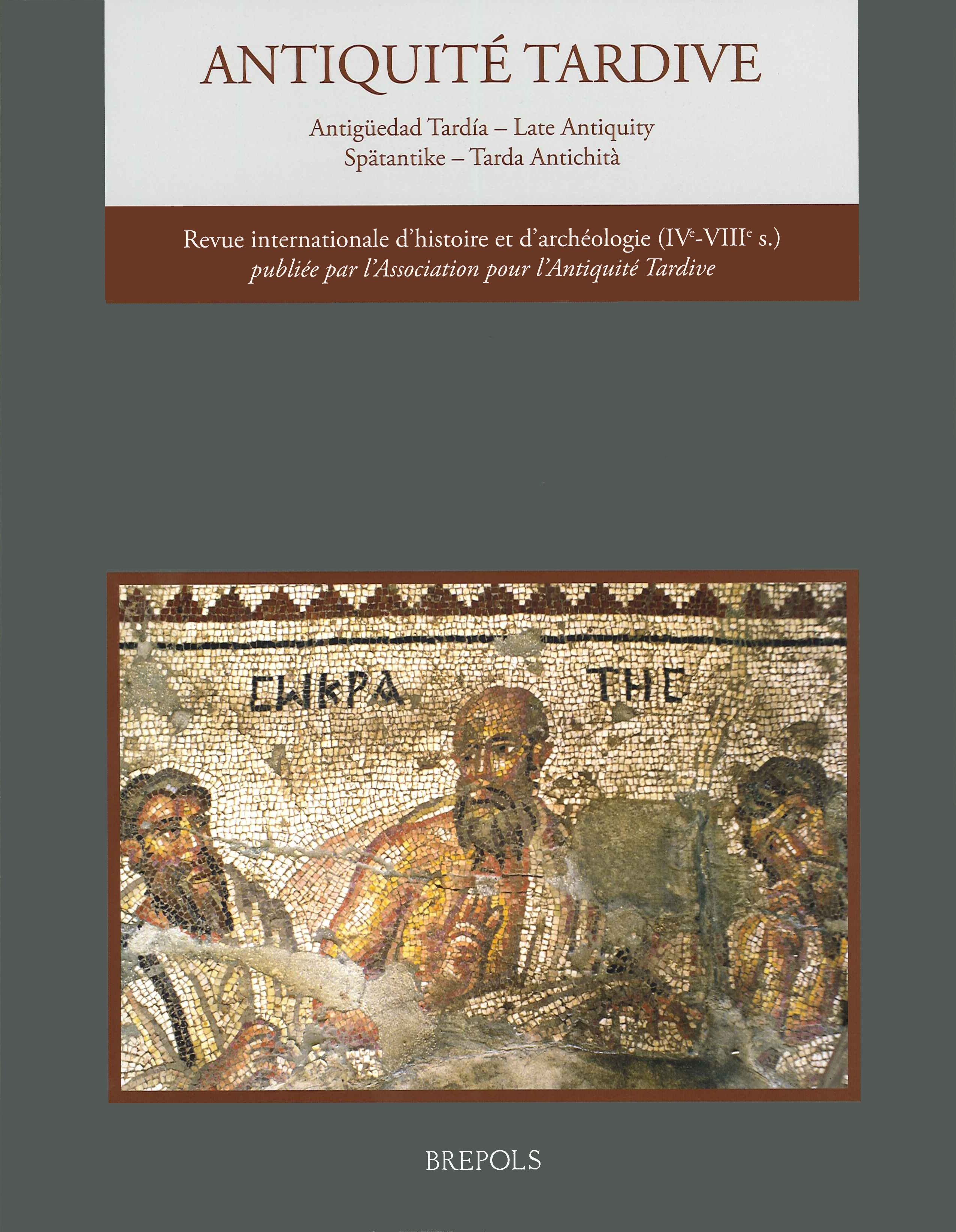
Volume 7, Issue 1, 2000
-
-
Front Matter (editorial information, title page, principales abbréviations, Table des matières, éditorial, in memoriam)
show More to view fulltext, buy and share links for:Front Matter (editorial information, title page, principales abbréviations, Table des matières, éditorial, in memoriam) show Less to hide fulltext, buy and share links for: Front Matter (editorial information, title page, principales abbréviations, Table des matières, éditorial, in memoriam)
-
-
-
Antioche de Pisidie capitale provinciale et l’œuvre de M. Valerius Diogenes
show More to view fulltext, buy and share links for:Antioche de Pisidie capitale provinciale et l’œuvre de M. Valerius Diogenes show Less to hide fulltext, buy and share links for: Antioche de Pisidie capitale provinciale et l’œuvre de M. Valerius DiogenesAuthors: Michel Christol and Thomas Drew-BearAbstractThe inscriptions edited here demonstrate the extent of the urban renewal carried out in the district of the theater of Antioch just after the creation of the Province of Pisidia, under the direction of the governor M. Valerius Diogenes, shortly before 311 A. D., towards the end of the reign of Galerius. Previously known inscriptions are restudied, re-edited and, in some cases, recombined from fragments published separately. Several new documents are presented. All these texts indicate how numerous were the edifices concerned by this program of (re)construction. These inscriptions honor the emperors Galerius, Maximinus Daia, Constantine and Licinius, who are ranked in the order that prevailed during the first half of 311. A long text in praise of Galerius, which employs the official vocabulary characteristic of that epoch, ends the series. The activity of the governor M. Valerius Diogenes, famous for his persecution of the Christians under Maximinus Daia from 311 to 313, is displayed as he restores the city, just promoted to the status of capital of a province, and devotes particular attention to the public buildings used for celebrating the cult rendered to the pagan emperors. [Author]
-
-
-
Los gobernadores de la Diœcesis Hispaniarum (ss. IV-V d.C.) y la continuidad de las estructuras administrativas romanas en la Península Ibérica
show More to view fulltext, buy and share links for:Los gobernadores de la Diœcesis Hispaniarum (ss. IV-V d.C.) y la continuidad de las estructuras administrativas romanas en la Península Ibérica show Less to hide fulltext, buy and share links for: Los gobernadores de la Diœcesis Hispaniarum (ss. IV-V d.C.) y la continuidad de las estructuras administrativas romanas en la Península IbéricaBy: Javier ArceAbstractThe author takes up anew the study of the governors of the Dioecesis Hispaniarum, last treated by A. Chastagnol in 1965, completing the list of office-holders thanks to recently discovered epigraphic documents and extending the chronological limits of the enquiry to the end of the 5th century. First, for the period from Diocletian to 400, he examines the characteristics, functions, places of residence and other aspects of the various administrative offices. Then, carrying on into the 5th century, he makes a series of observations and reflections regarding the continuity of the civil and territorial administration in Hispania and whether these offices disappeared or were transformed. Finally, he deals with the problems arising from the partition of territory between the Vandals, Suevi and Alans in 411. The article is rounded off with an appendix by J. Carlos Saquete, which sets out the most upto-date prosopographical information about the 4th century governors in Hispania. [Alexandra Chavarría, translated by S. Corcoran]
-
-
-
Die Officia der Statthalter in der Spätantike. Forschungsstand und Perspektiven
show More to view fulltext, buy and share links for:Die Officia der Statthalter in der Spätantike. Forschungsstand und Perspektiven show Less to hide fulltext, buy and share links for: Die Officia der Statthalter in der Spätantike. Forschungsstand und PerspektivenBy: Bernhard PalmeAbstractThe officia of the governor of the Late Roman Empire (consulares, correctores, praesides) have not so far been the subject of a systematic study. Various aspects of their composition, structure and staff numbers have been dealt with in the research literature on provincial history, social history or the study of the higher administrative organisms, in particular that of the praetorian prefect. The aim of the present contribution is to bring together the detailed evidence, in order to draw up a comprehensive picture of the provincial offices and those clerks (cohortales) who were appointed to them. Given that documentary sources providing substantial evidence, the papyri in particular, are still not used to full advantage, we are often forced to make deductions based on analogy with the well known offices of the praetorian and urban prefects. It appears, on the other hand, that the offices of the Late Roman Empire are more strongly linked to the better understood organisational scheme of the Principate than one might at first have assumed. The offices took a different appearance when the administration was divided into a military and a civil branch as a result of the reforms of Diocletian and Constantine. The office was strictly subdivided into a judicial section (largely corresponding to the officium of the Principate) and a financial section ; though civilian, the service continued to operate as militia. If, subsequently, the pattern of organisation and the spheres of competence of each post were subject to continual change and some adjustments in respect of rank, the basic structure nevertheless remained unchanged. The officia of the governor even survived to the end of Roman rule, as well in Italy as in the East. [Author, translated by Michael Jones]
-
-
-
Late Antique Governors’ Palaces : A Gazetteer
show More to view fulltext, buy and share links for:Late Antique Governors’ Palaces : A Gazetteer show Less to hide fulltext, buy and share links for: Late Antique Governors’ Palaces : A GazetteerBy: Luke LavanAbstractCe catalogue commenté des bâtiments qu’on a proposé d’interpréter comme palais de gouverneur tardifs cherche à faire le tri entre résidences probables, possibles (selon divers degrés de vraisemblance), peu probables ou improbables. L’auteur ne retient comme probables que Cologne, Aquincum, Gortyne et Ptolémaïs, praetoria auxquels il associe, par ressemblance, le palais du dux à Doura Europos. Parmi les possibles (sans qu’on ait vraiment les moyens de trancher) figurent Circencester, Gorsium, Césarée (où deux sites sont candidats) et Carthage. Peu probables ou improbables lui paraissent, en revanche, les hypothèses avancées pour Cordoue (Cercadilla), Caric±in Grad, Serdica, Sardes, Éphèse, Aphrodisias et Apamée. Dans bien des cas, il s’agit tout au plus de luxueuses domus privées. En appendice sont rappelés les monuments pour lesquels l’identification anciennement proposée comme palais de gouverneur a été définitivement écartée. [J.-M. C.]
-
-
-
Ambrose and Gratian
show More to view fulltext, buy and share links for:Ambrose and Gratian show Less to hide fulltext, buy and share links for: Ambrose and GratianAbstractL’auteur réexamine la chronologie des rencontres et des rapports d’Ambroise avec Gratien, en fonction des déplacements de l’empereur dans les années 375-385 et de ceux de l’évêque de Milan, à Rome en 378 et à Sirmium entre l’été 378 et fin février/mars 379. Cette révision de la chronologie habituellement admise entraîne d’importantes conséquences pour la datation des livres I-II du De Fide, composés non pas à Milan mais durant le séjour d’Ambroise à Sirmium : l’ouvrage aurait été commandé par Gratien se rendant en Orient et lui aurait été “livré” à son passage de retour, après Andrinople. La commande supplémentaire de Gratien, exprimée par lettre, ne trouve pas sa réalisation dans les livres III-V du même traité, adaptation de sermons milanais, mais dans le De spiritu sancto, composé fin 380 ou au printemps de 381. Dans l’intervalle, Ambroise a “boycotté” les visites de Gratien à Milan en 379 et 380, pour protester contre l’attribution d’une basilique aux homéens, basilique dont la restitution aux catholiques serait à placer dans l’hiver 380/381 : elle entraîna la réconciliation d’Ambroise avec Gratien et la composition du traité promis. [J.-M. C.]
-
-
-
Prêtre et fonctionnaire : l’essor d’un modèle épiscopal aux IVe-Ve siècles
show More to view fulltext, buy and share links for:Prêtre et fonctionnaire : l’essor d’un modèle épiscopal aux IVe-Ve siècles show Less to hide fulltext, buy and share links for: Prêtre et fonctionnaire : l’essor d’un modèle épiscopal aux IVe-Ve sièclesAbstractThis paper begins from the Epistle 121 of Synesius, the bishop of Ptolemais. It reveals a high sense of state and a full acceptance of the role of bishop also in the imposition of civil justice (“holy public office”). The writings of the same period by other bishops (the Oriental-Greek bishops as much as those of the West, from Gregory of Nazianzus to Maximus of Turin) confirm this willingness to be part of an imperial power, remote but at the same time operative through local authorities which the bishop was able and indeed obliged to monitor closely. It is shown how the absence of any conflict between the conscience of the priest and that of the imperial official finds its most explicit formulations in Ambrose of Milan, whose relationships with the highest ranks of political power (often present in the city) were, however, much closer and more complex. In response to recent studies (N. McLynn) an attempt has been made through a precise analysis of sources and specific situations to show how it was this self-same ex-clarissimus Ambrose who elaborated a new episcopal style able to safeguard and increase the prestige of his own authority also of a secular nature thanks to a charismatic “shield” patiently constructed and carefully dispensed in its formulations and the scriptural models selected: in particular, the exemplum of the prophet Elisha, the king's counsellor and the worker of countless miracles to guarantee his own authority (Elisha, once the favourite of Athanasius of Alexandria whom Ambrose must have met in Rome in his youth and whose follower he became both in theology and sometimes in literature). Thus on the foundation of this new “rhetoric” of episcopal power, on an unremitting pastoral and exegetic activity and on the attentive choice of collaborators of an elevated cultural level within his own sphere of influence Ambrose set in motion an episcopal model of high profile. In Northern Italy as in Gaul this model can be discerned sustaining the “noble bishops” of the 5th and 6th century, who become more and more rigidly distinct from the mass of the faithful and revered for their political as much as for their spiritual virtues. This was a radical mutation within the ecclesiastical ranks and is quite unparalleled in the dioceses of peninsular Italy of that time. [Author]
-
-
-
La capsella argentea di San Nazaro. Primi risultati di una nuova indagine
show More to view fulltext, buy and share links for:La capsella argentea di San Nazaro. Primi risultati di una nuova indagine show Less to hide fulltext, buy and share links for: La capsella argentea di San Nazaro. Primi risultati di una nuova indagineAuthors: Gemma Sena Chiesa and Fabrizio SlavazziAbstractFor the 1600th anniversary of Ambrose’s death, a team from the Archaeological Institute of the Università Statale di Milano made a new study of the famous Saint Nazarus reliquary and took excellent new photographs printed here. F. Salvazzi gives a material description of the reliquary, while G. Sena Chiesa provides a iconographical commentary in which she criticizes old hypotheses and proposes some new ones. G. Sena Chiesa also deals with the issue of authenticity, as the reliquary discovered by Saint Carlo Boromeo in 1578 has sometimes been dated to the 16th century. With the majority of contemporary scholars (H. Buchhausen, C. Bertelli, H. Brandenburg), G. Sena Chiesa concludes that the reliquary does date from the 4th century and shows that it fits well within the evolution of Christian art at this time. [Rédaction]
-
-
-
Le dossier hagiographique d’Irénée, évêque de Sirmium
show More to view fulltext, buy and share links for:Le dossier hagiographique d’Irénée, évêque de Sirmium show Less to hide fulltext, buy and share links for: Le dossier hagiographique d’Irénée, évêque de SirmiumBy: François DolbeauAbstractHere is a new edition of the Passio sancti Irenaei episcopi based on the readings of all the major manuscripts. The dossier, a Latin text with critical apparatus, French translation and commentary, was prepared in 1976 for a volume of the Franco-Serbian archaeological series Sirmium, which is not yet published, and has been updated by the author for the present publication. [Editors]
-
-
-
Grégoire le Grand : un christianisme renouvelé
show More to view fulltext, buy and share links for:Grégoire le Grand : un christianisme renouvelé show Less to hide fulltext, buy and share links for: Grégoire le Grand : un christianisme renouveléBy: Giorgio CraccoAbstractThe problem adressed by the present paper is whether, and in what sense, Christianity may be considered the foundation of western civilisation. This has led to a reconsideration of the figure of Gregory the Great (590-604) in the context of the religious renewal in the Mediterranean world of the sixth and seventh centuries. It is demonstrated accordingly that Gregory was not so much the pope who passed “from the State to the Church”, the 'consul Dei', but rather he who openly abandoned the Romano-Christian tradition (the religion of power) in order to embrace the religion of the New Testament and of Christ on the cross (the religion of service), far more suited to the ruralised and ethnically composite society of his time. Consequently, the Judaeo-Christian tradition was not renewed only in Arabia through Mohammed, nor was it renewed only in the eastern Roman Empire (as Gilbert Dagron has also demonstrated). It was renewed in the West as well through Gregory. This renewal was enormously successful. Thus one may say that Christianity was at the base of the western civilisation; at the same time, one must emphasize that this was a Christianity reshaped by Gregory the Great as evangelical, prophetic and spiritual. [Author with M. Jones]
-
-
-
Anomalies paléographiques des chiffres sur les inscriptions africaines de l’antiquité tardive
show More to view fulltext, buy and share links for:Anomalies paléographiques des chiffres sur les inscriptions africaines de l’antiquité tardive show Less to hide fulltext, buy and share links for: Anomalies paléographiques des chiffres sur les inscriptions africaines de l’antiquité tardiveBy: Pierre SalamaAbstractThe author presents the results of a survey for which he has accumulated the necessary data a number of years. Its starting point is a phenomenon which appears on African inscriptions from the 3rd century. In indicating hundreds, the ordinator [the man who planned the layout of the inscription], followed by the stonecutter, kept the minuscule form C from the draft text, probably to distinguish those letter Cs which represented figures from those which functioned as letters, and he did the same for the letter L, which could also be a figure, 50, or a letter. The beginning of this practice coincides with the change from the old form of minuscule (Old Roman Cursive) to the new form of minuscule (New Roman Cursive), a period during which the old form of the minuscule C continued to be used both in manuscripts and on inscriptions. The author demonstrates from a catalogue of these inscriptions (table 1 + 2, figs 3-10), the prototype being the Severan irrigation regulations from Lamasba, fig. 2, and from a catalogue of scripts in manuscripts drawn up from papyri, from ostraca, from wax, wood or bronze tablets, and from dipinti on amphorae (table 3, figs 11-12 and 14) the hypothesis that late antique script of manuscripts uses the same letter C for figures and the same archaic script. Having listed and classified the types of ductus (with 4, 3, 2 strokes, and finally a single one: see fig. 13) in the manuscripts (table 3), the author compares them with the forms encountered on African inscriptions (table 4). It appears that form III (a ligature with 2 strokes), attested as early as the Lamasba text and present everywhere during the 4th century, co-existed for a while with form II. The author is therefore able to suggest a chronological and geographical classification of three zones of workshops (table 5), which he then illustrates in statistical form (table 6). These observations enable us to qualify the hypothesis of the supposed ‘3rd-century change in scripts’. It must surely have been a process rather than an event, unequal in its effects and spread over a period of time. What is needed now is a research in other provinces. [J.-M. C., transl. by M. J. Jones]
-
-
-
L’Adnotatio de Constantin sur le droit de cité d’Orcistus en Phrygie
show More to view fulltext, buy and share links for:L’Adnotatio de Constantin sur le droit de cité d’Orcistus en Phrygie show Less to hide fulltext, buy and share links for: L’Adnotatio de Constantin sur le droit de cité d’Orcistus en PhrygieBy: D. FeisselAbstractThe Orcistus inscription (MAMA VII, 305) consists of four documents, spanning the years from 324-326 to 331. A fine edition was published in 1956, and there have been important studies of it in the last twenty years. Nevertheless, the nature of the first document, its author and its date remain controversial: is it a letter of the praetorian prefect or an imperial adnotatio? The disputed text can be precisely restored because it is cited word for word in the next document. By this means unnecessary restorations must be eliminated, and the imperial character of the text can be recognised beyond doubt from the verb sancimus. Consequently the first document is none other than the adnotatio of Constantine, in its complete, original form, including, it would appear, the imperial subscript (scripsi?). The adnotatio and the second document, adressed to Ablabius, are probably not later than 325-326. At this date, Ablabius is not yet praetorian prefect but in fact vicarius of Asia, and, as such, perhaps already a senator. In conclusion, there is a discussion of the rescript procedure, in which the imperial response was issued in two differing formats, and of adaptations undergone by the text from the manuscript copy to the inscribed version. [Author, transl. by M. J. Jones with S. Corcoran]
-
-
-
Les formes de l’assistance funéraire dans l’Empire romain et leur évolution dans l’Antiquité tardive
show More to view fulltext, buy and share links for:Les formes de l’assistance funéraire dans l’Empire romain et leur évolution dans l’Antiquité tardive show Less to hide fulltext, buy and share links for: Les formes de l’assistance funéraire dans l’Empire romain et leur évolution dans l’Antiquité tardiveBy: Éric RebillardAbstractIn order to understand fully what the Church did for the burial of the poor, this paper gives an inventory of the different means a poor person had in order to obtain a decent burial in the Roman Empire, and traces the evolution of these means through late antiquity. For reasons of health and sanitation, the city appears to be responsible in the first instance for the burial of abandoned corpses and of the poor. The patronage of a rich person is also a secure mean for obtaining a decent burial either in a specific tomb or in the monument of the familia. Last, collegia often take care of the burial of their members. These different means to obtain a free or an inexpensive burial still exist during late antiquity. The major change is that the Church, in addition to its direct involvement in the burial of the poor, a matter which is not very well documented, is designated by the emperor as well as by individual donors as an intermediary to provide for the burial of the poor. [Author]
-
-
-
I silenzi di Palladio e l’Italia: osservazioni sull’ultimo agronomo romano
show More to view fulltext, buy and share links for:I silenzi di Palladio e l’Italia: osservazioni sull’ultimo agronomo romano show Less to hide fulltext, buy and share links for: I silenzi di Palladio e l’Italia: osservazioni sull’ultimo agronomo romanoBy: Domenico VeraAbstractAccording to a majority of commentators, the villa which Palladius, a Gallic author transplanted to Italy, describes in his Opus agriculturae (perhaps written between 470-480), belongs to the classic “plantation”-villa type administrated directly and manned by a servile work force; some see it as an archaic anachronism, others as proof that this kind of exploitation still survived in the advanced Vth century. Such an interpretation is intenable in either case and requires an acrobatic argument, for the treatise nowhere mentions slaves, nor does it describe buildings to house them. Palladius also fails to mention the system of management otherwise well known for his period and certainly familiar to him: indirect management with a a work force of tenant farmers either free (coloni) or slaves (servi coloni). Indeed, unlike the predecessors whom he avoids repeating, he does not venture to describe any particular type of estate management. His interest in providing a practical, generally applicable treatise causes him to avoid the field of rural economy and adopt the format of a calendar of monthly labors.The geographic of the ‘Palladian’ villa is equally generic, even if it incorporates Italian features. Philological obstination has exhausted itself in trying to find objects that are absent from the text or even deliberately discarded by Palladius. The villa/praetorium is not described as a productive structure, but as a center for administrating and storing marketable goods handed over as rent by the tenants, for that was the principal concern of contemporary landowners, regardless of the type of management. At any rate, on several occasions, we can point out in Palladius’ text some signs of the presence of coloni (also found in De veterinaria medicina), both in and around the villa. The study of contemporary realia in the Opus agriculturae helps us to understand the background of this work. There predominate indirect forms of management, employing share cropping tenants (coloni), managerial lessees (conductores, emphyteots), or even a combination of both. The widespread use of colons partiaires living in vici outside the estate or included within leaves little room for slave labor or hired workers. Slaves are not totally absent, working either directly in the service of the residenceadministrative center villa, or in villulae organised on a coloni basis. Instructive are the revisions Palladius makes when citing Columelle : he eliminates outmoded features, to adapt his subject to present realities. Far from being an anachronistic and old-fashioned plagiarist, Palladius addresses the issues of his days. [J.-M. C., translated by David Parrish]
-
-
-
L’origine de la scène de la nativité dans l’art paléochrétien (d’après les sarcophages d’Occident). Catalogue et interprétation
show More to view fulltext, buy and share links for:L’origine de la scène de la nativité dans l’art paléochrétien (d’après les sarcophages d’Occident). Catalogue et interprétation show Less to hide fulltext, buy and share links for: L’origine de la scène de la nativité dans l’art paléochrétien (d’après les sarcophages d’Occident). Catalogue et interprétationBy: Dino MilinovićAbstractThe article deals with the first representations of Nativity – the Birth of Christ – in Early Christian art. The analysis, consisting of a detailed catalogue of collected examples, covers the period of the 4th century and, as far as it makes use of the existing and published material, is limited to Roman sarcophagi of this period. The fact that the sarcophagi can claim exclusiveness in this respect, highlights some of the issues important for the development of Early Christian art, such as the importance of the city of Rome and the influence of its workshops during the Late Roman empire. The research has led the author to raise once again the often debated issue on parallel development of Christian iconography in painting (catacomb frescoes) and sculpture (sarcophagi reliefs) of the period. It shows namely that no existing examples of the Nativity scene are to be found in the painting of the Roman catacombs and that the rare recorded examples can be conclusively dated to much later periods than the bulk of examples on the sarcophagi. The content of the Nativity scene during this period, starting with the simple presentation of the manger surrounded by shepherds and the two animals, as found on the earliest examples (second quarter of the 4th century), is gradually growing to include other motives taken from the Gospels or apocryphal sources. At the same time, Roman iconographical “formulas” are not to be found in the Eastern provinces where influence from Constantinople is increasingly present. The answer to these differences partly lies in the rapid organisation of the liturgical calendar in Rome (where we officially encounter, for the first time, the feast of the Nativity on December 24 around 330) and its influence on the development of Christian iconography during this period. The research however upholds the importance of “technical” considerations when analysing the origin and use of some of the Biblical motives on the sarcophagi, especially the ones usually destined for the lid area. It is an interesting fact that the entire study should be able to focus on one particular century (4th), one particular production (sarcophagi) and one particular geographical area (the city of Rome). [Author]
-
-
-
Économie et société de l’Égypte romano-byzantine (IVe-VIIe siècles). À propos de quelques publications récentes
show More to view fulltext, buy and share links for:Économie et société de l’Égypte romano-byzantine (IVe-VIIe siècles). À propos de quelques publications récentes show Less to hide fulltext, buy and share links for: Économie et société de l’Égypte romano-byzantine (IVe-VIIe siècles). À propos de quelques publications récentesAbstractThe author presents a critical overview of recent publications which bring forward both new documents and new discussions on the economic and social development of Roman and Byzantine Egypt. The agricultural accounts from Kellis modify our view of the Egyptian rural economy, and the dominant role traditionally attributed to the 'great estates'. They raise the issue of the abandonment of agricultural activity in the southern quarter of the Great Oasis, which is also the subject of an archaeo-ecological study by Bernard Bousquet at the site of Douch. Even in areas so close in place and time, the causes of abandonment may yet have been different. The reconsideration of the role of money in the late antique economy, and the reaction against the 19th century models of a 'natural economy' are reinforced, with regard to salaries, by the study by Francesco Morelli, of allocations of oil. On the question of professional 'corporations', as well as the issue of curiales, several historians have tackled the contradiction between the impressions given by the legal sources and by the papyrus documents, even when they are describing the same situation; this invites us to reconsider the ways in which these different kinds of source should be used, with more attention to their particular nature, and a more cautious approach to establishing their relationship to one another. [Author, translated by Charlotte Roueché]
-
-
-
À propos du nouveau livre de T. D. Barnes sur Ammien Marcellin
show More to view fulltext, buy and share links for:À propos du nouveau livre de T. D. Barnes sur Ammien Marcellin show Less to hide fulltext, buy and share links for: À propos du nouveau livre de T. D. Barnes sur Ammien MarcellinAbstractA critical review of the book which Timothy Barnes has devoted to Ammianus Marcellinus considers in turn the problems of historical distortion, Latin education, personal aspects of the author (geographic origin, environment, personality, religious position), and his sources. A long excursus on Ammianus’ use of clausulae, while correcting the ideas of R. G. Hall and St. M. Oberhelman on the matter of rythmics in literary Latin of the Late Empire, refutes the idea that the historian carries over a Greek system into Latin, and on the other hand confirms his excellent knowledge of Latin language and literature. [Rédaction, translated by M. Jones]
-
-
-
Frontal de sarcófago de Valcabrère con la adoración de los magos
show More to view fulltext, buy and share links for:Frontal de sarcófago de Valcabrère con la adoración de los magos show Less to hide fulltext, buy and share links for: Frontal de sarcófago de Valcabrère con la adoración de los magosAbstractThis is a corner piece of a sarcophagus frontal made of Saint Béat marble with two scenes: in one of them a vailed woman is lying on a bed with her child; she greets two young men who are standing near her and offering her some fruit. In the other scene, a bearded man dressed in a tunic and a pallium is touching a lion with a roll in his left hand while he is talking to a naked woman who is praying. J. Guyon and C. Dieulafait think that the two scenes are pagan but the author disagrees. The woman with the child looks like the Virgin on the lid of Doria Pamphili sarcophagus and the two men standing near the bed resemble the two men near the Virgin on Saint Nazarius reliquary, although these are wearing a one sleeve (exomid) tunic. The Three Young Hebrews in the fires of Babylon on the sarcophagus 750 of Deichmann’s Repertorium are dressed in tunic and pallium; and since the Three Hebrews often symbolize the Magi, the clothes of the young men at Valcabrère seem less strange. On the other hand, the gifts of the Magi are spherical, like small breads or fruit in other works such as the Dyptic of the Five Parts of the cathedral of Milan. The character represented as a nude woman to the right of the Virgin´s bed should have been a nude man, since he is certainly the prophet Daniel praying in the lion´s den. The Valcabrère artist must have mistaken Daniel for a woman (Eve ?) because of his long hair in some sculptures and paintings; the bearded man would in this case be the First Person of the Trinity. The Valcabrère sarcophagus style is reminiscent of the Roman workshops of the Dogmatic Sarcophagus and the Two Brothers Sarcophagus but also of Eastern workshops as do the Castiliscar stone coffin and a Toulousian piece of the Nativity. It is probable that these three pieces – Castiliscar, Toulouse, Valcabrère – were done by the same workshop or in similar workshops during the same period. [Author with Ch. Roueché]
-
-
-
Deux basiliques chrétiennes de Maurétanie Césarienne. Souk-el-Khemis (Galaxia ?) et Tarmount (Aras) et les vestiges chrétiens de la région
show More to view fulltext, buy and share links for:Deux basiliques chrétiennes de Maurétanie Césarienne. Souk-el-Khemis (Galaxia ?) et Tarmount (Aras) et les vestiges chrétiens de la région show Less to hide fulltext, buy and share links for: Deux basiliques chrétiennes de Maurétanie Césarienne. Souk-el-Khemis (Galaxia ?) et Tarmount (Aras) et les vestiges chrétiens de la régionAbstractThe author first identifies the ruins at Souk-el-Khemis with the site of Galaxia located on the route between Auxia and Equizeto. The city administration conducted excavations there in 1883 and discovered a basilica. It was known only from resumes of the original report. The rediscovery of the report in the archives of Cl. Poinssot has made it possible to publish the text and illustrations, but with necessary corrections of the very inexact plan. At Tarmount, ancient Aras, excavations were undertaken in 1935 and 1936 by an excellent specialist, P. Massiéra. However, his published report had no illustrations. The author tries to reconstruct the plan of a small basilica from the very precise written description. These are two important reflections of Christianization in a region where such evidence is rare, due to insufficient field research. [N. D., translated by D. Parrish]
-
Volumes & issues
-
Volume 32 (2024)
-
Volume 31 (2024)
-
Volume 30 (2022)
-
Volume 29 (2022)
-
Volume 28 (2021)
-
Volume 27 (2020)
-
Volume 26 (2019)
-
Volume 25 (2018)
-
Volume 24 (2017)
-
Volume 23 (2016)
-
Volume 22 (2015)
-
Volume 21 (2013)
-
Volume 20 (2013)
-
Volume 19 (2012)
-
Volume 18 (2011)
-
Volume 17 (2010)
-
Volume 16 (2009)
-
Volume 15 (2008)
-
Volume 14 (2007)
-
Volume 13 (2006)
-
Volume 12 (2005)
-
Volume 11 (2004)
-
Volume 10 (2003)
-
Volume 9 (2002)
-
Volume 8 (2001)
-
Volume 7 (2000)
-
Volume 6 (1999)
-
Volume 5 (1998)
-
Volume 4 (1997)
-
Volume 3 (1995)
-
Volume 2 (1994)
-
Volume 1 (1993)
Most Read This Month
