


European Medieval Drama
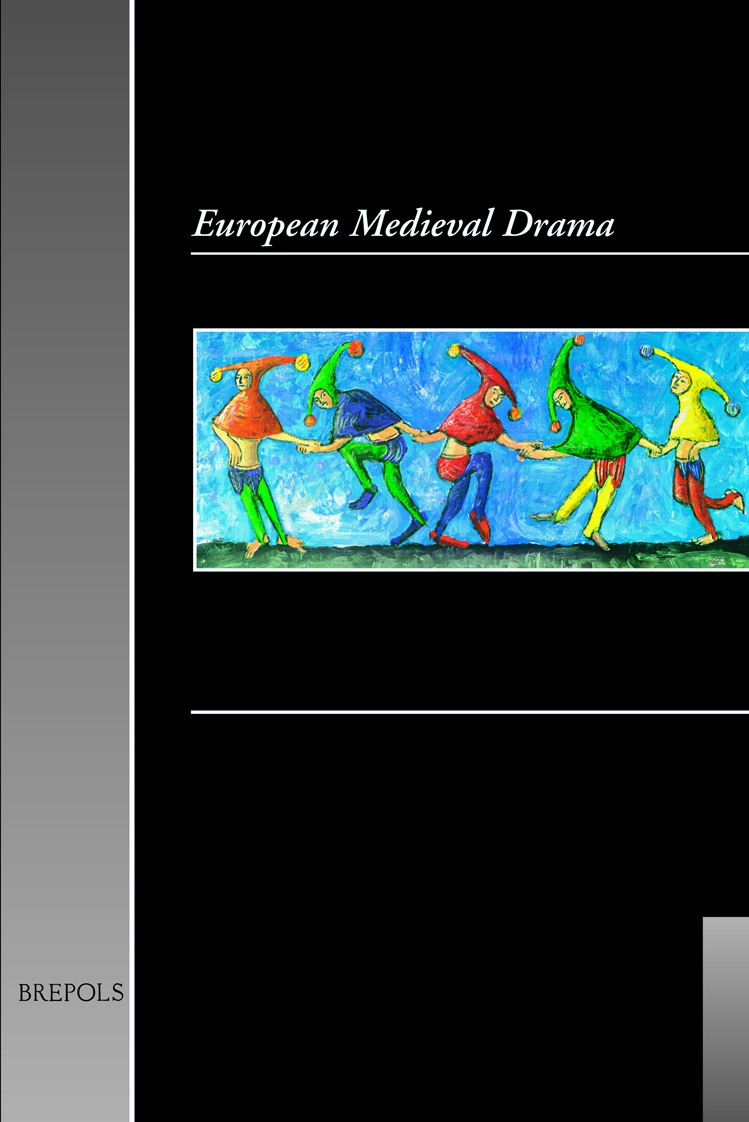
Volume 25, Issue 1, 2021
-
-
The Theatricality of Versus de Unibove
show More to view fulltext, buy and share links for:The Theatricality of Versus de Unibove show Less to hide fulltext, buy and share links for: The Theatricality of Versus de UniboveAbstractWhat is theatricality in Versus de Unibove? Is there a theatre of situations in this text? Can the folklore, the remote inspiration of this poem, be linked to some form of theatricality? This article analyses the theatricality of Versus de Unibove, often emphasised by many scholars, but never exhaustively addressed.
-
-
-
Performable Monologue: Profiling the Unconventional Theatricality of Tragèdia de Caldesa by Joan Roís de Corella, a Valencian Writer of the Fifteenth Century
show More to view fulltext, buy and share links for:Performable Monologue: Profiling the Unconventional Theatricality of Tragèdia de Caldesa by Joan Roís de Corella, a Valencian Writer of the Fifteenth Century show Less to hide fulltext, buy and share links for: Performable Monologue: Profiling the Unconventional Theatricality of Tragèdia de Caldesa by Joan Roís de Corella, a Valencian Writer of the Fifteenth CenturyBy: Peter CocozzellaAbstractWritten in 1458, Tragedia de Caldesa is the masterpiece of Joan Rois de Corella, one of the chief Valencian exponents of the early Renaissance in Spain. Arguably, this work, based entirely on the format of the monologue, constitutes an important specimen of an unconventional theater that rivals its contemporaneous counterpart of much greater renown: the dialogue-driven playwriting of Juan del Encina. Here I delve into Corella’s ingenious handling of the dramatic qualities that he deftly molds into a tightly-knit stage-worthy spectacle. Of special interest is the fashioning of a text that integrates a great variety of sources inherited from a bilingual and bicultural background. In fact, Corella is inspired by the two strains (one Castilian, the other Catalan) of the love-centered poetry and prose works that in his lifetime reached great popularity thanks to the numerous cancioneros and novelas sentimentales together with the poetry of the incomparable Ausias March.
-
-
-
Marian Laments from Medieval Bohemia: Performing Suffering and Redemption Through Compassion
show More to view fulltext, buy and share links for:Marian Laments from Medieval Bohemia: Performing Suffering and Redemption Through Compassion show Less to hide fulltext, buy and share links for: Marian Laments from Medieval Bohemia: Performing Suffering and Redemption Through CompassionAbstractThe paper presents several items from the Bohemian corpus of Marian laments from the fourteenth century that has not been yet introduced to international scholarly debate concerning the genre. The Latin planctus Mariae in the Passionale of Abbess Kunigunde, Old Czech Lament of Virgin Mary in the Manuscript from Hradec Kralove, and two shorter Old Czech verse laments, Šafařik Planct and Planct from Roudnice, are discussed in the context of medieval affective piety and with regard to their performative aspects, i.e. various forms of their presentation and reception (singing, declamation, theatrical[ized] performance) and the physical handling of the manuscripts they were originally part of, such as touching or kissing the texts and pictures that accompanied them on the foils.
-
-
-
‘Manus Tuas Commendo’: Blasphemy, Spells, and Night Prayers in Late Medieval Shepherds’ Plays from England and Castile
show More to view fulltext, buy and share links for:‘Manus Tuas Commendo’: Blasphemy, Spells, and Night Prayers in Late Medieval Shepherds’ Plays from England and Castile show Less to hide fulltext, buy and share links for: ‘Manus Tuas Commendo’: Blasphemy, Spells, and Night Prayers in Late Medieval Shepherds’ Plays from England and CastileAbstractIn the Towneley Second Shepherds’ Play, one of the central characters named Mak delivers what sounds like a blasphemous speech before going to sleep. He actually utters the sentence ‘Manus tuas commendo, Poncio Pilato’ (ll. 384-85), in which he seems to commend his protection and that of his fellows to Pilate. Then, he performs what has been considered a necromantic ritual by drawing a circle around the others. When played out on stage it would seem reasonable to understand that the author was sending a clear catechetical message against these ungodly practices. However, a re-visitation of the manuscript as well as a comparative analysis with other English and Castilian works which contain similar allusions and rituals has allowed the reading of these words differently. For that purpose, this study analyses the non-Christian elements and the alleged blasphemous references in late-medieval plays from both traditions. Apart from the dramatic material, some non-dramatic texts that contain similar formulae are considered in order to offer an alternative interpretation of these alleged impious words and behaviours in the English tradition.
-
-
-
Kindel, Wiege, Windel: Zur Interaktion mit sakralen Objekten in Weihnachtsritualen und Weihnachtsspielen
show More to view fulltext, buy and share links for:Kindel, Wiege, Windel: Zur Interaktion mit sakralen Objekten in Weihnachtsritualen und Weihnachtsspielen show Less to hide fulltext, buy and share links for: Kindel, Wiege, Windel: Zur Interaktion mit sakralen Objekten in Weihnachtsritualen und WeihnachtsspielenBy: Regina ToepferAbstractThis contribution is concerned with forms of interaction and intimacy between the Christ Child and his worshippers in the Middle Ages. It concentrates above all on how the Hessian Nativity Play and Benedikt Edelpock’s Christmas comedy represented the Christ Child, but also on the religious custom of Kindelwiegen (‘rocking the Christ Child’), which was not performed on stage. The author posits that, even if figures of the Christ Child were material objects, they took on lives of their own within the context of intimate worship. They thus differed from theatre props on the one hand and devotional images on the other. They were neither a means of creating an illusion of reality on stage nor mere objects of pious contemplation. Rather, they were meant to be touched and felt as a way of making the Christmas miracle more comprehensible.
-
-
-
Bewegte Grenzen: Beobachtungen zum kollusiven Potential ‘heiliger’ Figuren und Gegenstände im Mühlhäuser (thüringischen) Katharinenspiel
show More to view fulltext, buy and share links for:Bewegte Grenzen: Beobachtungen zum kollusiven Potential ‘heiliger’ Figuren und Gegenstände im Mühlhäuser (thüringischen) Katharinenspiel show Less to hide fulltext, buy and share links for: Bewegte Grenzen: Beobachtungen zum kollusiven Potential ‘heiliger’ Figuren und Gegenstände im Mühlhäuser (thüringischen) KatharinenspielBy: Angelika KemperAbstractMedieval German theater is, when performed in urban squares, characterized by movement in space and the co-presence of actor and audience. Arranged for a performance on a ‘simultaneous stage’, the plays show many ways of engaging the audience, regarding the spatial arrangement and the potential to act in concert. The Mühlhausen Play of St Catherine, which originated in Late Medieval Thuringia, serves as an example for exploring the collaborative processes emerging with the presentation of holiness on the stage. Dealing with the dramaturgic application of ‘holy’ figures and ‘holy’ objects, the contribution aims to detect their radius of action, characteristic scene constellations, and hagiographic image stimuli.
-
-
-
How to Mark a Saint on Stage: Felix Büchser’s Meinradspiel
show More to view fulltext, buy and share links for:How to Mark a Saint on Stage: Felix Büchser’s Meinradspiel show Less to hide fulltext, buy and share links for: How to Mark a Saint on Stage: Felix Büchser’s MeinradspielBy: Cora DietlAbstractThe Einsiedeln Play of St Meinrad (1576) is the earliest Swiss Counter Reformation saint play. Its performance was part of the monastery’s political plan to regain strength and importance after the Reformation, stressing the holiness of its forefather. While Protestant plays of the time mostly used rhetorical strategies to convince the audience of the ‘true’ faith, the Play of St Meinrad explores new means of using stage properties and special effects. The paper concentrates on the use of smoke and smell, puppets, bird-puppets, and ecclesiastical objects (cross and chalice) in the play. They serve to characterize the devils or humans doomed to hell, or to stress parallels between the protagonist and St Anthony, St Paul the Hermit, St Benedict and Christ. As arguments that can be seen and smelt, they support the text’s message that presents Meinrad as a model for holy life.
-
-
-
Processions, Processional Theatre, Simultaneous Stage: Variations of Venues and Stage Arrangements of the Lucerne Play Tradition from the Middle Ages to Early Modern Times
show More to view fulltext, buy and share links for:Processions, Processional Theatre, Simultaneous Stage: Variations of Venues and Stage Arrangements of the Lucerne Play Tradition from the Middle Ages to Early Modern Times show Less to hide fulltext, buy and share links for: Processions, Processional Theatre, Simultaneous Stage: Variations of Venues and Stage Arrangements of the Lucerne Play Tradition from the Middle Ages to Early Modern TimesAbstractReligious and secular theatrical events in Lucerne are probably the best documented in Europe. From sources dating back to the twelfth century we learn that during the Easter Triduum various kinds of ritual practices were held within the boundaries of the monastery im Hof. While monks were celebrating the Adoratio, Depositio and Elevatio Crucis and the Visitatio Sepulchri hidden from the public, the faithful commemorated the Passion and Resurrection of the Lord with processions and prayers in front of carved and painted Passion scenes and a temporarily constructed Holy Sepulchre. The first record of the staging of a vernacular Resurrection play in front of the parish church of St Peter’s dates to 1453. The earliest text and a stage plan, preserved in the Donaueschingen codex, allow the reconstruction of the performance on the Kapellplatz: as processional theatre. From 1500 onwards, performances of religious and secular plays took place on the Wine Market, the town’s new commercial centre. With the shift of the stage from the religious sphere (monastery, parish) to the trading and political centre, we notice a change in the mode of performance. Processional theatre is replaced by performance on the simultaneous stage, with a spatial division into areas for actors and areas for spectators. This paper analyses the interrelations between performance space and religious, social and political developments and focuses on stage arrangements and modes of performance relating to the different performance venues.
-
-
-
The Revival of the Lucerne Passion Play Tradition in the Twentieth Century
show More to view fulltext, buy and share links for:The Revival of the Lucerne Passion Play Tradition in the Twentieth Century show Less to hide fulltext, buy and share links for: The Revival of the Lucerne Passion Play Tradition in the Twentieth CenturyBy: Simone GfellerAbstractThis paper examines the reception of the Passion play tradition in Lucerne in the twentieth century. The scholar, director and playwright Oskar Eberle (1902-1956) was largely responsible for the revival of the Passion Play tradition in Switzerland. His main efforts were associated with his ambition for a general renewal of the Swiss amateur theatre tradition, especially the tradition of sacred plays of medieval Central Switzerland. This study shows how the socio-cultural and political situation in Switzerland changed during the interwar period and how the production conditions for Eberle’s Passion play efforts in 1949 became more difficult.
-
-
-
Unreliable Memories: Documenting the Scenography of the 1589 Florentine intermedi
show More to view fulltext, buy and share links for:Unreliable Memories: Documenting the Scenography of the 1589 Florentine intermedi show Less to hide fulltext, buy and share links for: Unreliable Memories: Documenting the Scenography of the 1589 Florentine intermediBy: M. A. KatritzkyAbstractNot least because of their exceptionally rich Italian textual and visual documentation, the 1589 Florentine intermedi are regarded as one of the outstanding court festivals of early modern Europe. The official festival accounts, written, published and distributed as court propaganda, aimed to inscribe the event into its audiences’ memories in a very specific way. I revisit the 1589 intermedi in the context of the selective memories reflected in non-Italian eyewitness accounts by three foreign visitors to Florence, an anonymous Frenchman and Bavarian, and the German Barthold von Gadenstedt. Previously, musicologists have mined them for information supplementing the Italian accounts. Here, my focus is on their unreliable memories of the spectacular and innovative scenography featured in the 1589 intermedi. I focus on what information can be gleaned about the identity, eye-witness status, sources and motivations of the three foreigners. I consider what brought them to Florence, what their recorded memories convey about the importance of the city and its stage heritage to the designs and props of the 1589 production, the impressions its theatre technology made on them, and how they (and we) address the challenge of identifying, classifying and documenting renaissance scenography.
-
-
-
Reviews
show More to view fulltext, buy and share links for:Reviews show Less to hide fulltext, buy and share links for: ReviewsAbstractDas Streitgedicht im Mittelalter, ed. by Jörg O. Fichte, Peter Stotz, Sebastian Neumeister, Roger Friedlein, Franziska Wenzel, and Holger Runow - Cora Dietl
Andrzej Dąbrówka, Theater and the Sacred in the Middle Ages, trans. by Jan Burzyński and Mikolaj Golubiewski - Nils Holger Petersen
Noah D. Guynn, Pure Filth: Ethics, Politics, and Religion in Early French Farce - Jelle Koopmans
Thomas Meacham, The Performance Tradition of the Medieval English University: The Works of Thomas Chaundler - Elza C. Tiner
Margaret M. McGowan, Festival and Violence: Princely Entries in the Context of War, 1480-1635 - Max Harris
Margarida Miranda, Miguel Venegas and the Earliest Jesuit Theater: Choruses for Tragedies in Sixteenth-Century Europe - Oscar Armando Garcia
-
Volumes & issues
-
Volume 28 (2024)
-
Volume 27 (2023)
-
Volume 26 (2022)
-
Volume 25 (2021)
-
Volume 24 (2020)
-
Volume 23 (2019)
-
Volume 22 (2018)
-
Volume 21 (2017)
-
Volume 20 (2016)
-
Volume 19 (2015)
-
Volume 18 (2014)
-
Volume 17 (2013)
-
Volume 16 (2012)
-
Volume 15 (2011)
-
Volume 14 (2010)
-
Volume 13 (2009)
-
Volume 12 (2008)
-
Volume 11 (2007)
-
Volume 10 (2006)
-
Volume 9 (2005)
-
Volume 8 (2004)
-
Volume 7 (2003)
-
Volume 6 (2003)
-
Volume 5 (2002)
-
Volume 4 (2001)
-
Volume 3 (2000)
-
Volume 2 (1998)
-
Volume 1 (1997)
Most Read This Month
