


The Journal of Medieval Latin
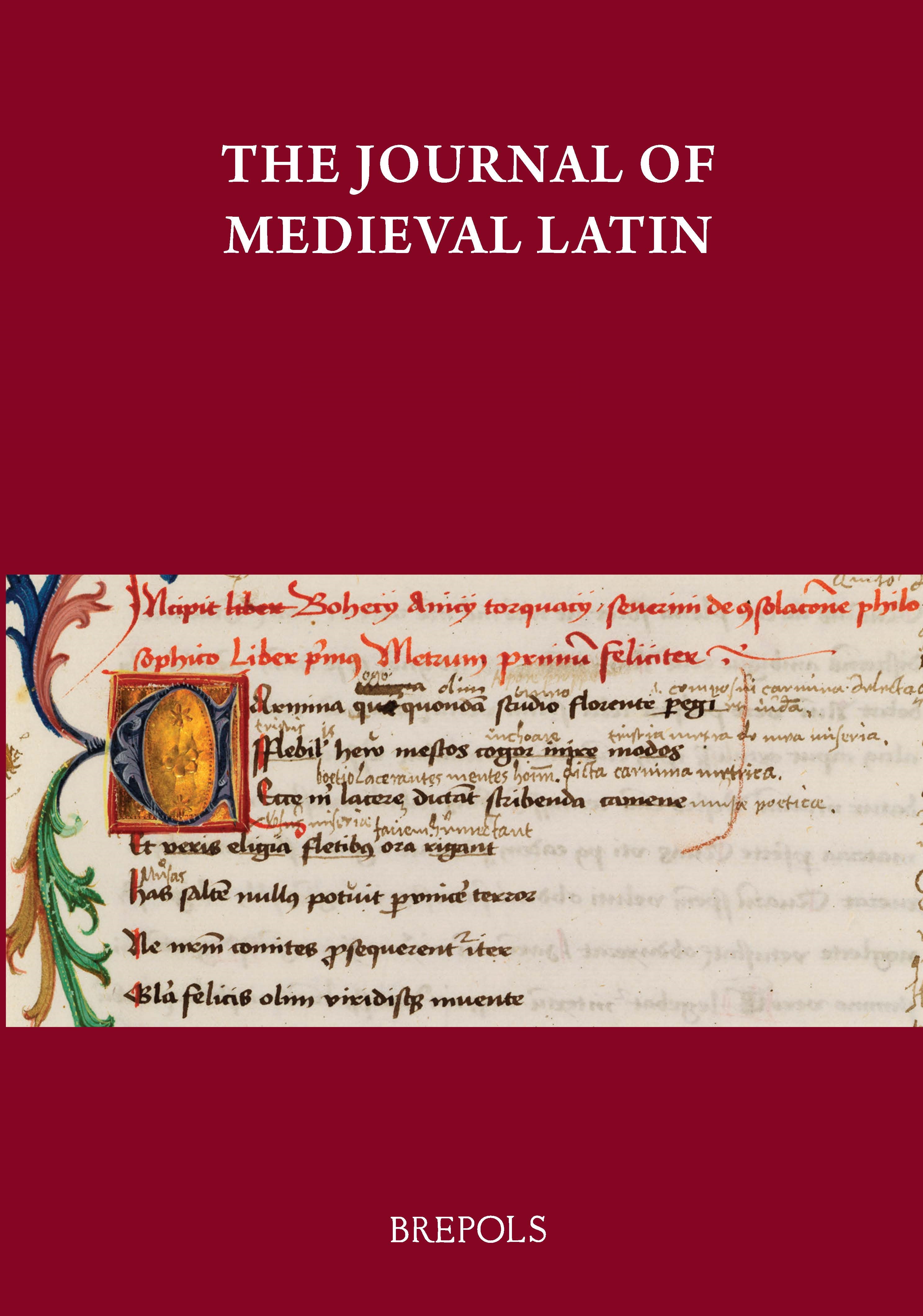
Volume 33, Issue 1, 2023
-
-
Front Matter ("Contents", "In memoriam Joseph Goering (1947-2023)", "In memoriam Jacqueline Hamesse (1942-2023)")
show More to view fulltext, buy and share links for:Front Matter ("Contents", "In memoriam Joseph Goering (1947-2023)", "In memoriam Jacqueline Hamesse (1942-2023)") show Less to hide fulltext, buy and share links for: Front Matter ("Contents", "In memoriam Joseph Goering (1947-2023)", "In memoriam Jacqueline Hamesse (1942-2023)")
-
-
-
Einhard and the Historia Augusta
show More to view fulltext, buy and share links for:Einhard and the Historia Augusta show Less to hide fulltext, buy and share links for: Einhard and the Historia AugustaAuthors: Justin Stover and George WoudhuysenAbstractIn recent years, a consensus has begun to develop that Einhard had read the Historia Augusta and that he used it in his Vita Karoli magni. In particular, scholars have argued that he must have drawn the rare word dicaculus from the text. In this article, we first review the history of the idea that Einhard had read the HA, then show how weakly grounded it is. In particular, we demonstrate that it is very unlikely that the text was his source for dicaculus. We conclude with some thoughts on the way that this might influence recent debate over the HA in the Carolingian period.
AbstractAu cours des dernières années, la communauté scientifique en est venue au consensus selon lequel Einhard aurait lu l’Historia Augusta et l’aurait utilisée dans sa Vita Karoli magni. Les chercheurs ont particulièrement mis de l’avant l’hypothèse qu’Einhard aurait emprunté à l’Historia Augusta le terme rare de dicaculus. Dans cet article, nous faisons le survol de l’historiographie qui prétend qu’Einhard aurait lu l’HA et démontrons ensuite la faiblesse des arguments qui sous-tendent ce raisonnement. Nous avançons qu’il est peu probable que l’HA ait été la source du mot dicaculus dans la Vita Karoli magni. En conclusion, nous offrons des réflexions sur la façon dont notre contribution pourrait influencer le débat récent sur la place de l’HA à l’époque carolingienne.
-
-
-
Michael of Cornwall’s First Invective Against Henry of Avranches
show More to view fulltext, buy and share links for:Michael of Cornwall’s First Invective Against Henry of Avranches show Less to hide fulltext, buy and share links for: Michael of Cornwall’s First Invective Against Henry of AvranchesAuthors: Thomas C. Sawyer and Paul VinhageAbstractThis article presents an updated edition and the first English translation of Michael of Cornwall’s first invective against Henry of Avranches. The poem was performed in London in 1254. It was first published by Alfons Hilka in 1926. Michael writes skillful leonine hexameter lines in his mockery and denigration of Henry’s poetry, intelligence, and birth. The invective puns effortlessly (and, at times, with great effort) in Latin, French, English, and Greek. Its exceptional style is exceeded only by its exceptional deployment of crass insult.
AbstractCet article présente une édition mise à jour et la première traduction anglaise de la première invective de Michel de Cornouailles contre Henri d’Avranches. Le poème a été jouée à Londres en 1254. Il a été publié pour la première fois par Alfons Hilka en 1926. Michael écrit habilement des lignes hexamétriques léonines dans sa moquerie et son dénigrement de la poésie, de l’intelligence et des origines d’Henri. L’invective fait des calembours sans effort (et, parfois, avec beaucoup d’effort) en latin, français, anglais et grec. Son style exceptionnel n’est dépassé que par son déploiement exceptionnel des injures grossières.
-
-
-
Tracing Ovid’s “Best” Line in the Middle Ages
show More to view fulltext, buy and share links for:Tracing Ovid’s “Best” Line in the Middle Ages show Less to hide fulltext, buy and share links for: Tracing Ovid’s “Best” Line in the Middle AgesBy: Rebecca MenmuirAbstractThis article considers the independent transmission of a line from Ovid’s Heroides throughout the later Middle Ages. This line, voiced by Helen to Paris, affirms that it is a virtue to refrain from pleasurable things, a sentiment which gained considerable traction as it was disengaged from the context of its speaker, poem, and author (despite being initially voiced in an ambiguous epistolary game between Helen and Paris in the Heroides). Firstly, in an imagined thirteenth- century encounter between two clerics and Ovid’s sepulchral voice, the line is judged to be the best line that Ovid ever wrote, prompting the questions: why is it considered to be the best, and what parameters form this judgement? The article discusses the moralizing Christian medieval environment within which Ovid was read, and then traces the circulation of Ovid’s “best” line as it was decontextualised from the rest of the Heroides. This decontextualization occurs both in medieval manuscripts of the Heroides via paratextual material, as well as in new literary contexts as the line is repurposed. Finally, the article turns to the figure of Helen, whose poetic voice is discarded as the line is adopted into new literary environments. Ultimately, following Ovid’s “best” line demonstrates the malleability of texts and authority throughout the Middle Ages.
AbstractCet article se penche sur la transmission indépendante d’un vers des Héroïdes d’Ovide tout au long du bas Moyen Âge. Ce vers, qu’adresse Hélène au prince Pâris, affirme qu’il est vertueux de s’abstenir des plaisirs du monde, une affirmation qui gagna en popularité (même si celle-ci est formulée dans le cadre d’un jeu épistolaire ambiguë entre Hélène et Pâris dans les Héroïdes) lorsqu’elle fut détachée de son contexte, soit du personnage qui l’énonce, du poème lui-même et de son auteur. D’abord, dans un épisode du XIIIe siècle, mettant en scène deux clercs et la voix d’outre-tombe d’Ovide, le vers en question est considéré comme le meilleur jamais produit par Ovide, ce qui donne lieu à une série de questions: qu’est-ce qui peut être jugé comme étant meilleur que toute autre chose, et quels paramètres doivent être retenus afin d’établir un tel jugement? Cet article analyse l’environnement chrétien, médiéval et moralisant par lequel Ovide était appréhendé, et retrace la circulation de ce « meilleur » vers d’Ovide alors qu’il se retrouve décontextualisé du reste des Héroïdes. Cette décontextualisation se produit à la fois dans le paratexte des manuscrits médiévaux des Héroïdes et dans les nouveaux contextes littéraires au sein desquels le vers se retrouve inséré. Enfin, l’article s’intéresse à la figure d’Hélène, dont la voix poétique est évacuée alors que le vers est intégré à de nouveaux environnements littéraires. Ultimement, suivre ce « meilleur » vers d’Ovide illustre la malléabilité des textes et la mesure de l’autorité au cours du Moyen Âge.
-
-
-
Common Authorship and the “Anonymous of Calais”: Reassessing an Anglo-Latin Political Poem from the Fourteenth Century
show More to view fulltext, buy and share links for:Common Authorship and the “Anonymous of Calais”: Reassessing an Anglo-Latin Political Poem from the Fourteenth Century show Less to hide fulltext, buy and share links for: Common Authorship and the “Anonymous of Calais”: Reassessing an Anglo-Latin Political Poem from the Fourteenth CenturyBy: Bard SwallowAbstractThis paper re-examines a fourteenth-century Anglo-Latin political poem last edited in the nineteenth century, known as the Cantica Leticie. Before providing a modern edition of the poem, the paper also addresses A.G. Rigg’s claim that a single author, whom he labels the “Anonymous of Calais,” is responsible for Cantica Leticie and a few other contemporary poems. It argues against Rigg’s common authorship claim from both codicological and internal stylistic evidence, concluding instead that the similarities Rigg notes point to a literary community rather than a single prolific poet.
AbstractCette étude réexamine un poème politique Anglo-Latin du XIVe siècle connu sous le nom de Cantica Leticie et édité pour la dernière fois au XIXe siècle. Avant d’offrir une édition moderne du poème, ce travail analyse l’affirmation de A.G. Rigg selon laquelle un même auteur, qu’il appelle l’« Anonyme de Calais », aurait produit le Cantica Leticie ainsi que quelques autres poèmes contemporains. Cet article conteste l’affirmation de Rigg sur la base de critères codicologiques et stylistiques et conclut en revanche que les similarités identifiées par Rigg suggèrent l’existence d’une communauté littéraire plutôt que d’un unique et prolifique poète.
-
-
-
Honorius Augustodunensis on the Neocosmos: Introduction, Latin Text, and Translation
show More to view fulltext, buy and share links for:Honorius Augustodunensis on the Neocosmos: Introduction, Latin Text, and Translation show Less to hide fulltext, buy and share links for: Honorius Augustodunensis on the Neocosmos: Introduction, Latin Text, and TranslationAbstractHonorius Augustodunensis’ De Neocosmo is a commentary on the hexaemeron or six-day work of creation, intended for readers who find the numerous available commentaries, and especially those by Augustine, more confusing than instructive. The commentary has four parts, corresponding roughly to the literal, the allegorical, the moral and the anagogical senses of Scripture. An introduction to the author, his work, and the text is followed by the Latin text and a translation into English. The Latin text is based on the one published by Bernard Pez and printed in PL 172, corrected in comparison with the unpublished critical edition by Robert D. Crouse, “Honorius Augustodunensis, De Neocosmo: A Critical Edition of the Text with Introduction and Notes” (PhD Diss., Harvard University, 1970).
AbstractLe De Neocosmo d’Honoré d’Autun est un commentaire sur l’hexaméron, la création du monde en six jours. Il cherche à venir en aide aux lecteurs qui trouveraient les nombreux commentaires traitant de ce thème, en particulier celui d’Augustin, plus obscurs qu’éclairants. Le commentaire comprend quatre parties, qui correspondent approximativement aux quatre sens de l’Écriture, soit les sens littéral, allégorique, tropologique et anagogique. L’article débute par une présentation de l’auteur et de son oeuvre. Viennent ensuite le texte latin du De Neocosmo et sa traduction anglaise. Le texte latin s’appuie sur celui publié par Bernard Pez, qu’on peut retrouver en version imprimée dans la PL 172, et a été corrigé en comparant cette édition à l’édition critique inédite de Robert D. Crouse, « Honorius Augustodunensis, De Neocosmo: A Critical Edition of the Text with Introduction and Notes » (PhD Diss., Harvard University, 1970).
-
-
-
The Hermetic Origins of the Liber sigillorum of Techel
show More to view fulltext, buy and share links for:The Hermetic Origins of the Liber sigillorum of Techel show Less to hide fulltext, buy and share links for: The Hermetic Origins of the Liber sigillorum of TechelAuthors: Lauri Ockenström and Vajra ReganAbstractThis article presents new evidence for the Hermetic origins of the Liber sigillorum (The Book of Sigils), a medical-magical lapidary on engraved gems. Commonly attributed to a mysterious Techel (Thetel, Chael, Cehel), the Liber sigillorum was widely copied, and its influence can be detected in such diverse fields as natural history, philosophy, and medicine as well as magic. Thomas of Cantimpré included a version in his encyclopedia through which it was transmitted to Konrad von Megenberg and eventually to Paracelsus. It was also given serious consideration by philosophers such as Albert the Great; yet, despite this, the Latin text has never been the subject of systematic study, and many questions still surround its origins. In the following pages, we identify the oldest version of the text and show that it derives from the Hermetic Liber planetarum (Liber Saturni), a twelfth-century Latin translation of a lost Arabic treatise on astrological image-magic. Along the way, we provide a more detailed description of the early manuscript tradition than has hitherto been attempted. In the Appendix, passages from sixteen chapters of the Liber planetarum are compared alongside the corresponding chapters from the Liber sigillorum as found in manuscripts from the twelfth to the fifteenth-sixteenth centuries. The corresponding chapters from Thomas of Cantimpré’s Liber de natura rerum are also included as well as select chapters from Camillus Leonardi’s Speculum Lapidum (1502). English translations accompany the Latin text.
AbstractCet article avance de nouvelles preuves quant aux origines hermétiques du Liber sigillorum (Livre des sceaux), un livre de magie et de médecine, qui consiste plus précisément en un lapidaire portant sur les pierres précieuses gravées. Souvent attribué au mystérieux Techel (Thetel, Chael, Cehel), le Liber sigillorum a été copié profusément et son influence peut être décelée dans des domaines aussi variés que l’histoire naturelle, la philosophie, la médecine ainsi que la magie. Thomas de Cantimpré en inclut une version dans son encyclopédie, version qui sera reprise par Konrad von Megenberg et éventuellement par Paracelse. Le Liber sigillorum a également été étudié en profondeur par des philosophes comme Albert le Grand. En dépit de cet intérêt marqué, le texte latin n’a jamais fait l’objet d’une étude systématique, et plusieurs questions demeurent en suspens quant à ses origines. Dans les pages qui suivent, nous identifions la version la plus ancienne du texte et démontrons qu’elle est dérivée d’une oeuvre hermétique, le Liber planetarum (Liber Saturni), une traduction latine datant du XIIe siècle d’un traité arabe sur la magie astrologique, maintenant perdu. Au fil du texte, nous offrons une description plus détaillée de la tradition manuscrite primitive, qui n’avait jusqu’alors jamais été réalisée. Dans l’appendice, nous comparons des passages de seize chapitres du Liber planetarum avec les chapitres correspondants du Liber sigillorum, tels qu’on les retrouve dans des manuscrits des XIIe au XVe et XVIe siècles. Les chapitres correspondants du Liber de natura rerum de Thomas de Cantimpré sont aussi inclus, aux côtés de chapitres choisis du Speculum Lapidum (1501) de Camillus Leonardi. Le texte latin est accompagné d’une traduction anglaise.
-
-
-
Origen Issues: The Reception of a Renegade Greek Theologian in Early Medieval Europe
show More to view fulltext, buy and share links for:Origen Issues: The Reception of a Renegade Greek Theologian in Early Medieval Europe show Less to hide fulltext, buy and share links for: Origen Issues: The Reception of a Renegade Greek Theologian in Early Medieval EuropeBy: Scott G. BruceAbstractOrigen of Alexandria (ca. 185-255 CE) earned notoriety as a speculative theologian whose ideas about the divine nature of the human soul and the universal salvation of all rational creatures, including the Devil, led to his vilification during the First Origenist Controversy (ca. 380-410 CE) and his condemnation as a heretic at the Fifth Ecumenical Council (553). These debates, which centered on Origen’s treatise De principiis (On First Principles) and took place primarily in the eastern Mediterranean, have long overshadowed the popularity of his exegetical and homiletical writings in Latin translation in early medieval Europe. This article examines the reception history of the “Latin Origen” from the fifth to the tenth centuries. In contrast to his condemnation in eastern Christianity, Origen was the most widely copied Greek patristic author in Latin translation before the year 1000. This study surveys the Latin portraits of Origen as a scholar and a martyr composed in the fourth century that predisposed western audiences to appreciate his biblical scholarship. It then introduces the late antique translators who rendered his work into Latin and examines the manuscript evidence for the survival of his exegetical and homiletical writings in Merovingian, Anglo-Saxon, and Carolingian libraries. His widespread appeal may account for renewed interest in On First Principles in the ninth century. The article concludes by showing how Carolingian readers mediated their encounter with this challenging treatise by copying it alongside late antique apologies for Origen that provided assurance of his orthodoxy. Long before his modern rehabilitation in the Catholic tradition, early medieval scholars claimed this renegade Greek theologian as their own, despite the issues raised by his most questionable doctrines.
AbstractOrigène d’Alexandrie (v. 185-255) doit sa notoriété en tant que théologien spéculatif, à ses idées sur la nature divine de l’âme humaine et sur le salut universel de toutes les créatures rationnelles, y compris le diable. Elles lui ont valu de virulentes critiques lors de la première controverse origéniste (v. 380-410) et une condamnation comme hérétique lors du cinquième concile oecuménique (553). Ces débats, centrés sur le traité d’Origène De principiis (Sur les premiers principes), se sont déroulés principalement en Méditerranée orientale et ont longtemps éclipsé le succès de ses écrits exégétiques et homilétiques, traduits en latin dans l’Europe du haut Moyen Âge. C’est à l’histoire de la réception de l’ « Origène latin » du Ve au Xe siècle qu’est consacré cet article. Contrastant avec la condamnation dont il a fait l’objet dans la chrétienté orientale, Origène est le Père grec le plus abondamment copié en traduction latine avant l’an 1000. Cette étude analyse les portraits latins d’Origène composés au IVe siècle, le décrivant comme érudit et martyr, et qui ont conduit le public occidental à apprécier son travail sur les Écritures. Elle présente ensuite les traducteurs de l’Antiquité tardive qui ont transmis son oeuvre en latin, et elle examine les preuves manuscrites de la survie de ses écrits exégétiques et homilétiques dans les bibliothèques mérovingiennes, anglo-saxonnes et carolingiennes. La popularité de l’auteur peut ainsi expliquer le regain d’intérêt pour Sur les premiers principes au IXe siècle. L’article se referme en montrant comment les lecteurs carolingiens ont préparé leur rencontre avec ce traité difficile en le copiant auprès des apologies d’Origène, composées dans l’Antiquité tardive et qui garantissaient son orthodoxie. Bien avant sa réhabilitation moderne dans la tradition catholique, les érudits du haut Moyen Âge se réclament ainsi de ce théologien grec renégat, en dépit des problèmes soulevés par ses doctrines les plus discutables.
-
-
-
Reviews
show More to view fulltext, buy and share links for:Reviews show Less to hide fulltext, buy and share links for: ReviewsAbstractRuperti Tuitiensis Anulus seu Dialogus de Sacramentis Fidei, ed. Alessio Magoga. (Sigbjørn Olsen Sønnesyn)
Alcuini Excerptiones super Priscianum, ed. Louis Holtz and Anne Grondeux. (Michela Rosellini)
Abbonis Floriacensis Miscellanea de computo, de astronomia et de cosmographia secundum codicem Berolinensem Phill. 1833, ed. Alfred Lohr with introduction by Barbara Obrist. (James T. Palmer)
LUCIE DOLEŽALOVÁ (with contributions by Michal Dragoun and Kimberly Rivers), Passionate Copying in Late Medieval Bohemia: The Case of Crux de Telcz (1434-1504). (Michael Van Dussen)
Der “Oxforder Boethius”: Studie und lateinisch-deutsche Edition, ed. Daniela Mairhofer and Agata Mazurek. (Nikolaus Henkel)
Dokumente zur Geschichte des Deutschen Reiches und seiner Verfassung. 1336-1344 (1347), vol. 2: 1340-1343, ed. Michael Menzel. (Ben Pope)
Bede’s Latin Poetry, ed. and trans. Michael Lapidge. (Robert Gallagher)
Medieval Futurity: Essays for the Future of a Queer Medieval Studies, ed. Will Rogers and Christopher Michael Roman. (David Townsend)
Appendix Ovidiana: Latin Poems Ascribed to Ovid in the Middle Ages, ed. and trans. Ralph Hexter, Laura Pfunter, and Justin Haynes. (Kyle Gervais)
Prudentius, Psychomachia. Einleitung, Text, Übersetzung und Kommentar, ed. Magnus Frisch. (Aaron Pelttari)
Understanding Hagiography: Studies in the Textual Transmission of Early Medieval Saints’ Lives, ed. Paulo Farmhouse Alberto, Paolo Chiesa, and Monique Goullet. (Nicholas Everett)
DAVID R. CARLSON, Gower and Anglo-Latin Verse. (Siân Echard)
-
Volumes & issues
-
Volume 35 (2025)
-
Volume 34 (2024)
-
Volume 33 (2023)
-
Volume 32 (2022)
-
Volume 31 (2021)
-
Volume 30 (2020)
-
Volume 29 (2019)
-
Volume 28 (2018)
-
Volume 27 (2017)
-
Volume 26 (2016)
-
Volume 25 (2015)
-
Volume 24 (2014)
-
Volume 23 (2013)
-
Volume 22 (2012)
-
Volume 21 (2011)
-
Volume 20 (2010)
-
Volume 19 (2009)
-
Volume 18 (2008)
-
Volume 17 (2007)
-
Volume 16 (2006)
-
Volume 15 (2005)
-
Volume 14 (2004)
-
Volume 13 (2003)
-
Volume 12 (2002)
-
Volume 11 (2001)
-
Volume 10 (2000)
-
Volume 9 (1999)
-
Volume 8 (1998)
-
Volume 7 (1997)
-
Volume 6 (1996)
-
Volume 5 (1995)
-
Volume 4 (1994)
-
Volume 3 (1993)
-
Volume 2 (1992)
-
Volume 1 (1991)
Most Read This Month
