


oa Éléments d’une histoire ancienne de la tradition des discours de Grégoire de Nazianze. Les variantes arméno-latines de l’Or. 38
- By: Caroline Macé
- Publication: Organising a Literary Corpus in the Middle Ages , pp 115-159
- Publisher: Brepols
- Publication Date: January 2024
- DOI: https://doi.org/10.1484/M.IPM-EB.5.137791


Éléments d’une histoire ancienne de la tradition des discours de Grégoire de Nazianze. Les variantes arméno-latines de l’Or. 38, Page 1 of 1
< Previous page | Next page > /docserver/preview/fulltext/10.1484/M.IPM-EB.5.136883/M.IPM-EB.5.137791-1.gif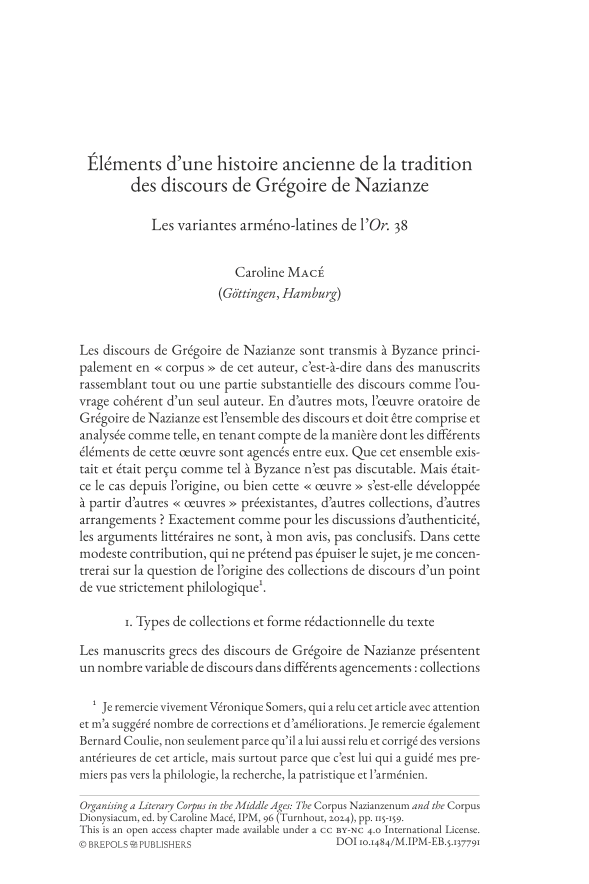
The two oldest translations of Gregory of Nazianzus’ Orations, the Latin translation by Rufinus at the end of the fourth century and the anonymous Armenian translation dating from the end of the fifth or the beginning of the sixth century, present common variant readings of which no trace can be found in the preserved Greek manuscript tradition. These common variants can only be explained as readings present in the Greek models of both translations. At least some of these variants are lectiones difficiliores and the corresponding reading in the Greek manuscripts must, therefore, be explained as a copying error or a deliberate change. This implies that all surviving Greek manuscripts are derived from a hyparchetype containing these errors or changes. This conclusion, already drawn for Orations 2, 6 and 27, is now extended to Oration 38. It has the corollary that the Armenian version can be used as a touchstone not only to assess the primary character of the variants of the Greek tradition but also to determine the primitive form of dissemination of the Greek collection of Orations.

Full text loading...
-
From This Site
/content/books/10.1484/M.IPM-EB.5.137791dcterms_title,dcterms_subject,pub_serialIdent,pub_author,pub_keyword-contentType:Contributor -contentType:Concept -contentType:Institution105