
Full text loading...





The Fifth Theological Oration of Gregory Nazianzen and the Historical Contingency of Revelation, Page 1 of 1
< Previous page | Next page > /docserver/preview/fulltext/10.1484/M.STR-EB.5.110574/J.BAIEP.5.107527-1.gif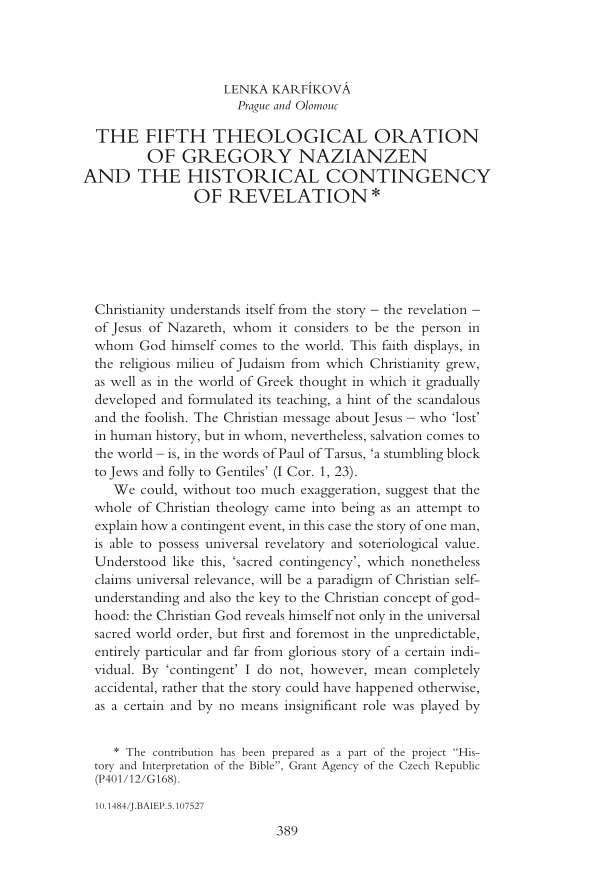
The revelation of God in the story of Christ establishes a pattern of revelation that is both historical and contingent (that is, it could have happened otherwise). The historical and contingent but nonetheless binding character of this revelation is echoed in the development of Christian doctrine. In his famous pneumatological oration (Or. 31, 25-27), Gregory Nazianzen describes how God’s pedagogy involves progressive revelation, which includes the historical nature of the theological knowledge attained through the gradual recognition of the deity of the Father, the Son and the Holy Spirit. This type of historicity does not mean the increasing manifestation of an atemporal truth or of a God who is himself becoming history. Rather, the progressive revelation applies both to God’s atemporal Trinity and to human historical cognition and reception. It thus implies truth which is at one and the same time atemporal and historical, since it changes the historical situation of human beings.
Full text loading...