
Full text loading...





Scritture epigrafiche e scritture su papiro in età ellenistico-romana. Spunti per un confronto, Page 1 of 1
< Previous page | Next page > /docserver/preview/fulltext/10.1484/M.BIB-EB.6.09070802050003050305020003/M.BIB-EB.3.4511-1.gif
[
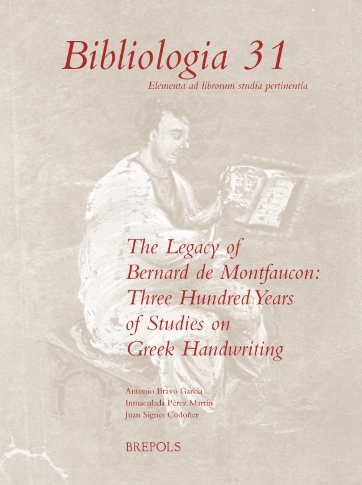
In September 2008, the seventh edition of the International Colloquium of Greek Palaeography (Madrid-Salamanca, 15-20 September 2008) celebrated the 300th anniversary of the Palaeographia Graeca, the pioneer work of the Benedictine Bernard de Montfaucon that established the fundamentals of the discipline. Papers by renowned specialists in the field contributed to the methodology of study and to our knowledge of Greek manuscripts, and opened new perspectives for the study of the Greek manuscripts preserved mostly in European libraries, taking into account new methodological approaches, the possibilities of online resources and the results of ongoing research projects.
The Proceedings published here include contributions by specialists from over ten different countries, dealing with palaeographical issues such as ancient capital and lower-case lettering, writing and books in the Macedonian, Comnenian and Palaeologan periods, and Greek scribes and ateliers in the Renaissance (especially in manuscripts from the Iberian Peninsula). Many contributors also take a codicological approach and consider the material aspects of the codex, as well as other new research techniques. Finally, some papers deal with the book as object and how this relates to its content, as well as with the history of texts.
The International Colloquia of Greek Palaeography are organized by the International Committee of Greek Palaeography, presided by Prof. Dieter Harlfinger. The seventh edition payed tribute to the memory of the late Jean Irigoin, who died in 2006.
,The palaeography of epigraphic texts is a topic neglected by both epigraphists and palaeographers, especially for the period ranging from the Hellenistic to the Imperial period, even though it was especially in those centuries that the production of inscriptions reached its highest peak. More specifically, we are still lacking a systematic study of the relationships between the epigraphic and papyrological scripts, a topic usually discussed in a few footnotes in the editions of texts dependent upon these sources. The present contribution is a first enquiry in that direction, even if in a tentative and asystematic way. From the gathered evidence, the interaction between exhibited (epigraphic) writings and papyrus writings is grounded in two main patterns: (1) insertion, within a graphic typology employed on a specific material support, of distinctive elements (letters, decorations, diacritical or paratextual marks) developed for writings connected to material supports of a different kind; or (2) the employ of a whole graphic typology on a material support structurally different from the one conventionally used with it. The texts associated with this second pattern, even if few, always show a great historical and cultural interest: among them there are important documents (such as imperial letters) or even interesting literary texts, like the so-called ‘Epitaph of Sophytos’, found in Kandahar in 2004 and written in “epsilon-theta style”, or the fragments of an Athenian inscription with passages from Sophocles’ Paean written in “round majuscule”.
The palaeographical analysis of such evidence significantly increases our knowledge of the way inscriptions were made and of their dating. It offers also an important contribution to the reconstruction of Hellenistic and Roman intellectual practises, opening new ways to penetrate inside cultural milieux that are complex, but not inaccessible.
]
Full text loading...