
Full text loading...





Zacharie Calliergis et Alde Manuce: éléments d’une étude à l’occasion de la découverte d’un nouveau manuscrit-modèle de l’édition aldine de Sophocle (a. 1502), Page 1 of 1
< Previous page | Next page > /docserver/preview/fulltext/10.1484/M.BIB-EB.6.09070802050003050305020003/M.BIB-EB.3.4525-1.gif
[
Zacharias Kallierges, the outstanding Cretan scribe and publisher who lived in Italy at the end of the 15th-beginning of the 16th century, was associated with many contemporary scholars belonging to the circle of Aldus Manutius, the most famous printer and publisher in Renaissance Italy. This paper focuses on Kallierges’ collaboration in the printing activities of Aldus Manutius himself, a subject that has not previously been treated. The author concludes that Kallierges collaborated with the Aldine press not only as a copyist of manuscripts used as exemplars for some Aldine printed editions, but also as a corrector and consequently textual editor of some of them. The first conclusion is based on examining the codices Sélestat 347, and Firenze, Biblioteca Riccardiana, gr. 29, both written by Kallierges and used for Aldus’ first editions of Aristophanes (1498) and Pausanias (1516). The second conclusion is based on study of Par. gr. 2939 and Vat. gr. 1379, used for preparing the Aldine edition of Ulpian’s comments on Demosthenes (1503) as well as that of the Tetrasticha of Ignatios the Deacon (1505), which prove that Kallierges was the corrector responsible for the emendations introduced afterwards into the Aldine printed text.
To the list of manuscripts known to have served as exemplars in the Venetian printing office of Aldus Manutius we should now add a new one, the codex Escur. Ω.IV.7, which was revised by the Cretan Ioannes Gregoropoulos and used for the first printed edition of Sophocles’ plays in 1502. Even though it was not Zacharias Kallierges who copied Sophocles’ text in the Escurialensis, we believe nevertheless that this manuscript witnesses to Kallierges’ relationship with the Aldine press, since, in addition to Sophocles’ text, it preserves some fragments of Aristophanes’ plays that were copied by Kallierges and, most likely, used as a supplementary exemplar, next to the Sélestat 347, for Aldus’ first edition of Aristophanes in 1498.
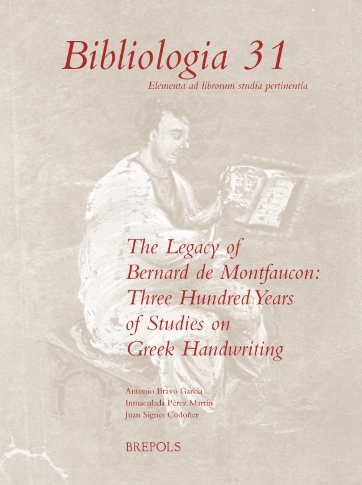
,In September 2008, the seventh edition of the International Colloquium of Greek Palaeography (Madrid-Salamanca, 15-20 September 2008) celebrated the 300th anniversary of the Palaeographia Graeca, the pioneer work of the Benedictine Bernard de Montfaucon that established the fundamentals of the discipline. Papers by renowned specialists in the field contributed to the methodology of study and to our knowledge of Greek manuscripts, and opened new perspectives for the study of the Greek manuscripts preserved mostly in European libraries, taking into account new methodological approaches, the possibilities of online resources and the results of ongoing research projects.
The Proceedings published here include contributions by specialists from over ten different countries, dealing with palaeographical issues such as ancient capital and lower-case lettering, writing and books in the Macedonian, Comnenian and Palaeologan periods, and Greek scribes and ateliers in the Renaissance (especially in manuscripts from the Iberian Peninsula). Many contributors also take a codicological approach and consider the material aspects of the codex, as well as other new research techniques. Finally, some papers deal with the book as object and how this relates to its content, as well as with the history of texts.
The International Colloquia of Greek Palaeography are organized by the International Committee of Greek Palaeography, presided by Prof. Dieter Harlfinger. The seventh edition payed tribute to the memory of the late Jean Irigoin, who died in 2006.
]
Full text loading...