
Full text loading...





L’analyse structurelle du codex, clef de sa genèse et de son histoire, Page 1 of 1
< Previous page | Next page > /docserver/preview/fulltext/10.1484/M.BIB-EB.6.09070802050003050305020003/M.BIB-EB.3.4533-1.gif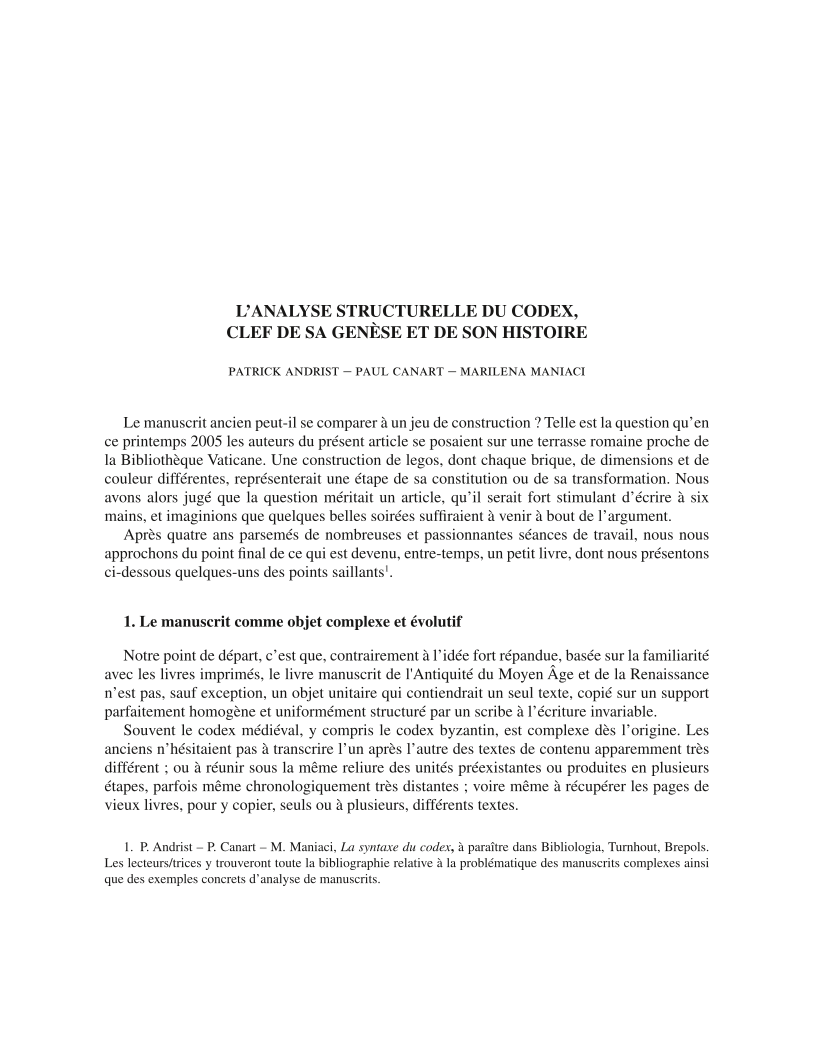
[
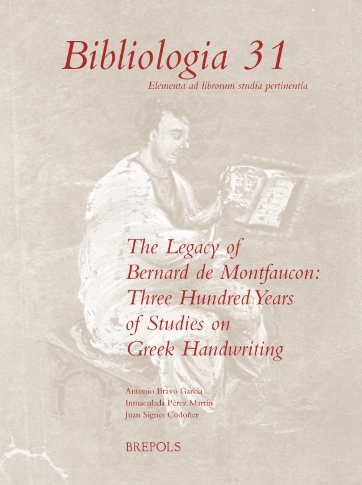
In September 2008, the seventh edition of the International Colloquium of Greek Palaeography (Madrid-Salamanca, 15-20 September 2008) celebrated the 300th anniversary of the Palaeographia Graeca, the pioneer work of the Benedictine Bernard de Montfaucon that established the fundamentals of the discipline. Papers by renowned specialists in the field contributed to the methodology of study and to our knowledge of Greek manuscripts, and opened new perspectives for the study of the Greek manuscripts preserved mostly in European libraries, taking into account new methodological approaches, the possibilities of online resources and the results of ongoing research projects.
The Proceedings published here include contributions by specialists from over ten different countries, dealing with palaeographical issues such as ancient capital and lower-case lettering, writing and books in the Macedonian, Comnenian and Palaeologan periods, and Greek scribes and ateliers in the Renaissance (especially in manuscripts from the Iberian Peninsula). Many contributors also take a codicological approach and consider the material aspects of the codex, as well as other new research techniques. Finally, some papers deal with the book as object and how this relates to its content, as well as with the history of texts.
The International Colloquia of Greek Palaeography are organized by the International Committee of Greek Palaeography, presided by Prof. Dieter Harlfinger. The seventh edition payed tribute to the memory of the late Jean Irigoin, who died in 2006.
,In contrast to the modern printed book, which generally constitutes an entirely homogeneous and uniformly structured object supporting a single text or a coherent set of integrally related texts, the medieval manuscript (Byzantine or otherwise) often takes the form of a “composite codex”—a complex object composed of multiple parts. These parts can be temporally close or distant from each other and may have been subjected, over the course of their history, to a series of (frequently radical) changes. In order to correctly analyze and describe a medieval manuscript it is therefore necessary to take into account both its “genetic history” (meaning the origins of each of its components) and its “stratigraphical history” (meaning the succession of forms in which all such components have circulated, either separately or in unison with one or more of the other components).
The article anticipates some of the results that will be included in a volume soon to be published. The said volume will develop a theory on composite codices; readers will be provided with suitable tools in order to help them to correctly recognise, interpret and describe specific characteristics/forms. A discussion of some theoretical models for composite codices, composed initially of one or more “production units” and later subjected to various transformations that give rise to a range of “production units”, makes it possible to illustrate the basic steps required in order to apply the analytical method proposed.
]
Full text loading...