
Full text loading...





Further Notes on the Bindings and Rebindings of the Manuscripts from the Monastery of St. John Prodromos at Serres (Northern Greece). A Preliminary Study, Page 1 of 1
< Previous page | Next page > /docserver/preview/fulltext/10.1484/M.BIB-EB.6.09070802050003050305020003/M.BIB-EB.3.4540-1.gif
[
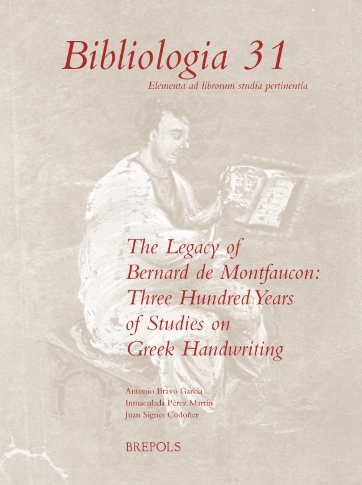
In September 2008, the seventh edition of the International Colloquium of Greek Palaeography (Madrid-Salamanca, 15-20 September 2008) celebrated the 300th anniversary of the Palaeographia Graeca, the pioneer work of the Benedictine Bernard de Montfaucon that established the fundamentals of the discipline. Papers by renowned specialists in the field contributed to the methodology of study and to our knowledge of Greek manuscripts, and opened new perspectives for the study of the Greek manuscripts preserved mostly in European libraries, taking into account new methodological approaches, the possibilities of online resources and the results of ongoing research projects.
The Proceedings published here include contributions by specialists from over ten different countries, dealing with palaeographical issues such as ancient capital and lower-case lettering, writing and books in the Macedonian, Comnenian and Palaeologan periods, and Greek scribes and ateliers in the Renaissance (especially in manuscripts from the Iberian Peninsula). Many contributors also take a codicological approach and consider the material aspects of the codex, as well as other new research techniques. Finally, some papers deal with the book as object and how this relates to its content, as well as with the history of texts.
The International Colloquia of Greek Palaeography are organized by the International Committee of Greek Palaeography, presided by Prof. Dieter Harlfinger. The seventh edition payed tribute to the memory of the late Jean Irigoin, who died in 2006.
,Building upon the significant progress shown over the last decades in the field of studying Byzantine and Post-Byzantine bindings, a new approach is now attempted concerning the conclusions made by the late Linos Politis on the bindings of manuscripts from the Monastery of St. John Prodromos, situated near Serres in Northern Greece.
Through a methodologically systematic description of the decorative and structural elements, some groups of bindings are formed which, when correlated with the rich palaeographical elements of these manuscripts, shed new light on the activity of the Monastery’s workshop regarding the copying, restoration treatments and rebindings of the old manuscripts.
Some of the aims of this research are to clarify the decorative and structural elements of the bindings produced ex novo for manuscripts copied in the workshop of the Monastery; to identify and characterize the rebindings and their structural and decorative elements, which replaced older bindings during the conservation treatments made in the Monastery’s workshop; to determine what the differences are, where they exist, among the bindings of the first group; and finally, to identify the bindings that originated in other places, monasteries or known workshops.
The research will be extended to the bindings of all the manuscripts from the Monastery of St. John Prodromos, which are kept today in the National Library of Greece in Athens. In the current paper, the method of collecting the data and some first conclusions are presented.
]
Full text loading...