
Full text loading...





Les deux types de chaînes exégétiques sur le livre de Jérémie: une mise en page adaptée au contenu?, Page 1 of 1
< Previous page | Next page > /docserver/preview/fulltext/10.1484/M.BIB-EB.6.09070802050003050305020003/M.BIB-EB.3.4543-1.gif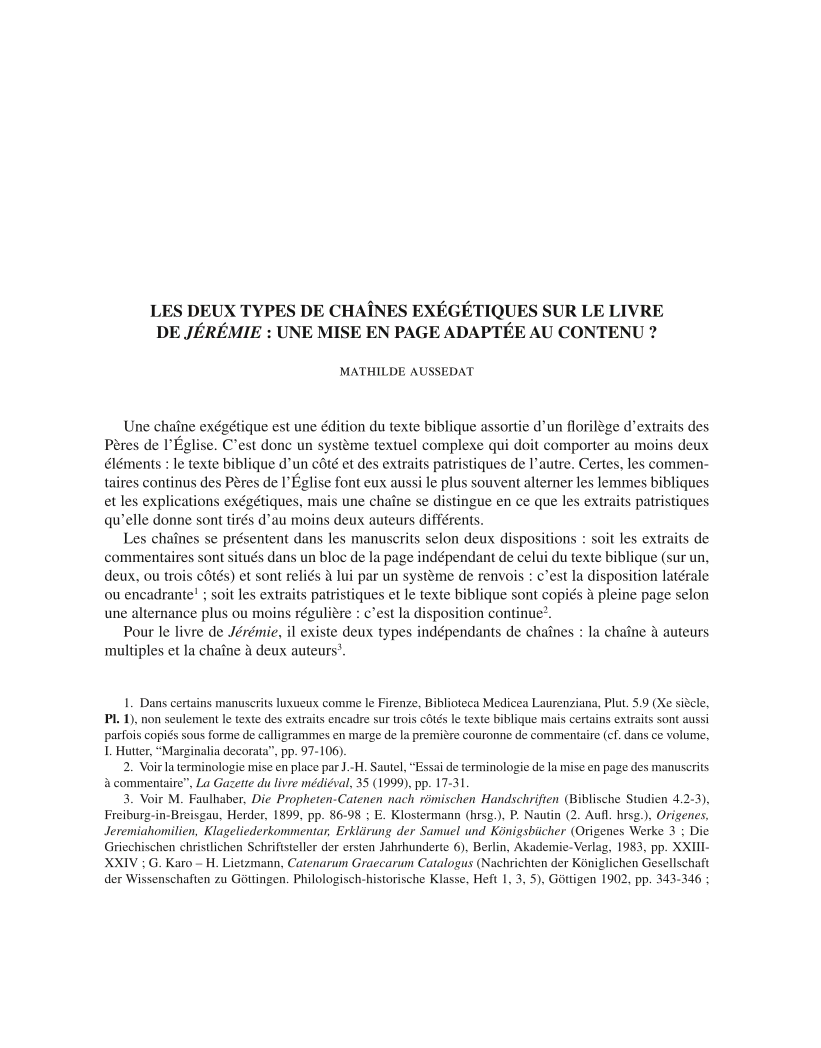
[
In September 2008, the seventh edition of the International Colloquium of Greek Palaeography (Madrid-Salamanca, 15-20 September 2008) celebrated the 300th anniversary of the Palaeographia Graeca, the pioneer work of the Benedictine Bernard de Montfaucon that established the fundamentals of the discipline. Papers by renowned specialists in the field contributed to the methodology of study and to our knowledge of Greek manuscripts, and opened new perspectives for the study of the Greek manuscripts preserved mostly in European libraries, taking into account new methodological approaches, the possibilities of online resources and the results of ongoing research projects.
The Proceedings published here include contributions by specialists from over ten different countries, dealing with palaeographical issues such as ancient capital and lower-case lettering, writing and books in the Macedonian, Comnenian and Palaeologan periods, and Greek scribes and ateliers in the Renaissance (especially in manuscripts from the Iberian Peninsula). Many contributors also take a codicological approach and consider the material aspects of the codex, as well as other new research techniques. Finally, some papers deal with the book as object and how this relates to its content, as well as with the history of texts.
The International Colloquia of Greek Palaeography are organized by the International Committee of Greek Palaeography, presided by Prof. Dieter Harlfinger. The seventh edition payed tribute to the memory of the late Jean Irigoin, who died in 2006.
,The existence of a specific page layout for each of the two types of catenae on the Book of Jeremiah (a marginal arrangement for the catena by multiple authors and a continuous arrangement for the catena by two authors) makes it possible to discuss the explanation proposed by G. Dorival in his work on the catenae on Psalms, that is, that the page layout is not relevant to defining the catenae. In fact, with regard to the Book of Jeremiah, the page layout is relevant to the definition of catenae, not because these reproduce in a systematic way the layout of their main patristic font, but because they present a page layout suited to their contents and particularly to how the biblical texts are mentioned (fully or partly; copied on a biblical or a patristic manuscript) and how the biblical lemmata as well as the patristic extracts are correlated or coordinated with each other. The way each catena is composed and read is determined by the page layout, which does not rely upon a decision of the scribes but of the catenists themselves.
]
Full text loading...