
Full text loading...





Juxtaposition / assemblage de textes et histoire de la tradition: le cas du Par. gr. 1711, Page 1 of 1
< Previous page | Next page > /docserver/preview/fulltext/10.1484/M.BIB-EB.6.09070802050003050305020003/M.BIB-EB.3.4550-1.gif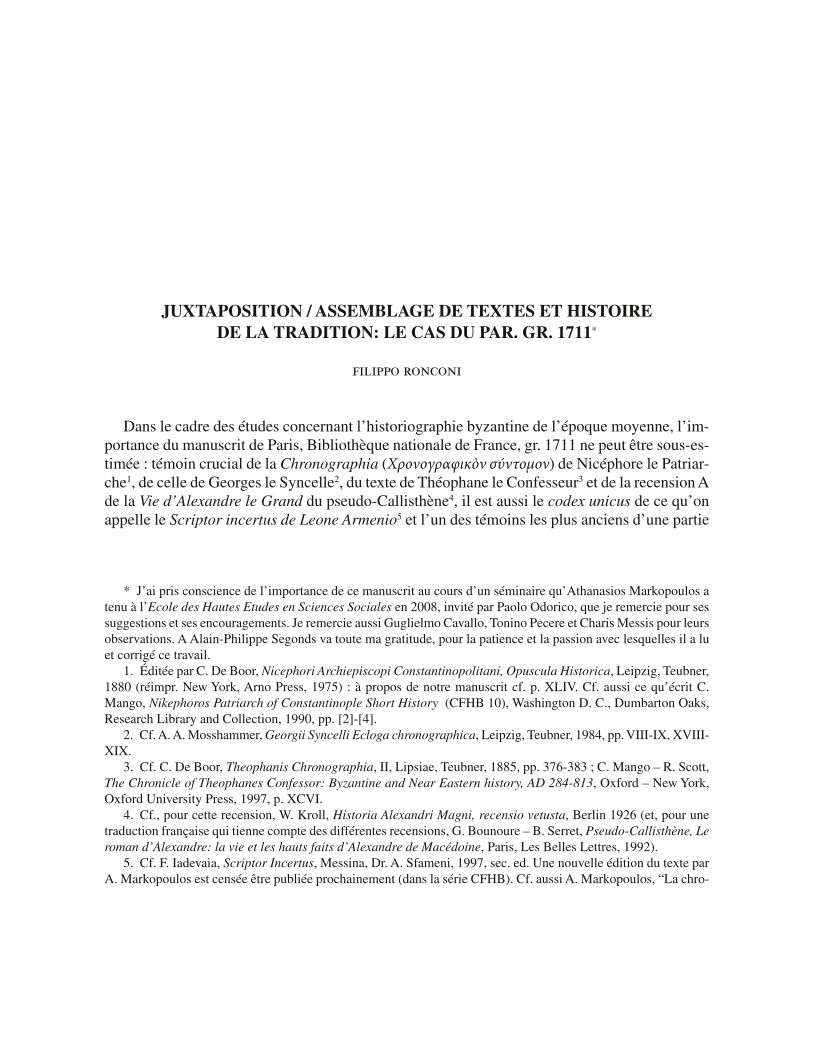
[
In September 2008, the seventh edition of the International Colloquium of Greek Palaeography (Madrid-Salamanca, 15-20 September 2008) celebrated the 300th anniversary of the Palaeographia Graeca, the pioneer work of the Benedictine Bernard de Montfaucon that established the fundamentals of the discipline. Papers by renowned specialists in the field contributed to the methodology of study and to our knowledge of Greek manuscripts, and opened new perspectives for the study of the Greek manuscripts preserved mostly in European libraries, taking into account new methodological approaches, the possibilities of online resources and the results of ongoing research projects.
The Proceedings published here include contributions by specialists from over ten different countries, dealing with palaeographical issues such as ancient capital and lower-case lettering, writing and books in the Macedonian, Comnenian and Palaeologan periods, and Greek scribes and ateliers in the Renaissance (especially in manuscripts from the Iberian Peninsula). Many contributors also take a codicological approach and consider the material aspects of the codex, as well as other new research techniques. Finally, some papers deal with the book as object and how this relates to its content, as well as with the history of texts.
The International Colloquia of Greek Palaeography are organized by the International Committee of Greek Palaeography, presided by Prof. Dieter Harlfinger. The seventh edition payed tribute to the memory of the late Jean Irigoin, who died in 2006.
,One of the most important sources of Byzantine historiography, Par. gr. 1711, contains the Χρονογραφικὸν σύντομον of the Patriarch Nikephoros, the Chronographia of George the Syncellus, the chronicle of Theophanes the Confessor and the Life of Alexander by the Pseudo-Callisthenes. This codex is also the unique witness of the so-called Scriptor incertus de Leone Armenio and one of the oldest manuscripts of the Chronicle of Symeon the Logothetes.
Codicological, palaeographical and textual analysis of the manuscript demonstrates its composite nature and enables us to reconstruct its complex genesis. In the 11th century an anonymous copyist transcribed from various sources the texts of George the Syncellus, the Pseudo-Callisthenes, Theophanes the Confessor, Symeon the Logothetes and the Scriptor incertus (the last three were probably found, all together, in a manuscript that had been copied by a grammatikos named Leo). About a century later, two anonymous copyists restored the manuscript, adding the text of Nikephoros. Between the 12th and 16th centuries various readers and/or owners of the codex wrote historical annotations on a bifolio added at the beginning of the manuscript.
The long evolution of Par. gr. 1711 makes it not only a monument of Byzantine historiography but also a witness of the cultural attitude of Byzantine readers towards History.
]
Full text loading...