
Full text loading...



What Descartes’s Embryology Tells Us about his Dualism, Page 1 of 1
< Previous page | Next page > /docserver/preview/fulltext/10.1484/M.DESCARTES-EB.5.123382/M.DESCARTES-EB.5.132890-1.gif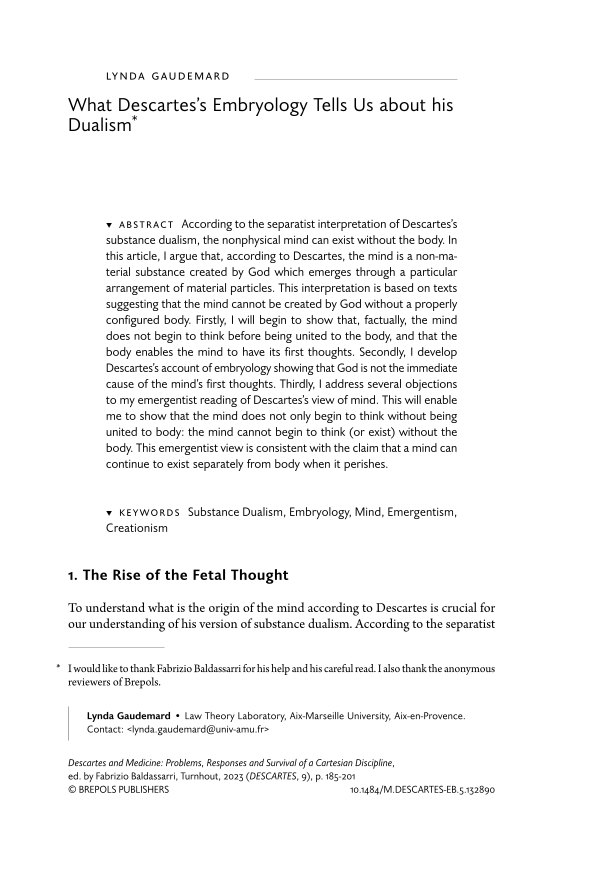
According to the separatist interpretation of Descartes’s substance dualism, the nonphysical mind can exist without the body. In this article, I argue that, according to Descartes, the mind is a non-material substance created by God which emerges through a particular arrangement of material particles. This interpretation is based on texts suggesting that the mind cannot be created by God without a properly configured body. Firstly, I will begin to show that, factually, the mind does not begin to think before being united to the body, and that the body enables the mind to have its first thoughts. Secondly, I develop Descartes’s account of embryology showing that God is not the immediate cause of the mind’s first thoughts. Thirdly, I address several objections to my emergentist reading of Descartes’s view of mind. This will enable me to show that the mind does not only begin to think without being united to body: the mind cannot begin to think (or exist) without the body. This emergentist view is consistent with the claim that a mind can continue to exist separately from body when it perishes.
Full text loading...