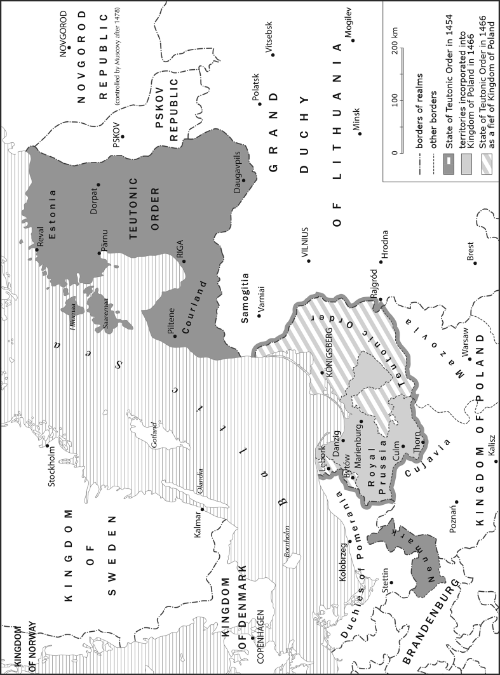
Territorial boundaries of the Teutonic Order’s dominion in Prussia and Livonia. Following The Thirteen Years’ War, the 1466 Second Peace of Thorn assigned the Teutonic Order’s western territories, subsequently known as Royal Prussia, to Poland. The remainder of the Order’s dominion was held by the Order as a fief of Poland.
Map 4.Territorial boundaries of the Teutonic Order’s dominion in Prussia and Livonia. Following The Thirteen Years’ War, the 1466 Second Peace of Thorn assigned the Teutonic Order’s western territories, subsequently known as Royal Prussia, to Poland. The remainder of the Order’s dominion was held by the Order as a fief of Poland.
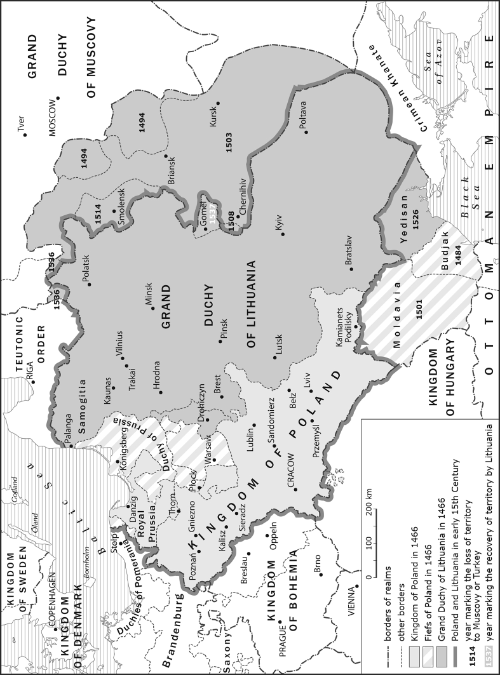
Poland and Lithuania during the sixteenth century. In 1525, the Teutonic Order in Prussia was secularised as a duchy and a fief of Poland when its Grandmaster, who was also the Polish king’s nephew, renounced Catholicism in favour of the Lutheran Confession. In 1526, the male line of the Masovian Piasts became extinct upon the death of Duke Janusz III, and Mazovia, as a reverted fief, became a palatinate within the Kingdom of Poland.
Map 5.Poland and Lithuania during the sixteenth century. In 1525, the Teutonic Order in Prussia was secularised as a duchy and a fief of Poland when its Grandmaster, who was also the Polish king’s nephew, renounced Catholicism in favour of the Lutheran Confession. In 1526, the male line of the Masovian Piasts became extinct upon the death of Duke Janusz III, and Mazovia, as a reverted fief, became a palatinate within the Kingdom of Poland.
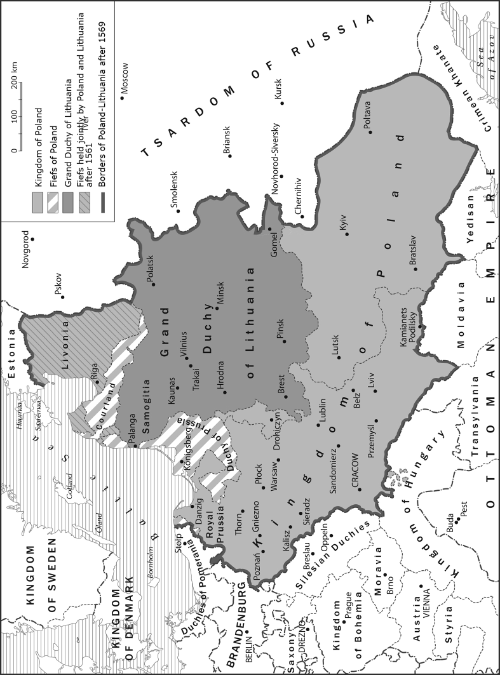
Administrative divisions of Poland and Lithuania prior to the 1569 union and following it. During the union negotiations in 1569 Ukraine and Podlasie were incorporated into the Kingdom of Poland.
Map 6.Administrative divisions of Poland and Lithuania prior to the 1569 union and following it. During the union negotiations in 1569 Ukraine and Podlasie were incorporated into the Kingdom of Poland.