
Full text loading...





Terence’s language between oratory and vulgar Latin, Page 1 of 1
< Previous page | Next page > /docserver/preview/fulltext/10.1484/M.LVLT-EB.5.142508/M.LVLT-EB.5.143285-1.gif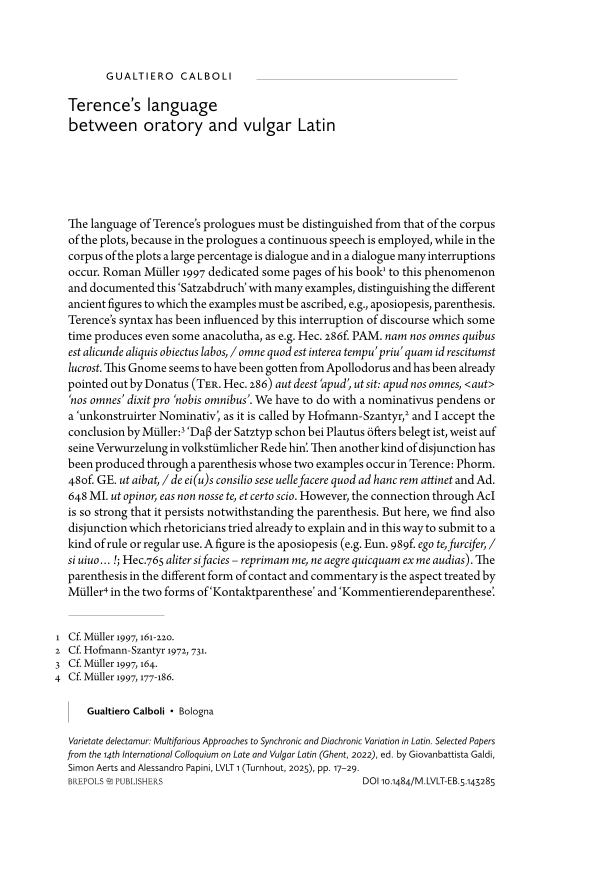
Terence’s language must be examined from different points of view: (1) the language of the comedy (Terence in comparison with Plautus, Caecilius, Luscius Lanuvinus); (2) the oratorical approach to some problems discussed in the prologues; (3) the direct or indirect influence of Greek on Terence’s language.
As for point (2), Terence could distinguish the style of Menander’s Perinthia from that of the Andria: Andr. 9-12 Menander fecit Andriam et Perinthiam. / qui utramuis recte norit ambas nouerit: / non ita dissimili sunt argumento, et tamen / dissimili oratione sunt factae et stilo. Since Perinthia was presumably an early work of Menander’s ,we can assume that Terence could distinguish a comedy composed by the young Menander from another one of the old poet. Another intriguing story is told in Phormio’s prologue where Luscius’ opinion about Terence’s comedy is given (Phorm. 4-8).
These discussions and defences of Terence’s comedies are given in discourses held by a speaker (Haut. 11 oratorem esse uoluit me, non prologum; Hec.1 Orator ad uos uenio ornatu prologi) in the prologus conceived as a discourse to be held in a trial Therefore I will take into account this ‘style’ and kind of discourse and study it by applying the theory of elocutio we find in the first complete rhetorical handbook, namely the Ad Herennium, written about eighty years later, and in particular at 4,10,15, where the swollen style is described and illustrated with a couple of examples which can be compared for the exaggerated pathos with Luscius’ comedy as it is described in Phorm.7-8 (ceruam uidere fugere et sectari canes / et eam plorare, etc.). I suggest that the language employed by Terence could be defined as sermo uolgaris, i.e. as the language usually employed, according to the meaning provided in Rhet. Her. 3,12,36 and 4,56,69. We must therefore start from Terence to know which was the original meaning of sermo uulgaris opposed to the oratorical language. On the other hand, and as pointed out by Goldberg 1986, 202, ‘Terence left behind the diffuse rambles of early prose and the playful verbosity of his comic predecessors, creating instead the kind of Latin that first showed clearly those features from which the great stylistics of later times developed their individual voices’. The change of styles by Terence and the mention of oratorial style in his prologues show attention to different kinds of language asked for different situations and people. An attention we don’t find in Plautus who used masterly his language to comic effects but without a systematic distinction of high and low style.
Full text loading...