
Full text loading...





Morphologies in contact in Bible translations . The nomina agentis in New Testament Latin, Page 1 of 1
< Previous page | Next page > /docserver/preview/fulltext/10.1484/M.LVLT-EB.5.142508/M.LVLT-EB.5.143297-1.gif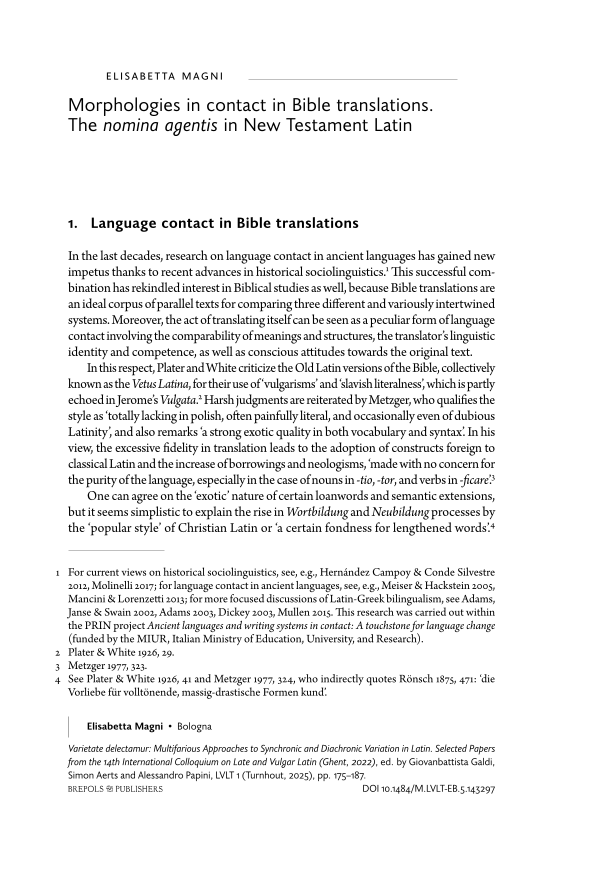
This article aims to investigate the increase and multiple functions of agent nouns in the Latin versions of the New Testament, particularly in the Vulgate. Comparison with the original text shows that, in most cases, literal translation does not involve altering Latin morphology but rather delving into the meanings and structures of Greek words to reproduce them ‘morpheme by morpheme’. The data also highlight the functional asymmetry between Greek nouns in -της and their Latin counterparts in -tor, which nevertheless find formal and semantic correspondences with a variety of nouns, adjectives, and participles. This versatility does not reflect the diachronic expansion of Latin derivatives but the synchronic oscillation of agentive nominalizations along the noun-verb continuum, which translators exploit effectively.
Full text loading...