


oa Shaping shapes. Sicilicus and other diacritics in Latin epigraphy
- Authors: Lucia Tamponi and Serena Barchi
- Publication: Varietate delectamur: Multifarious Approaches to Synchronic and Diachronic Variation in Latin , pp 753-766
- Publisher: Brepols
- Publication Date: January 2025
- DOI: https://doi.org/10.1484/M.LVLT-EB.5.143340


Shaping shapes. Sicilicus and other diacritics in Latin epigraphy, Page 1 of 1
< Previous page | Next page > /docserver/preview/fulltext/10.1484/M.LVLT-EB.5.142508/M.LVLT-EB.5.143340-1.gif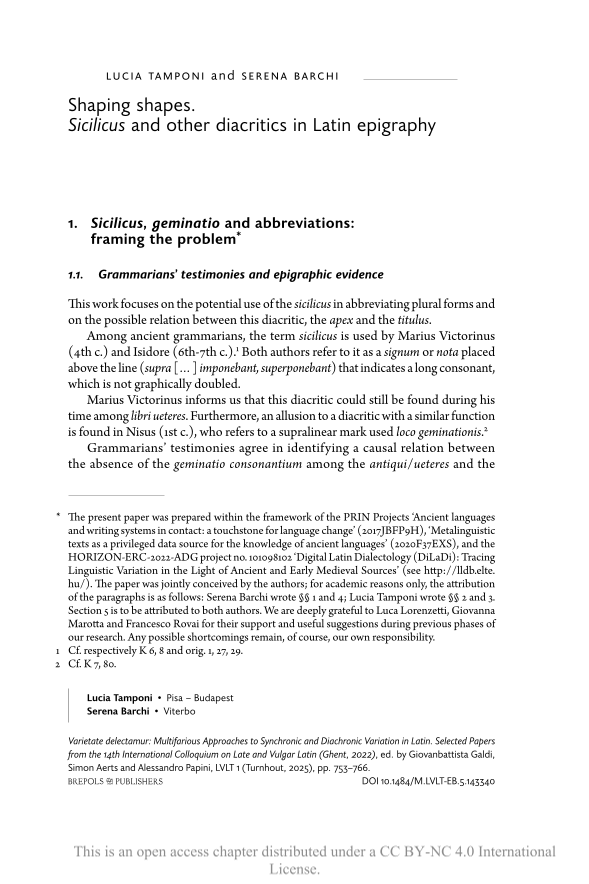
The present paper builds upon the analysis of the sicilicus, a diacritic which, although occupying an altogether marginal space in Latin epigraphy, may provide insights into phono‑orthographic issues in the Latin language. The sicilicus is seldom attested in Latin orthographic tradition, and ancient grammarians’ testimonies suggest that it could have marked long consonants before the spread of geminatio consonantium.
Traces of the evolution of this mark might be spotted in the epigraphic notation of abbreviations standing for plural forms. Such forms can be notated either through geminatio consonantium or through a supralinear diacritic of varying shape, which can be identified with a sicilicus or with an apex. Therefore, a common origin of both the sicilicus and the apex has been suggested by some scholars, to indicate the doubling of a grapheme.
In order to shed light on the variability of shape and function of these marks, we examined the diacritics and abbreviations attested in a corpus of Latin inscriptions from Latium (including Rome) and Campania. Our preliminary results will explore the possibility of relating the use of the examined diacritic marks of varying shape to the sicilicus, discussing whether they can represent its evolution.

Full text loading...
-
From This Site
/content/books/10.1484/M.LVLT-EB.5.143340dcterms_title,dcterms_subject,pub_serialIdent,pub_author,pub_keyword-contentType:Contributor -contentType:Concept -contentType:Institution105