


oa Thucydides and the Politics of Plague
- By: Mauro Bonazzi
- Publication: Epidemics and Pandemics , pp 25-36
- Publisher: Brepols
- Publication Date: January 2024
- DOI: https://doi.org/10.1484/M.STPH-EB.5.136405


Thucydides and the Politics of Plague, Page 1 of 1
< Previous page | Next page > /docserver/preview/fulltext/10.1484/M.STPH-EB.5.127756/M.STPH-EB.5.136405-1.gif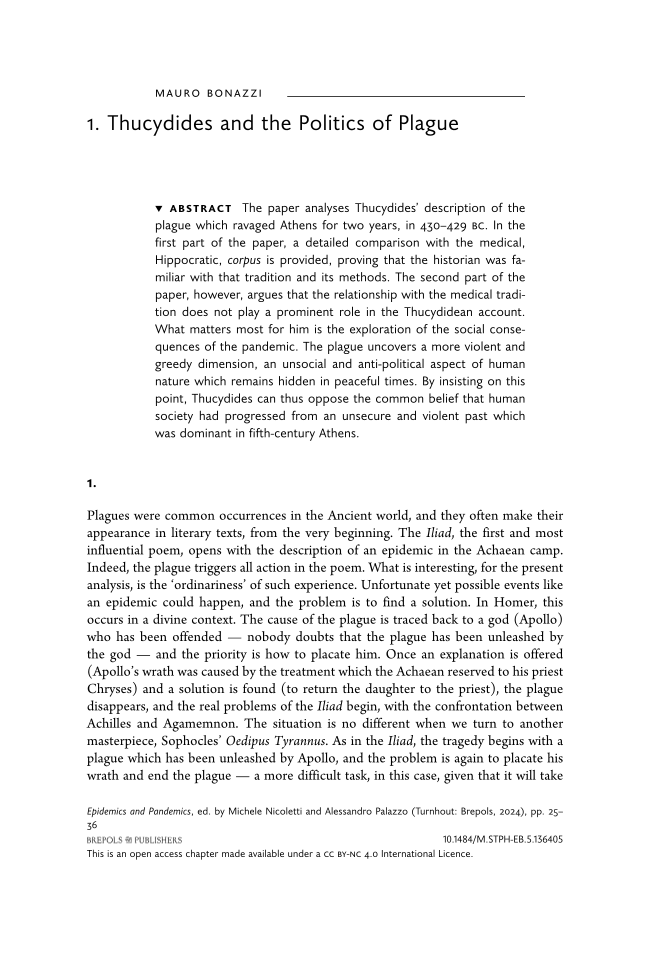
Abstract
The paper analyses Thucydides’ description of the plague which ravaged Athens for two years, in 430–429 bc. In the first part of the paper, a detailed comparison with the medical, Hippocratic, corpus is provided, proving that the historian was familiar with that tradition and its methods. The second part of the paper, however, argues that the relationship with the medical tradition does not play a prominent role in the Thucydidean account. What matters most for him is the exploration of the social consequences of the pandemic. The plague uncovers a more violent and greedy dimension, an unsocial and anti-political aspect of human nature which remains hidden in peaceful times. By insisting on this point, Thucydides can thus oppose the common belief that human society had progressed from an unsecure and violent past which was dominant in fifth-century Athens.

Full text loading...
References
-
BibliographyGalenus, De difficultate respirationis, ed. Karl Gottlob Kühn, vol. 7 (Leipzig: 1824, repr. Hildesheim: Georg Olms Verlagsbuchhandlung, 1965).
-
Herodotus, Historiarum libri IX, ed. Heinrich Rudolf Dietsch (Leipzig: Teubner, 1926–).
-
Hippocrates, Ancient Medicine, in Hippocrates. Volume 1, trans. by W.H.S. Jones (Cambridge, Mass.: Harvard University Press, 1923).
-
Hippocrates, Airs, waters, places, in Hippocrates. Volume 1, trans. by W.H.S. Jones (Cambridge, Mass.: Harvard University Press, 1923).
-
Hippocrates, Epidemics 1 and 3, in Hippocrates. Volume 1, trans. by W.H.S. Jones (Cambridge, Mass.: Harvard University Press, 1923).
-
Hippocrates, Breaths, in Hippocrates. Volume 2, trans. by W.H.S. Jones (Cambridge, Mass.: Harvard University Press, 1923).
-
Hippocrates, The Sacred Disease, in Hippocrates. Volume 2, trans. by W.H.S. Jones (Cambridge, Mass.: Harvard University Press, 1923).
-
Hippocrates, Nature of Man, in Hippocrates. Volume 4, trans. by W.H.S. Jones (Cambridge, Mass.: Harvard University Press, 1931).
-
Plato, Symposium, in Platonis Opera, ed. J. Burnet, vol. ii (Oxford: Clarendon, 1899).
-
Strabo, Geographica, ed. August Meineke (Leipzig: Teubner: 1895–1899).
-
Thucydides, History of the Peloponnesian War, with an English Translation by Charles F. Smith (Cambridge, Mass.: Harvard University Press, 1959).
-
***Bonazzi, Mauro, ‘Il Movimento reale. Tucidide sulla guerra e l’uomo’, in Guerra e pace. Storia e teoria di un’esperienza filosofica e politica, ed. by Carlo Altini (Bologna: Il Mulino, 2015), pp. 35–49.
-
Bonazzi, Mauro, Atene la città inquieta (Torino: Einaudi, 2017).
-
Bonazzi, Mauro, The Sophists (Cambridge University Press: Cambridge, 2020).
-
Bonazzi, Mauro, ‘Political, all too Political: Again on Protagoras Myth in its Intellectual Context’, Polis. The Journal for Ancient Political Thought, 39 (2022), 425-445.
-
Cochrane, Charles Norris, Thucydides and the Science of History (Oxford University Press: London, 1929).
-
Connor, W. Robert, Thucydides (Princeton: Princeton University Press, 1984).
-
Craik, Elizabeth M., ‘Thucydides on the Plague: Physiology of Flux and Fixation’, Classical Quarterly, 51 (2001), pp. 102–8.
-
Demont, Paul, ‘Notes sur le récit de la pestilence athénienne chez Thucydide et sur ses rapports avec la médecine grecque de l’époque classique’, in Formes de la pensée dans la Collecion Hippocratique ed. by François Lasserre and Philippe Mudry (Drosz: Genève, 1983), pp. 341–53.
-
Demont, Paul, ‘The Causes of the Athenian Plague and Thucydides’, in Thucydides between History and Literature, ed. by Antonis Tsakmakis and Melina Tamiolaki (Berlin: De Gruyter, 2013), pp. 73–87.
-
Fleming, Rebecca, ‘Galen and the Plague’, in Galens’ peri alypias and the History of the Roman Empire, ed. by Caroline Petit (Leiden: Brill, 2019), pp. 219–44.
-
Furley, William D., ‘Thucydides and Religion’, in Brill’s Companion to Thucydides, ed. by Antonios Rengakos and Antonis Tsamakis (Leiden: Brill, 2006), pp. 415–38.
-
Gomme, Arnold Wycombe, A Historical Commentary on Thucydides, vol. 2 (Oxford: Clarendon Press, 1945).
-
Guthrie, William Keith Chambers, The Sophists (Cambridge: Cambridge University Press, 1971).
-
Holladay, A. J., and Poole, J. F. C., ‘Thucydides and the Plague of Athens’, Classical Quarterly 29 (1979), pp. 282–300.
-
Hornblower, Simon, A Commentary on Thucydides, vol. 1 (Oxford: Clarendon Press, 1991).
-
Jouanna, Jacques, ‘Air, Miasma, Contagion in the Time of Hippocrates and the Survival of Miasmas in Post-Hippocratic Medicine (Rufus of Ephesus, Galen and Palladius)’, in Greek Medicine from Hippocrates to Galen. Selected Papers, ed. by Jacques Jouanna (Leiden: Brill, 2012), pp. 121–37.
-
Lichtenthaeler, Charles, Thucydide et Hippocrate vus par un historien-medecin (Droz: Geneve, 1965)
-
Lloyd, Geoffrey Ernest Richard, In the Grip of Disease. Studies in Greek Imagination (Oxford: Oxford University Press, 2003).
-
Loraux, Nicole, ‘Thucydide et la sédition dans les mots’, in Ead., La tragédie d’Athènes. La politique entre l’ombre et l’utopie (Paris: Seuil, 2005), pp. 84–87.
-
MacLeod, Colin, ‘Thucydides on Faction’, Proceedings of the Cambridge Philological Society, 205 (1979), pp. 52–68.
-
Mittelstadt, Michael, ‘The Thucydidean Tragic View: The Moral Implications’, Ramus, 14 (1985), pp. 59–73.
-
Morgan, Thomas E., ‘Plague or Poetry? Thucydides on the Epidemic at Athens’, Transactions of the American Philological Association, 124 (1994), pp. 197–209.
-
Orwin, Clifford, ‘Stasis and Plague: Thucydides on the Dissolution of Society’, Journal of Politics, 50 (1988), pp. 831–47.
-
Paci, Enzo, Storia del pensiero presocratico (Rome: ERI, 1957).
-
Page, Denys Lionel, ‘Thucydides’ Description of the Great Plague at Athens’, Classical Quarterly, 47 (1953), pp. 97–119.
-
Parry, Adam, ‘The Language of Thucydides’ Description of the Plague’, Bulletin of the Institute of Classical Studies, 16 (1969), pp. 106–18.
-
Ponchon, Pierre, La rationalité tragique. Essai sur la constitution d’une forme de pensée d’Héraclite à Thucidyde et sur sa critique platonicienne, Ph.D. thesis, Clermont-Ferrand.
-
Price, Jonathan J., Thucydides and Internal War (Cambridge: Cambridge University Press, 2001).
-
Rawlings, Hunter R., A Semantic Study of prophasis to 400 B.C. (Wiesbaden: Hermes, 1975).
-
Rechenhauer, Georg, Thukydides und die hippokratische Medizin (Hildesheim: Olms, 1991)
-
Thomas, Rosalind, ‘Thucydides Intellectual Milieu and the Plague’, in Brill’s Companion to Thucydides, ed. by Antonios Rengakos and Antonis Tsamakis (Leiden: Brill, 2006), pp. 87–108.
-
Visvardi, Eirene, Emotion in Action. Thucydides and the Tragic Chorus (Leiden: Brill, 2015).
References
-
BibliographyGalenus, De difficultate respirationis, ed. Karl Gottlob Kühn, vol. 7 (Leipzig: 1824, repr. Hildesheim: Georg Olms Verlagsbuchhandlung, 1965).
-
Herodotus, Historiarum libri IX, ed. Heinrich Rudolf Dietsch (Leipzig: Teubner, 1926–).
-
Hippocrates, Ancient Medicine, in Hippocrates. Volume 1, trans. by W.H.S. Jones (Cambridge, Mass.: Harvard University Press, 1923).
-
Hippocrates, Airs, waters, places, in Hippocrates. Volume 1, trans. by W.H.S. Jones (Cambridge, Mass.: Harvard University Press, 1923).
-
Hippocrates, Epidemics 1 and 3, in Hippocrates. Volume 1, trans. by W.H.S. Jones (Cambridge, Mass.: Harvard University Press, 1923).
-
Hippocrates, Breaths, in Hippocrates. Volume 2, trans. by W.H.S. Jones (Cambridge, Mass.: Harvard University Press, 1923).
-
Hippocrates, The Sacred Disease, in Hippocrates. Volume 2, trans. by W.H.S. Jones (Cambridge, Mass.: Harvard University Press, 1923).
-
Hippocrates, Nature of Man, in Hippocrates. Volume 4, trans. by W.H.S. Jones (Cambridge, Mass.: Harvard University Press, 1931).
-
Plato, Symposium, in Platonis Opera, ed. J. Burnet, vol. ii (Oxford: Clarendon, 1899).
-
Strabo, Geographica, ed. August Meineke (Leipzig: Teubner: 1895–1899).
-
Thucydides, History of the Peloponnesian War, with an English Translation by Charles F. Smith (Cambridge, Mass.: Harvard University Press, 1959).
-
***Bonazzi, Mauro, ‘Il Movimento reale. Tucidide sulla guerra e l’uomo’, in Guerra e pace. Storia e teoria di un’esperienza filosofica e politica, ed. by Carlo Altini (Bologna: Il Mulino, 2015), pp. 35–49.
-
Bonazzi, Mauro, Atene la città inquieta (Torino: Einaudi, 2017).
-
Bonazzi, Mauro, The Sophists (Cambridge University Press: Cambridge, 2020).
-
Bonazzi, Mauro, ‘Political, all too Political: Again on Protagoras Myth in its Intellectual Context’, Polis. The Journal for Ancient Political Thought, 39 (2022), 425-445.
-
Cochrane, Charles Norris, Thucydides and the Science of History (Oxford University Press: London, 1929).
-
Connor, W. Robert, Thucydides (Princeton: Princeton University Press, 1984).
-
Craik, Elizabeth M., ‘Thucydides on the Plague: Physiology of Flux and Fixation’, Classical Quarterly, 51 (2001), pp. 102–8.
-
Demont, Paul, ‘Notes sur le récit de la pestilence athénienne chez Thucydide et sur ses rapports avec la médecine grecque de l’époque classique’, in Formes de la pensée dans la Collecion Hippocratique ed. by François Lasserre and Philippe Mudry (Drosz: Genève, 1983), pp. 341–53.
-
Demont, Paul, ‘The Causes of the Athenian Plague and Thucydides’, in Thucydides between History and Literature, ed. by Antonis Tsakmakis and Melina Tamiolaki (Berlin: De Gruyter, 2013), pp. 73–87.
-
Fleming, Rebecca, ‘Galen and the Plague’, in Galens’ peri alypias and the History of the Roman Empire, ed. by Caroline Petit (Leiden: Brill, 2019), pp. 219–44.
-
Furley, William D., ‘Thucydides and Religion’, in Brill’s Companion to Thucydides, ed. by Antonios Rengakos and Antonis Tsamakis (Leiden: Brill, 2006), pp. 415–38.
-
Gomme, Arnold Wycombe, A Historical Commentary on Thucydides, vol. 2 (Oxford: Clarendon Press, 1945).
-
Guthrie, William Keith Chambers, The Sophists (Cambridge: Cambridge University Press, 1971).
-
Holladay, A. J., and Poole, J. F. C., ‘Thucydides and the Plague of Athens’, Classical Quarterly 29 (1979), pp. 282–300.
-
Hornblower, Simon, A Commentary on Thucydides, vol. 1 (Oxford: Clarendon Press, 1991).
-
Jouanna, Jacques, ‘Air, Miasma, Contagion in the Time of Hippocrates and the Survival of Miasmas in Post-Hippocratic Medicine (Rufus of Ephesus, Galen and Palladius)’, in Greek Medicine from Hippocrates to Galen. Selected Papers, ed. by Jacques Jouanna (Leiden: Brill, 2012), pp. 121–37.
-
Lichtenthaeler, Charles, Thucydide et Hippocrate vus par un historien-medecin (Droz: Geneve, 1965)
-
Lloyd, Geoffrey Ernest Richard, In the Grip of Disease. Studies in Greek Imagination (Oxford: Oxford University Press, 2003).
-
Loraux, Nicole, ‘Thucydide et la sédition dans les mots’, in Ead., La tragédie d’Athènes. La politique entre l’ombre et l’utopie (Paris: Seuil, 2005), pp. 84–87.
-
MacLeod, Colin, ‘Thucydides on Faction’, Proceedings of the Cambridge Philological Society, 205 (1979), pp. 52–68.
-
Mittelstadt, Michael, ‘The Thucydidean Tragic View: The Moral Implications’, Ramus, 14 (1985), pp. 59–73.
-
Morgan, Thomas E., ‘Plague or Poetry? Thucydides on the Epidemic at Athens’, Transactions of the American Philological Association, 124 (1994), pp. 197–209.
-
Orwin, Clifford, ‘Stasis and Plague: Thucydides on the Dissolution of Society’, Journal of Politics, 50 (1988), pp. 831–47.
-
Paci, Enzo, Storia del pensiero presocratico (Rome: ERI, 1957).
-
Page, Denys Lionel, ‘Thucydides’ Description of the Great Plague at Athens’, Classical Quarterly, 47 (1953), pp. 97–119.
-
Parry, Adam, ‘The Language of Thucydides’ Description of the Plague’, Bulletin of the Institute of Classical Studies, 16 (1969), pp. 106–18.
-
Ponchon, Pierre, La rationalité tragique. Essai sur la constitution d’une forme de pensée d’Héraclite à Thucidyde et sur sa critique platonicienne, Ph.D. thesis, Clermont-Ferrand.
-
Price, Jonathan J., Thucydides and Internal War (Cambridge: Cambridge University Press, 2001).
-
Rawlings, Hunter R., A Semantic Study of prophasis to 400 B.C. (Wiesbaden: Hermes, 1975).
-
Rechenhauer, Georg, Thukydides und die hippokratische Medizin (Hildesheim: Olms, 1991)
-
Thomas, Rosalind, ‘Thucydides Intellectual Milieu and the Plague’, in Brill’s Companion to Thucydides, ed. by Antonios Rengakos and Antonis Tsamakis (Leiden: Brill, 2006), pp. 87–108.
-
Visvardi, Eirene, Emotion in Action. Thucydides and the Tragic Chorus (Leiden: Brill, 2015).
-
From This Site
/content/books/10.1484/M.STPH-EB.5.136405dcterms_title,dcterms_subject,pub_serialIdent,pub_author,pub_keyword-contentType:Contributor -contentType:Concept -contentType:Institution105