


oa Zoonosis
Access full text
Chapter
- By: Carlo Brentari
- Publication: Epidemics and Pandemics , pp 217-233
- Publisher: Brepols
- Publication Date: January 2024
- DOI: https://doi.org/10.1484/M.STPH-EB.5.136412
Preview this chapter:


Zoonosis, Page 1 of 1
< Previous page | Next page > /docserver/preview/fulltext/10.1484/M.STPH-EB.5.127756/M.STPH-EB.5.136412-1.gif
Abstract
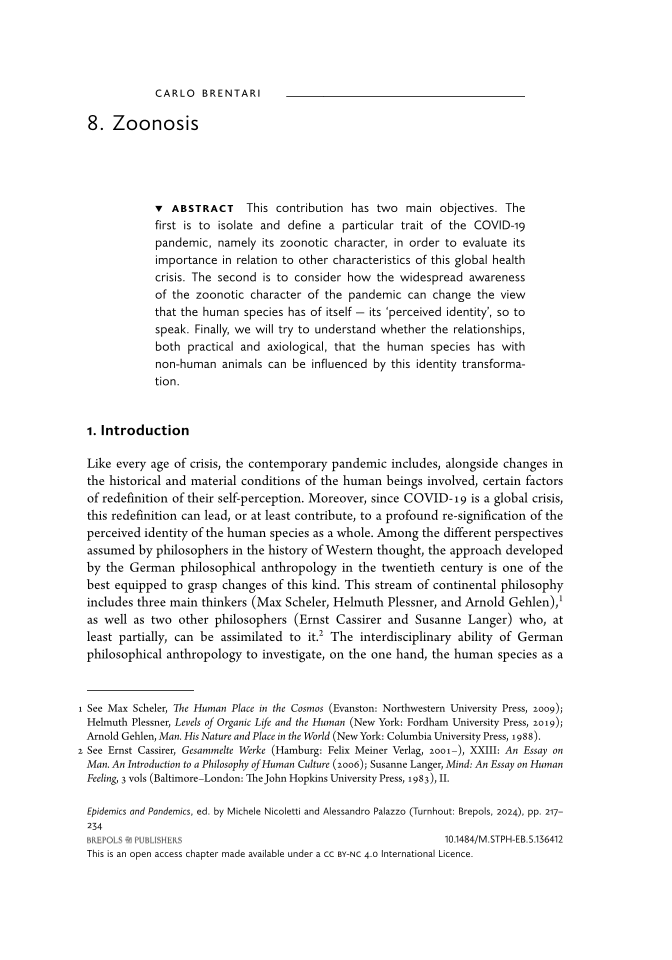
This contribution has two main objectives. The first is to isolate and define a particular trait of the COVID-19 pandemic, namely its zoonotic character, in order to evaluate its importance in relation to other characteristics of this global health crisis. The second is to consider how the widespread awareness of the zoonotic character of the pandemic can change the view that the human species has of itself — its ‘perceived identity’, so to speak. Finally, we will try to understand whether the relationships, both practical and axiological, that the human species has with non-human animals can be influenced by this identity transformation.
Hardbound ISBN:
978-2-503-59892-5
E-book ISBN:
978-2-503-59893-2

Full text loading...
/deliver/fulltext/10.1484/M.STPH-EB.5.127756/M.STPH-EB.5.136412.html?itemId=/content/books/10.1484/M.STPH-EB.5.136412&mimeType=html&fmt=ahah
Zoonosis
https://doi.org/10.1484/M.STPH-EB.5.136412
/content/books/10.1484/M.STPH-EB.5.136412
/content/books/10.1484/M.STPH-EB.5.136412
[Citing articles]
[Web of Science]
[Medline]
References
-
Anzieu, Didier, The Skin-ego (London: Karnak Book, 2016).
-
Brentari, Carlo, ‘The Role of the Missing Reason: the Search for a Stratum-Specific Form of Determination in Nicolai Hartmann’s Theory of Life’, in New Research on the Philosophy of Nicolai Hartmann, ed. by Keith Peterson and Roberto Poli (Berlin-Boston: De Gruyter, 2016), pp. 65–80.
-
Cassirer, Ernst, Gesammelte Werke (Hamburg: Felix Meiner Verlag, 2001–).
-
Cassirer, Ernst, An Essay on Man. An Introduction to a Philosophy of Human Culture (2006).
-
Cazzolla Gatti, Roberto, and others, ‘Diversity lost: COVID-19 as a Phenomenon of the Total Environment’, Science of the Total Environment, 756 (2021), https://doi.org/ (last accessed 11/09/2021) [Crossref]
-
Cox-Singh, Janet, and Balbir Singh, ‘Knowlesi Malaria: Newly Emergent and of Public Health Importance?’, Trends in Parasitology, 24. 9 (2008), pp. 406–10.
-
Gehlen, Arnold, Man. His Nature and Place in the World (New York: Columbia University Press, 1988).
-
Gould, Stephen Jay, Challenges to Neo-Darwinism and Their Meaning for a Revised View of Human Consciousness, (Cambridge University: Clare Hall, 1984).
-
Habermas, Jürgen, ‘Corona und der Schutz des Lebens. Zur Grundrechtsdebatte in der pandemischen Ausnahmesituation‘, Blätter für deutsche und internationale Politik, 66. 9 (2021), pp. 65–78.
-
Habermas, Jürgen, Auf dem Weg zu einer liberalen Eugenik? Der Streit um das ethische Selbstverständnis der Gattung, in Id., Die Zukunft der menschlichen Natur. Auf dem Weg zu einer liberalen Eugenik? Erweiterte Ausgabe (Frankfurt a.M.: Suhrkamp, 2002), pp. 34–163.
-
Harari, Yuval N., Sapiens. A Brief History of Humankind (London: Vintage, 2019).
-
Hartmann, Nicolai, New Ways of Ontology (Chicago: Henry Regnery Company 1953).
-
Jonas, Hans, The Imperative of Responsibility. In Search for an Ethics for the Technological Age (Chicago-London: University of Chicago Press, 1984).
-
Jones, Kate E., and et al., ‘Global Trends in Emerging Infectious Diseases’, Nature 451 (2008), pp. 990–94.
-
Karesh, William B., and et al., ‘Zoonoses 1. Ecology of Zoonoses: Natural and Unnatural Histories’, The Lancet, 380 (2012), pp. 1936–45.
-
Kilpatrick, A. Marm, and Sarah E. Randolph, ‘Zoonosis 2. Drivers, Dynamics, and Control of Emerging Vector-Borne Zoonotic Diseases’, The Lancet, 380 (2012), pp. 1946–55.
-
Kurashima, Yosuke, and Hiroshi Kiyono, ‘Mucosal Ecological Network of Epithelium and Immune Cells for Gut Homeostasis and Tissue Healing’, Annual Review of Immunology, 35 (2017), pp. 119–47.
-
Lakoff, George, and Mark Johnson, Metaphors We Live By (Chicago-London: University of Chicago Press, 1980).
-
Langer, Susanne, Mind: An Essay on Human Feeling, 3 vols (Baltimore–London: The John Hopkins University Press, 1983).
-
Margulis, Lynn, Symbiosis in Cell Evolution: Microbial Communities in the Archean and Proterozoic Eons (New York: W.H. Freeman, 1993).
-
Matassa, Elvira, Zoonosi e sanità pubblica. Un approccio interdisciplinare per un problema globale (Milano: Springer Italia, 2017).
-
Morse, Stephen S., and et al., ‘Zoonoses 3. Prediction and Prevention of the Next Pandemic Zoonosis’, The Lancet, 380 (2012), pp. 1956–65.
-
Pepin, Jacques, and Annie-Claude Labbé, ‘Noble Goals, Unforeseen Consequences: Control of Tropical Diseases in Colonial Central Africa and the Iatrogenic Transmission of Blood-borne Diseases’, Tropical Medicine and International Health, 13. 6, (2008), pp. 744–753.
-
Plessner, Helmuth, Levels of Organic Life and the Human (New York: Fordham University Press, 2019).
-
Quammen, David, Spillover. Animal Infections and the Next Human Pandemic (London: Vintage Books, 2013).
-
Scheler, Max, The Human Place in the Cosmos (Evanston: Northwestern University Press, 2009).
-
Scott, James C., Against the Grain. A Deep History of the Earliest States (New Haven-London: Yale University Press, 2017).
-
Soresi, Enzo, Il cervello anarchico (Milano: UTET, 2013).
-
Swiatczak, Bartlomiej, and Alfred I. Tauber, ‘Philosophy of Immunology’, The Stanford Encyclopedia of Philosophy, ed. by Edward N. Zalta, https://plato.stanford.edu/archives/sum2020/entries/immunology/
-
Tauber, Alfred I., The Immune Self. Theory or Metaphor? (Cambridge: Cambridge University Press, 1994).
-
Tauber, Alfred I., ‘Immunity in Context: Science and Society in Dialogue’, Theoria: An International Journal for Theory, History and Foundations of Science, 31. 2 (2016), pp. 207–24.
-
Tian, Huai-Yu, and et al., ‘How Environmental Conditions Impact Mosquito Ecology and Japanese Encephalitis: An Eco-epidemiological Approach’, Environment International, 79 (2015), pp. 17–24.
-
Worobey, Michael, and et al., ‘Direct Evidence of Extensive Diversity of HIV-1 in Kinshasa by 1960’, Nature, 455 (2008), pp. 661–64.
[Citing articles]
[Web of Science]
[Medline]
References
-
Anzieu, Didier, The Skin-ego (London: Karnak Book, 2016).
-
Brentari, Carlo, ‘The Role of the Missing Reason: the Search for a Stratum-Specific Form of Determination in Nicolai Hartmann’s Theory of Life’, in New Research on the Philosophy of Nicolai Hartmann, ed. by Keith Peterson and Roberto Poli (Berlin-Boston: De Gruyter, 2016), pp. 65–80.
-
Cassirer, Ernst, Gesammelte Werke (Hamburg: Felix Meiner Verlag, 2001–).
-
Cassirer, Ernst, An Essay on Man. An Introduction to a Philosophy of Human Culture (2006).
-
Cazzolla Gatti, Roberto, and others, ‘Diversity lost: COVID-19 as a Phenomenon of the Total Environment’, Science of the Total Environment, 756 (2021), https://doi.org/ (last accessed 11/09/2021) [Crossref]
-
Cox-Singh, Janet, and Balbir Singh, ‘Knowlesi Malaria: Newly Emergent and of Public Health Importance?’, Trends in Parasitology, 24. 9 (2008), pp. 406–10.
-
Gehlen, Arnold, Man. His Nature and Place in the World (New York: Columbia University Press, 1988).
-
Gould, Stephen Jay, Challenges to Neo-Darwinism and Their Meaning for a Revised View of Human Consciousness, (Cambridge University: Clare Hall, 1984).
-
Habermas, Jürgen, ‘Corona und der Schutz des Lebens. Zur Grundrechtsdebatte in der pandemischen Ausnahmesituation‘, Blätter für deutsche und internationale Politik, 66. 9 (2021), pp. 65–78.
-
Habermas, Jürgen, Auf dem Weg zu einer liberalen Eugenik? Der Streit um das ethische Selbstverständnis der Gattung, in Id., Die Zukunft der menschlichen Natur. Auf dem Weg zu einer liberalen Eugenik? Erweiterte Ausgabe (Frankfurt a.M.: Suhrkamp, 2002), pp. 34–163.
-
Harari, Yuval N., Sapiens. A Brief History of Humankind (London: Vintage, 2019).
-
Hartmann, Nicolai, New Ways of Ontology (Chicago: Henry Regnery Company 1953).
-
Jonas, Hans, The Imperative of Responsibility. In Search for an Ethics for the Technological Age (Chicago-London: University of Chicago Press, 1984).
-
Jones, Kate E., and et al., ‘Global Trends in Emerging Infectious Diseases’, Nature 451 (2008), pp. 990–94.
-
Karesh, William B., and et al., ‘Zoonoses 1. Ecology of Zoonoses: Natural and Unnatural Histories’, The Lancet, 380 (2012), pp. 1936–45.
-
Kilpatrick, A. Marm, and Sarah E. Randolph, ‘Zoonosis 2. Drivers, Dynamics, and Control of Emerging Vector-Borne Zoonotic Diseases’, The Lancet, 380 (2012), pp. 1946–55.
-
Kurashima, Yosuke, and Hiroshi Kiyono, ‘Mucosal Ecological Network of Epithelium and Immune Cells for Gut Homeostasis and Tissue Healing’, Annual Review of Immunology, 35 (2017), pp. 119–47.
-
Lakoff, George, and Mark Johnson, Metaphors We Live By (Chicago-London: University of Chicago Press, 1980).
-
Langer, Susanne, Mind: An Essay on Human Feeling, 3 vols (Baltimore–London: The John Hopkins University Press, 1983).
-
Margulis, Lynn, Symbiosis in Cell Evolution: Microbial Communities in the Archean and Proterozoic Eons (New York: W.H. Freeman, 1993).
-
Matassa, Elvira, Zoonosi e sanità pubblica. Un approccio interdisciplinare per un problema globale (Milano: Springer Italia, 2017).
-
Morse, Stephen S., and et al., ‘Zoonoses 3. Prediction and Prevention of the Next Pandemic Zoonosis’, The Lancet, 380 (2012), pp. 1956–65.
-
Pepin, Jacques, and Annie-Claude Labbé, ‘Noble Goals, Unforeseen Consequences: Control of Tropical Diseases in Colonial Central Africa and the Iatrogenic Transmission of Blood-borne Diseases’, Tropical Medicine and International Health, 13. 6, (2008), pp. 744–753.
-
Plessner, Helmuth, Levels of Organic Life and the Human (New York: Fordham University Press, 2019).
-
Quammen, David, Spillover. Animal Infections and the Next Human Pandemic (London: Vintage Books, 2013).
-
Scheler, Max, The Human Place in the Cosmos (Evanston: Northwestern University Press, 2009).
-
Scott, James C., Against the Grain. A Deep History of the Earliest States (New Haven-London: Yale University Press, 2017).
-
Soresi, Enzo, Il cervello anarchico (Milano: UTET, 2013).
-
Swiatczak, Bartlomiej, and Alfred I. Tauber, ‘Philosophy of Immunology’, The Stanford Encyclopedia of Philosophy, ed. by Edward N. Zalta, https://plato.stanford.edu/archives/sum2020/entries/immunology/
-
Tauber, Alfred I., The Immune Self. Theory or Metaphor? (Cambridge: Cambridge University Press, 1994).
-
Tauber, Alfred I., ‘Immunity in Context: Science and Society in Dialogue’, Theoria: An International Journal for Theory, History and Foundations of Science, 31. 2 (2016), pp. 207–24.
-
Tian, Huai-Yu, and et al., ‘How Environmental Conditions Impact Mosquito Ecology and Japanese Encephalitis: An Eco-epidemiological Approach’, Environment International, 79 (2015), pp. 17–24.
-
Worobey, Michael, and et al., ‘Direct Evidence of Extensive Diversity of HIV-1 in Kinshasa by 1960’, Nature, 455 (2008), pp. 661–64.
-
From This Site
/content/books/10.1484/M.STPH-EB.5.136412dcterms_title,dcterms_subject,pub_serialIdent,pub_author,pub_keyword-contentType:Contributor -contentType:Concept -contentType:Institution105
/content/books/10.1484/M.STPH-EB.5.136412
dcterms_title,dcterms_subject,pub_serialIdent,pub_author,pub_keyword
-contentType:Contributor -contentType:Concept -contentType:Institution
10
5