


Bulletin de Philosophie Médiévale
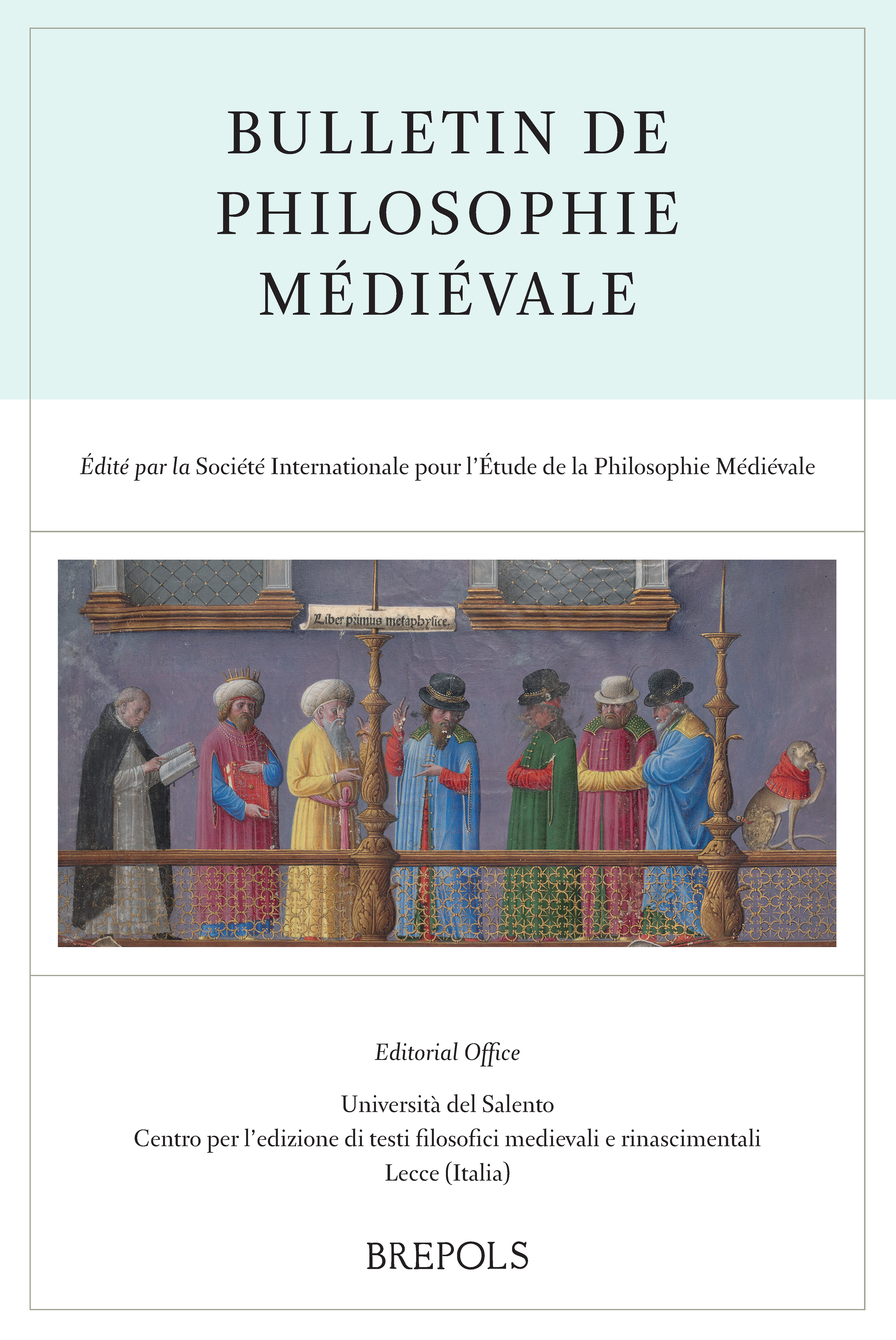
Volume 63, Issue 1, 2021
-
-
Henry of Ghent and Divine Illumination: A Response to Andrea Aiello and Robert Wielockx
show More to view fulltext, buy and share links for:Henry of Ghent and Divine Illumination: A Response to Andrea Aiello and Robert Wielockx show Less to hide fulltext, buy and share links for: Henry of Ghent and Divine Illumination: A Response to Andrea Aiello and Robert WielockxAbstractIn 2008, Andrea Aiello and Robert Wielockx published an article in Documenti e Studi sulla Tradizione Filosofica Medievale that criticized a crucial aspect of my understanding of Henry of Ghent’s theory of human knowledge of the truth. They targeted my claim that after 1279 or 1280, Henry began to move away from his early description of human knowledge of pure truth (sincera veritas) as dependent on an Augustinian illumination of the intellect by God’s light of Truth and to turn to a more Aristotelian notion of truth-perception as consisting of more precise knowledge of the mental object’s essence or quiddity. As evidence that I was wrong, Aiello and Wielockx pointed to numerous passages in Henry’s later works where he directed the reader inquiring about truth back to his earliest explanation of the matter in the beginning of his Summa. In this response, I show that I have always accepted the idea that Henry-all the way to his last works-never abandoned the notion that God as repository of ideal forms played a fundamental role in human knowledge of truth, for he realized that his mature theory of essence meant that his Aristotelianizing version of truth-perception entailed the mind’s penetrating to the divine ideal. And I argue that we should not be surprised that, on those occasions where he directed the reader back to his earliest explanation of knowledge of truth, he did not mention that in precise terms he had modified the mechanics of truthperception. For the mature Henry’s account of knowledge of truth, though not expressed literally in terms of illumination, for all its Aristotelian complexion still maintained the Augustinian insistence that knowledge of truth depended on rati cation by God.
-
-
-
Il Quodlibet di Adenulfo di Anagni. Analisi ed edizione
show More to view fulltext, buy and share links for:Il Quodlibet di Adenulfo di Anagni. Analisi ed edizione show Less to hide fulltext, buy and share links for: Il Quodlibet di Adenulfo di Anagni. Analisi ed edizioneBy: Massimo PerroneAbstractIl presente contributo fornisce la prima edizione integrale delle diciotto questioni quodlibetali ascritte ad Adenulfo di Anagni (†1289) con uno studio introduttivo attinente alla sua biografia e alle opere che gli sono attribuite. Sebbene l’analisi conclusiva dei testi riveli una dipendenza letterale dalla Summa Halensis, da Tommaso d’Aquino e da Gerardo di Abbeville e pertanto un’attitudine non propensa alla originalità, le questioni di Adenulfo costituiscono una fonte significativa per la storia del tomismo nascente e per la ricezione delle figure di riferimento della Scolastica del XIII sec.
AbstractThis article provides the first complete edition of the eighteen quodlibetal questions ascribed to Adenulf of Anagni (†1289) with an introductory study concerning the life and works of this author. Although the analysis of the texts reveals a strong dependence of Adenulf on the Summa Halensis, Thomas Aquinas and Gerard of Abbeville and a modest degree of originality, these questions represent an important source for the rising Thomism and the reception of the most prominent 13th-century figures.
-
-
-
Petrarch’s Reading of Enarrationes in Psalmos: The Glosses to ms. Paris, BnF, Latin 1994 and Paris, BnF, Latin 19891 - 19892
show More to view fulltext, buy and share links for:Petrarch’s Reading of Enarrationes in Psalmos: The Glosses to ms. Paris, BnF, Latin 1994 and Paris, BnF, Latin 19891 - 19892 show Less to hide fulltext, buy and share links for: Petrarch’s Reading of Enarrationes in Psalmos: The Glosses to ms. Paris, BnF, Latin 1994 and Paris, BnF, Latin 19891 - 19892By: Marcela BorelliAbstractIn this work, I will begin by briefly describing the codices that belonged to Petrarch’s library and contain his glosses to the Enarrationes in Psalmos of Augustine: Paris, BnF, Latin 1994 and Paris, BnF, Latin 19891 - 19892. I will then describe the type of marginal markings found in it, and I will lastly offer a complete edition of the glosses.
-
-
-
Guglielmo da Ockham e gli infinita in actu
show More to view fulltext, buy and share links for:Guglielmo da Ockham e gli infinita in actu show Less to hide fulltext, buy and share links for: Guglielmo da Ockham e gli infinita in actuBy: Antonio GeraceAbstractThe article analyses the concept of actual infinity in William of Ockham’s thought, thanks to a close reading of his writings, first those on physics, where he argues more than once the existence of the actual infinity, intended as a set of infinite parts in act present in a continuum. By virtue of this representation of infinity, Ockham also states that two sets with infinite parts are not necessarily equal, but one of the two can be greater than the other, as would happen with the revolutions of the moon and the sun in an endless time. Nonetheless, in the theological works, the Franciscan seems to have apparently a different position, since he denies the possibility of the actual infinity, either as a set of infinite entities existing all simultaneously, or as an infinite entity, since in both cases a limit would be placed on God’s omnipotence. Ockham instead demonstrates that he has a double vision of the actual infinity, similar to that of Cantor, as already proposed by Annaliese Maier. The essay will therefore show the compatibility of Ockham’s physics and theological writings by virtue of the different meanings of infinity.
-
-
-
Commenti ad Aristotele nella biblioteca dell’Istituto Campana a Osimo: Umberto di Preuilly, Rodolfo Brito, Giovanni di Jandun
show More to view fulltext, buy and share links for:Commenti ad Aristotele nella biblioteca dell’Istituto Campana a Osimo: Umberto di Preuilly, Rodolfo Brito, Giovanni di Jandun show Less to hide fulltext, buy and share links for: Commenti ad Aristotele nella biblioteca dell’Istituto Campana a Osimo: Umberto di Preuilly, Rodolfo Brito, Giovanni di JandunBy: Aurora PanzicaAbstractThis article concerns two medieval codices kept at the library of the Istituto Campana in Osimo that contain commentaries on Aristotle. The focus of the paper is the identification of a new copy of Humbertus of Preuilly’s Sententia on the Metaphysics, transmitted in manuscript 18.M.11, and of a new copy of John of Jandun’s Questions on the Physics, transmitted in manuscript 18.L.38. In addition, information is provided on two texts transmitted anonymously in manuscript 18.L.38, namely Radulphus Brito’s Questions on Aristotle’s Meteorology and a commentary on the Physics by a Bolognese master of the first half of the fourteenth century.
-
-
-
Le Questiuncule di Simone di Castello sul De proporcionibus velocitatum in motibus, qq. 8-10
show More to view fulltext, buy and share links for:Le Questiuncule di Simone di Castello sul De proporcionibus velocitatum in motibus, qq. 8-10 show Less to hide fulltext, buy and share links for: Le Questiuncule di Simone di Castello sul De proporcionibus velocitatum in motibus, qq. 8-10By: Stefano CarotiAbstractAs a master of Arts at the University of Bologna in the second half of XIVth Century, Simon of Castello decided to pour what he learned at the University of Paris into updating the university education and training. His project is clearly delineated in the opening words (a sort of prologue) to his two works : De proporcionibus velocitatum in motibus (edited by J. McCue in 1961) and the unpublished Questiuncule decem, introduced as a comment to De proportionibus. The three last of these Questiuncule are edited here with a brief introduction. They have been selected for their referring to latitudines; explicit quotations from Burley’s works on latitudes (Tractatus primus and secundus) speaks to the early diffusion of the English master in the Italian university education. Simon expresses his gratitude toward Henry of Langenstein, his master in Paris.
-
-
-
Quodlibetal Problemata in the Arts Quodlibets at the University of Prague c. 1400-1417: An Analysis with a Catalogue
show More to view fulltext, buy and share links for:Quodlibetal Problemata in the Arts Quodlibets at the University of Prague c. 1400-1417: An Analysis with a Catalogue show Less to hide fulltext, buy and share links for: Quodlibetal Problemata in the Arts Quodlibets at the University of Prague c. 1400-1417: An Analysis with a CatalogueBy: Zuzana LukšováAbstractThe paper focuses on the so-called problemata, a topic that has not yet evoked much scholarly interest. In the beginning of the 15th century, problemata regularly occurred in the quodlibetal handbooks of the Prague University masters alongside the usual quaestiones. The paper introduces a catalogue of problemata found in the quodlibetal handbooks of the Prague University masters active between 1400 and 1417, i.e. John Arsen of Langenfeld, Matthias of Knín, John Hus, Simon of Tišnov, and Procopius of Kladruby. Moreover, it provides a basic overview of how the individual authors of quodlibetal disputations formulated their problemata and the sources they used.
-
-
-
La Guida dei perplessi di Maimonide nella biblioteca di Giovanni Pico della Mirandola
show More to view fulltext, buy and share links for:La Guida dei perplessi di Maimonide nella biblioteca di Giovanni Pico della Mirandola show Less to hide fulltext, buy and share links for: La Guida dei perplessi di Maimonide nella biblioteca di Giovanni Pico della MirandolaBy: Giovanna MuranoAbstractTwo different copies of the influental Jewish philosophical and theological Maimonides’ Guide of the Perplexed, one in Hebrew and a second in Latin, are recorded in Pico’s library. A third copy, probably also belonged to him, is now the ms. Kassel, Universitätsbibliothek - Landesbibliothek und Murhardsche Bibliothek der Stadt, 2° theol. 67. The manuscript now in Kassel shows that Pico was not only a reader of Maimonides’ Guide but also a translator. Numerous passages have in fact been revised by Pico in order to improve the latin translation evidently considered not particularly correct.
-
-
-
Plague and Astrology in the Fourteenth Century: The Plague Tractate by Augustine of Trento
show More to view fulltext, buy and share links for:Plague and Astrology in the Fourteenth Century: The Plague Tractate by Augustine of Trento show Less to hide fulltext, buy and share links for: Plague and Astrology in the Fourteenth Century: The Plague Tractate by Augustine of TrentoBy: Francesca BoniniAbstractThe 14th-century plague tractate by Augustine of Trento addresses the matter of plague before the Black Death. The text aims both to predict plague epidemics and to prevent the disease’s spreading. The author attempts to forecasts the outbreak of plague epidemics thanks to the methods of judicial astrology. He also advises hygiene rules and dietary precepts in order to counter the spread of the disease. Moreover, Augustine makes clear that astrological knowledge and techniques serve medical purposes and medical practice can benefit from astrology. In fact, he discusses the topic of medical prognostication and defends the idea that medical practice should not be empirical but guided by astrological principles. The treatise draws on the major astrological and medical sources of Greek and Arab origin and contains references to contemporary masters of medicine. The article updates the author’s biography, examines the manuscript tradition, analyzes the two redactional stages of the text, and provides a new critical edition.
-
-
-
A Short Sixteenth-Century Catalogue of Scholastic Sentences Commentaries in Vat. Lat. Lat. 3919
show More to view fulltext, buy and share links for:A Short Sixteenth-Century Catalogue of Scholastic Sentences Commentaries in Vat. Lat. Lat. 3919 show Less to hide fulltext, buy and share links for: A Short Sixteenth-Century Catalogue of Scholastic Sentences Commentaries in Vat. Lat. Lat. 3919By: Cal LedshamAbstractThis article contains an edition of a list of authors of Sentences commentaries in Vatican City, BAV, Cod. Vat. Lat. 3919, which is similar to one found in the 1535 Quentel edition of Denys the Carthusian's texts. This manuscript version is thus a primary text indicating the content of a (Germanic) library in the early 1500's, and showing how sixteenthcentury editors took library lists and both homogenized and regularized their attribution, orthography and chronology. The names listed are identified against modern lists and their variation against that 1535 edition noted, the provenance and date of the list established and not readily-identifiable names are discussed.
-
-
-
České Budějovice: “Cognitive Issues in the Long Scotist Tradition”
show More to view fulltext, buy and share links for:České Budějovice: “Cognitive Issues in the Long Scotist Tradition” show Less to hide fulltext, buy and share links for: České Budějovice: “Cognitive Issues in the Long Scotist Tradition”
-
-
-
Nijmegen: “Complexio. Across Times and Disciplines”
show More to view fulltext, buy and share links for:Nijmegen: “Complexio. Across Times and Disciplines” show Less to hide fulltext, buy and share links for: Nijmegen: “Complexio. Across Times and Disciplines”Authors: Chiara Beneduce and Paul J. J. M. Bakker
-
-
-
Sao Paulo: “II Colóquio de Filosofia Patrística e Medieval da PUC-SP: Homenagem a Carlos Arthur Ribeiro do Nascimento”
show More to view fulltext, buy and share links for:Sao Paulo: “II Colóquio de Filosofia Patrística e Medieval da PUC-SP: Homenagem a Carlos Arthur Ribeiro do Nascimento” show Less to hide fulltext, buy and share links for: Sao Paulo: “II Colóquio de Filosofia Patrística e Medieval da PUC-SP: Homenagem a Carlos Arthur Ribeiro do Nascimento”
-
-
-
Commission VIII: Byzantine Philosophy. Section 2: Thomas de Aquino Byzantinus (2015-2021)
show More to view fulltext, buy and share links for:Commission VIII: Byzantine Philosophy. Section 2: Thomas de Aquino Byzantinus (2015-2021) show Less to hide fulltext, buy and share links for: Commission VIII: Byzantine Philosophy. Section 2: Thomas de Aquino Byzantinus (2015-2021)Authors: John A. Demetracopoulos and Charalambos Dendrinos
-
-
-
Informations concernant la S.I.E.P.M.
show More to view fulltext, buy and share links for:Informations concernant la S.I.E.P.M. show Less to hide fulltext, buy and share links for: Informations concernant la S.I.E.P.M.Abstract1. S.I.E.P.M. Junior Scholar Award 2021
2. A Statement on Plagiarism from the Board of the S.I.E.P.M.
3. Minutes of the 96th Meeting of the Bureau of the S.I.E.P.M.
-
Volumes & issues
-
Volume 66 (2024)
-
Volume 65 (2023)
-
Volume 64 (2022)
-
Volume 63 (2021)
-
Volume 62 (2020)
-
Volume 61 (2019)
-
Volume 60 (2018)
-
Volume 59 (2017)
-
Volume 58 (2016)
-
Volume 57 (2015)
-
Volume 56 (2014)
-
Volume 55 (2013)
-
Volume 54 (2012)
-
Volume 53 (2011)
-
Volume 52 (2010)
-
Volume 51 (2009)
-
Volume 50 (2008)
-
Volume 49 (2007)
-
Volume 48 (2006)
-
Volume 47 (2005)
-
Volume 46 (2004)
-
Volume 45 (2003)
-
Volume 44 (2002)
-
Volume 43 (2001)
-
Volume 42 (2000)
-
Volume 41 (1999)
-
Volume 40 (1998)
-
Volume 39 (1997)
-
Volume 38 (1996)
-
Volume 37 (1995)
-
Volume 36 (1994)
-
Volume 35 (1993)
-
Volume 34 (1992)
-
Volume 33 (1991)
-
Volume 32 (1990)
-
Volume 31 (1989)
-
Volume 30 (1988)
-
Volume 29 (1987)
-
Volume 28 (1986)
-
Volume 27 (1985)
-
Volume 26 (1984)
-
Volume 25 (1983)
-
Volume 24 (1982)
-
Volume 23 (1981)
-
Volume 22 (1980)
-
Volume 21 (1979)
-
Volume 20 (1978)
-
Volume 19 (1977)
-
Volume 18 (1976)
-
Volume 16-17 (1974)
-
Volume 15 (1973)
-
Volume 14 (1972)
-
Volume 13 (1971)
-
Volume 10-11-12 (1968)
-
Volume 8-9 (1966)
-
Volume 7 (1965)
-
Volume 6 (1964)
-
Volume 5 (1963)
-
Volume 4 (1962)
-
Volume 3 (1961)
-
Volume 2 (1960)
-
Volume 1 (1959)
Most Read This Month
