


Bulletin de Philosophie Médiévale
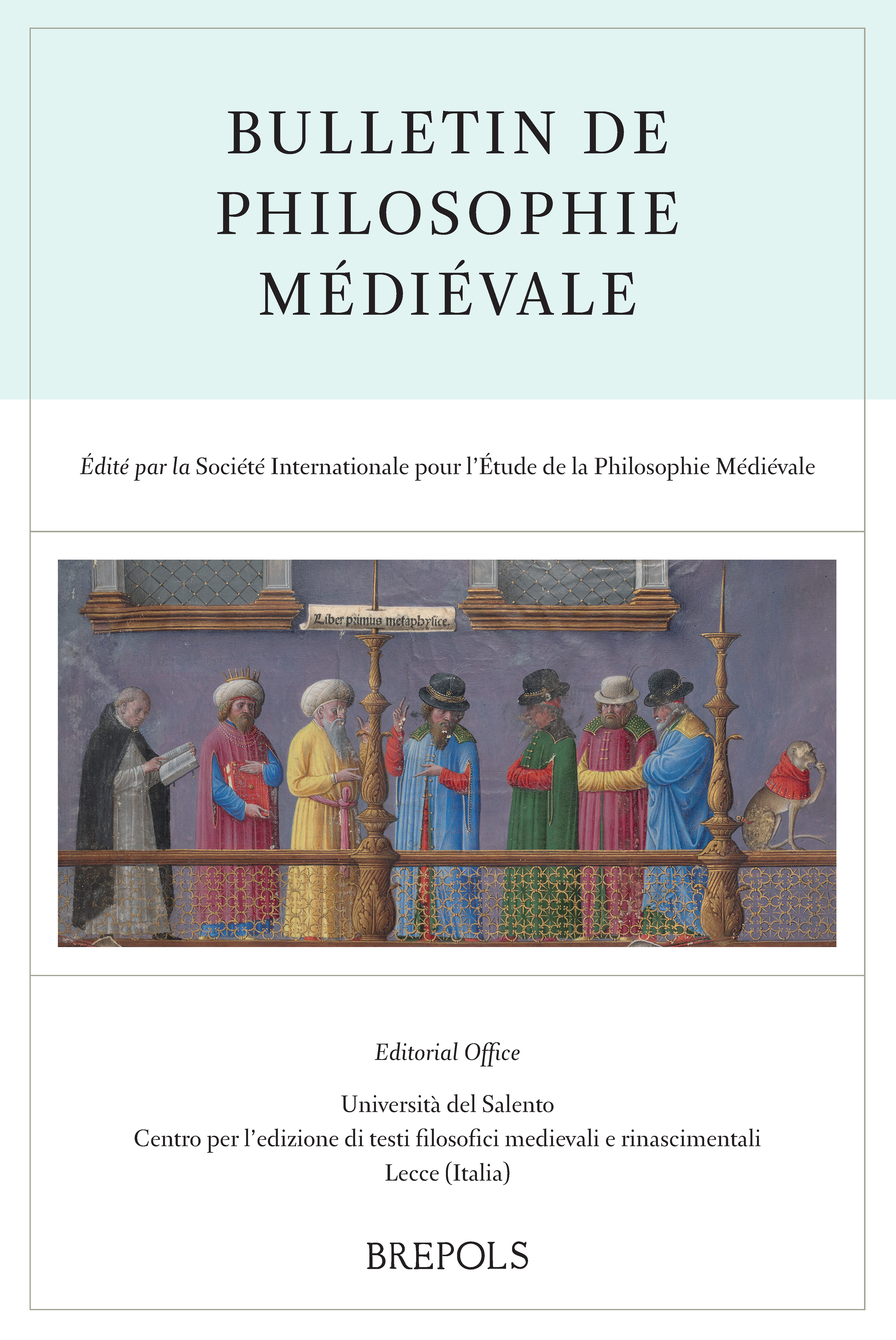
Volume 64, Issue 1, 2022
-
-
«Inducere Amore in potenzia là ove non è». Nobiltà, grazia e predisposizione naturale dalla Vita nuova alla Commedia
show More to view fulltext, buy and share links for:«Inducere Amore in potenzia là ove non è». Nobiltà, grazia e predisposizione naturale dalla Vita nuova alla Commedia show Less to hide fulltext, buy and share links for: «Inducere Amore in potenzia là ove non è». Nobiltà, grazia e predisposizione naturale dalla Vita nuova alla CommediaBy: Arianna BrunoriAbstractThe article investigates the influence that the theological debates on divine grace have exercised on the evolution of Dante’s reflection on the relationship between nobility of the soul and natural predisposition, from the Vita nuova to the Commedia. If in his youthful work, commenting the sonnet Negli occhi porta la mia donna amore, Dante had attributed to Beatrice the ability to «induce Love in potentiality where he is not» (Vn. 12, 6) - an ability that Augustine’s doctrine of grace had reserved to God -, in Le dolci rime d’amor and, above all, in the IV book of the Convivio, Dante affirms, with Guinizelli, the essential correlation between a «gentle heart» and love, that is to say the necessity of a natural predisposition for the purpose of possessing nobility, i. e. the divine «grace» (Cv. IV XX 7). Finally, in the Commedia, the poet returns to freeing God’s gift from any preventive natural disposition, as demonstrated not only by the repeated references to the twins Jacob and Esau, destined to opposite fates by virtue of the «grace» with which God «at his own pleasure endows each creature differently» (Pd. XXXII, vv. 65-6), but also by the XXX canto of Purgatorio, where Dante no longer appears uncertain whether to attribute his genius to a «good star» or to «a better thing» (If. XXVI, vv. 21-24), but clearly affirms its dependence on the «largess of celestial graces» (v. 112).
-
-
-
The Figure and Thought of Berthold of Moosburg. New Studies and Perspectives
show More to view fulltext, buy and share links for:The Figure and Thought of Berthold of Moosburg. New Studies and Perspectives show Less to hide fulltext, buy and share links for: The Figure and Thought of Berthold of Moosburg. New Studies and PerspectivesBy: Mario LoconsoleAbstractIn recent years, studies on Berthold of Moosburg have seen a significant growth, which has broadened the understanding of his philosophical thought. The Expositio super Elementationem theologicam Procli, as a comprehensive commentary on the Proclian work, is emerging in its full complexity as the project of glorification of Platonism and of Proclian sapiential perspective over Aristotelian intellectualism. In his philosophical programme, Berthold thus ascribes Avicenna to the party of the Peripatetics, places philosophers such as Avicebron as the main pillars of an autonomous Platonic current, takes up Eriugenian philosophy to solidify the link between Proclus’ paganism and Christian Neoplatonism, and uses Dietrich of Freiberg’s perspectives to clarify Aristotelian doctrines. The influence that these authors had on Berthold’s thought has been the subject of the latest research findings, which have also unveiled the significance of the relation with the authors of the school of Cologne, the impact of Oxford intellectual life - especially Thomas of York - and the relevance of Hermetic philosophy. Moreover, Berthold’s work is by no means lacking in independent reflection, as can be seen from the consideration of the extensive proemial part of the Expositio and from the insights into philosophical solutions which are peculiar to Berthold, such as the doctrine of the unum animae.
-
-
-
Suggestions for Research on Oxford Sentences Commentaries and New Information on Richard of Billingham
show More to view fulltext, buy and share links for:Suggestions for Research on Oxford Sentences Commentaries and New Information on Richard of Billingham show Less to hide fulltext, buy and share links for: Suggestions for Research on Oxford Sentences Commentaries and New Information on Richard of BillinghamAbstractWhile we know the year in which many bachelors of theology read the Sentences at Paris, we do not have equivalent information on bachelors of theology at Oxford. This note discusses the limitations of the principal source for Oxford, the Biographical Register of the University of Oxford, and illustrates the importance of consulting the manuscript sources, especially both series of registers of common letters in the Vatican Archives.
-
-
-
Zur Überlieferung und Rezeption (bei Johannes von Gmunden?) der Quaestiones circa tractatum de sphaera des Albert von Sachsen. Nebst Nachweis einer Expositio Alberts
show More to view fulltext, buy and share links for:Zur Überlieferung und Rezeption (bei Johannes von Gmunden?) der Quaestiones circa tractatum de sphaera des Albert von Sachsen. Nebst Nachweis einer Expositio Alberts show Less to hide fulltext, buy and share links for: Zur Überlieferung und Rezeption (bei Johannes von Gmunden?) der Quaestiones circa tractatum de sphaera des Albert von Sachsen. Nebst Nachweis einer Expositio AlbertsBy: Harald BergerAbstractIn 1922, Aleksander Birkenmajer presented an unknown work of Albert of Saxony, Quaestiones de sphaera, in a manuscript at the Dominicans in Vienna. In 1989, Jürgen Sarnowsky found a second manuscript in Rome. This paper presents a third complete manuscript (BNE Madrid) and an incomplete one (Amploniana Erfurt) of this work. Furthermore, it is argued that an anonymous expositio of Sacrobosco’s treatise can be ascribed to Albert of Saxony. Finally, an anonymous commentary on Albert’s questions in two manuscripts (Munich, Salzburg) is presented. The possibility that this commentary stems from the famous Viennese master John of Gmunden (d. 1442) is considered, but no decisive result could be achieved yet. In an appendix, a complete list of the titles of Albert’s questions is added.
-
-
-
John Buridan’s Physics Commentaries Revisited Manuscripts and Redactions
show More to view fulltext, buy and share links for:John Buridan’s Physics Commentaries Revisited Manuscripts and Redactions show Less to hide fulltext, buy and share links for: John Buridan’s Physics Commentaries Revisited Manuscripts and RedactionsAuthors: Paul J. J. M. Bakker and Michiel StreijgerAbstractThis article revisits the manuscript tradition and the different redactions of John Buridan’s commentaries on Aristotle’s Physics. The aim of the article is threefold. First, it makes some corrections to the lists of manuscripts containing the third redaction and the final redaction of Buridan’s questions commentary on the Physics. Second, it argues that manuscript Zaragoza, Biblioteca Capitular de la Seo, cod. 15-61, ff. 1r-62v, contains a previously unknown version of the final redaction (together with the standard version from f. 62v onwards). Third, to facilitate further study of the manuscripts of Buridan’s questions on the Physics and their mutual relations, appendices at the end of the article provide detailed tables of contents for the third redaction and the final redaction, as well as editions of selected questions from the Zaragoza manuscript, the third redaction of Buridan’s questions on the Physics, and the so-called Quaestiones breves.
-
-
-
Jaume Janer OCist († after 1506) and the Tradition of Scoto-Lullist Metaphysics
show More to view fulltext, buy and share links for:Jaume Janer OCist († after 1506) and the Tradition of Scoto-Lullist Metaphysics show Less to hide fulltext, buy and share links for: Jaume Janer OCist († after 1506) and the Tradition of Scoto-Lullist MetaphysicsAuthors: Claus A. Andersen and Rafael Ramis-BarcelóAbstractThe Cistercian Jaume Janer († after 1506) was the most prolific student of Pere Daguí, the first professor in the Lullist Studium on Majorca, and became himself, by royal privilege from the Crown of Aragon, the leader of a similar institution in Valencia. Janer’s and Daguí’s brand of Lullism embraced elements from Scotism. In particular, Janer in three of his works discussed the system of distinctions put forward by Peter Thomae, one of Duns Scotus’s early followers. This preoccupation with Scotist distinction theory remained a doctrinal centerpiece of eclectic Lullism at least until the second half of the seventeenth century.
-
-
-
Cusanus-Marginalien. Zur Edition und Interpretation einer Textüberlieferung am Seitenrand
show More to view fulltext, buy and share links for:Cusanus-Marginalien. Zur Edition und Interpretation einer Textüberlieferung am Seitenrand show Less to hide fulltext, buy and share links for: Cusanus-Marginalien. Zur Edition und Interpretation einer Textüberlieferung am SeitenrandAuthors: Mario Meliadò and Hans Gerhard SengerAbstractThe extant manuscripts of Nicholas of Cusa’s private library are not only a unique testimony to the reading world of one of the most important philosophers of the 15th century. They also document the material context of a specific literary activity by their reader: as is well known, Cusanus frequently annotated his books, noting his thoughts in the margins. This paper focuses on Cusanus’ marginalia as an object of research and edition. In a first step, the essay reconstructs the 20th-century editorial history of this special textual tradition and embeds it in the developments of the modern philological and historiographical work on Nicholas of Cusa. In a second step, it offers an interpretation of Cusanus’ marginalia as a coherent textual corpus and investigates the reading and writing practices to which this corpus bears witness. Finally, against this background, the paper presents a case for the scientific relevance of a continuation and re-conception of the critical edition of Cusanus’ marginalia, which began in 1941 with the first volume of the series Cusanus-Texte III. Marginalien and has remained unfinished to date.
-
-
-
Maino of Milan’s Durandian Theory of the Intellect
show More to view fulltext, buy and share links for:Maino of Milan’s Durandian Theory of the Intellect show Less to hide fulltext, buy and share links for: Maino of Milan’s Durandian Theory of the IntellectBy: Antoine CôtéAbstractThis contribution consists of an edition, and an introductory study, of the questio “Utrum sit necesse ponere intellectum agentem”, dated to 1315-1320, by the Italian Averroist Maino of Milan. The study shows that while Maino defended the existence of the agent intellect in the face of the criticisms of Durand of Saint-Pourçain, he also subscribed to central features of Durand’s noetics, which he struggled to reconcile with his Aristotelian and Averroist convictions.
-
-
-
La stoppa, il fuoco, il cielo e Dio. L’articolo 156 del Sillabo di Tempier e Giovanni di Napoli
show More to view fulltext, buy and share links for:La stoppa, il fuoco, il cielo e Dio. L’articolo 156 del Sillabo di Tempier e Giovanni di Napoli show Less to hide fulltext, buy and share links for: La stoppa, il fuoco, il cielo e Dio. L’articolo 156 del Sillabo di Tempier e Giovanni di NapoliAbstractThe tow, the fire, the Heavens and God, Article 156 of Tempier’s Syllabus and John of Naples. Through the examination of the direct textual tradition of the March 1277 condemnation, the indirect tradition and the possible interpretations linked to each of the main variants, the article attempts to reconstruct the original meaning of article 156 of Tempier’s Syllabus. The issue at the heart of the question is whether the impossibility of fire burning the tow after the cessation of the celestial movement is due to the fact that God would then also cease to exist (quia nec Deus esset or quia Deus non esset, prevailing variants in the manuscript and indirect tradition), or to the fact that nature would cease to exist (quia natura deesset, minority variant chosen by Roland Hissette in his own edition of the text of the condemnation published in 1977, and since then commonly accepted). On the basis of the evidence provided especially by two quodlibetal questions by John of Naples, it is suggested that the correction proposed by Hissette is unnecessary, and that article 156 concerns the inseparability of God’s cosmological function as mover of the Heavens from His own Divine nature. The appendix contains the first critical edition of John of Naples’ Quodl. III, q. 10.
-
-
-
Lecce: “La mente di Dante. Visioni, percezioni, rappresentazioni”
show More to view fulltext, buy and share links for:Lecce: “La mente di Dante. Visioni, percezioni, rappresentazioni” show Less to hide fulltext, buy and share links for: Lecce: “La mente di Dante. Visioni, percezioni, rappresentazioni”Authors: Tommaso Ferro and Giulio Navarra
-
-
-
Foggia: “Medicine and Philosophy III: Contagion and Fascination”
show More to view fulltext, buy and share links for:Foggia: “Medicine and Philosophy III: Contagion and Fascination” show Less to hide fulltext, buy and share links for: Foggia: “Medicine and Philosophy III: Contagion and Fascination”Authors: Martin Lenz and Evelina Miteva
-
-
-
München: “Medieval Arabic and Latin Conceptions of Spirit”
show More to view fulltext, buy and share links for:München: “Medieval Arabic and Latin Conceptions of Spirit” show Less to hide fulltext, buy and share links for: München: “Medieval Arabic and Latin Conceptions of Spirit”By: Michele Meroni
-
-
-
Pisa: “Da Baghdad a Firence: Itinerari del sapere sulle orme di Alberto Magno”
show More to view fulltext, buy and share links for:Pisa: “Da Baghdad a Firence: Itinerari del sapere sulle orme di Alberto Magno” show Less to hide fulltext, buy and share links for: Pisa: “Da Baghdad a Firence: Itinerari del sapere sulle orme di Alberto Magno”Authors: Ginevra Tozzi and Germano Gorga
-
-
-
München: “Meister Eckhart heute. Übersetzen, übertragen, neu entdecken”
show More to view fulltext, buy and share links for:München: “Meister Eckhart heute. Übersetzen, übertragen, neu entdecken” show Less to hide fulltext, buy and share links for: München: “Meister Eckhart heute. Übersetzen, übertragen, neu entdecken”By: Freimut Löser
-
Volumes & issues
-
Volume 66 (2024)
-
Volume 65 (2023)
-
Volume 64 (2022)
-
Volume 63 (2021)
-
Volume 62 (2020)
-
Volume 61 (2019)
-
Volume 60 (2018)
-
Volume 59 (2017)
-
Volume 58 (2016)
-
Volume 57 (2015)
-
Volume 56 (2014)
-
Volume 55 (2013)
-
Volume 54 (2012)
-
Volume 53 (2011)
-
Volume 52 (2010)
-
Volume 51 (2009)
-
Volume 50 (2008)
-
Volume 49 (2007)
-
Volume 48 (2006)
-
Volume 47 (2005)
-
Volume 46 (2004)
-
Volume 45 (2003)
-
Volume 44 (2002)
-
Volume 43 (2001)
-
Volume 42 (2000)
-
Volume 41 (1999)
-
Volume 40 (1998)
-
Volume 39 (1997)
-
Volume 38 (1996)
-
Volume 37 (1995)
-
Volume 36 (1994)
-
Volume 35 (1993)
-
Volume 34 (1992)
-
Volume 33 (1991)
-
Volume 32 (1990)
-
Volume 31 (1989)
-
Volume 30 (1988)
-
Volume 29 (1987)
-
Volume 28 (1986)
-
Volume 27 (1985)
-
Volume 26 (1984)
-
Volume 25 (1983)
-
Volume 24 (1982)
-
Volume 23 (1981)
-
Volume 22 (1980)
-
Volume 21 (1979)
-
Volume 20 (1978)
-
Volume 19 (1977)
-
Volume 18 (1976)
-
Volume 16-17 (1974)
-
Volume 15 (1973)
-
Volume 14 (1972)
-
Volume 13 (1971)
-
Volume 10-11-12 (1968)
-
Volume 8-9 (1966)
-
Volume 7 (1965)
-
Volume 6 (1964)
-
Volume 5 (1963)
-
Volume 4 (1962)
-
Volume 3 (1961)
-
Volume 2 (1960)
-
Volume 1 (1959)
Most Read This Month
