


Alfonsine Astronomy

The Tables of 1322 by John of Lignères
An Edition with Commentary
Medieval astronomers used tables to solve most of the problems they faced. These tables were generally assembled in sets which constituted genuine tool-boxes aimed at facilitating the task of practitioners of astronomy. In the early fourteenth century the set of tables compiled by the astronomers at the service of King Alfonso X of Castile and León (d. 1284) reached Paris where several scholars linked to the university recast them and generated new tables. John of Lignères one of the earliest Alfonsine astronomers assembled his own set of astronomical tables mainly building on the work of previous Muslim and Jewish astronomers in the Iberian Peninsula especially in Toledo. Two major sets had been compiled in this town: one in Arabic the Toledan Tables during the second half of the eleventh century and the Castilian Alfonsine Tables under the patronage of King Alfonso.
This monograph provides for the first time an edition of the Tables of 1322 by John of Lignères. It is the earliest major set of astronomical tables to be compiled in Latin astronomy. It was widely distributed and is found in about fifty manuscripts. A great number of the tables were borrowed directly from the work of the Toledan astronomers while others were adapted to the meridian of Paris and many were later transferred to the standard version of the Parisian Alfonsine Tables. Therefore John of Lignères’ set can be considered as an intermediary work between the Toledan Tables and the Parisian Alfonsine Tables.
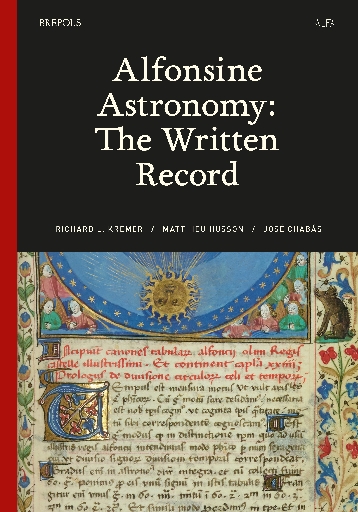
Alfonsine Astronomy
The Written Record
Compiled between 1262 and 1272 in Toledo under the patronage of Alfonso X the Castilian Alfonsine Tables were recast in Paris in the 1320s resulting in what we now call the Parisian Alfonsine Tables. These materials circulated widely and fostered astronomical activities throughout Europe. This resulted in a significant number of new works of which there are a few hundred extant in more than 600 manuscript codices and dozens of printed editions. These manuscripts and imprints broadly contemporary to the works they witness comprise the written record of Alfonsine astronomy and provide the focus of this volume.
A first series of essays examines individual manuscripts containing Alfonsine works. The authors seek to reconstruct from the manuscript evidence the cultural astronomical and mathematical worlds in which the manuscripts were initially copied compiled used and collected. A second series of essays turns from the particular codex to the individual work or author. These contributions ask how particular works have been transmitted in surviving manuscript witnesses and how broader manuscript cultures shaped the diffusion over two centuries of Alfonsine astronomy across Europe. A final essay reflects on the challenges and opportunities offered by digital humanities approaches in such collective studies of a large manuscript corpus.